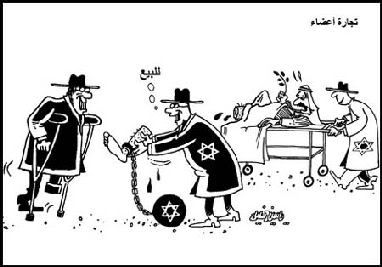
Last week Sweden’s largest daily newspaper published an article containing shocking material: testimony and circumstantial evidence indicating that Israelis may have been harvesting internal organs from Palestinian prisoners without consent for many years.
Worse yet, some of the information reported in the article suggests that in some instances Palestinians may have been captured with this macabre purpose in mind.
In the article, “Our sons plundered for their organs,” veteran journalist Donald Bostrom writes that Palestinians “harbor strong suspicions against Israel for seizing young men and having them serve as the country’s organ reserve – a very serious accusation, with enough question marks to motivate the International Court of Justice (ICJ) to start an investigation about possible war crimes.”1
An army of Israeli officials and apologists immediately went into high gear, calling both Bostrom and the newspaper’s editors “anti-Semitic.” The Israeli foreign minister was reportedly “aghast” and termed it “a demonizing piece of blood libel.” An Israeli official called it “hate porn.”
Commentary magazine wrote that the story was “merely the tip of the iceberg in terms of European funded and promoted anti-Israel hate.” Numerous people likened the article to the medieval “blood libel,” (widely refuted stories that Jews killed people to use their blood in religious rituals). Even some pro-Palestinian writers joined in the criticism, expressing skepticism.
The fact is, however, that substantiated evidence of public and private organ trafficking and theft, and allegations of worse, have been widely reported for many years. Given such context, the Swedish charges become far more plausible than might otherwise be the case and suggest that an investigation could well turn up significant information.
Below are a few examples of previous reports on this topic.
Israel’s first heart transplant
Israel’s very first, historic heart transplant used a heart removed from a living patient without consent or consulting his family.
In December 1968 a man named Avraham Sadegat (the New York Times seems to give his name as A Savgat)2 died two days after a stroke, even though his family had been told he was “doing well.”
After initially refusing to release his body, the Israeli hospital where he was being treated finally turned the man’s body over to his family. They discovered that his upper body was wrapped in bandages; an odd situation, they felt, for someone who had suffered a stroke.
When they removed the bandages, they discovered that the chest cavity was stuffed with bandages, and the heart was missing.
During this time, the headline-making Israeli heart transplant had occurred. After their initial shock, the man’s wife and brother began to put the two events together and demanded answers.
The hospital at first denied that Sadegat’s heart had been used in the headline-making transplant, but the family raised a media storm and eventually applied to three cabinet ministers. Finally, weeks later and after the family had signed a document promising not to sue, the hospital admitted that Sadagat’s heart had been used.
The hospital explained that it had abided by Israeli law, which allowed organs to be harvested without the family's consent.3 (The United Nations Convention against Transnational Organized Crime includes the extraction of organs in its definition of human exploitation.)
Indications that the removal of Sadagat’s heart was the actual cause of death went unaddressed.
Director of forensic medicine on missing organs
A 1990 article in the Washington Report on Middle East Affairs entitled “Autopsies and Executions” by Mary Barrett reports on the grotesque killings of young Palestinians. It includes an interview with Dr. Hatem Abu Ghazalch, the former chief health official for the West Bank under Jordanian administration and director of forensic medicine and autopsies.
Barrett asks him about “the widespread anxiety over organ thefts which has gripped Gaza and the West Bank since the intifada began in December of 1987.”
He responded:
"There are indications that for one reason or another, organs, especially eyes and kidneys, were removed from the bodies during the first year or year and a half. There were just too many reports by credible people for there to be nothing happening. If someone is shot in the head and comes home in a plastic bag without internal organs, what will people assume?”4
Mysterious Scottish death
In 1998 a Scot named Alisdair Sinclair died under questionable circumstances while in Israeli custody at Ben Gurion airport.
His family was informed of the death and, according to a report in J Weekly, “...told they had three weeks to come up with about $4,900 to fly Sinclair's corpse home. [Alisdair’s brother] says the Israelis seemed to be pushing a different option: burying Sinclair in a Christian cemetery in Israel, at a cost of about $1,300.”
The family scraped up the money, brought the body home, and had an autopsy performed at the University of Glasgow. It turned out that Alisdair’s heart and a tiny throat bone were missing. At this point the British Embassy filed a complaint with Israel.
The J report states:
“A heart said to be Sinclair's was subsequently repatriated to Britain, free of charge. James wanted the [Israeli] Forensic Institute to pay for a DNA test to confirm that this heart was indeed their brother's, but the Institute's director, Professor Jehuda Hiss refused, citing the prohibitive cost, estimated by some sources at $1,500.”
Despite repeated requests from the British Embassy for the Israeli pathologist's and police reports, Israeli officials refused to release either.5 6 7
Israeli government officials raise questions
Palestinian journalist Khalid Amayreh reports in an article in CCUN:
“In January, 2002, an Israeli cabinet minister tacitly admitted that organs taken from the bodies of Palestinian victims might have been used for transplants in Jewish patients without the knowledge of the Palestinian victims’ families.
“The minister, Nessim Dahan, said in response to a question by an Arab Knesset member that he couldn’t deny or confirm that organs of Palestinian youths and children killed by the Israeli army were taken out for transplants or scientific research.
“‘I couldn’t say for sure that something like that didn’t happen.’”
Amayreh writes that the Knesset member who posed the question said that he “had received ‘credible evidence proving that Israeli doctors at the forensic institute of Abu Kabir extracted such vital organs as the heart, kidneys, and liver from the bodies of Palestinian youth and children killed by the Israeli army in Gaza and the West Bank.”8
Israel’s chief pathologist removed from post for stealing body parts
For a number of years there were allegations that Israel’s leading pathologist was stealing body parts. In 2001 the Israeli national news service reported:
“... the parents of soldier Ze’ev Buzgallo who was killed in a Golan Heights military training accident, are filing a petition with the High Court of Justice calling for the immediate suspension of Dr. Yehuda Hiss and that criminal charges be filed against him. Hiss serves as the director of the Abu Kabir Forensic Institute....According to the parents, the body of their son was used for medical experimentation without their consent, experiments authorized by Hiss.9
In 2002 the service reported:
“The revelation of illegally stored body parts in the Abu Kabir Forensic Institute has prompted MK Anat Maor, chairman of the Knesset Science Committee, to demand the immediate suspension of the director, Prof. Yehuda Hiss."
Alisdair Sinclair’s death had first alerted authorities to Hiss’s malfeasance in 1998, though nothing was done for years. The Forward reported:
“In 2001, an Israeli Health Ministry investigation found that Hiss had been involved for years in taking body parts, such as legs, ovaries and testicles, without family permission during autopsies, and selling them to medical schools for use in research and training. He was appointed chief pathologist in 1988. Hiss was never charged with any crime, but in 2004 he was forced to step down from running the state morgue, following years of complaints.”10
Harvesting kidneys from impoverished communities
According to the Economist, a kidney racket flourished in South Africa between 2001 and 2003. “Donors were recruited in Brazil, Israel and Romania with offers of $5,000-20,000 to visit Durban and forfeit a kidney. The 109 recipients, mainly Israelis, each paid up to $120,000 for a “transplant holiday”; they pretended they were relatives of the donors and that no cash changed hands.”11
In 2004 a legislative commission in Brazil reported, “At least 30 Brazilians have sold their kidneys to an international human organ trafficking ring for transplants performed in South Africa, with Israel providing most of the funding.”
According to an IPS report: “The recipients were mostly Israelis, who receive health insurance reimbursements of 70,000 to 80,000 dollars for life-saving medical procedures performed abroad.”
IPS reports:
The Brazilians were recruited in Brazil’s most impoverished neighbourhoods and were paid $10,000 per kidney, “but as ‘supply’ increased, the payments fell as low as 3,000 dollars.” The trafficking had been organized by a retired Israeli police officer, who said “he did not think he was committing a crime, given that the transaction is considered legal by his country's government.”
The Israeli embassy issued a statement denying any participation by the Israeli government in the illegal trade of human organs but said it did recognize that its citizens, in emergency cases, could undergo organ transplants in other countries, "in a legal manner, complying with international norms," and with the financial support of their medical insurance.
However, IPS reports that the commission chair termed the Israeli stance “at the very least ‘anti-ethical’, adding that trafficking can only take place on a major scale if there is a major source of financing, such as the Israeli health system.” He went on to state that the resources provided by the Israeli health system "were a determining factor" that allowed the network to function.12
Tel Aviv hospital head promotes organ trafficking
IPS goes on to report:
“Nancy Scheper-Hughes, who heads the Organs Watch project at the U.S. University of California, Berkeley, testified to the Pernambuco legislative commission that international trafficking of human organs began some 12 years ago, promoted by Zacki Shapira, former director of a hospital in Tel Aviv.
“Shapira performed more than 300 kidney transplants, sometimes accompanying his patients to other countries, such as Turkey. The recipients are very wealthy or have very good health insurance, and the ‘donors’ are very poor people from Eastern Europe, Philippines and other developing countries, said Scheper-Hughes, who specialises in medical anthropology.”
Israel prosecutes organ traffickers
In 2007 Israel’s Ha’aretz newspaper reported that two men confessed to persuading “Arabs from the Galilee and central Israel who were developmentally challenged or mentally ill to agree to have a kidney removed for payment.” They then would refuse to pay them.
The paper reported that the two were part of a criminal ring that included an Israeli surgeon. According to the indictment, the surgeon sold the kidneys he harvested for between $125,000 and $135,000.13
Earlier that year another Israeli newspaper, the Jerusalem Post, reported that ten members of an Israeli organ smuggling ring targeting Ukrainians had been arrested.14
In still another 2007 story, the Jerusalem Post reported that “Professor Zaki Shapira, one of Israel's leading transplant surgeons, was arrested in Turkey on Thursday on suspicion of involvement in an organ trafficking ring. According to the report, the transplants were arranged in Turkey and took place at private hospitals in Istanbul.”
Israeli organ trafficking comes to the U.S.?
In July of this year even US media reported on the arrest of Levy Izhak Rosenbaum, from Brooklyn, recently arrested by federal officials in a massive corruption sweep in New Jersey that netted mayors, government officials and a number of prominent rabbis. Bostrom opens his article with this incident.
According to the federal complaint, Rosenbaum, who has close ties to Israel, said that he had been involved in the illegal sale of kidneys for 10 years. A US Attorney explained: "His business was to entice vulnerable people to give up a kidney for $10,000 which he would turn around and sell for $160,000."15
This is reportedly the first case of international organ trafficking in the U.S.
University of California anthropologist and organ trade expert Nancy Scheper-Hughes, who informed the FBI about Rosenbaum seven years ago, says she heard reports that he had held donors at gunpoint to ensure they followed through on agreements to “donate” their organs.16
Israel’s organ donor problems
Israel has an extraordinarily small number of willing organ donors. According to the Israeli news service Ynet, “the percentage of organs donated among Jews is the lowest of all the ethnic groups... In western countries, some 30 per cent of the population have organ donor cards. In Israel, in contrast, four percent of the population holds such cards.17
“According to statistics from the Health Ministry’s website, in 2001, 88 Israelis died waiting for a transplant because of a lack of donor organs. In the same year, 180 Israelis were brain dead, and their organs could have been used for transplant, but only 80 of their relatives agreed to donate their organs.”
According to Ynet, the low incidence of donors is related to “religious reasons.” In 2006 there was an uproar when an Israeli hospital known for its compliance with Jewish law performed a transplant operation using an Israeli donor. The week before, “a similar incident occurred, but since the patient was not Jewish it passed silently.”18 19
The Swedish article reports that ‘Israel has repeatedly been under fire for its unethical ways of dealing with organs and transplants. France was among the countries that ceased organ collaboration with Israel in the 1990s. Jerusalem Post wrote that “the rest of the European countries are expected to follow France’s example shortly.”
“Half of the kidneys transplanted to Israelis since the beginning of the 2000s have been bought illegally from Turkey, Eastern Europe or Latin America. Israeli health authorities have full knowledge of this business but do nothing to stop it. At a conference in 2003 it was shown that Israel is the only western country with a medical profession that doesn’t condemn the illegal organ trade. The country takes no legal measures against doctors participating in the illegal business – on the contrary, chief medical officers of Israel’s big hospitals are involved in most of the illegal transplants, according to Dagens Nyheter (December 5, 2003).”
To fill this need former Prime Minister Ehud Olmert, then health minister of Israel, organized a big donor campaign in the summer of 1992, but while the number of donors skyrocketed, need still greatly surpassed supply.
Palestinian disappearances increase
Bostrom, who earlier wrote of all this in his 2001 book Inshallah,20 reports in his recent article:
“While the campaign was running, young Palestinian men started to disappear from villages in the West Bank and Gaza. After five days Israeli soldiers would bring them back dead, with their bodies ripped open.
“Talk of the bodies terrified the population of the occupied territories. There were rumors of a dramatic increase of young men disappearing, with ensuing nightly funerals of autopsied bodies.”
“I was in the area at the time, working on a book. On several occasions I was approached by UN staff concerned about the developments. The persons contacting me said that organ theft definitely occurred but that they were prevented from doing anything about it. On an assignment from a broadcasting network I then travelled around interviewing a great number of Palestinian families in the West Bank and Gaza – meeting parents who told of how their sons had been deprived of organs before being killed.”
He describes the case of 19-year-old Bilal Achmed Ghanan, shot by Israeli forces invading his village.
“The first shot hit him in the chest. According to villagers who witnessed the incident he was subsequently shot with one bullet in each leg. Two soldiers then ran down from the carpentry workshop and shot Bilal once in the stomach. Finally, they grabbed him by his feet and dragged him up the twenty stone steps of the workshop stair... Israeli soldiers loading the badly wounded Bilal in a jeep and driving him to the outskirts of the village, where a military helicopter waited. The boy was flown to a destination unknown to his family.”
Five days later he was returned, “dead and wrapped up in green hospital fabric.” Bostrom reports that as the body was lowered into the grave, his chest was exposed and onlookers could see that he was stitched up from his stomach to his head. Bostrom writes that this was not the first time people had seen such a thing.
“The families in the West Bank and in Gaza felt that they knew exactly what had happened: “Our sons are used as involuntary organ donors,” relatives of Khaled from Nablus told me, as did the mother of Raed from Jenin and the uncles of Machmod and Nafes from Gaza, who had all disappeared for a number of days only to return at night, dead and autopsied.”
Why autopsies?
Bostrom describes the questions that families asked:
“Why are they keeping the bodies for up to five days before they let us bury them? What happened to the bodies during that time? Why are they performing autopsy, against our will, when the cause of death is obvious? Why are the bodies returned at night? Why is it done with a military escort? Why is the area closed off during the funeral? Why is the electricity interrupted?”
Israel’s answer was that all Palestinians who were killed were routinely autopsied. However, Bostrom points out that of the133 Palestinians who were killed that year, only 69 were autopsied.
He goes on to write:
“We know that Israel has a great need for organs, that there is a vast and illegal trade of organs which has been running for many years now, that the authorities are aware of it and that doctors in managing positions at the big hospitals participate, as well as civil servants at various levels. We also know that young Palestinian men disappeared, that they were brought back after five days, at night, under tremendous secrecy, stitched back together after having been cut from abdomen to chin.
“It’s time to bring clarity to this macabre business, to shed light on what is going on and what has taken place in the territories occupied by Israel since the Intifada began.”21
The new “Blood Libel”?
In scanning through the reaction to Bostrom’s report, one is struck by the multitude of charges that his article is a new version of the old anti-Semitic “blood libel.” Given that fact, it is interesting to examine a 2007 book by Israel’s preeminent expert on medieval Jewish history, and what happened to him.
The author is Bar-Ilan professor (and rabbi) Ariel Toaff, son of the former chief rabbi of Rome, a religious leader so famous that an Israeli journalist writes that Toaff’s father “is to Italian Jewry as the Eiffel Tower is to Paris.” Ariel Toaff, himself, is considered “one of the greatest scholars in his field.”22 23
In February 2007 the Israeli and Italian media were abuzz (though most of the U.S. media somehow missed it) with news that Professor Toaff had written a book entitled "Pasque di Sangue" (“Blood Passovers”)24 containing evidence that there “was a factual basis for some of the medieval blood libels against the Jews.”
Based on 35 years of research, Toaff had concluded that there were at least a few, possibly many, real incidents.
In an interview with an Italian newspaper (the book was published in Italy), Toaff says:
“My research shows that in the Middle Ages, a group of fundamentalist Jews did not respect the biblical prohibition and used blood for healing. It is just one group of Jews, who belonged to the communities that suffered the severest persecution during the Crusades. From this trauma came a passion for revenge that in some cases led to responses, among them ritual murder of Christian children.”25 26
Professor Toaff was immediately attacked from all sides, including pressure orchestrated by Anti-Defamation League chairman Abe Foxman, but Toaff stood by his 35 years of research, announcing:
"I will not give up my devotion to the truth and academic freedom even if the world crucifies me... One shouldn't be afraid to tell the truth."
Before long, however, under relentless public and private pressure, Toaff had recanted, withdrawn his book, and promised to give all profits that had already accrued (the book had been flying off Italian bookshelves) to Foxman’s Anti-Defamation League. A year later he published a “revised version.”27
Donald Bostrom’s experience seems to be a repeat of what Professor Toaff endured: calumny, vituperation, and defamation. Bostrom has received death threats as well, perhaps an experience that Professor Toaff also shared.
If Israel is innocent of organ plundering accusations, or if its culpability is considerably less than Bostrom and others suggest, it should welcome honest investigations that would clear it of wrongdoing. Instead, the government and its advocates are working to suppress all debate and crush those whose questions and conclusions they find threatening.
Prime Minister Benjamin Netanyahu, rather than responding to calls for an investigation, is demanding that the Swedish government abandon its commitment to a free press and condemn the article. The Israeli press office, apparently in retaliation and to prevent additional investigation, is refusing to give press credentials to reporters from the offending newspaper.
Just as in the case of the rampage against Jenin, the attack on the USS liberty, the massacre of Gaza, the crushing of Rachel Corrie, the torture of American citizens, and a multitude of other examples, Israel is using its considerable, worldwide resources to interfere with the investigative process.
It is difficult to conclude that it has nothing to hide.
Notes
- There are two English translations; this article uses the first:
http://www.tlaxcala.es/pp.asp?reference=8390&lg=en
http://www.theoccidentalobserver.net/authors/SwedishTrans.html
The original Swedish article in Aftonbladet can be viewed at
http://www.aftonbladet.se/kultur/article5652583.ab - New York Times, Feb. 3, 1969, p. 8, Column 6 (53 words)
- http://www.haaretz.com/hasen/spages/1046041.html
40 years after Israel's first transplant, donor's family says his heart was stolen By Dana Weiler-Polak, Haaretz Correspondent, Dec. 14, 2008 - http://www.wrmea.com/backissues/0490/9004021.htm
Washington Report on Middle East Affairs, April 1990, Page 21, The Intifada: Autopsies and Executions - http://www.jweekly.com/
October 30, 1998,Bizarre death of Scottish tourist involves suicide, missing heart by NETTY C. GROSS, Jerusalem Post Service - http://www.forward.com/articles/112915/
The Forward, Illicit Body-Part Sales Present Widespread Problem, By Rebecca Dube, Aug. 26, 2009 - http://www.mail-archive.com/ctrl@listserv.aol.com/msg114437.html
Masons, Muslims, Templars, Jews, Henry and Dolly. - http://ccun.org/Opinion
Al-Jazeerah: Cross-Cultural Understanding, Khalid Amayreh, August 20, 2009 - http://www.israelnationalnews.com/News/Flash.aspx/12699
- http://www.forward.com/articles/112915/
Forward, Illicit Body-Part Sales Present Widespread Problem, By Rebecca Dube, August 26, 2009 - http://www.economist.com/
The Economist, Organ transplants: The gap between supply and demand, Oct. 9, 2008 - 12/http://ipsnews.net/news.asp?idnews=22524
BRAZIL: Poor Sell Organs to Trans-Atlantic Trafficking Ring
By Mario Osava, IPS, Feb. 23, 2004 - http://www.haaretz.com/hasen/spages/935092.html
Haaretz, Two Haifa men sentenced to jail for organ trafficking, By Fadi Eyadat, Dec. 18, 2007 - http://www.jpost.com/
Police uncover illegal organ trade ring
By REBECCA ANNA STOIL, July 23, 2007 - http://www.thestar.com/news/world/article/671687
Sting rocks U.S. transplant industry, David Porter, Carla K. Johnson, ASSOCIATED PRESS, july 25, 2009 - http://www.haaretz.com/hasen/spages/1102799.html
U.S. Professor: I told FBI about kidney trafficking 7 years ago
By Natasha Mozgovaya, Haaretz Correspondent, August, 3, 2009 - http://www.ynetnews.com/articles/0,7340,L-3388529,00.html
A mitzvah called organ donation, Efrat Shapira-Rosenberg, 10.6.07 - http://www.ynetnews.com/articles/0,7340,L-3265889,00.html
Orthodox in uproar over organ donation incident, Neta Sela, 06.22.06 - http://www.israelshamir.net/English/Body_Snatchers.htm
The Return of the Body Snatchers, By Israel Shamir
Israeli writer Israel Shamir reports that some years ago “...a leading Chabad rabbi, Yitzhak Ginzburgh, gave his religious permission for a Jew to take a liver from a non-Jew even without his consent. He said that ‘a Jew is entitled to extract the liver from a goy if he needs it, for the life of a Jew is more valuable than the life of a goy, likewise the life of a goy is more valuable than the life of an animal.’ - http://www.bokus.com/b/9789170370939.html
- http://www.tlaxcala.es/pp.asp?reference=8390&lg=en
- http://www.haaretz.com/hasen/spages/829381.html
Ha’aretz. The Wayward Son, by Adi Schwartz, March 1, 2007 - http://www.haaretz.com/hasen/spages/824152.html
Ha’aaretz, Bar-Ilan to order professor to explain research behind blood libel book By Ofri Ilani, Haaretz Service and The Associated Press, Feb 11, 2007 - http://www.bloodpassover.com/toafftableofcontents.htm
- http://haaretz.com/hasen/spages/824152.html
Haaretz, Bar Ilan to order professor to explain research behind blood libel book, by Ofri Hani, Feb. 11, 2007. - Earlier books containing related information on medieval and modern Judaism, some of it particularly relevant to discussions of organ extraction, as well as on the widespread suppression of such information, were published some years ago, also by an Israeli professor, Israel Shahak, of whom Noam Chomsky once wrote, “Shahak is an outstanding scholar, with remarkable insight and depth of knowledge. His work is informed and penetrating, a contribution of great value.” We encourage people to read these books in full: “Jewish History, Jewish Religion, The Weight of Three Thousand Years” and Jewish Fundamentalism in Israel” coauthored by Professor Norton Mezvinsky.
- http://www.haaretz.com/hasen/spages/957357.html
Ha’aretz, 'Historian recants theory that Jews killed Christian child in ritual murder,' By Adi Schwartz, Feb 24, 2008
Source: If Americans Knew 







 Posts
Posts

