
by Karine Mac Allister
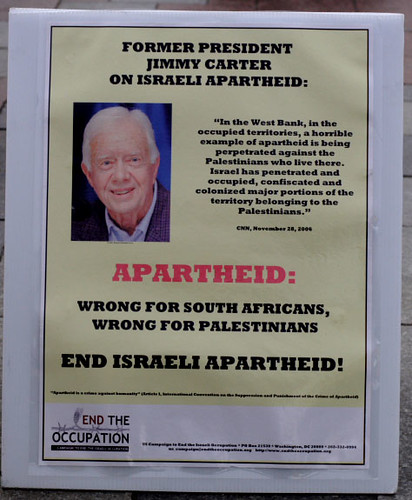
Apartheid is an Afrikaans term for "apartness," which means to "separate," to "put apart," to "segregate." It can be summed up as the institutionalization of a regime of systematic racial discrimination or more precisely, "a political system where racism is regulated in law through acts of parliament."1
Discussions on whether Israel is guilty of the crime of apartheid are not new; numerous articles were published in the 1980s and 1990s concluding that the situation in Israel and to some extent the occupied Palestinian territory (OPT) is one of apartheid.2 These discussions were, however, sidelined by the Madrid-Oslo process in the mid-1990s, which was widely expected to bring about at least partial self-determination of the Palestinian people in the OPT. Discussions on the applicability of the apartheid label to Israel have recently re-emerged, mainly as a result of the entrenchment of Israel's regime of occupation and colonization in the OPT and its continued discriminatory policies towards Palestinian refugees and citizens of Israel.3
While several political and historical comparisons between Israel and South Africa have been published, there has been no systematic legal analysis of Israeli apartheid as it affects all sectors of Palestinian society: Palestinians in the occupied territory, Palestinian citizens of Israel, and Palestinian refugees. This article is a work in progress which aims to provide a legal framework within which the applicability of the crime of apartheid to Israel can be discussed. It argues that the policies and practices of the Israeli government amount to apartheid against Palestinian nationals - wherever they are and whatever their legal status. Hence, Palestinian citizens of Israel, refugees, and those in the OPT are victims, albeit in different ways, of Israel's regime of apartheid.
While this article is limited to the applicability of the crime of apartheid, it does not negate nor contradict the fact that Israel's regime against the Palestinian people is also one of belligerent occupation and colonialism. Indeed, Israel's obligations as an occupying power in the OPT, in particular to end its belligerent occupation and withdraw from the occupied territory, are not affected by the applicability of the crime of apartheid; to the contrary, they are heightened, as are the obligations of the international community. Hence, victims of the crime of apartheid, Palestinians are not only protected civilians in the OPT, but also a people - i.e., Palestinian nationals - victims of gross violations of international human rights law (i.e., apartheid and colonialism) and entitled to reparations, including return, restitution, compensation, and satisfaction.
Colonialism, the "subjection of peoples to alien subjugation, domination and exploitation"4 is thus core to any analysis of the Israeli-Palestinian conflict. The conflict is colonial because it is rooted in political Zionism which aims to Judaize Palestine by creating a Jewish majority over Mandate Palestine - or more expansively, Eretz Israel.5 At the heart of Zionism is thus an exclusivist project: the creation of a Jewish state for the Jewish people. Such a project involves or necessitates the denial of the other; of their presence, rights and existence on the land and reconstruction of the past, namely that the land was empty before the advent of Zionist settlement, hence the movement's slogan describing "a land without people for a people without land."6 In its practical implementation, Zionism translates into a sophisticated legal, social, economic and political regime of racial discrimination that has led to colonialism and apartheid as well as the dispossession and displacement of the Palestinian people. In this sense, apartheid - the separation of the indigenous people from their lands on the one hand, and from Jewish Israelis on the other - permits the colonial enterprise that is inherent to political Zionism.
The Crime of Apartheid under International Law
Apartheid violates a jus cogens norm of international law and is a crime against humanity.7 Central to the definition of apartheid is the Convention on the Suppression and Punishment of the Crime of Apartheid (hereinafter the Apartheid Convention) which defines apartheid as "similar policies and practices of racial segregation and discrimination as practiced in southern Africa" which have "the purpose of establishing and maintaining domination by one racial group of persons over any other racial group of persons and systematically oppressing them." While the Convention is based on the South African experience, it is not limited to it.8 In its General Comment, the Committee on the Elimination of Racial Discrimination further explained that while "the reference to apartheid may have been directed exclusively to South Africa... the article [condemning racial segregation and apartheid] as adopted prohibits all forms of racial segregation in all countries."9
The Convention on the Elimination of Racial Discrimination broadly defines racial discrimination as "any distinction, exclusion, restriction or preference based on race, color, descent, or national or ethnic origin which has the purpose or effect of nullifying or impairing the recognition, enjoyment or exercise, on an equal footing, of human rights and fundamental freedoms in the political, economic, social, cultural or any other field of public life."10 The Apartheid Convention also defines apartheid as violations of international law perpetrated by one racial group against another in order to obtain and maintain supremacy - or in other terms, "all those activities and practices which are intended to protect the advantages of a dominant group and/or to maintain or widen the unequal position of a subordinate group."11 Central to the logic of apartheid is "[disaggregation of] the other along ethnically defined lines so as to divide and rule."12In this sense, apartheid is one of the most severe forms of racism.
The crime of apartheid includes denial of the right to life and liberty, such as murder, serious bodily or mental harm, infringement of freedom or dignity, torture or cruel, inhuman or degrading treatment or punishment and arbitrary arrest and illegal imprisonment. It also includes the deliberate imposition on a racial group or groups of living conditions calculated to cause its or their physical destruction in whole or in part, exploitation of labor, including forced labor, and persecution of organizations and persons who oppose apartheid.13
In addition, apartheid is
"any legislative measures and other measures calculated to prevent a racial group or groups from participation in the political, social, economic and cultural life of the country and the deliberate creation of conditions preventing the full development of such a group or groups, in particular by denying to members of a racial group or groups basic human rights and freedoms, including the right to work, the right to form recognized trade unions, the right to education, the right to leave and to return to their country, the right to a nationality, the right to freedom of movement and residence, the right to freedom of opinion and expression, and the right to freedom of peaceful assembly and association."14
Lastly, apartheid includes
"any measures, including legislative measures, designed to divide the population along racial lines by the creation of separate reserves and ghettos for the members of a racial group or groups, the prohibition of mixed marriages among members of various racial groups, the expropriation of landed property belonging to a racial group or groups or to members thereof."15
Under international humanitarian law, the first Additional Protocol to the Geneva Conventions also includes as grave breaches "practices of apartheid and other inhuman and degrading practices involving outrages upon personal dignity, based on racial discrimination."16
Under international criminal law, apartheid is clearly recognized as a crime against humanity when committed as part of a widespread or systematic attack against civilian population, i.e., inhumane acts that are massive in scale or result from deliberate and systematic planning. The Rome Statute defines apartheid as inhumane acts "committed in the context of an institutionalized regime of systematic oppression and domination by one racial group over any other racial group or groups and committed with the intention of maintaining that regime." These acts can include deportation or forcible transfer of population, imprisonment or other severe deprivation of physical liberty in violation of fundamental rules of international law, torture, persecution against any identifiable group or collectivity on political, racial, national, ethnic, cultural, religious, gender or other grounds that are universally recognized as impermissible under international law and other inhumane acts of a similar character intentionally causing great suffering, or serious injury to body or to mental or physical health."17
The Apartheid Convention includes one of the most expansive definitions of international criminal jurisdiction and enforcement.18 The Convention stipulates that "international criminal responsibility shall apply, irrespective of the motive involved, to individuals, members of organizations and institutions and representatives of the State, whether residing in the territory of the State in which the acts are perpetrated or in some other State, whenever they: a) Commit, participate in, directly incite or conspire in the commission of the acts mentioned in article II of the present Convention; b) Directly abet, encourage or co-operate in the commission of the crime of apartheid."19 The universal jurisdiction granted by the Convention enables the prosecution of individuals, members of organizations and agents of the state, who can be held criminally liable regardless of their location and their motive, and whether they encourage, cooperate with, or directly commit actions or omissions as part of the crime of apartheid.20
Applicability of the Crime of Apartheid to Israel
Defining Racial Groups
Central to the definition of apartheid is the institutionalized - "legalized" - domination of one racial group over another. An examination of whether the policies and practices of the government of Israel amount to apartheid first requires a definition what is intended by the term ‘racial group' and who are the racial groups in the context of the Israeli-Palestinian conflict. Can we say that Palestinians and Jews are racial groups, and if so, who is included in these groups? Are all the Palestinians and Jews members of a racial group or only a limited number of them?

The concepts of ‘race' and ‘racial' have evolved from a biologically-driven definition to one that "stand[s] for historically specific forms of cultural connectedness and solidarity."21 "Race serves to naturalize the groupings that it identifies in its own name."22 "While the reality of ‘race' is indeed neither natural and biological, nor psychological... it does nevertheless exist" because "it does kill people" and "continues to provide the backbone of some ferocious systems of domination."23 According to Colette Guillaumin, race is a "legal, political and historical reality which plays a real and constraining role in a number of societies" which explains why "any appeal to race... is a political move."24
The term ‘ethnic group' has been defined by Max Weber as "those human groups that entertain a subjective belief in their common descent because of similarities of physical type or of customs or both, or because of memories of colonization and migration; this belief must be important for group formation; furthermore it does not matter whether an objective blood relationship exists."25 In some instances, ‘ethnic group' has replaced or been used interchangeably with ‘racial group' although this practice is not accepted by all.26 In practice, however, the UN Committee on the Elimination of Racial Discrimination uses ‘racial group' or ‘ethnic group' interchangeably. Hence the definitions of and differences between a racial and ethnic group are malleable and have blurred. For the purpose of this article, they are used interchangeably based on the assumption that both concepts are constructed identities developed as a result of perceived common cultural, national, religious, descent or biological traits.
The definition of a ‘racial' or ‘ethnic' group primarily results from individual self-identification, which requires voluntary and conscious choice. Indeed, the Committee on the Elimination of Racial Discrimination is of the opinion that "the ways in which individuals are identified as being members of a particular racial or ethnic groups... shall, if no justification exists to the contrary, be based upon self-identification by the individual concerned."27
The victims of apartheid, in the Israeli case, are the Palestinian people, namely persons belonging to the Palestinian nation. For Palestinians, the test is whether they identify themselves as Palestinian nationals. If they do, and regardless of their geographic location or legal status, they constitute one ‘racial' or ‘ethnic' group because of their shared identity, which for instance includes a common culture, history and origin. Whether Palestinians are citizens of Israel, refugees and/or protected persons in the OPT is irrelevant, as long as they identify themselves as Palestinians. Hence, Palestinians are an ethno-national group based on their voluntary self-identification as Palestinian nationals.
| Administering Apartheid In addition to one's self-identification, identification with a ‘racial' or ‘ethnic' group can result from the projected perceptions of ‘the other' such as the state or another ‘racial' or ‘ethnic' group. By projecting or imposing its perceptions of ‘the other,' the individual, state or other racial group constructs its identity, and with it the identity of ‘the other.' As Richard Jenkins explains, "identity is our understanding of who we are and of who other people are, and reciprocally, other people's understanding of themselves and of others (which include us)."28 In that sense, group or collective identity is not a unilateral process because "all identities (individual and collective) are constituted by the process of internal-external dialectic of identification." 29 In the context of an apartheid regime, this identification of ‘the other' takes on an added bureaucratic form to facilitate the administration of discriminatory legislation, policy and practice. In the context of the Israeli-Palestinian conflict, Palestinians are also racialized through the construction and projection of racial Palestinianization by Zionist Jewish Israelis through the state of Israel. Palestinians are "treated as a racial group, not simply in the manner of a racial group, but as a despised and demonic racial group."30 In contrast, Jewish "Israelis occupy the structural position of whiteness in the racial hierarchy of the Middle East."31 On the legal and administrative level, the definition of who is a Palestinian national is for instance imposed through Israeli control of the population registry in Israel and the OPT. This control allows Israel to define who is a Palestinian - namely, a ‘non-Jew,' (i.e., Arab), ‘absentee' or ‘present-absentee.' In Israel, the state has maintained a registry of Palestinians by incorporating the differentiation between ‘Jews' and ‘Arabs' into the bureaucracy governing its citizens, a differentiation that was clearly marked on the Identity Cards issued by the state to its citizens until 2002.32 The change came not as a result of a desire to end systematic discrimination against Palestinian citizens, but because of disagreements within the Jewish religious establishment of who constitutes a Jew.33 As a result, citizens' ‘nationality' was no longer marked on state-issued ID cards, but Palestinians are still identified as ‘Arab' on their birth certificates as well as in the records of the Israeli Ministry of Interior. More simply put, "Israel does not have one single universal citizenship for all of its citizens."34 In the OPT (except Jerusalem35), the military ‘civil' administration controls the population registry and ultimately, whether the Palestinian Authority can issue Palestinian ID cards to residents of the OPT. Hence, through laws, practices and policies the state of Israel has established a hierarchy of statuses affecting all Palestinian nationals. Israel’s Hierarchy of Statuses | | Identity | Citizenship/ID | Legal status with regard to their land | Mobility access to land | | Status A | Jewish Israelis | Israeli citizenship | | No access to Area A in OPT | | Status B | Palestinian citizens of Israel | Israeli citizenship | | No access to Area A in OPT | | Status C | Palestinians IDPs in Israel | Israeli citizenship | present absentee | No access to Area A in OPT | | Status D | Palestinian residents of occupied east Jerusalem | Jerusalem ID | | Restricted access within OPT | | Status E | Palestinian refugees resident in occupied east Jerusalem | Jerusalem ID | Absentee | Restricted access within OPT | | Status F | Palestinian residents of the occupied West Bank | West Bank ID | Governed by PA | No access beyond OPT | | Status G | Palestinian residents of the occupied Gaza Strip | Gaza ID | Governed by PA | No access beyond OPT | | Status H | Palestinians internally displaced in the OPT | West Bank or Gaza ID | Absentee | No access to the lands in the OPT from which displaced | | Status I | Palestinian refugees in OPT | West Bank or Gaza ID | Absentee | No access to lands in Israel from which displaced | | Status J | Palestinian refugees outside historic Palestine | determined by country of residence/ citizenship | Absentee | No access to historic Palestine (unless granted tourist visas on foreign passports) | |
In the case of the dominant group and perpetrators of apartheid, the test is based on whether people identify themselves as Jewish citizens of Israel and Zionists. Jews are all considered Israeli nationals under the peculiar extraterritorial definition of nationality as defined and applied by the state of Israel, although there is significant social and economic discrimination against non-European Jewish Israelis that is beyond the scope of this article. Not all Jews, however, have exercised their privilege and acquired Israeli citizenship. Hence, not all people of Jewish faith can be considered part of one racial or ethnic group in the context of the Israeli-Palestinian conflict, despite the fact that the state of Israel projects itself as the representative of Jews around the world. Hence, only those who have voluntarily become Israeli citizens and adhere to Israel's political ideology, Zionism, constitute the relevant ‘racial' or ‘ethnic' group in this context. Political Zionism - "the transformation of Palestine, in whole or in part, into the Jewish Land of Israel (Eretz Israel), through the dispossession and mass transfer of the native indigenous Palestinian Arab population out of Palestine, and the establishment, through the Jewish colonization of Palestine, of a sovereign Jewish state" - is the heart of the legal, political and historical reality of the state of Israel,36 a state controlled by Zionist Jewish Israelis. Hence, the common element of this ethno-national group is self-identification as Jewish Israeli and Zionist.
While Jewish Israeli society can be considered complicit in the commission of the crime of apartheid through funding the state apparatus with their tax moneys, service in the Israeli military and other institutions involved in the commission of the crime, and otherwise, Jewish Israelis who have opposed Zionism and recognize Palestinian rights cannot be held to the same level of accountability. Furthermore, including Zionist political ideology in our analysis of the perpetrators of apartheid enables us to distinguish the increased responsibility of those who have consciously chosen to implement their right to Israeli citizenship through Israel's Law of Return as well as those who have actively sought to perpetuate the commission of apartheid through work and membership in institutions complicit in this commission, particularly in the fields of governmental and military decision-making. A framework incorporating supporters of Zionism as guilty parties in the crime of apartheid also enables us to hold international actors who have supported the Zionist project, such as Christian Zionist groups, accountable for encouraging and cooperating with the racial group that has implemented the policies and practices constituting the crime of apartheid.
Hence, for the purpose of the applicability of the crime of apartheid to the state of Israel, the two relevant ‘racial or ethnic' groups are Palestinian nationals and Zionist Jewish Israelis.
Apartheid across the Green Line and Boundaries
Zionist Jewish Israelis, the group that forms and controls the Israeli government, has ‘legalized' a system of institutionalized racial discrimination against Palestinian nationals which intends to establish and maintain domination of Zionist Jewish Israelis over Palestinian nationals. Although the legal status of the territory of Israel and the OPT differ, some of the most fundamental laws and institutions of Israel are applied to and work in both areas indiscriminately, affecting all Palestinian nationals, including those who have been displaced outside the boundaries of these areas, i.e. refugees. As Miloon Kothari, former UN special rapporteur on the right to housing, concluded "essentially, the institutions, laws and practices that Israel had developed to dispossess the Palestinians (now Israeli citizens) inside its 1948 border (the Green Line) have been applied with comparable effect in the areas occupied since 1967."37
While the following section deals with the geographic continuity of Israel's crime of apartheid in that it affects Palestinian nationals regardless of their location, it is important to note that particular apartheid laws, policies and practices listed in the Apartheid Convention and violated by Israel often have different effects on different segments of the Palestinian group. For instance, denial of the right of return (listed as an apartheid policy and practice in Article II(c) of the Apartheid Convention) disproportionately targets Palestinian refugees and internally displaced persons whether they live in a refugee camp in Lebanon or Gaza or in a city near their original village in Israel; while the restrictions of Palestinian freedom of movement prevent citizens of Israel from entering Gaza and "Area A" in the West Bank and Palestinian with West Bank ID from crossing the Green Line and moving within the OPT. A central point to keep in mind in what follows is that regardless of the variation in the ways in which Israeli apartheid affects different segments of the Palestinian population, since it is the same state operating on behalf of the Zionist Jewish Israeli group that is implementing these laws, policies and practices with the clear goal of establishing and maintaining the domination of that group in Israel and the OPT, then it is inaccurate to consider the violations as limited to one area; a mistake made by many in limiting their analysis of Israeli apartheid to a particular geographic area or a particular segment of Palestinian society. As Oren Yiftachel argues, the "common scholarly and political attempts to portray the existence of Israel proper within the Green Line, as "Jewish and democratic," are hence both analytically flawed and politically deceiving."38 He suggests that "the entire area under Israeli control - that is, Israel/Palestine between river and sea - should be analyzed as one political-geographic unit." 39 Central to such an analysis are the people displaced and denied return to this political-geographic unit.
The systematic nature of racial discrimination - the intent and plan to distinguish, exclude, dominate, and oppress on grounds of nationality - is embodied in a number of Israeli laws, policies and practices driven by political Zionism. Among these laws, policies and practices are the numerous plans of population transfer developed by Zionist Jewish Israelis to transfer - either internally or externally - Palestinian nationals from Israel and the OPT and prevent the return of those who have been displaced.40 These plans include Plan Dalet, the military plan implemented in 1948 which aimed to expand the Jewish areas beyond those allocated by the United Nations in the 1947 Partition Plan (Resolution 181) and remove Arab/Palestinian presence from these areas; the Allon Plan, which aimed to annex as much Palestinian land as possible immediately after the 1967 occupation of the West Bank and Gaza, the central motto of which was "maximum security and maximum territory for Israel with the minimum Arabs"; and, the Dayan Plan, which aimed to facilitate Israel's control over lands in the OPT and developed by Moshe Dayan, who explained "it is also important for ourselves to emphasize that we are not foreigners in the west Bank. Judea and Samaria is Israel and we are not there as foreign conquerors but as returners to Zion."41
It is beyond the scope of this article to examine the entire regime that sustains apartheid in Israel and the occupied Palestinian territory. It suffices to say that a number of laws, policies and practices fundamental to the state of Israel amount to systematic institutionalized racial discrimination for the purpose of establishing and maintaining the superiority of Zionist Jewish Israelis over Palestinians.42
Among these laws is the 1950 Law of Return, which stipulates that all Jews in the world are considered nationals of the state and can acquire Israeli citizenship.43 Palestinians (non-Jews) are subject to the 1952 Citizenship and Entry into Israel Law, which limits eligibility for Israeli citizenship to non-Jews who were present in the territory of Israel between 1948 and 1952 and their descendents. This law excludes and de facto de-nationalizes Palestinian refugees who were displaced in 194844 while any Jew around the world can "return" to "Israel," including the occupied Palestinian territory. Combined, the Law of Return and the Citizenship Law form the basis of a regime of systematic discrimination; it creates a superior status- Jewish nationals - and an inferior status - ‘non-Jews' composed mainly of Palestinians. This regime discriminates against Palestinians, in particular Palestinian refugees, on grounds of nationality. John Quigly concludes that "by discriminating against the indigenous inhabitants, both those who were displaced and those who were not, the two statutes constitute apartheid legislation."45 In addition, the Israeli parliament, the Knesset, recently passed the Ensuring Rejection of the Right of Return Law, which provides that the refugees, including those displaced in 1967 from the West Bank and Gaza Strip, will not be returned unless approved by an absolute majority of ministers.46 The Knesset has also passed a temporary amendment to the Citizenship and Entry into Israel Law which suspends the possibility of granting Israeli citizenship and residence permits in Israel, including through family reunification, to residents of the Occupied Palestinian Territory.47 These more recent laws were passed with the intent to maintain a demographic Jewish majority in Israel and the OPT and to protect this advantage by denying the rights of Palestinians to return and to family reunification.
 Moreover, in the OPT, two legal systems apply. The Israeli delegation at the review of the state of Israel by the Committee on the Elimination of Racial Discrimination verbally confirmed that two legal regimes apply in the OPT: Jewish people are subject to Israeli law (Israeli Basic Law) while Palestinians are subject to a complex mixture of Ottoman, British, Jordanian law and Israeli military orders.48 In other words, Israel applies Israeli law extra-territorially - wherever an Israeli citizen goes in the OPT, Israeli law follows. As Golda Meir said "the frontier [of Israel] is where Jews live, not where there is a line on the map."49 This reality creates a two tier legal system clearly constituting discrimination on national grounds against Palestinian nationals in and from the occupied Palestinian territory.
Para-statal institutions such as the Jewish Agency (JA) and the World Zionist Organization (WZO), which includes the Jewish National Fund (JNF), the United Israel Appeal, and other corporations or institutions owned and controlled by the WZO50 and the governmental Israel Land Administration ensure Jewish immigration and control and manage approximately 92 percent51 of land in Israel. These organizations are para-statal in that "the exclusivist constitutional stipulations of the WZO, JA and JNF (for Jews only) are incorporated into the body of the laws of the State of Israel through a detailed sequence of strategic Knesset legislation..."52 The Constitution of the Jewish Agency stipulates that "land is to be acquired as Jewish property and... the title of the lands acquired is to be taken in the name of the JNF to the end that the same shall be held the inalienable property of the Jewish people. The Agency shall promote agricultural colonization based on Jewish labor, and in all works or undertakings carried out or furthered by the Agency, it shall be deemed to be a matter of principle that Jewish labor shall be employed."53 The Jewish Agency and World Zionist Organization are part of the state of Israel. Their mandate and relationship is enshrined in the 1952 World Zionist Organization and Jewish Agency Status Law; the 1953 Keren Kayemeth Leisrael (Jewish National Fund) Law; the 1954 Covenant between the Government of Israel and the Zionist Executive; the 1961 Covenant between the Government of Israel and the Jewish National Fund; the 1971 Covenant between the State of Israel and the World Zionist Organization.
The Israeli Knesset (parliament) and the WZO/JA signed the 1952 World Zionist Organization and Jewish Agency Status Law, which stipulates:
"The mission of gathering in the exiles, which is the central task of the State of Israel and the Zionist Movement in our days, requires constant effort by the Jewish people in the Diaspora; the State of Israel, therefore, expects the cooperation of all Jews, as individuals and groups, in building up the State and assisting the immigration to it of the masses of the [Jewish] people..."54
The Memorandum of Association of the JNF as incorporated in Israel in 1954 defines its primary goal as "to purchase, acquire on lease or in exchange, etc,... in the prescribed region (which expression shall in this Memorandum mean the state of Israel in any area within the jurisdiction of the Government of Israel) or any part thereof, for the purpose of settling Jews on such lands and properties."55 The JA and WZO "enjoy a legal right to discriminate in favor of Jews"56 because their control over the land ensures the basis of the "national Jewish home" or Eretz Israel.57 In a new Covenant between the Jewish Agency and World Zionist Organization in 1971, a division of labor on a geopolitical basis was agreed whereby the JA is active in Israel whereas the WZO is active in all member states of the UN and the OPT. "Subject to this arrangement, the Settlement Division of the WZO, funded by the government of Israel and/or by non-tax-exempt donations, is active in the 1967 occupied territories, whereas the Israel department of the JA, funded by various tax-exempt Zionist appeals, is active inside the state of Israel."58 In the OPT, over 40 percent of the land in the occupied West Bank is under the control of Jewish settlements and related infrastructure, and no longer accessible to Palestinians.59 It is therefore undeniable that the Jewish Agency and the World Zionist Organization operate in both policy and practice for the exclusive benefit of Jewish nationals in Israel and the OPT, and work as para-statal organizations that implement and administer apartheid policies and practices on behalf of the Israeli state.
In order to acquire land, a number of laws and measures were enacted. These include for instance the 1943 Land (Acquisition for Public Purposes) Ordinance and the 1950 Absentee Property Law.60 The latter allows the state to acquire the lands of Palestinians displaced during the Nakba. Under this law, displaced Palestinians are considered ‘absentees,' defined as any person, who before September 1948, was out of the country in an area under the control of the Arab League Forces, or who had left his or her normal place of residence during the period prescribed in the law, or who, between 29 November 1947 and the date of coming into effect of this law, was otherwise deemed ‘absent.'61 While not overtly discriminatory, the term ‘person' in the law is interpreted as not including Jews.62 This law applies to Palestinian refugees and internally displaced persons (IDP) in Israel, who are considered ‘present absentees' (physically present but absent under the law). Lands confiscated under this law were transferred to the state's Custodian of Absentee Property. A similar regime exists in the OPT, whereby confiscated lands are transferred to the Custodian of Governmental and Abandoned Property in Judea and Samaria (i.e. occupied West Bank) under a number of military orders such as the 1967 Military Order 58, Order Concerning Absentee Property (Private Property). Under this order "property whose legal owner, or whoever is granted the power to control it by law, left the area prior to 7 June 1967 or subsequently"63 is declared absentee or abandoned property. The property is transferred to the Custodian who acquires all rights previously vested with the owner.64
"Theoretically and legally, the ‘Custodian' is entrusted with protecting the property and assets of ‘absentees' until they return to reclaim their rights. In practice, however, and because Israel has consistently barred the repatriation of refugees, the ‘Custodian' in the West Bank functions very similarly to his counterpart inside Israel. Essentially, the former facilities the transfer of ‘absentee properties' (especially lands) to Jewish control and thus prevents the rightful Palestinian owners from pressing claims to their own lands and properties." 65
The 1950 Absentee Law and the Military Order 58, Order Concerning absentee Property (Private Property) violate the prohibition against the expropriation of landed property belonging to a racial group.66 In other words "Israeli legislation excludes the indigenous population from the settler's land but does not exclude the settlers from the indigenous land."67
In addition to Israel's apartheid legislation, the state also enforces practices of physical separation and segregation. For instance, the Israeli government has a policy of house demolition and forced eviction of Palestinians in Israel and the OPT, in particular in areas which Israel aims to acquire, such as Area C, eastern Jerusalem and the closed area between the Wall and the Green Line in the West Bank, and the Naqab (Negev), Jaffa and the Galilee.68 Miloon Kothari, UN Special Rapporteur on housing, found that "the demolitions ordered either for lack of permit or another pretext have a military dimension and a gratuitously cruel nature."69 The Committee against Torture in its review of Israel concurred and expressed concern that "Israeli policies on house demolitions ... may, in certain instances, amount to cruel, inhuman or degrading treatment or punishment."70 The policy of the government of Israel to destroy Palestinian houses clearly denies the right to dignity and freedom from torture, inhuman or degrading treatment or punishment. In the OPT the Wall and its associated regime clearly have the purpose and effect of separating Jewish Israelis from Palestinians, the acquisition of Palestinian lands for Jewish-only colonies and related infrastructure and the establishment of a Jewish majority on these lands.71 The International Court of Justice, a number of UN Human Rights treaty bodies, independent experts and the International Committee of the Red Cross concluded that the construction of the Wall causes forced displacement and amounts to population transfer.72
In Israel, Palestinians displaced beyond the borders of the new state of Israel were intentionally and systematically barred from returning. In the 1948-1966 period, Israel maintained and expanded on the British Mandate system's emergency laws directing them exclusively at the Palestinians who managed to stay within the nascent state's borders. These emergency laws involved restrictions to mobility, arbitrary military governance that involved the governance of the Palestinian citizens under military laws while Jewish Israeli citizens were governed under civil laws. The central aim of these laws was clearing the land of its indigenous inhabitants for the purpose of transferring title of the land to the state and international Zionist agencies.73 The policies and practices used by Israel in the administration of Palestinians in the OPT are a clear extension of the 1948-1966 military governance regime.
In Israel, national planning laws and master plans have a similar effect in particular in the Naqab, Jaffa and the Galilee, where there are still large numbers of Palestinians. For instance, Palestinian Bedouin in the Naqab live in villages that predate the establishment of the Israeli state but are ‘unrecognized' under the 1965 Planning and Building Law. This law re-zoned communities and areas where building and construction is permitted and rendered illegal any building or habitations outside these zones, and therefore subject to demolition.74 Israel does not provide these villages access to basic services, frequently fumigates their lands with poisonous chemicals and subjects the houses in these areas to demolition, taking control of the land for so-called Jewish development projects.75 The displaced residents are forced to relocate to one of seven planned ‘concentration' towns- the equivalent of reservations - where they are circumscribed to minimum space, completely inadequate for their nomadic and pastoral way of life.76 In a recent report, Human Rights Watch concluded that "discriminatory land and planning policies have made it virtually impossible for Bedouin to build legally where they live, and also exclude them from the state's development plans for the region. The state implements forced evictions, home demolitions, and other punitive measures disproportionately against Bedouin as compared with actions taken regarding structures owned by Jewish Israelis that do not conform to planning law."77 According to Human Rights Watch, "the state's motives for these discriminatory, exclusionary and punitive policies can be elicited from policy documents and official rhetoric. The state appears intent on maximizing its control over Naqab land and increasing the Jewish population in the area for strategic, economic and demographic reasons."78 The policy of the state of Israel towards Palestinians in Israel prevents their full development by denying them their right to freedom of residence and adequate standard of living and amounts to policies and practices designed to divide the population along racial or ethnic lines by the creation of separate reserves for Palestinians.
In addition, the few ‘mixed' communities in Israel, such as Ramle and Lydd, have walls and earth embankments that separate the Jewish and Palestinian residents. The municipalities and the Israeli government often describe these separations as "acoustic walls" aimed to prevent noise coming from Palestinian neighborhoods, burglaries and the free passage of drug addicts. They were however more accurately described by the secretary of Moshav Zvi as measures aimed to block both physical and eye contact between the two communities.79 The UN Committee on the Elimination of Racial Discrimination expressed deep concern about the fact that Israel maintains separate "sectors" for Jews and Palestinians and recommended that Israel assess to which extent this may amount to racial segregation and avoid separation of communities.80 Measures such as house demolition, forced eviction and displacement, walls designed to divide the population along ethnic or racial groups, the result being the creation of separate reserves and ghettos for Palestinian nationals thus violating the Apartheid Convention.
Conclusion
Fundamental laws, policies and practices of the Israeli government aim to establish and maintain Zionist Jewish Israeli domination over Palestinian nationals through the colonization of their lands and resources. These laws, policies and practices affect all Palestinian nationals, irrespective of their location and status since at least the Nakba of 1948. Hence, the crime of apartheid is applicable to Israel over all of Israel and the OPT. The ongoing exclusion of Palestinians from their homes, lands and country through internal and external displacement over the past 60 years has forced 70 percent of Palestinians to live as refugees and/or IDPs; the largest and longest standing refugee and IDP crises in the world today.
In order to challenge Israel's rejection of international law as a valid framework capable of bringing a lasting solution to the conflict and its apartheid laws, policies and practices, it is necessary to support the shift of the struggle from the limited focus on the occupation of the OPT back to its roots as a struggle against apartheid and colonialism and occupation in all of mandate Palestine. In other words, only reparations based on an end to racial discrimination through the institutionalization of justice will end the conflict and bring peace. Uri Davis describes this process as "the dismantlement of the state of Israel as a Jewish state in the political Zionist sense of the term, an apartheid state, and its replacement with a democratic Palestine."81 Hence, the conflict will end when the colonizer and colonized live together, in equality, in all of Palestine. Until then, the racist and discriminatory laws, policies and practices of the state of Israel must be exposed and the government encouraged and pressured to annul its apartheid and colonial laws, policies and practices.
-----------------------
*Karine Mac Allister is the former Coordinator for Legal Advocacy at Badil. We wish her all the best is she begins her years as a doctoral candidate in Montreal.
Endnotes
1. Uri Davis, Apartheid Israel, Possibilities for the Struggle Within, Zed Books, London, 2003, p. 37.
2. See for instance John Quigly, “Apartheid Outside Africa: The Case of Israel,” 2 Ind. International and Comparative Law Review. 221, 1991-1992 or Uri Davis, Israel: An Apartheid State, Zed Books, London, 1987.
3. “I argue that the Oslo process was a turning point: from then onward a dominant form of control has emerged, which includes ghettoization, spatial confinement and restriction of Palestinians to their villages and towns.”Alina Korn, “The Ghettoization of the Palestinians” in Thinking Palestine, Ed. Ronit Lentin, Zed Books, London & New York, 2008, p. 116.
4. Declaration on the Granting of Independence to Colonial Countries and Peoples, UNGA Resolution 1514 (XV),14 December 1960, para. 1.
5. Eretz Israel is a varying geographical construct that extend to parts of Jordan, Syria and Egypt and as far as Iraq – often captured in the phrase 'from the Nile to the Euphrates.’ The Israel Ministry of Foreign Affairs writes “the State of Israel is a Jewish state, first and foremost, in view of the right of the Jewish people to a single independent state of their own, and by reason of the historic and biblical connection between the Jewish people and the Land of Israel (Eretz Israel).” See Israel, the Conflict and Peace: Answers to frequently asked questions, November 2007, available from: http://www.mfa.gov.il/mfaIlan Pappe, The Ethnic Cleansing of Palestine, Oneworld, Oxford, 2007, pp. 10-15; Uri Davis, Apartheid Israel, Possibilities for the Struggle Within, Zed Books, London, 2003, p. 19;Oren Yiftachel, Ethnocracy, Land and Identity Politics in Israel/Palestine, University of Pennsylvania Press, Philadelphia, p.3; On creating and maintaining a Jewish majority, see Jonathan Cook, Blood and Religion, The Unmasking of the Jewish and Democratic State, Pluto Press, London, 2006, p. 100.
6. See Nur Masalha, Expulsion of the Palestinians: The Concept of 'Transfer' in Zionist Political Thought 1882-1948, Institute for Palestine Studies, US, 1992.
7. See Ronald C Slye, “Apartheid as a Crime Against Humanity: A Submission to the South African Truth and Reconciliation Commission,” 20 Michigan Journal of International Law. 267, 1998-1999, p. 288-289.
8. Roger S. Clark, “Apartheid,” International Criminal Law, Second Edition, Volume I, Edt. M. Cherif Bassiouni, 1991, p. 643, 644.
9. CERD General Recommendation No. 19, Racial segregation and apartheid (Art. 3) : 18 August 1995. The Convention on the Elimination of All Forms of Racial Discrimination, states “particularly condemn racial segregation and apartheid and undertake to prevent, prohibit and eradicate all practices of this nature in territories under their jurisdiction.” Article 3, Convention on the Elimination of all Forms of Racial Discrimination.
10. Article 1, Convention on the Elimination of All Forms of Racial Discrimination.
11. Robert Miles, “Racism as a Concept” in Racism, Edts. Martin Bulmer and John Solomos, Oxford University Press, p. 351.
12. David Theo Goldberg, “The Semantics of Race,” in Racism, Edts. Martin Bulmer and John Solomos, Oxford University Press, p. 372.
13. Article 2, Convention on the Suppression of the Crime of Apartheid.
14. Article 2, Convention on the Suppression of the Crime of Apartheid. [emphasis added]
15. Article 2, Convention on the Suppression of the Crime of Apartheid.
16. Article 85(4), First Additional Protocol to the Fourth Geneva Conventions, 1977.
17. Article 7, Rome Satute of the ICC. [Emphasis added]
18. See Ronald C Slye, “Apartheid as a Crime Against Humanity: A Submission to the South African Truth and Reconciliation Commission,” 20 Michigan Journal of International Law. 267, 1998-1999, p. 293.
19. Article 3, Convention on the Suppression and Punishment of the Crime of Apartheid.
20. Roger S. Clark, “Apartheid,” International Criminal Law, Second Edition, Volume I, Edt. M. Cherif Bassiouni, 1991, p. 645.
21. David Theo Goldberg, “The Semantics of Race,” in Racism, Edts. Martin Bulmer and John Solomos, Oxford University Press, p. 370.
22. “In articulating as natural ways of being in the world and the institutional structures in and through such ways of being expressed, race both establishes and rationalized the order of difference as a law of nature.”David Theo Goldberg, “The Semantics of Race,” in Racism, Edts. Martin Bulmer and John Solomos, Oxford University Press, p. 374.
23. Colette Guillaumin, “The changing face of Race,” in Racism, Edts. Martin Bulmer and John Solomos, Oxford University Press, p. 362.
24. Colette Guillaumin, “The changing face of Race,” in Racism, Edts. Martin Bulmer and John Solomos, Oxford University Press, p. 362.
25. Max Weber [1922]1978 Economy and Society eds. Guenther Roth and Claus Wittich, trans. Ephraim Fischof, vol. 2 Berkeley: University of California Press, p. 389.
26. See Roselle Tekiner, “Race and the Issue of National Identity in Israel,” International Journal of Middle East. Studies 23, 1991, p. 41,42.
On the relation between racial and ethnic group see Robert Miles, “Racism as a Concept” in Racism, Edts. Martin Bulmer and John Solomos, Oxford University Press, p. 345.
Goldberg believes that the concept of race is ethnocentric because “ethnicity is the mode of cultural identification and distinction.” David Theo Goldberg, “The Semantics of Race,” in Racism, Edts. Martin Bulmer and John Solomos, Oxford University Press, p. 371.
27. CERD General Recommendation No. 08: Identification with a particular racial or ethnic group (Art.1, par.1 & 4), 22 August 1990.
28. Richard Jenkins, Social Identity, Second Edition, Routledge, London and New York, 2005, p. 5.
29. Richard Jenkins, Social Identity, Second Edition, Routledge, London and New York, 2005, p. 18.
30. David Theo Goldberg,“Racial Palestinianization” in Thinking Palestine, Ed. Ronit Lentin, Zed Books, London & New York, 2008, p. 42.
31. David Theo Goldberg,“Racial Palestinianization” in Thinking Palestine, Ed. Ronit Lentin, Zed Books, London & New York, 2008, p. 33.
32. Until 2000-2001, Israeli citizens' ID cards included a section under the heading 'nationality' that differentiated between Jews, Arabs, Druze, and Circassian.
33. Uri Davis, Apartheid Israel, Possibilities for the Struggle Within, Zed Books, London, 2003, p. 96.
34. Uri Davis, Apartheid Israel, Possibilities for the Struggle Within, Zed Books, London, 2003, p. 107.
35. Jerusalem ID cards are identical to those of Israeli citizen, with the notable exception that those Palestinians granted these cards in the year 1967 when the remainder of the city was occupied have ID numbers that begin with 080, and Palestinians granted these cards as a result of family unification have ID numbers that begin with 086.
36. Uri Davis, Apartheid Israel, Possibilities for the Struggle Within, Zed Books, London, 2003, p. 19.
37. Report of the Special Rapporteur on adequate housing as a component of the right to an adequate standard of living, Mr, Miloon Kothari, E/CN.4/2003/5/Add.1, June 2002, p. 4.
38. Oren Yiftachel, Ethnocracy, Land and Identity Politics in Israel/Palestine, University of Pennsylvania Press, Philadelphia, p.8.
39. Oren Yiftachel, Ethnocracy, Land and Identity Politics in Israel/Palestine, University of Pennsylvania Press, Philadelphia, p.8.
40. Prior to 1948, some of these plans were: Weizman Transfer Scheme (1930), Soskin Plan of Compulsory Transfer (1937), Royal (Peel) Commission recommendations (transfer of Arabs to Transjordan) (1937), Weitz Transfer Plan (1937), Bonne Scheme (1938), al-Jazirah Scheme (second transfer committee) (1938), Norman Transfer Plan to Iraq (1934-38), Ben-Horin Plan (1943-48), Plan Dalet (1948).See for instance Nur Masalha, Expulsion of the Palestinians: The Concept of 'Transfer' in Zionist Political Thought 1882-1948, Institute for Palestine Studies, US, 1992.See also Ilan Pappe, The Ethnic Cleansing of Palestine, Oneworld, Oxford, 2007.
Post 1948, “Resettlement” plans (various resettlement plans from the 1950s to the 1980s were elaborated to send Palestinians to Arab states (Libya, Jordan and El'Arish in Sinai Egypt) and Latin American countries. Other plans included the "Allon Plan" which called for Israel's annexation of up to half the West Bank, while Palestinians would be confined to the other half in two unconnected cantons to the north and south (late 1960s), the Jewish Agency and the World Zionist Organization Twenty-Year Plan (1975-1995), Sharon Seven Stars Plan and Trans-Israel Highway project (1977) calling for contiguous Israeli urban growth straddling both sides of the "Green Line"; Drobles Settlement Plan (1980-85); Unilateral disengagement plan (2003) – confirming Israel's intention to annex settlement blocks as part of Israel.See Nur Masalha, A Land Without a People, Israel, Transfer and the Palestinians 1949-1996, Faber and Faber, London, 1997.See also Souad A. Dajani, Ruling Palestine, A History of the Legally Sanctioned Jewish-Israeli Seizure of Land and Housing in Palestine, Center on Housing Rights and Evictions (COHRE) and Badil Resource Center for Palestinian Residency and Refugee Rights, Bethlehem, 2005, p. 72-78.
On current talks about transfer:In July 2001, a bill was proposed to encourage the emigration of Palestinian citizens of Israel on the grounds that “they do not identify with the Jewish character of the state” and in order to strengthen “Israel as a Jewish state and a democracy.”Sultany, Nimer, Citizens Without Citizenship. Mada’s First Annual Political Monitoring Report: Israel and the Palestinian Minority 2000–2002, Haifa: Mada, 2003, pp. 42–43. In November 2004, the National Union party drafted a bill (Person for Person Law 2004) proposing to transfer one Palestinian from Israel to the OPT for every Jewish settler removed from the OPT to Israel. When this bill was rejected, it was replaced by a new proposal (Disengagement Law 2004) that would “organize the evacuation of residents of southern Jerusalem.” According to the initiators, “the transfer of Arabs from densely populated Jewish areas will reduce the friction with the local residents, and may improve the fabric of Jewish life, the Jewish economy, and Jewish security.” Israel and the Palestinian Minority 2004, Sultany, Nimer (ed.), Mada’s Third Annual Political Monitoring Report. Haifa: Mada, July 2005, p. 33. In 2006, the right-wing Herut political party in Israel adopted as part of their electoral campaign the slogan “A good Arab is not a dead Arab; a good Arab sometimes wants to leave.” The slogan was eventually barred by the Central Committee managing the Israeli elections, although the party continued to advocate for the transfer of Palestinians. See Weekly Review of Human Rights Violations against the Palestinian Arab Minority in Israel, No. 264/3–10 March 2006, Nazareth: Arab Association for Human Rights, p. 3. For more, also See Jonathan Cook, Blood and Religion, The Unmasking of the Jewish and Democratic State, Pluto Press, London, 2006, pp. 118-122.
41. See Souad A. Dajani, Ruling Palestine, A History of the Legally Sanctioned Jewish-Israeli Seizure of Land and Housing in Palestine, Center on Housing Rights and Evictions (COHRE) and Badil Resource Center for Palestinian Residency and Refugee Rights, Bethlehem, 2005, p. 28, 73.
42. See Uri Davis, Apartheid Israel, Possibilities for the Struggle Within, Zed Books, London, 2003; John Quigly, “Apartheid Outside Africa: The Case of Israel,” Ind. and International Comparative Law Review, 2, 1991-1992, p. 231.
43. Law of Return, Laws of the State of Israel, 1950.
44. Citizenship Law, Law of the State of Israel, 1952. Denial of the right of return through the Citizenship Law is unlawful.For instance, CERD urgent Israel “to assure equality in the right to return to one’s country and in the possession of property.” Concluding Observations of the Committee on Racial Discrimination, CERD/C/ISR/CO/13, 14 June 2007,para 18. For more on the de-nationalization of Palestinian refugees, see Gail J. Boiling, The 1948 Palestinian Refugees and the Individual Right of Return, An International Law Analysis, Badil Resource Center for Palestinian Residency and Refugees Rights, Bethlehem, Second Edition, July 2007, pp. 42-44.
45. John Quigly, “Apartheid Outside Africa: The Case of Israel,” Ind. and International Comparative Law Review, 2, 1991-1992, p. 231.
46. Ensuring Rejection of the Right of Return Law, 2001.In explaining the motive for the proposed bill during preliminary readings on 17 May 2000, MK Yisrael Katz said “the bill reflects a Zionist consensus not to allow the refugees of 1948 and 1967 to return to the sovereign areas of the State of Israel.....whoever wishes to live in a democracy and in equality – will find a place with us. Whoever seeks another national identity – let him go elsewhere. The right of return, a state for all its citizens – are expressions synonymous to the wish to destroy Israel.” In Nimer Sultany, Citizens without Citizenship, Mada's First Annual Political Monitoring Report: Israel and the Palestinian Minority 2000-2002, Mada – Arab Center for Applied Social Research, Haifa, 2003, pp. 19-20.
47. (Temporary Order) of 31 May 2003.
48. “The Committee notes with concern the application in the Occupied Palestinian Territories of different laws, policies and practices applied to Palestinians on the one hand, and to Israelis on the other hand.” Concluding Observations of the Committee on Racial Discrimination, CERD/C/ISR/CO/13, 14 June 2007,para 35.
49. Souad A. Dajani, Ruling Palestine, A History of the Legally Sanctioned Jewish-Israeli Seizure of Land and Housing in Palestine, Center on Housing Rights and Evictions (COHRE) and Badil Resource Center for Palestinian Residency and Refugee Rights, Bethlehem, 2005, p. 72.
50. “The JNF has become a private Israeli company since 1953 according to a special law enacted by the Knesset known as the Israel National Fund Law of 1953. according to its memorandum the JNF acts within any area under the jurisdiction of the Government of Israel and for the benefit of Jews only, and in the case of dissolution of the JNF, all its property will be transferred to the Israeli Government. It is estimated that the JNF owns around 13 percent of the lands in Israel. In addition to the JNF Law, in 1953 the Israeli Parliament (Knesset) enacted the World Zionist Organization and the Jewish Agency (Status) Law. According to Article 4 of this law, these two “national organizations” have been recognized by the state of Israel as allowed “to continue acting in Israel to develop the state and its inhabitants, and to settle immigrants from the diaspora....” Usama Halabi, Israel's Land Laws as a Legal-Political Tool, Working Paper No. 7, Badil Resource Center for Palestinian Residency and Refugee Rights, Bethlehem, December 2004, p. 3. See also Uri Davis, Apartheid Israel, Possibilities for the struggle within, Zed Books, London, 2003, pp. 40-52.
51. See John Quigly, “Apartheid Outside Africa: The Case of Israel,” Ind. and International Comparative Law Review, 2, 1991-1992, p. 234.See Usama Halabi, Israel's Land Laws as a Legal-Political Tool, Working Paper No. 7, Badil Resource Center for Palestinian Residency and Refugee Rights, Bethlehem, December 2004, p. 6.
52. Uri Davis, Apartheid Israel, Possibilities for the struggle within, Zed Books, London, 2003, p. 41.
53. See Uri Davis, Israel: An Apartheid State, Zed Books, London, 1987, pp. 55-57.
54. Souad A. Dajani, Ruling Palestine, A History of the Legally Sanctioned Jewish-Israeli Seizure of Land and Housing in Palestine, Center on Housing Rights and Evictions (COHRE) and Badil Resource Center for Palestinian Residency and Refugee Rights, Bethlehem, 2005, p. 57.
55. See Uri Davis, Israel: An Apartheid State, Zed Books, London, 1987, pp. 55-57.
56. Jonathan Cook, Blood and Religion, The Unmasking of the Jewish and Democratic State, Pluto Press, London, 2006, p. 17.
57. See Usama Halabi, Israel's Land Laws as a Legal-Political Tool, Working Paper No. 7, Badil Resource Center for Palestinian Residency and Refugee Rights, Bethlehem, December 2004, p. 3.
58. Uri Davis, Apartheid Israel, Possibilities for the struggle within, Zed Books, London, 2003, p. 46.See also Souad A. Dajani, Ruling Palestine, A History of the Legally Sanctioned Jewish-Israeli Seizure of Land and Housing in Palestine, Center on Housing Rights and Evictions (COHRE) and Badil Resource Center for Palestinian Residency and Refugee Rights, Bethlehem, 2005, p. 57, 75.
59. Souad A. Dajani, Ruling Palestine, A History of the Legally Sanctioned Jewish-Israeli Seizure of Land and Housing in Palestine, Center on Housing Rights and Evictions (COHRE) and Badil Resource Center for Palestinian Residency and Refugee Rights, Bethlehem, 2005, p. 71.
60. Emergency Regulation Concerning Absentee Property, 1948 and later the Absentee Property Law 1950.Other laws are also used to expropriate Palestinian land such as the 1953 Land Acquisition (Validity of Acts and Compensation) Law and the 1943 Lands (Acquisition for Public Purposes) Ordinance, which although neutral, has been discriminatory. All lands taken under the 1943 Ordinance have become part of the state property according to the 1951 State Property Law. For more, see Usama Halabi, Israel's Land Laws as a Legal-Political Tool, Working Paper No. 7, Badil Resource Center for Palestinian Residency and Refugee Rights, Bethlehem, December 2004, p. 5.
61. According to the law, absentees are (1) a person who between 29th November 1947 and 19th May 1948 has ceased to exist, was a legal owner of any property situated in the area of Israel or enjoyed or held it, whether by himself or through another, and who, at any time during this period was a national or citizen of Lebanon, Egypt, Saudi Arabia, Trans-Jordan, Iraq or the Yemen or was in one of these countries or in any part of Palestine outside the area of Israel or was a Palestinian citizen and left his ordinary place of residence in Palestine for a place outside Palestine before 1sr September 1948 or for a place in Palestine held at that time by forces which sought to prevent the establishment of the state of Israel or which fought against its establishment; (2) a body of persons which, at any time during the period specified in paragraph (1), was a legal owner of any property situated in the area of Israel or enjoyed or held such property, whether by itself or through another, and all the members, partners, shareholders, directors or managers of which are absentees within the meaning of paragraph (1), or the management of the business of which is otherwise decisively controlled such absentees, or all the capital which is in the hands of such absentees. The Absentees’ Property Law, 5710-1950 in Souad A. Dajani, Ruling Palestine, A History of the Legally Sanctioned Jewish-Israeli Seizure of Land and Housing in Palestine, Center on Housing Rights and Evictions (COHRE) and Badil Resource Center for Palestinian Residency and Refugee Rights, Bethlehem, 2005, p. 41.
62. Souad A. Dajani, Ruling Palestine, A History of the Legally Sanctioned Jewish-Israeli Seizure of Land and Housing in Palestine, Center on Housing Rights and Evictions (COHRE) and Badil Resource Center for Palestinian Residency and Refugee Rights, Bethlehem, 2005, p. 41.
63. Souad A. Dajani, Ruling Palestine, A History of the Legally Sanctioned Jewish-Israeli Seizure of Land and Housing in Palestine, Center on Housing Rights and Evictions (COHRE) and Badil Resource Center for Palestinian Residency and Refugee Rights, Bethlehem, 2005, p. 85.
64. Souad A. Dajani, Ruling Palestine, A History of the Legally Sanctioned Jewish-Israeli Seizure of Land and Housing in Palestine, Center on Housing Rights and Evictions (COHRE) and Badil Resource Center for Palestinian Residency and Refugee Rights, Bethlehem, 2005, p. 85.
65. Souad A. Dajani, Ruling Palestine, A History of the Legally Sanctioned Jewish-Israeli Seizure of Land and Housing in Palestine, Center on Housing Rights and Evictions (COHRE) and Badil Resource Center for Palestinian Residency and Refugee Rights, Bethlehem, 2005, p. 85.
66. Convention on the Suppression and Punishment of the Crime of Apartheid, 1976, Article 2. See John Quigly, “Apartheid Outside Africa: The Case of Israel,” Ind. and International Comparative Law Review, 2, 1991-1992, p. 234.
67. John Quigly, “Apartheid Outside Africa: The Case of Israel,” Ind. and International Comparative Law Review, 2, 1991-1992, p. 236.
68. Only in Area C in the OPT, Israel has demolished 1,600 houses between January 2000 and September 2007and 3,000 houses have received demolition orders and could be demolished at any moment. See UN OCHA, ““Lack of Permit” Demolitions and Resultant Displacement in Area C,” OCHA Special Focus, May 2008. House demolition and forced evictions are implemented through a number of practices such as collective punishment and demolitions for so-called lack of building permit and military orders.
69. UN Commission on Human Rights, Report of the Special Rapporteur on adequate housing as a component of the right to an adequate standard of living, Mr. Miloon Kothari, Fifty-ninth session, E/CN.4/2003/5/Add.1, 12 June 2002, para. 22.
70. UN Committee Against Torture, Concluding Observations; Israel, 2001.
71. In 2005, Minister of Justice, Tzipi Livni, confirmed that "the wall is the future border of the state of Israel" and that "the High Court of Justice, in its ruling over the fence, is drawing the country's border.” Haaretz, 1 December 2005.
“Israel's separation barrier in and around Jerusalem is meant to ensure a Jewish majority in the disputed city, a Cabinet minister acknowledged Monday, contradicting government claims that the divider is solely a temporary security measure. Haim Ramon, the Israeli Cabinet minister for Jerusalem, told Israel Radio the barrier is not only making the city safer by buffering against suicide bombers, but "also makes it more Jewish.” “Israeli Official: Wall to Ensure Jewish Majority,” Fox News, 11 July 2005.
72. The International Court of Justice in its advisory opinion the Legal Consequences of the Construction of a Wall in the Occupied Palestinian Territory in July 2004 reached a similar conclusion because .”..a significant number of Palestinians have already been compelled by the construction of the wall and its associated regime to depart from certain areas, a process that will continue as more of the wall is built, that construction, coupled with the establishment of the Israeli settlements […] is tending to alter the demographic composition of the [occupied Palestinian territory].” International Court of Justice, Legal Consequences of the Construction of a Wall in the Occupied Palestinian Territory, Advisory Opinion, 9 July 2004, para. 133.
“Actions that change the demographic composition of the Occupied Palestinian Territories are also of concern as violations of human rights and international humanitarian law.”Concluding Observations of the Committee on Racial Discrimination, CERD/C/ISR/CO/13, 14 June 2007,para 14.
“The ICRC also conveyed its concern to the Israeli authorities about the legal and humanitarian implications of the West Bank barrier, particularly the destruction or expropriation of Palestinian property and land and the forced displacement and isolation of Palestinian communities living in its path or vicinity.”ICRC Annual report 2004, p. 285.
73. For more on the Military Rule system, see Sabri Jiryis, The Arabs in Israel, Beirut: Institute of Palestine Studies, 1966.
74. Souad A. Dajani, Ruling Palestine, A History of the Legally Sanctioned Jewish-Israeli Seizure of Land and Housing in Palestine, Center on Housing Rights and Evictions (COHRE) and Badil Resource Center for Palestinian Residency and Refugee Rights, Bethlehem, 2005, p. 63.
75. See Oren Yiftachel, Ethnocracy, Land and Identity Politics in Israel/Palestine, University of Pennsylvania Press, Philadelphia, p.4.
76. In November 2004, Prime Minister Ariel Sharon decided to create an emergency plan to “save the outlying areas” in the Naqab and Galilee. The plan is intended to increase land held by the Jewish population and ensure a Jewish majority in the Naqab (Negev) and Galilee. See Mada al-Carmel, The Arab Center for Applied Social Research, Israel and the Palestinian Minority 2004, Sultany, Nimer, (ed.), Mada’s Third Annual Political Monitoring Report, pp.41-42. See also Arab Association for Human Rights, 'Bedouins in the Negev, fact sheetand the Regional Council for the Unrecognized Villages in the Negev.
“In November 2005, the government adopted the Negev 2015 plan, a US$3.6 billion 10-year scheme aimed at increasing the Jewish population of the Negev by 200,000 by developing upscale residential neighborhoods, fast transportation networks for commuters, high tech establishments, and better educational facilities. While the plan does propose upgrades to the appalling infrastructure and educational facilities in the government-planned Bedouin townships, it completely ignores the needs of the Bedouin living in unrecognized villages in the Negev.” “Israeli officials insist that Bedouin can relocate to seven existing government-planned townships. But in fact alternative housing there is not readily available, and these towns are currently ill-equipped to handle a further influx of residents. Most Bedouin reject the idea of relocating to the townships, where poverty and crime rates are high, basic socioeconomic infrastructure is lacking, and they cannot continue traditional means of livelihood such as herding and grazing. Most important, the state requires Bedouin who move to the townships to renounce their ancestral land claims, which is unthinkable for most Bedouin who have such claims to land.” Human Rights Watch, Off the Map Land and Housing Rights Violations in Israel’s Unrecognized Bedouin Villages, Volume 20, No. 5 (E),March 2008, pp. 4, 5.
CERD recommended that Israel “enquire into possible alternatives to the relocation of inhabitants of unrecognized Bedouin villages in the Negev/Naqab to planned towns, in particular through the recognition of these villages and the recognition of the rights of the Bedouins to own, develop, control and use their communal lands, territories and resources traditionally owned or otherwise inhabited or used by them. It recommends that the State party enhance its efforts to consult with the inhabitants of the villages and notes that it should in any case obtain the free and informed consent of affected communities prior to such relocation.” Concluding Observations of the Committee on Racial Discrimination, CERD/C/ISR/CO/13, 14 June 2007,para 25.
77. Bedouin comprise 25 percent of the population of the northern Negev (Naqab), but have jurisdiction over less than 2 percent of the land there.“Israeli officials contend that they are merely enforcing zoning and building codes, but the state systematically demolishes Bedouin homes while overlooking or retroactively legalizing illegal construction by Jewish citizens.”Human Rights Watch, Off the Map Land and Housing Rights Violations in Israel’s Unrecognized Bedouin Villages, Volume 20, No. 5 (E),March 2008, p. 5.
78. Human Rights Watch, Off the Map Land and Housing Rights Violations in Israel’s Unrecognized Bedouin Villages, Volume 20, No. 5 (E),March 2008, p. 5.
79. Comments by Yaron Levy, secretary of Moshav Nir Zvi regarding the separation wall between the moshav and Pardes Snir neighbourhood in the city of Lid.Larry Ben-David, “The Separation Wall within the Green Line,” Ma'ariv Online, 3 March 2003 (in Hebrew) cited in Behind the Walls, Separation Wall between Arabs and Jews in Mixed Cities and neighbourhoods in Israel, Arab Association for Human Rights, Nazareth, December 2005, p. 18. See also Jonathan Cook, Blood and Religion, The Unmasking of the Jewish and Democratic State, Pluto Press, London, 2006, p. 4.
80. Concluding Observations of the Committee on Racial Discrimination, CERD/C/ISR/CO/13, 14 June 2007, para 22.
81. Uri Davis, Apartheid Israel, Possibilities for the struggle within, Zed Books, London, 2003, p. 2
Source: The One Democratic State Group










 Posts
Posts


