Showing posts with label Israeli Aparteid. Show all posts

Saturday, January 30, 2010

This is ZIonism: Female soldiers break their silence

Female soldiers break their silence

Six years after first collection of Breaking the Silence testimonies, organization releases booklet of testimonies from female soldiers who served in territories. Stories include systematic humiliation of Palestinians, reckless and cruel violence, theft, killing of innocent people and cover-up. Here are only some of testimonies


"A female combat soldier needs to prove more…a female soldier who beats up others is a serious fighter…when I arrived there was another female there with me, she was there before me…everyone spoke of how impressive she is because she humiliates Arabs without any problem. That was the indicator. You have to see her, the way she humiliates, the way she slaps them, wow, she really slapped that guy."

The Breaking the Silence organization on Friday released a booklet of testimonies by female soldiers recounting various abuse cases involving Palestinians in the West Bank.

Remnants of War

Soldiers say received orders to shoot first, worry later in Gaza war / Reuters

Breaking the Silence activist group presents report of testimonies from Gaza offensive in which soldiers say destruction, civilian casualties were direct result of IDF policy. Army: Testimonies are general, anonymous, and unreliable
Full story

In recent years, females have been increasingly involved in combat and field operations in the IDF and Border Guard. Among other things, these female soldiers engage in daily contact with the Palestinian population – at roadblocks and in Palestinian communities.

According to the latest testimonies, many of these young women have trouble coping with the violent reality they are exposed to and find themselves facing situations that contradict their values. Some of them end up engaging in acts, or turning a blind eye to acts, that will burden them years later. Like their male counterparts, some of these females have a need to speak about what they saw.

"The girls have greater difficulties in telling the story, because they're the minority to begin with" the organization's director Dana Golan says.

'Each soldier would give them a pet'

In the framework of the latest project, Breaking the Silence gathered the testimonies of more than 50 female soldiers who served in various posts in the territories. Ynet presents some of the highlights in this report.

Golan noted that female soldiers were not more sensitive to the Palestinians than their male comrades.

"We discovered that the girls try to be even more violent and brutal than the boys, just to become one of the guys," she said.


Reporter took a picture, 'special patrol' sent to get them (Photo: Reuters)

A female Seam Line Border Guard spoke of the chase after illegal aliens: "In half an hour you can catch 30 people without any effort." Then comes the question of what should be done with those who were caught – including women, children, and elderly. "They would have them stand, and there's the well-known Border Guard song (in Arabic): 'One hummus, one bean, I love the Border Guard' – they would make them sing this. Sing, and jump. Just like they do with recruits… The same thing only much worse. And if one of them would laugh, or if they would decide someone was laughing, they would punch him. Why did you laugh? Smack… It could go on for hours, depending on how bored they are. A shift is eight hours long, the times must be passed somehow."

Most of the female soldiers say that they sensed there was a problem during their service, but did nothing.

Another female soldier's testimony, who served at the Erez checkpoint, indicates how violence was deeply rooted in the daily routine: "There was a procedure in which before you release a Palestinian back into the Strip – you take him inside the tent and beat him."

That was a procedure?

"Yes, together with the commanders."

How long did it last?

"Not very long; within 20 minutes they would be back in the base, but the soldiers would stop at the post to drink coffee and smoke cigarettes while the guys from the command post would beat them up."

This happened with every illegal alien?

"There weren't that many...it's not something you do everyday, but sort of a procedure. I don't know if they strictly enforced it each and every time...it took me a while to realize that if I release an illegal alien on my end, by the time he gets back to Gaza he will go through hell... two or three hours can pass by the time he gets into the Strip. In the case of the kid, it was a whole night. That's insane, since it's a ten minute walk. They would stop them on their way; each soldier would give them a 'pet', including the commanders."

'Child's hand broken on the chair'

A female soldier in Sachlav Military Police unit, stationed in Hebron, recalled a Palestinian child that would systematically provoke the soldiers by hurling stones at them and other such actions. One time he even managed to scare a soldier who fell from his post and broke his leg.

Retaliation came soon after: "I don't know who or how, but I know that two of our soldiers put him in a jeep, and that two weeks later the kid was walking around with casts on both arms and legs…they talked about it in the unit quite a lot – about how they sat him down and put his hand on the chair and simply broke it right there on the chair."

Even small children did not escape arbitrary acts of violence, said a Border Guard female officer serving near the separation fence: "We caught a five-year-old…can't remember what he did…we were taking him back to the territories or something, and the officers just picked him up, slapped him around and put him in the jeep. The kid was crying and the officer next to me said 'don't cry' and started laughing at him. Finally the kid cracked a smile – and suddenly the officer gave him a punch in the stomach. Why? 'Don't laugh in my face' he said."


'Palestinian beaten before being released to Strip' (Photo: AFP)

Was there also abuse of women?

"Yes" the same soldier replied. "Slaps, that kind of thing. Mainly slaps."

From men?

"Also. From whoever. It was mainly the female combat soldiers who beat people. There were two who really liked to beat people up. But also men, they had no problem slapping a woman around. If she screamed, they'd say, 'Shut it,' with another slap. A routine of violence. There were also those who didn't take part, but everyone knew it happened."

Sometimes an entire "production" was necessary to satisfy the violent urges. "There's a sense of violence," a border policewoman in the Jenin area said. "And yes, it's boring, so we'd create some action. We'd get on the radio, and say they threw stones at us, then someone would be arrested, they'd start investigating him… There was a policewoman, she was bored, so okay, she said they threw stones at her. They asked her who threw them. 'I don't know, two in grey shirts, I didn't manage to see them.' They catch two guys with grey shirts… beat them. Is it them? 'No, I don't think so.' Okay, a whole incident, people get beaten up. Nothing happened that day."

An education noncommissioned officer from the Border Guard took her officers for a Sunday of culture – a show in Tel Aviv. When they got back to their base in the Gaza Strip, they were appalled by the dissonance – one moment they're clapping in a theater, the next moment they're acting like beasts.

"Crossing the checkpoint, it's like another world… Palestinians walk with trolleys on the side of the road, with wagons, donkeys… so the Border Guards take a truck with the remains of food and start throwing it at them… cottage cheese, rotten vegetables… it was the most appalling thing I experienced in the territories."

The soldier said she tried to protest, but was silenced by the commanding officers. When she tried to go around them to higher authorities, she found a solution. "Almost immediately I got into an officers' course."

'You don't know which side you're on'

Some of the testimonies document incidents of vandalism of Palestinian property, and even theft. The same female soldier who recounted her time at the Erez checkpoint said, "Many times the soldiers would open the Palestinians' food."

And would they take it as well?

"Yes. They take things all the time at checkpoints in the territories. You'll never see a soldier without musabaha (chickpea past similar to hummus). And that is something they give many times… They are so desperate to pass that they even sort of bribe the soldiers a little…"

A female Border Guard officer spoke of how Palestinian children would arrive at checkpoints with bags of toys for sale – and how the Border Guard would deal with them: "'Okay, throw the bag away. Oh, I need some batteries,', and they would take, they would take whatever they wanted."

What would they take?

"Toys, batteries, anything… cigarettes. I'm sure they took money as well, but I don't remember that specifically." She also spoke of one incident in which the looting was caught by a television camera, and the affair blew up. "Then, the company commander gathered us and reprimanded us: 'How did you not think they might see you?'" No one was punished: "Really, it was an atmosphere in which we were allowed to hit and humiliate."

Some of the gravest stories come from Hebron. A Sachlav female soldier spoke of one of the company's hobbies: Toy guns. "Those plastic pellets really hurt… we had a bunch of those… you're sitting on guard and 'tak' you fire at a kid, 'tak' – you fire at another kid."

She recounted an incident in which a Palestinian reporter took a picture of one of the soldiers aiming a gun at a boy's head. She said a "special patrol" went into Hebron, and came back with the pictures. The soldier said they either paid the reporter, or threatened her.

And the pictures were circulated in the company?

"No, they were destroyed the same day."

What did the company commander say about it?

"He said it's a good thing they didn't reach the IDF Spokesperson's Unit."


Company commander reprimands, but no one punished (Photo: Reuters)

Some of the testimonies from Hebron deal with the difficult position the soldiers find themselves in, between Palestinians and settlers – who they say are even harder to handle. Some of the female soldiers were shocked with the level of violence the settlers' children used against the Palestinians. "They would throw stones at them, the Jewish kids," a Nahal female soldier said, "and the parents would say anything… you see this every day in Tel Rumeida."

Doesn't it seem strange to you that one child throws a stone at another child?

"Because the one child is Jewish and the other is Palestinians, it's somehow okay… and it was obvious that there would be a mess afterwards. And you also don't really know which side you are on…I have to make a switch in my head and keep hating the Arabs and justify the Jews."

In her frustration, the same female soldier told of how she once spit on a Palestinian in the street: "I don't think he even did anything. But again, it was cool and it was the only thing I could do to… you know, I couldn't take brag that I caught a terrorists… But I could spit on them and degrade them and laugh at them."

Another female Sachlav soldier told the story of the time an eight-year-old settler girl in Hebron decided to bash a stone into the head of a Palestinian adult crossing her passing by her in the street. "Boom! She jumped on him, and gave it to him right here in the head… then she started screaming 'Yuck, yuck, his blood is on me'".

The soldier said the Palestinian then turned in the girl's direction – a move that was interpreted as a threat by one of the soldiers in the area, who added a punch of his own: "And I stood there horrified… an innocent little girl in her Shabbat dress… the Arab covered the wound with his hand and ran." She recalled another incident with the same child: "I remember she had her brother in the stroller, a baby. She was giving him stones and telling him: 'Throw them at the Arab'."

9-year-old shot to death

Other testimonies raise concerns as to the procedures of opening fire in the territories, particularly crowd control weapons. A female Border Guard detailed to protocol she called "dismantling rubber" – the dismantling of rubber bullets from clusters of three to single bullets, and peeling the rubber off of them. She also said that, despite the clear orders to fire in the air or at the demonstrators' feet, it was common procedure to fire at the abdomen.

A female Border Guard officer in Jenin spoke of an incident in which a nine-year-old Palestinian, who tried to climb the fence, failed, and fled – was shot to death: "They fired… when he was already in the territories and posed no danger. The hit was in the abdomen area, they claimed he was on a bicycle and so they were unable to hit him in the legs."

But the soldier was most bewildered by what happened next between the four soldiers present: "They immediately got their stories straight… An investigation was carried out, at first they said it was an unjustified killing… In the end they claimed that he was checking out escape routes for terrorists or something… and they closed the case."

A female intelligence soldier who served near Etzion recounted an incident in which snipers killed a boy suspected of throwing a Molotov cocktail. The soldiers coordinated their stories, and the female soldier was shocked, mainly by the happy atmosphere that surrounding the incident: "It was written in the situation evaluation after the incident that from now on there will be quiet… This is the best kind of deterrence."

'They don't know how to accept the women'

The female soldiers repeatedly mention the particular difficulties they had as women, who had to prove that to were "fighters" in the midst of the goading male soldiers on the one hand, and the Palestinians, who have a hard time handling women in uniform on the other hand. The following story of a female Border Guard officer sums the matter up.

When the interviewer asked her if the Palestinians "suffer even more from the women in the Border Guard", she said: "Yes. Yes. Because they don't know how to accept the women. The moment a girl slaps a man, he is so humiliated, he is so humiliated he doesn't know what to do with himself… I am a strong and well-built girl, and this is even harder for them to handle. So one of their ways of coping is to laugh. They really just started to laugh at me. The commander looks at me and tells me, 'What? Are you going to let that slide? Look how he's laughing at you'.

"And you, as someone who has to salvage your self-respect… I told them to sit down and I told him to come…I told him to come close, I really approached him, as if I was about to kiss him. I told him, 'Come, come, what are you afraid of? Come to me!' And I hit him in the balls. I told him, 'Why aren't you laughing?' He was in shock, and then he realized that… not to laugh. It shouldn't reach such a situation."

You hit him with your knee?

"I hit him in the balls. I took my foot, with my military show, and hit him in the balls. I don't know if you've ever been hit in the balls, but it looks like it hurts. He stopped laughing in my face because it hurt him. We then took him to a police station and I said to myself, 'Wow, I'm really going to get in trouble now.' He could complain about me and I could receive a complaint at the Military police's criminal investigation division.

"He didn’t say a word. I was afraid and I said. I was afraid about myself, not about him. But he didn't say a word. 'What should I say, that a girl hit me?' And he could have said, but thank God, three years later I didn’t get anything and no one knows about it."

What did it feel like that moment?

"Power, strength that I should not have achieved this way. But I didn't brag about it. That's why I did it that way, one on one. I told them to sit on the side, I saw that he wasn't looking. I said to myself that it doesn't make sense that as a girl who gives above and beyond and is worth more than some boys – they should laugh at me like that because I am a girl. Because you think I can't do it…"

Today, when you look at it three years later, would you have done things differently?

"I would change the system. It's seriously defective."

What does that mean?

"The system is deeply flawed. The entire administration, the way things are run, it's not right. I don't know how I would… I don't think I did the right thing in this incident but it was what I had to do. It's inevitable under these circumstances."

You're saying the small soldiers on the ground are not the problem, but the whole situation surrounding them?

"Yes, this entire situation is problematic."

The Israel Defense Forces Spokesperson's Office said in response to the publication: "These are anonymous testimonies, without any mention of a time or a place, and their reliability cannot be examined in any way. The IDF is a controlled state organization, which learns and draws lessons, and cooperates with any serious body with the shared goal of exhausting any inquiry when such an examination is inquired.


"The forces in the Central Command are engaged in a daily battle against the terror organizations. The soldiers undergo a professional training which includes a special reference to the contact with the Palestinian population, mental preparation led by professionals, a routine training by their commanders and ongoing control.

"Another aspect in the supervision over the IDF's activity is the investigative-legal aspect. The IDF includes a number of bodies whose job it is to probe incidents in which any activity against the orders is suspected. Appealing to these bodies is the right, but also the duty, of any soldier or commander, who feels that any activity is being done against orders. Female soldiers and commanders receive the same training given to the fighters."


Source: YNET
Bookmark and Share

Friday, December 25, 2009

US campaign for academic boycott gaining strength


The following press release was issued by the United States Campaign for an Academic and Cultural Boycott of Israel (USACBI) on 23 December 2009:

27 December 2009 marks the one-year anniversary of the beginning of "Operation Cast Lead," Israel's 22-day assault on the captive population of Gaza, which killed 1,400 people, one third of them children, and injured more than 5,300. During this war on an impoverished, mostly refugee population, Israel targeted civilians, using internationally-proscribed white phosphorous bombs, deprived them of power, water and other essentials, and sought to destroy the infrastructure of Palestinian civil society, including hospitals, administrative buildings and UN facilities. It targeted with peculiar consistency educational institutions of all kinds: the Islamic University of Gaza, the Ministry of Education, the American International School, at least ten UNRWA schools, one of which was sheltering internally displaced Palestinian civilians with nowhere to flee, and tens of other schools and educational facilities.

While world leaders have tragically failed to come to Gaza's help, civilians everywhere are rallying to show their solidarity with the Palestinian people, with anniversary vigils taking place this week in New York, Washington DC, Seattle, Portland, San Francisco, Boston, Los Angeles, and many more cities and towns in the US and world-wide.

The United States Campaign for an Academic and Cultural Boycott of Israel was formed in the immediate aftermath of Operation Cast Lead, bringing together educators of conscience who were unable to stand by and watch in silence Israel's indiscriminate assault on the Gaza Strip and its educational institutions. Today, over 500 US-based academics, authors, artists, musicians, poets and other arts professionals have endorsed our call. Our academic endorsers include postcolonial critics and transnational feminists Chandra Talpade Mohanty and Gayatri Chakravorty Spivak, Indigenous scholars J. Kehaulani Kauanui and Andrea Smith, philosopher Judith Butler, Black studies scholars Cedric Robinson, Fred Moten, evolutionary biologist Robert Trivers, and intellectual historian Joseph Massad.

"Cultural workers" who have endorsed our call include well known author Barbara Ehrenreich, The Electronic Intifada cofounder Ali Abunimah, poets Adrienne Rich and Lisa Suhair Majjaj, International Solidarity Movement cofounder and documentary filmmaker Adam Shapiro, Jordan Flaherty of Left Turn Magazine, and Adrienne Maree Brown of the Ruckus Society.

Among the 34 organizations supporting our mission are and the US Campaign to End the Israeli Occupation, the Green Party, Code Pink, INCITE! Women of Color Against Violence, Artists Against Apartheid and Teachers Against the Occupation.
The Advisory Board of the United States Campaign for an Academic and Cultural Boycott of Israel (USACBI) has grown to include Archbishop Desmond Tutu, Hamid Dabashi, Lawrence Davidson, Bill Fletcher Jr., Glen Ford, Mark Gonzales, Marilyn Hacker, Edward Herman, Annemarie Jacir, J. Kehaulani Kauanui, Robin Kelley, Ilan Pappe, James Petras, Vijay Prashad, Andrenne Rich, Michel Shehadeh and Lisa Taraki.

Israeli academics listed among the organization's International Endorsers have also joined us, including Emmanuel Farjoun, Hebrew University; Rachel Giora, Tel Aviv University; Anat Matar, Tel Aviv University; Kobi Snitz, Technion; and Ilan Pappe now at Exeter.

The USACBI Mission Statement calls for a boycott of Israeli academic and cultural institutions in support of an appeal by the Palestinian Campaign for the Academic and Cultural Boycott of Israel. Individual Israelis are not targeted by the boycott.

Specifically, supporters are asked to:

(1) Refrain from participation in any form of academic and cultural cooperation, collaboration or joint projects with Israeli institutions that do not vocally oppose Israeli state policies against Palestine;

(2) Advocate a comprehensive boycott of Israeli institutions at the national and international levels, including suspension of all forms of funding and subsidies to these institutions;

(3) Promote divestment and disinvestment from Israel by international academic institutions;

(4) Work toward the condemnation of Israeli policies by pressing for resolutions to be adopted by academic, professional and cultural associations and organizations;

(5) Support Palestinian academic and cultural institutions directly without requiring them to partner with Israeli counterparts as an explicit or implicit condition for such support.

This boycott, modeled upon the global boycott, divestment and sanctions movement that put an end to South African apartheid, is to continue until Israel meets its obligation to recognize the Palestinian people's inalienable right to self-determination and fully complies with the precepts of international law by:

1. Ending its occupation and colonization of all Arab lands and dismantling the Wall;

2. Recognizing the fundamental rights of the Arab-Palestinian citizens of Israel to full equality; and

3. Respecting, protecting and promoting the rights of Palestinian refugees to return to their homes and properties as stipulated in UN resolution 194.


Source: The Electronic Intifada

Bookmark and Share

Saturday, December 12, 2009

Israeli Occupation, Colonialism and Apartheid


The Cape Town, South Africa-based Human Sciences Research Council (HSRC) "conduct(s) large-scale, policy-relevant, social-scientific projects for public-sector users, non-governmental organisations and international development agencies," and disseminates its findings widely.

In May 2009, it issued a damning report titled, "Occupation, Colonialism, Apartheid? A re-assessment of Israel's practices in the occupied Palestinian territories under international law." At the time John Dugard was the UN's Special Human Rights Rapporteur for Occupied Palestine. At his January 2007 suggestion, the study was undertaken "to scrutinise (his) hypothesis from the perspective of international law." It stated:

"Israel is clearly in military occupation of the OPT (Occupied Palestinian Territories). At the same time, elements of the occupation constitute forms of colonialism and of apartheid, which are contrary to international law. What are the legal consequences of a regime of prolonged occupation with features of colonialism and apartheid for the occupied people, the Occupying Power and third States?"

Given South Africa's past, the HSRC had an "obvious interest" in pursuing these issues. After 15 months of research, its report concluded that:

"....Israel, since 1967, has been the belligerent Occupying Power in the OPT, and that its occupation of these territories has become a colonial enterprise, which implements a system of apartheid."

Although occupation is legal after armed conflict, it's intended only to be temporary. International law also prohibits the unilateral annexation or permanent acquisition of territory through force, and Fourth Geneva obligates signatories to protect civilians in time of war and occupation.

Its Article 3 states:

"Persons taking no active part in the hostilities, including members of armed forces who have laid down their arms and those placed hors de combat (out of the fight) by sickness, wounds, detention, or any other cause, shall in all circumstances be treated humanely, without any adverse distinction founded on race, colour, religion or faith, sex, birth or wealth, or any other similar criteria."

Its Article 4 defines "protected persons" as follows:

"Persons protected by the Convention are those who, at a given moment and in any manner whatsoever, find themselves, in case of conflict or occupation, in the hands of a Party to the conflict or Occupying Power of which they are not nationals."

Its Article 49 states:

"Individual or mass forcible transfers, as well as deportations of protected persons from occupied territory to the territory of the Occupying Power or to that of any other country, occupied or not, are prohibited, regardless of their motive." Neither shall "The Occupying Power....deport or transfer parts of its own civilian population into the territory it occupies."

In addition, numerous UN resolutions established "no legal validity" for occupied land acquisitions or settlement building. When violations of international law occur, no nation may recognize or support the unlawful situation or the state responsible.

In addition, colonialism and apartheid are particularly serious international law breaches because they fundamentally violate core legal order standards and values. The International Court of Justice (ICJ) affirmed self-determination as "one of the essential principles of contemporary international law," obligating all states to respect and promote it. Colonialism is in clear violation.

The 1960 Declaration on the Granting of Independence to Colonial Countries and Peoples (the Declaration on Colonialism), condems "colonialism in all its forms and manifestations," including settlements deemed to be illegal.

According to the 1973 International Convention for the Suppression and Punishment of the Crime of Apartheid (the Apartheid Convention), this practice is state-sanctioned discriminatory "inhuman" racism "committed for the purpose of establishing and maintaining domination by one racial group of persons over any other racial group of persons and systematically oppressing them."

Apartheid is an international crime. The above definition builds on the 1965 International Convention on the Elimination of All Forms of Racial Discrimination (ICERD). In addition, the 1998 Rome Statute of the International Criminal Court calls apartheid a crime under the Court's jurisdiction. Israel is flagrantly guilty but not yet held accountable.

International laws prohibiting colonialism and apartheid are "peremptory," meaning they are "accepted and recognized by the international community of States as a whole as (standards) from which no derogation is permitted." Every country is legally bound to respect and observe them. They're also duty bound to:

-- work cooperatively to end individual state violations;
-- not extend recognition to lawless ones; nor
-- provide them aid in any form.

Legal Framework in the OPT

Applicable international law recognizes:

-- the Palestinians' right to self-determination;
-- the fact that Gaza, the West Bank and East Jerusalem are illegally occupied;
-- that Israel has no sovereignty over these Territories, only an earlier temporary administrative right no longer applicable;
-- that land seizures are illegal; so is the Separation Wall as the ICJ affirmed in 2004;
-- that the 2005 Gaza "disengagement" left Israel in control; and
-- that, as an Occupying Power, international law obligates Israel to "abide by the....rules of armed conflict (and relevant human rights laws) in its administration of the territories."

For over 42 years, Israel willfully violated the law under a dual discriminatory regime. Its occupation and land seizures are illegal. Its settlers are protected under civil laws assuring them free movement and essential services. Palestinians come under military law and its courts with procedures that violate international judiciary standards. Israel's High Court affirmed the bifurcated system that "discriminate(s) between these two groups by according (them) very different rights, protections, and life chances in the same territory." This system violates the laws of armed conflict, and also the international legal colonialism and apartheid prohibitions.

Under the Declaration on Colonialism, this practice exists when states annex or otherwise lawlessly retain territorial control and deny indigenous peoples their right to self-determination. Israel does it six ways by:

-- violating the integrity of the Occupied Territories:
-- prohibiting meaningful self-government;
-- integrating the area's economy into its own;
-- controlling its resources;
-- denying the population economic enfranchisement, free movement, expression, its historical heritage, their right to develop and practice it, and equal justice under the law; and
-- maintaining a 42-year state of war, including killings, targeted assassinations, mass arrests, incarcerations, torture and abuse, and other degrading and humiliating treatment.

Under ICERD's Article 3, apartheid is prohibited as a particularly egregious form of discrimination, without precisely defining the practice. The Apartheid Convention and Rome Statute went further with a better one and by criminalizing certain apartheid-related acts - specifically, "inhuman (ones) committed for the purpose of establishing and maintaining domination by one racial group of persons over any other and systematically oppressing them."

Both focus on systematic, institutionalized discrimination to achieve racial segregation and unchallenged dominance. Under the Apartheid Convention's Article 2, HSRC determined that:

-- Israeli measures deprive Palestinians of their right to "life and liberty of person;"
-- they include state-sponsored violence; killings; extrajudicial assassinations; arbitrary arrests and incarcerations; torture and abuse; other cruel, inhuman or degrading treatment; kangaroo court justice in military tribunals; and administrative detentions without charge, adequate access to counsel, trial, or proper judicial review;
-- state-sponsored collective punishment seriously impairing life and health, especially in Gaza under siege;
-- Palestinians have no free and equal participation in their political, social, economic and cultural lives;
-- they're also denied their basic human rights and freedoms with regard to free movement; their right of return; to live anywhere in historic Palestine freely in the land of their birth; and to a nationality through self-determination;
-- they're denied economic self-determination and their right to work anywhere in historic Palestine;
-- their trade unions aren't recognized so they can't represent Palestinians effectively;
-- under military occupation, their right to education, medical care and other essential services is seriously impaired;
-- censorship laws restrict free expression and opinion;
-- military orders deny free assembly and public gatherings of 10 or more persons without express permission; non-violent gatherings are regularly suppressed with live ammunition, rubber-coated steel bullets, tear gas, and various other weapons;
-- most Palestinian parties are considered illegal; charities, cultural organizations and other institutions and agencies connected to them are subjected to closure and attack;
-- home and community intrusions, beatings, arrests, and killings occur regularly; and
-- all of these practices occur in extreme form in Gaza under siege, the one difference being Jewish settlers no longer reside there, but, at any time, Israel may decide to return them and displace Palestinians by so doing.

The West Bank, in contrast, is balkanized into cantons and enclaves in which group identity determines residence and free entry. Jews have the choicest parts and keep expanding them, leaving Palestinians shrinking amounts of the rest.

HSRC's report concluded that Israeli occupation, colonialism and apartheid are "systematic and comprehensive, as the exercise of the Palestinian population's right to self-determination has been frustrated in all of its principal modes of expression."

Comparing Israeli and South African Apartheid

Despite differences, Israeli and South African apartheid practices are defined by similar dominant features. Three legislative pillars underpinned South Africa's:

-- the first demarcated people into racial groups through the 1950 Population Registration Act; it institutionalized racial discrimination by affording special rights, privileges and services to whites and denied them to blacks;
-- the second segregated people by geographic areas, allocated by law to different racial groups; it restricted passage from assigned areas to others to insure white supremacy; overall, it constituted "grand apartheid" by establishing "Homelands" or "Bantustans" in which "denationalized" blacks were transferred and forced to reside, while whites got special political rights denied blacks;
-- the third was a matrix of draconian security laws and policies, employed to suppress opposition and reinforce racial domination "by providing for administrative detention, torture, censorship, banning, and assassination."

In the OPT, Israel has the same three pillars:

The first legally establishes Jewish identity and affords preferential legal status and material benefits to Jews alone. Palestinians are discriminated against as inferior by religion, ethnicity, and subsequent social status.

Israel's citizenship laws underpin the system under which Jews anywhere in the world automatically qualify for citizenship in an exclusive Jewish state. The 1950 Law of Return defines Jewishness and begins saying:

"Every Jew has the right to immigrate to this country."

The 1952 Citizenship Law granted automatic citizenship to Jewish immigrants, while denying non-Jews similar rights. The 2003 Citizenship and Entry into Israel Law banned Palestinian family unification, giving Jews alone special rights.

The second pillar reflects Israel's policy to expropriate choice land, segregate and dominate. It plays out through separating East Jerusalem from the rest of the West Bank, seizing increasing amounts of it for settlement development, and separating Palestinians by means of walls, barriers, checkpoints, separate roads, a discriminatory permit and ID system, and a militarized matrix of control.

In contrast, Jews have free movement and freedom. The "geographic fragmentation has the effect of crushing Palestinian socio-economic life, securing Palestinian vulnerability to Israeli economic dominance, and of enforcing a rigid segregation of Palestinian and Jewish populations," similar to South African apartheid.

The third pillar is Israel's "invocation of security" to justify sweeping restrictions on Palestinian free expression, opinion, assembly, association and movement and enforce them through suppression of dissent, conflict, state-sponsored violence, extrajudicial killings, arbitrary arrests and incarcerations, torture and abuse, and other kinds of cruel, inhuman and degrading treatment.

In sum, these policies are "integrated and complementary elements of an institutionalised and oppressive system of Israeli domination and oppression over Palestinians as a group; that is, a system of apartheid," under which Israeli repression is harsh, discriminatory, and illegal under international law.

Although Israel bares primary responsibility, the international community must act cooperatively to remedy the situation as follows:

-- require Israel start dismantling the structures and institutions of occupation, colonialism and apartheid;
-- have it pay reparations for decades of lawlessness; and
-- assure Palestinians can exercise their right of self-determination or have equal rights as citizens in one Israeli/Palestinian state.

"The realisation of self-determination and the prohibition on apartheid are peremptory norms of international law from which no derogation is permitted." These principles obligate the entire world community to cooperate to end all breaches everywhere, including in Occupied Palestine. Failure to do so constitutes "an internationally wrongful act." Further, any state aiding another's lawlessness axiomatically becomes complicit in the commission of crimes, requiring other nations to hold it accountable.

International organizations like the UN bear equal responsibility. As the ICJ stated in its Separation Wall ruling, this body is obligated to resolve the Israeli-Palestinian conflict, one it helped initiate through its 1947 partition plan under UN General Assembly Resolution 181. At a time Jews comprised one-third of the population, it gave them 56% of the choicest land, the rest to Palestinians with Jerusalem designated an international city.

HSRC and John Dugard urged the ICJ to rule on this matter in accordance with the UN Charter's Article 96 authorizing "The General Assembly or the Security Council (to) request (an ICJ) advisory opinion on any legal question." Under Article 65 of the ICJ's Statute, it "may give an advisory opinion on any legal question at the request of whatever body may be authorized by or in accordance with the Charter of the United Nations to make such a request."

According to HSRC, at issue is the following:

"Do the policies and practices of Israel within the (OPT) violate the norms prohibiting apartheid and colonialism; and, if so, what are the legal consequences arising from Israel's policies and practices, considering the rules and principles of international law, including the International Convention on the Elimination of all forms of Racial Discrimination, the International Convention on the Suppression and Punishment of the Crime of Apartheid, the Declaration on the Granting of Independence to Colonial Countries and Peoples, UN General Assembly (1960) Resolution 1514 (on granting independence to colonial countries and peoples), and other relevant Security Council and General Assembly resolutions?"

After 61 years of displacement and 42 years of occupation, these matter remain unresolved.

Source: Media With A Conscience

Bookmark and Share

Friday, December 11, 2009

BLOOD DIAMONDS: Israeli blood diamonds sponsor war crimes 9Dec09

Beware – you or someone you know might unwittingly buy Israeli blood diamonds this Christmas

Blood Diamonds

Israeli blood diamonds will be forever ….on your conscience.

As the Christmas season approaches the Israeli government can look forward to another bumper inflow of revenue to its exchequer funded by consumers the world over who unwittingly purchase Israeli blood diamonds. Few people are aware that Israel is the world’s largest producer of cut and polished diamonds.

With exports worth 16.7 billion US dollars in 2006 (1) , accounting for 35% of total manufacturing exports, diamonds are Israel’s best friends. In the same year Israeli arms sales were valued at 4.2 billion dollars (2) and total agricultural exports amounted to just over 1 billion dollars. The significance of the diamond industry to the Israeli economy can best be appreciated when one considers that the budget of the Israeli Ministry of Defence in 2008 was 13 billion dollars (3).

Israel is the world’s largest producer of cut and polished diamonds. Diamond exports significantly out-perform all other export commodities including electrical, machinery, pharmaceutical, agricultural or medical devices. Israel’s overdependence on a single luxury commodity leaves its economy vulnerable to fashion trends and public opinion. Unlike other Israeli exports; technology, software and armaments, diamonds are purchased by individual consumers, not by companies or governments. People buy diamonds for very personal reasons and anything that tarnishes their image could have a very significant impact on public attitudes to wearing diamonds, especially Israeli diamonds which help fund crimes against humanity and war crimes in Palestine. The fate of the once fashionable fur trade is a salutary example of how public opinion can quickly change a must-have product to pariah status in a relatively short time. The diamond industry is Israel’s Achilles heel.

In recent years the romantic image of diamonds as objects of desire was tarnished by bloody conflicts in central Africa that were being funded by locally mined diamonds. This trade in conflict or “blood diamonds” was highlighted by human rights organisations and eventually forced the diamond industry to take action to curtail the trade. The resulting UN based Kimberly process (4) now enforces a tracing system for uncut or rough diamonds. According to the Kimberly process “conflict diamonds, also known as “blood” diamonds, are rough diamonds used by rebel movements or their allies to finance armed conflict aimed at undermining legitimate governments.” The Kimberly process ring-fenced a narrow definition of blood diamonds that excludes cut and polished diamonds from conflict zones. Only rough diamonds traded by rebel movements or their allies are classified as blood diamonds. Cut and polished diamonds, regardless of the bloody conflicts they may fund, are not regarded as blood diamonds according to the Kimberly definition. Cut and polished diamonds that fund wars crimes and crimes against humanity in Palestine are completely ignored by the Kimberly process. Israel’s blood diamonds are kosher.

The World Diamond Council (WDC) (5) of which Israel is a leading member, claims “its ultimate mandate is the development, implementation and oversight of a tracking system for the export and import of rough diamonds to prevent the exploitation of diamonds for illicit purposes such as war and inhumane acts”. The WDC carefully limits its concerns to the trade in “rough diamonds” completely ignoring the genocide funded in part by revenue streams from the much more lucrative cut and polished diamond industry in Israel.

The Kimberly process has served the diamond industry well to-date. Public concerns about the ethics of the industry increased as news of diamond-sponsored conflicts made news headlines world wide peaking in 2007 with the release of the award wining film Blood Diamond.

A worldwide promotional campaign by the diamond industry reassured consumers that the trade in “blood diamonds” had been curtailed thus preventing a potentially devastating collapse in consumer confidence as happened to the once fashionable fur trade in the 80s. However, jewellers continue to sell Israeli diamonds to unsuspecting consumers, most of whom are completely unaware that the glittering rocks were crafted in Israel which uses taxes collected from the industry to fund the illegal occupation of Palestinian lands and the brutal subjugation of its people including the war crimes committed by Israeli forces in Gaza and elsewhere.

Despite all this, the international campaign of Boycott Divestment and Sanctions (BDS) against Israel has failed to highlight this major source of revenue feeding the Israeli war machine.

Some efforts were made in Ireland (6) to raise public awareness about the trade in Israeli diamonds. The Ireland Palestine Solidarity Campaign (IPSC) has called for the Kimberly definition of blood diamonds to be expanded to include cut and polished diamonds from conflict zones. The IPSC has also called for all diamonds to be hallmarked using laser inscription so consumers can identify where they were crafted allowing them to choose diamonds from countries that respect human rights (Some diamond manufacturers already laser inscribe their diamonds to promote their brand).

The failure of the international community, Western governments in particular, to protect innocent Palestinian civilians from constant attacks on their person and property by the belligerent Israeli state makes it imperative that civil society take action. Rejecting Israeli blood diamonds is the most effective means of sanction available to civil society.

1. http://www.intracen.org/appli1/TradeCom/TP_EP_CI.aspx?R…=2006
2. http://www.ynetnews.com/articles/0,7340,L-3338042,00.html.
3. http://en.wikipedia.org/wiki/Israel_Defense_Forces#Budget
4. http://www.kimberleyprocess.com/
5. http://www.worlddiamondcouncil.com/
6. http://www.ipsc.ie/campaigns_diamond_boycott.php

Source: Australians For Palestine


Bookmark and Share

Palestinians still deprived of their fundamental rights


On 10 December, the world observes the 61st International Human Rights Day, commemorating the adoption of the Universal Declaration of Human Rights (UDHR) by the United Nations General Assembly. This year, International Human Rights Day will focus on non-discrimination, a right enshrined in, inter alia, Article 1 of the UDHR:

"All human beings are born free and equal in dignity and rights. They are endowed with reason and conscience and should act towards one another in a spirit of brotherhood."

However, 61 years after the adoption of the UDHR, Israel continues to pursue clearly discriminatory policies and practices and the violation of Palestinians' human rights have persisted, and escalated.

Israel's persistent human rights violations would not be possible without the complicity or support of the international community. As recently illustrated by the events surrounding the Goldstone report, states' tacit consent or active efforts serve to undermine the fundamental premise of the UDHR: that human rights apply equally and universally. Influential states -- who claim to promote and safeguard human rights -- either grant Israel impunity or prioritize a "peace process" based on political considerations, while disregarding justice, accountability and the rule of law. The UDHR itself recalls that "recognition of the inherent dignity and of the equal and inalienable rights of all members of the human family is the foundation of freedom, justice and peace in the world."

This year began with Israel's devastating 23-day offensive on the Gaza Strip, ("Operation Cast Lead"). This military offensive resulted in the killing of over 1,400 Palestinians, the vast majority of whom were civilian, and the devastation of the Gaza Strip's infrastructure. To date, Gaza continues to suffer a humanitarian crisis due to Israel's unrelenting illegal blockade, which has, inter alia, rendered reconstruction -- and thus recovery -- impossible. This collective punishment indiscriminately affects all of Gaza's 1.5 million inhabitants, compounding an already dire human rights situation. Those most vulnerable include refugees, women, children and the elderly.

Over the course of 2009 existing illegal Israeli settlements on Palestinian land have expanded and new settlements have been established. The confiscation and annexation of Palestinian land has continued unabated, and intensified in East Jerusalem. In 2004, the International Court of Justice ruled that the Annexation Wall is a violation of Israel's obligations under international law. However, construction continues, and approximately 58 percent of the Annexation Wall has been completed to date. When finished, 85 percent of the 723km long Wall will stand on Occupied Palestinian Territory (OPT).

Forcible transfers of Palestinians and an increase of internally displaced persons (IDPs) and refugees are a consequence of the aforementioned Israeli policies and practices in the OPT. Almost 70 percent of the Palestinian people are forcibly displaced persons who have remained without access to durable solutions and reparations.

As a result of Israel's systematic discrimination, occupation and colonization, the Palestinian people have faced increased violations of, inter alia, their right to life, their right to housing and property, their right not to be subjected to torture or cruel and inhuman punishment or treatment, their right to free movement, their right to return, and their right to an effective judicial remedy. At the core of these violations is the denial of Palestinians' right to self-determination.

The systematic violation of Palestinians' human rights cannot be allowed to continue any longer. As the international community celebrates International Human Rights Day, we as Palestinian non-governmental organizations remind the Member States of the United Nations to uphold their pledge "to achieve, in co-operation with the United Nations, the promotion of universal respect for and observance of human rights and fundamental freedoms," as enshrined in the UDHR.

Human rights violations will continue as long as Israel is granted the ability to act as a state above the law. The international community must make tangible efforts to combat impunity, and uphold victims' rights, this includes implementation of the Goldstone report's recommendations, and the 2004 Advisory Opinion on the Wall by the International Court of Justice. International pressure must also be put on Israel to respect the territorial integrity of the OPT, including East Jerusalem, end illegal confiscation and annexation of Palestinian land, dismantle illegal Israeli settlements, and provide reparation to Palestinian victims, including refugees and IDPs. Ultimately, Israel's occupation, which is the root cause of Israel's human rights violations, must cease as demanded by international law.

Without human rights and the rule of law there can be no justice, without justice there can be no peace.

Source: The Electronic Intifada
Bookmark and Share

Thursday, December 10, 2009

German ex-diplomats say constant support for Israel must cease


Twenty-four former German ambassadors urged the German government to take a harder position against Israel and to rethink its Middle East policy.

In letters sent to German Chancellor Angela Merkel and Foreign Minister Guido Westerwelle, they ask for a more resolute stance against Israel’s settlement policy.

”Israel will not be able to keep on hoping to gain peace and retain its hold on Palestinian territories at the same time,” the group wrote in a position paper quoted by the Süddeutsche Zeitung daily.

The idea for the position paper was Martin Schneller’s, former German ambassador to Jordan. Among the diplomats who singed it were Hans-Georg Wieck, former chief of Germany’s Federal Intelligence service (BND), and German ambassadors Gerhard Fulda and Michael Libal.

Remember the past, look to the future

The diplomats stressed that Germany has committed itself to protect Israel’s security “as a historical legacy,” however, true security can “only be achieved through political means, not through occupation and colonization or by relying on military superiority. Instead, it can be reached by a withdrawal from the occupied Palestinian territories and a subsequent Palestinian state.”

The German Middle East policy, added the paper, should focus on the “urgent necessities of the future”, without forgetting the German-Jewish past.

The Middle East conflict as it is would constitute a “breeding ground for extremism that seriously threatens public safety, not only in the region itself but also in Europe and other parts of the world,” continued the paper.

The paper further calls for a “tougher stance” against Israel and the Palestinian Authority, which would demand they implement the two-state solution. “The continuation of certain benefits or financial support to one side or the other, as well as an increasing convergence with the European Union, could be made dependable of concrete progresses in conflict management.”

The fact that the letter mention financial sanction, even if very vaguely, is considered breaking a German taboo.

Among the changes the diplomats wish to instate is involving Hamas in the political process as a negotiating partner. They also demanded the Gaza crossings be opened.

The diplomats claim that the “assertion that a Palestinian state will threaten Israel’s existence can no longer be accepted seriously, but a continued conflict will inevitably lead to unforeseeable risks.”

‘We’re not anti-Israel’

The paper, its authors stressed, is not meant to be anti-Israel. Former ambassador Michael Libal told German television that “We are not against Israel, we’re just for peace in the Middle East.”

The group said it wants to encourage the German government to support US-led peace initiatives, even if it calls for the use of some pressure.

Currently, he said, the principle of solidarity can be interpreted as supporting every Israeli policy by any Israeli government. “I think, in the long run, we’ll do Israel a greater service by participating in the international effort to achieve peace.”

German news website “Deutsche Welle Online” reported Wednesday that German diplomats had been secretly complaining for quite a while, that Germany thwarts any attempts to force Israel to adhere to international agreements.

The website cites the example of a consumers ban on settlement-produced goods by some European countries, which Germany hindered, as well as Germany’s efforts within EU bodies to curb the growing criticism of Israel’s the settlement policy.

Source: Austrailians for Palestine


Bookmark and Share

Palestinian Christians call for economic sanctions and boycott of Israel, echoing Apartheid-era appeal


Sent on behalf of the Ecumenical Accompaniment Programme in Palestine and Israel (www.eappi.org )

Senior Palestinian Christians from all the denominations in the Holy Land will call this week for economic sanctions and boycott of Israel to end its occupation of Gaza and the West Bank, echoing a call by black South African theologians at a crucial stage in the campaign against Apartheid.

In a historic moment of unity among Palestinian Christians, signatories to a document by the Palestine Kairos Initiative will call for “a response to what the civil and religious institutions have proposed… the beginning of a system of economic sanctions and boycott” on Israel. “This is not revenge but rather a serious action in order to reach a just and definitive peace,” they will say.
In a document entitled “A moment of truth: A word of faith and hope from the heart of Palestinian suffering,” senior theologians and church leaders will emphasize co-existence among Christians, Muslims and Jews and urges Christians worldwide to revisit interpretations of the bible that attach “a biblical and theological legitimacy to the infringement of our rights.”

The document’s authors call on individuals, churches, governments and the international community to implement a system of economic sanctions and boycott of Israel, adding that these are not acts of revenge but are intended “to reach a just and definitive peace that will put an end to Israeli occupation… and guarantee security and peace for us and for Israel itself.”

The document resembles the Kairos Document of 1985, in which a group of black South African liberation theologians called for reconciliation, justice and an end to the atrocities of the Apartheid regime.

Journalists are warmly invited to attend the document’s launch on Friday, December 11, 2009 at the International Centre of Bethlehem (Dar Al Nadwa) from 14:00-19:00.

Source: Austrailians For Palestine

Bookmark and Share

Wednesday, December 9, 2009

GUESS WHO CAME TO LEVIEV’S ‘APARTHEID BREAKFAST?’


Commentary by Chippy Dee, Photos © by Bud Korotzer

Earlier this week about 25 anti-occupation, anti Israeli-apartheid activists, organized by Adalah-NY, presented a noisy surprise to the members of the Israeli Business Leaders Delegation having breakfast at a reception for them at the Leviev jewelry store on Madison Avenue in N.Y.C. Astonished, disturbed faces appeared at the window above the Leviev store. The demonstrators chanted and sang parodies of holiday songs that were critical of Israel’s policies toward the Palestinian people in general, and of Lev Leviev in particular. They used their voices, a guitar, a banjo, and a pot being banged with a spoon, while others handed out leaflets.

I Made a Little Settlement
Apartments for Jews only-
Discrimination, sure!
He thinks Palestine’s the problem
and Apartheid is the cure!

Oh, boycott, boycott, boycott
Don’t buy Leviev today.
Funds crime with all that profit.
Who needs diamonds anyway?

Several Israelis left the reception to come down and address the demonstrators. One said that Israel was going to pull out of the West Bank and leave all that good housing to the Palestinians. Another brought his camera and solemnly photographed the demonstrators.

At one point the police were called. Two officers went into the store for a few minutes and then came out and left. A police van drove up and remained outside the store. When a member of the delegation came out and became argumentative with the demonstrators, one of the police officers stepped between him and the demonstrators and urged him to disengage.

At about 11 AM the reception ended and the guests began to leave. As they filed out some made flippant gestures, some tried to defend Israel’s dismal human rights record, and others gave hostile glances, but most avoided eye contact. One of those in the group was TV personality, Dr. Ruth Westheimer, who seemed to be trying to avoid notice. Another woman glanced at the demonstrators and found herself looking into the face of a friend. The person protesting said, “What are you doing here?” and the friend replied, “You know I’m against the occupation and settlements.” The other answered, “But this man [Leviev] is the settlements and the occupation!”

Ethan Heitner from Adalah-NY explained, “By holding this breakfast at Leviev, the Israeli Business Leaders Delegation and the American-Israel Friendship League have endorsed Israeli settlements. People should not be attending lavish breakfasts hosted by Leviev when his settlements are cutting off Palestinian villages from their farmland and impoverishing them, and Palestinian activists like Mohammed Othman from Jayyous are being imprisoned for protesting against them.”

According to a press release issued by Adalah-NY, “The breakfast at Leviev’s store came at the end of a 3 day N.Y. program for the delegation, organized by the America-Israel Friendship League that featured business and government VIPs from Israel and the U.S., including guest speakers like AOL CEO Tim Armstrong, Loews president James Tish, Homeland Security Secretary Janet Napolitano, Israeli Ambassador Michael Oren, and Israeli Government Ministers Gideon Sa’as and Uzi Landau.

In addition to Leviev, other Israeli companies featured in the delegation are deeply involved in Israel’s apartheid policies. Michael Federmann, Chairman of the Board of Elbeit Systems Ltd. spoke in the’Homeland Security Roundtable, ‘ though the Norwegian government divested from Elbit due to its provision of surveillance equipment for Israel’s wall that cuts through the West Bank…. Another speaker was Moshe Gaon, Chairman of the Board of B. Gaon Holdings, owner of Ahava, the Israeli cosmetics company that has been the subject of a successful worldwide boycott campaign, organized by CodePink, over Ahava’s exploitation of Dead Sea minerals from the Occupied West Bank, in violation of international law.

Alexis Stern from Adalah-NY explained, ‘the visit of this Israeli business delegation to the U.S. was shameful because there should be no business as usual with Apartheid Israel. Many Israeli companies are directly or indirectly involved in supporting Israel’s oppression of the Palestinian people. They should be boycotted, not celebrated.’ “

Later in the day, some of the same demonstrators joined the 2 granny groups working together – the ‘Granny Peace Brigade’ and the Raging Grannies’.Some folks are really trying to make that ‘CHANGE’ a reality….

Thanks to Desert Peace where we first saw this article. Check them out HERE

Bookmark and Share

Tuesday, December 8, 2009

The Goldstone Report on the Israeli incursion into Gaza


Israel claims self-defense, but Gaza incursion was a war crime.

Palm Beach County Democratic officials ignored overwhelming evidence of Israeli war crimes in Gaza by disinviting Rep. Dennis Kucinich as their keynote Truman-Kennedy-Johnson Dinner speaker.

Efforts to malign the report of Justice Richard Goldstone into Israeli and Hamas war crimes last winter are irresponsible and highlight the growing sense of Israeli exceptionalism - international law applies to others but not to Israel. The 344-36 House vote last month condemning the Goldstone Report, which encourages Israel and Hamas to conduct "credible" independent investigations of war crimes, may help Israeli leaders avoid prosecution in the short term. But American backing for Israeli lawlessness ­- and the devastating siege of Gaza - does American interests in the world no good.

Palm Beach County defenders of Israel's Gaza onslaught cite self-defense. The principle underlies Israel's argument for the war and is central to the American rejection of Goldstone. Absent self-defense, political and military officials in Israel are subject to charges that go beyond those in the Goldstone Report, including the crime of war of aggression. However, the self-defense claim is inconsistent with both fact and law.

Within weeks of the Egyptian-brokered June 2008 cease-fire agreement, Hamas rocket fire halted. According to the Israeli Ministry of Foreign Affairs, the cease-fire was so successful that it brought "normal life" and "calm" back to Israeli towns near Gaza. The ministry even lauded Hamas in July 2008: "On several occasions, Hamas members have arrested Fatah operatives who were involved in firing at Israel and confiscated their arms."

According to The New York Times, calm prevailed until Israeli forces broke the cease-fire agreement on Nov. 4, 2008. While the world's gaze turned that day to a historic American election, Israel attacked Gaza, killing six Hamas members and catapulting the region into a renewed wave of violent hostilities. Hamas rocket fire followed.

Two weeks later, Israeli Defense Minister Ehud Barak admitted that "the recent waves of rocket attacks are a result of our operations, which have resulted in the killing of 20 Hamas gunmen." Still, Hamas offered to reinstate and extend the cease-fire on Dec. 23. Instead, Israel four days later launched a gruesome aerial offensive against Gaza. Israeli Foreign Minister Tzipi Livni even boasted that Israel was "going wild - and this is a good thing."

Israeli forces targeted schools, hospitals, factories, the only flour mill in Gaza, an egg farm, thousands of private homes, government buildings and Palestinian civilians. The Goldstone Report concluded, "While the Israeli government has sought to portray its operations as essentially a response to rocket attacks in the exercise of its right to self-defense, the mission considers the plan to have been directed, at least in part, at a different target: the people of Gaza as a whole."

Rep. Kucinich may be persona non grata in Palm Beach County, but international law, human rights, and common decency are on his side. These are the very principles that usually inspire Palm Beach County Democrats when Israel isn't involved.

Source: The Institute for Middle East Understanding

Bookmark and Share

Monday, December 7, 2009

You Want to Understand Anti-Semitism? Just Look in the Mirror

Benjamin Weinthal, the Jerusalem Post’s correspondent in Berlin wondered earlier this week whether Germany has learned from its Nazi history? The question is in itself very intriguing. Considering its past, one may expect Germany to oppose any form of racist, discriminatory, expansionist and nationalist ideology. Bearing in mind Israelis are considered the ‘Nazis of our time’ by more than just a few commentators, one may expect the Germans to advise the Israelis what not to do. One may also expect Germany to stand by the Palestinians for the Palestinians are, de facto, the last victims of Hitler.

Do not hold your breath. When Jpost’s writer Weinthal refers to Germany learning from its history, he means the complete opposite. What he seeks is German subservience to the Zionist ideology and Jewish national interests. Weinthal, wants to see a clear diplomatic rift between Germany and Iran in the name of the Shoa and its memory. “With regard to its more future-oriented responsibility to prevent Iran's acquisition of nuclear weapons and its threats to obliterate Israel, critics say Germany is stumbling.” Weinthal makes it transparent that as far as Zionists are concerned, guilt-tripping the Germans is the way forward.

Weinthal reports that the paths of Iran and Demjanjuk crossed at the International Mideast Freedom Forum Berlin conference ‘Time to Act’ last weekend. “The Berlin conference's policy experts raised questions about Germany's historic responsibility to Israel and the lessons from the genocidal Nazi anti-Semitism.” In case one is failing to understand, the Jewish lobby in Germany is mounting pressure on German politicians and academia to increasingly act against Iran in the name of Jewish suffering.

In the conference Dr. Charles Small , the head of the Yale ‘Initiative for the Interdisciplinary Study of Anti-Semitism’ insisted that Germany had failed to extract the necessary lessons from the Nazi period. The Germans, according to this exceptionally lame ‘interdisciplinary’ academic Zionist do nothing to prevent an “Iran-organized Shoah”.

Zionist academics are indeed amusingly innovative. Interestingly enough, I myself never thought that Anti Semitism is a subject for an ‘interdisciplinary’ study. I always believed that if Zionists and Jewish tribal campaigners are interested in the origin of anti Jewish feeling all they really need to do is to look in the mirror. In fact Dr Small and the Jpost’s Weinthal who promote the prospects of a new world conflict in Germany should self-reflect so they understand where the resentment to Jewish nationalism and tribal activism are coming from. Once again, it is Jewish activists who openly promote conflict. Once again they do it in the name of Jewish suffering. This is enough to make Jewish national politics a repugnant concept.

“Holocaust denial is unlawful in Germany”, says Weinthal, yet Iranian Holocaust-deniers are welcome in German conferences. For a change Weinthal is almost correct. There is indeed an element of discrepancy here. But it can be resolved quite easily. Holocaust denial laws in Germany and anywhere else must be abolished immediately. It doesn’t make any sense that a certain historical chapter within our living memory should be legally restricted. Holocaust denial laws are an assault against humanism and free thought. Leave alone the fact that they make the Zionist Shoa narrative look highly suspicious.

Weinthal concludes by posing a criticism of German intellectual integrity. “Historical responsibility unites Demjanjuk and the Islamic Republic”, yet he continues, “the glacier-like pace at which the connection is being understood is rather surprising in a country that helped to develop philosophical thinking based on connections.”

There is a Glimpse of truth in Weinthal’s argument. On the face of it there is a discrepancy here between the German legal action and the state’s attitude towards Iran. Yet again, the solution is pretty simple: as I argued in a previous paper, Demjanjuk should have never been put on trial in Germany or anywhere else for ‘accessory’ charges. If the Germans are interested in Nazi ‘accessories’ they may start with the Jewish Kapos, continue with the Judenrat and eventually finish with the Zionist agencies that collaborated with Nazis all along the war.

According to Weinthal, the Germans fail to ‘make connections’. I would advise Weinthal that the Germans are indeed famous for their superior philosophers. It is also depressingly notable that Germany didn’t produce a single major philosophical work or a great symphony since the end of WWII. Due to its guilt and the constant Zio-centric pressure, Germany is wary of its own greatness or even greatness in general. Instead of hosting some major academic conferences that would elaborate on questions to do with Being, Ethics or Metaphysics (following the tradition of Kant, Hegel, Nietzsche and Heidegger), Berlin is welcoming some of the shallowest ‘interdisciplinary’ Zionist minds, the likes of Dr. Charles Small. Germany must immediately liberate itself of this pseudo academic trend.

Unlike Weinthal, I do believe that Germans have not lost their ability to think, to judge and to ‘make connections’. Germans do grasp what is really going on. In dismay they see the crimes that are committed in Palestine by the Jewish state. Germans may be confused by it all, but not for too long. Making the necessary ethical connections is inevitable.

To conclude, I do not think that anyone except Zionists doubt the fact that German people learned their lesson. However, it is evidently clear that Israelis, Zionists and Jewish Interdisciplinary tribal activists fail to draw the necessary lesson from the Shoa. Instead of making our planet a peace seeking habitable place the Zionists and Jewish tribal activists use Jewish suffering as an excuse for more wars and world conflicts. Zionists had a chance to open a new page in Jewish history. They obviously failed completely. The images of Israel starving Palestinians and dropping white phosphorus on populated neighborhoods depict a total Israeli ethical failure. Israel implements genocidal tactics. Israel is the only state to practice Nazi like racist discriminatory ideology and policies.

If Israel and its supporters want to tackle anti-Jewish resentments they should stop chasing their critics at once. They instead better look in the mirror and understand once and for all that the problem is inside.

Source: Gilad Atzmon


Bookmark and Share

Saturday, December 5, 2009

ALL I WANT FOR CHRISTMAS IS AN END TO APARTHEID


And YOU can help make my wish come true…..

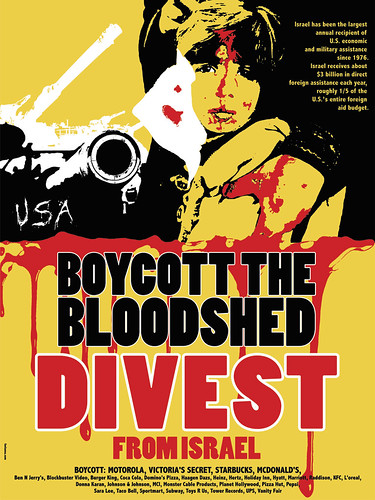
Attention Christmas Shoppers: Top Ten Brands to Boycott

While there are many Israeli and multinational companies that benefit from apartheid, we put together this list to highlight ten specific companies to target. Many of these produce goods in such a way that directly harms Palestinians — exploiting labor, developing technology for military operations, or supplying equipment for illegal settlements. Many are also the targets of boycotts for other reasons, like harming the environment and labor violations.

1. AHAVA

This brand’s cosmetics are produced using salt, minerals, and mud from the Dead Sea — natural resources that are excavated from the occupied West Bank. The products themselves are manufactured in the illegal Israeli settlement Mitzpe Shalem. AHAVA is the target of CODEPINK’s “Stolen Beauty” campaign.

2. Delta Galil Industries

Israel’s largest textiles manufacturer provides clothing and underwear for such popular brands as Gap, J-Crew, J.C. Penny, Calvin Klein, Playtex, Victoria’s Secret (see #10) and many others. Its founder and chairman Dov Lautman is a close associate of former Israeli President Ehud Barak. It has also been condemned by Sweatshop Watch for its exploitation of labor in other countries such as Egypt, Jordan, and Turkey.

motobomb3. Motorola

While many of us know this brand for its stylish cellphones, did you know that it also develops and manufactures bomb fuses and missile guidance systems? Motorola components are also used in unmanned aerial vehicles (UAVs or “drones”) and in communications and surveillance systems used in settlements, checkpoints, and along the 490 mile apartheid wall. The US Campaign to End the Israeli Occupation has launched the “Hang Up on Motorola” campaign.

4. L’Oreal / The Body Shop

This cosmetics and perfume company is known for its investments and manufacturing activities in Israel, including production in Migdal Haemek, the “Silicon Valley” of Israel built on the land of Palestinian village Al-Mujaydil, which was ethnically cleansed in 1948. In 1998, a representative of L’Oreal was given the Jubilee Award by Israeli Prime Minister Netanyahu for strengthening the Israeli economy.

Dorot5. Dorot Garlic and Herbs

These frozen herbs that are sold at Trader Joe’s are shipped halfway around the world when they could easily be purchased locally. Trader Joe’s also sells Israeli Cous Cous and Pastures of Eden feta cheese that are made in Israel. QUIT, South Bay Mobilization, and other groups have targeted Trader Joe’s with a “Don’t Buy into Apartheid” campaign.

6. Estee Lauder

This company’s chairman Ronald Lauder is also the chairman of the Jewish National Fund, a quasi-governmental organization that was established in 1901 to acquire Palestinian land and is connected to the continued building of illegal settlements. Estee Lauder’s popular brands include Clinique, MAC, Origins, Bumble & Bumble, Aveda, fragrance lines for top designers, and many others. They have been the target of QUIT’s “Estee Slaughter Killer Products” campaign.

7. Intel

This technology company that manufactures computer processors and other hardware components employs thousands of Israelis and has exports from Israel totaling over $1 billion per year. They are one of Israel’s oldest foreign supporters, having established their first development center outside of the US in 1974 in Haifa. Al-Awda (the Palestinian Right to Return Coalition) has urged action against Intel for building a facility on the land of former village Iraq Al Manshiya, which was cleansed in 1949.

sabra8. Sabra

This brand of hummus, baba ghanoush and other foods is co-owned by Israel’s second-largest food company The Strauss Group and Pepsico. On the “Corporate Responsibility” section of its website, The Strauss Group boasts of its relationship to the Israeli Army, offering food products and political support.

9. Sara Lee

Sara Lee holds a 30% stake in Delta Galil (see #2) and is the world’s largest clothing manufacturer, which owns or is affiliated with such brands as Hanes, Playtex, Champion, Leggs, Sara Lee Bakery, Ball Park hotdogs, Wonderbra, and many others. Similar to L’Oreal (see #4), a representative of Sara Lee received the Jubilee Award from Netanyahu for its commitment to business with Israel.

10. Victoria’s Secret

Most of Victoria’s Secret’s bras are produced by Delta Galil (see #2), and much of the cotton is also grown in Israel on confiscated Palestinian land. Victoria’s Secret has also been the target of labor rights’ groups for sourcing products from companies with labor violations, and by environmental groups for their unsustainable use of paper in producing their catalogues. That’s not sexy!

top_ten_thumbRemember, it’s also important to let these companies — and the stores that sell them — know that we will not support them as long as they support Israeli apartheid!


Bookmark and Share