Showing posts with label Canadian Human Rights Comission. Show all posts

Saturday, October 17, 2009

Writers call for probe into human rights commission


Ezra Levant and Mark Steyn appeared before the justice committee on Monday, asking for a probe into the Canadian Human Rights Commission. (CBC)

Two writers appeared before the justice committee on Monday, repeating their call for a repeal of a controversial section of the Human Rights Act, and asking for a probe into the Canadian Human Rights Commission.

Ezra Levant and Mark Steyn are also calling for the elimination of Section 13 of the Canadian Human Rights Act, which allows the commission to investigate allegations of hate speech.

"I think a very practical, doable thing for this committee and for Parliament would be to repeal Section 13 of the Human Rights Act altogether, to leave any hate speech prosecutions to the Criminal Code with its proper checks and balances, and frankly, to bring in a forensic audit to the Human Rights Commission to examine the allegations that I have made," Levant told the commission.

Levant is alleging that employees of the commission belong to neo-Nazi organizations, an accusation he made in July in a National Post column.

Some committee members, like New Democrat MP Joe Comartin, seemed incredulous at the accusation.

"I think I like everybody sitting at this table are at some disadvantage, Mr. Levant and Mr. Steyn, in terms of the accusations that you're making against members of the commission and their staff."

Levant offered to give MPs documents to back his accusations and come back to testify once they had read them.

Levant was subject of a complaint to the Alberta Human Rights Commission under the act for reprinting the provocative Danish Muhammad cartoons in his magazine in 2006. He published the controversial cartoons depicting the Prophet Muhammad in the now defunct Western Standard, arguing that they were "the central fact in the largest news story of the month."

A complaint was launched by the Canadian Islamic Congress against Steyn for an article he wrote titled "The Future Belongs to Islam" and posted on the magazine's website in October 2006.

The article, an excerpt of a book authored by Steyn, talks about Islam being a threat to North American institutions and values. It used statistics to show higher birth rates plus immigration mean Muslims will outnumber followers of other religions in Western Europe.

Both complaints were eventually dismissed.

But Levant and Steyn argue that they should not have been investigated in the first place.

Steyn said it is hard to defend against a complaint to the human rights commission.

"Truth is no defence, so you can make a statement, every aspect of which is factually accurate, and if certain people decide they are going to be offended by it, the factual accuracy of that is irrelevant."

Liberal MP Ujjal Dosanjh asked why they were recommending the abolition of Section 13, instead of amending it.

"So you believe there then should be nothing between absolute free speech and the Criminal Code provisions?" he asked.

But Steyn said society can deal with hate speech.

"I prefer social disapproval, activist parents, a school board firing, to a law restricting what individuals can say and think."

Source: CBC.CA


Bookmark and Share

Thursday, September 3, 2009

Canadian Hate Speech Laws Ruled Unconstitutional


The Canadian Human Rights Tribunal on Wednesday ruled that Section 13, Canada's much maligned human rights hate speech law, violates the Charter right to free expression because it carries the threat of punitive fines.

The shocking decision by Tribunal member Athanasios Hadjis leaves several hate speech cases in limbo, and appears to strip the Canadian Human Rights Commission of its controversial legal mandate to pursue hate on the Internet, which it has strenuously defended against complaints of censorship.

It also marks the first major failure of Section 13(1) of the Canadian Human Rights Act, an anti-hate law that was conceived in the 1960s to target racist telephone hotlines, then expanded in 2001 to the include the entire Internet, and for the last decade used almost exclusively by one complainant, activist Ottawa lawyer Richard Warman.

Mr. Warman's first big loss is a victory for the respondent Marc Lemire, webmaster of freeedomsite.org and a prominent figure in the Canadian far right.

Typically for the messy state of Canada's perennial hate speech debate, public reaction to the ruling yesterday was polarized, running the spectrum from glowing praise for the "bold" Mr. Hadjis, to criticism that his "outrageous" conclusion is "vulnerable on judicial review."

All sides seem to agree, however, that the stage is set for pitched battle in federal court, where CHRT rulings can be appealed. Another less likely outcome is for Parliament itself to repeal or amend Section 13, a law that even supporters say needs updating in the age of the Internet.

Neither the CHRC nor Mr. Warman would comment.

"No matter what happens, this decision is going to federal court," Mr. Lemire said. "This is the beginning of the end for Section 13 now. This law is 32 years old. Not a single person has ever won until today. But did I really win? I have given up six years of my life. The process is the punishment."

Mr. Warman, a former investigator for the CHRC, brought a complaint against Mr. Lemire in 2003, after monitoring his website for almost a year. He alleged that postings on the discussion forum, mostly written by others, contravened Section 13 in that they were "likely to expose" identifiable groups to "hatred or contempt." Mr. Warman later urged the CHRC investigators to expand their investigation to other websites he believed Mr. Lemire was involved with, but to "hold off on informing" Mr. Lemire "until the police take a good look at it." No criminal charges were ever filed.

In all but one case, Mr. Hadjis decided that these postings either did not contravene Section 13(1), or that Mr. Lemire cannot be held responsible for what others posted on his website.

Mr. Hadjis found Mr. Lemire violated the law in one case, by posting an article called "AIDS Secrets", written by an American neo-Nazi, which Mr. Hadjis found was "rife with hyperbole and moral condemnation. Homosexuals, and Blacks to a lesser extent, are denigrated as purveyors of a "killer" that is on the loose, agonizingly destroying the lives of American children and adults alike."

Even with this finding, however, Mr. Hadjis declined to make any order against Mr. Lemire. As a statutory tribunal, Mr. Hadjis does not have the legal authority to officially declare a law unconstitutional. But if he finds it would be unconstitutional to enforce it, he can do as he has done, which is to "simply refuse to apply these provisions."

Part of his motivation was that virtually all the offending material was removed either before or shortly after Mr. Lemire received word of the complaint against him.

"Mr. Lemire had not only "amended" his conduct by removing the impugned material, but sought conciliation and mediation as soon as he learned of the complaint against him," Mr. Hadjis wrote. "The problem had thus already been eliminated, yet the complaint continued to be processed."

Section 13(1) remains valid Canadian law, despite this ruling. Its constitutionality was last upheld by the Supreme Court of Canada in a 1990 split decision, before the Internet age.

That decision, about neo-Nazi John Ross Taylor, upheld the law as a justifiable limit on free expression largely because of its remedial, non-punitive purpose. But Mr. Hadjis found that that, today, the law "has become more penal in nature," and this renders it an unjustifiable limit on freedom of expression.

Ever since a 1998 amendment to allow the Tribunal to levy fines up to $10,000 -- payable to the government -- the pursuit of Section 13(1) cases "can no longer be considered exclusively remedial, preventative and conciliatory in nature," he wrote.

He cited Mr. Warman's request for a $7500 penalty against Mr. Lemire. Mr. Warman has won over a dozen other Section 13(1) cases, many leading to similar fines, payments to himself, and legal restrictions on Internet activity.

This criticism about a punitive law masquerading as a remedial one echoes that of Richard Moon, a law professor hired by the CHRC last year to provide an expert analysis of their online hate speech mandate. In essence, his advice was that it could not be done fairly, and so should not be done at all.

Prof. Moon said Wednesday's decision is "obviously a significant moment in the history of Section 13, but it seems like it is in some important sense inconclusive."

He said the ruling has no weight as legal precedent, and could theoretically be ignored by future tribunals, but in practice it is impossible to ignore, and it hints at a fundamental problem with the law.

"As soon as the Supreme Court confirmed that the scope of Section 13 was narrow, and confined to extremely hateful messages, then it was highly unlikely that we were going to have a kind of regular human rights process that involves conciliation between the parties," he said. "That was always something that we could have foreseen."

"We still believe Section 13 is constitutional. There seems to be some major difference of opinion within the Tribunal itself," said Bernie Farber, CEO of the Canadian Jewish Congress, referring to previous constitutional challenges of Section 13 that went the other way.

Marvin Kurz, legal counsel to B'nai Brith, which was an intervenor in this case along with the CJC and others, echoed Mr. Farber's question about why Mr. Hadjis did not simply "read out" the penalty section -- that is, ignore it, but allow the actual hate speech section to stand.

"Not only did he not do it, but he failed to explain why he did not consider the alternative," Mr. Kurz said. "It's like if the police act wrongly in a criminal case, you don't throw out the criminal law. That's what he's done here, and that doesn't make sense to me."

Ezra Levant, a blogger who has led the campaign against human rights hate speech law, said the ruling "shows that the CHRC has been acting illegally for many years," and it forces the Conservative government to make a "new kind of decision" about whether to appeal.

"If they launch an appeal, they are casting their lot with the censors," he said.

Pearl Eliadis, a human rights lawyer and a defender of Section 13, played down the importance of the ruling, and said Mr. Hadjis "just got it wrong. With respect, it's constitutionally not within the normal way that these provisions are dealt with." She said he should have simply ignored the offending penalty section and upheld the law.

Bruce Ryder, a constitutional law professor at York University, said Mr. Hadjis was correct to find that the penalty provision "exacerbated the chilling effect" on freedom of expression. But he said Mr. Hadjis' reasoning "broke down at the end," and he should have simply rejected the penalty provision.

He also wondered how Mr. Lemire was acquitted over the posting of an article that explicitly denied the Holocaust, which he called "outrageous and inconsistent with jurisprudence," and makes the entire ruling "vulnerable on judicial review."

Mark Steyn, a conservative author who was the target of a prominent hate speech complaint over his writing in Maclean's, said Mr. Hadjis' realized "that there is no future for Section 13 because of the damage done to it by the dress-up Nazis of the CHRC and and the sordid racket of Richard Warman."

"It makes explicit that section 13 has no friends," he said.

Source: National Post

Bookmark and Share

Thursday, August 13, 2009

The CHRC is ethically challenged


Recently, Canadian Human Rights Commission chief Jennifer Lynch criticized me for relying on "one source that is full of misinformation," in my parliamentary study of the CHRC ( "Canadians 'misinformed' on hate speech," June 22). It may surprise Ms. Lynch to learn that the source of my "misinformation" is her own commission and its companion body, the Canadian Human Rights Tribunal.

Every question I raised in committee about the lack of due process and an ethics code for commission employees, and the absence of rules of evidence, came from commission and tribunal documents, many of which are currently available on the commission's own website ( www.chrc-ccdp.ca).The transcripts of tribunal hearings provide telling evidence of the wayward approach the commission's investigators take in prosecuting their cases. Recent hearings, such as the Marc Lemire case, have revealed that current CHRC investigator Dean Steacy and former CHRC investigator Richard Warman regularly posted neo-Nazi diatribes under assumed names on white supremacist web-sites. Further, uncontradicted expert evidence presented before the hearing demonstrated that investigator Steacy illegitimately used an unsuspecting private citizen's wireless Internet service to post his offensive comments.

Perhaps not coincidentally, the commission asked the tribunal to exclude the media from the hearing that day. Fortunately, for the sake of accountability, a secret hearing was rejected and we know more about the CHRC's inner workings.

However, other hearings have been held in secret, as Ms. Lynch has admitted, supposedly for the "safety" of a witness but contrary to the ancient right of being able to face one's accuser in court. Indeed, in the ongoing case of beachesboy@aol.comvs. drumsaremybeat@aol.com,the commission hasn't even revealed the identity of the complainant. Interestingly, the commission's website does name the complainant for 12 of the 14 hate speech cases that have come before the tribunal in the last eight years: Richard Warman. Ms. Lynch's deputy appeared before my committee in Parliament recently and admitted that the commission does not have to follow rules of evidence or legal procedure, but merely has "operating procedures" that identify the timelines for addressing complaints. To put that in plain English: defendants have no guarantee of a fair hearing.

A 2003 internal government review of the CHRC found that the commission scored only 2.5 out of five on an ethics test. The review recommended the commission adopt an ethics code, which it has still not done. Given the questionable activities of its investigators, perhaps it is time for Ms. Lynch to revisit this recommendation.

I'll let the readers decide who is "misinformed." - Russ Hiebert is the Conservative Member of Parliament for South Surrey-White Rock-Cloverdale.

Source: The National post

Bookmark and Share

Monday, August 10, 2009

Rein In the Human Rights Bureaucracy


In a column in the National Post Ezra Levant, who has been battling Alberta human rights zealots, identified seven individuals who work for the Canadian Human Rights Commission (CHRC) who also joined neo-Nazi, anti-Semitic, or white hate groups.

It's not that these individuals are Nazi sympathizers or racists who've infiltrated the hallowed halls of human rights activists. They aren't. What they are, are provocateurs, using the Internet to join suspect hate groups in order to collect evidence against them.

In other words, it's a form of entrapment.

Intelligence agents joining (penetrating) a group to assess possible treason or subversion, is vastly different from enticing, provoking or encouraging a racist reaction by pretending to be more extreme than the extremists -- which is what CHRC provocateurs do.

Levant, has been summoned before human rights tribunals (accused of "hate" for publishing Danish cartoons mocking Islamic terrorism), as has Mark Steyn, for exercising free speech, in a book in which he contends the high birthrate among Muslims will change the demographics of western countries.

In both the above cases human rights bureaucrats have looked foolish to despicable -- and have lost credibility among Canadians. At least, one hopes this is the case. The CHRC is, arguably, an often bigoted and unnecessary institution in our country.

As Levant says, "CHRC employees have been active members of neo-Nazi organizations for years, and have published countless anti-Semitic, anti-gay and anti-black comments online." Such as referring to Jews, gays or Muslims as "scum," etc.

Jennifer Lynch heads the CHRC. I took a swipe at her views a while back when she advocated "tolerance and open-mindedness," and then proceeded to show her own intolerance and closed-minded approach, in my view, towards issues she disagrees with.

"Tolerating" views you agree with is not tolerance at all. It's "echoing."

Levant depicts Lynch as cowardly for refusing to appear before a Parliamentary committee.

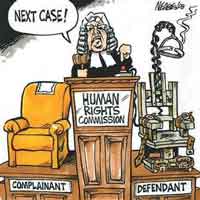
To many (including me) the CHRC is unnecessary and a direct threat to free speech -- a kangaroo court more intent on lynching (no pun intended) than seeking truth or justice.

CHRC investigators likely see themselves as crusaders, exposing suspect or dangerous organizations and gathering evidence to protect society. Hardly.

Canadian democracy is not threatened by white supremacists or anti-Semites.

Democratic countries generally show repugnance toward extremism.

One gets the feeling the CRHC sets up targets to knock down, thereby justifying its existence. For more details on CRHC mischief, try going to the blog ezralevant.com, or other sites giving details about provocateurs pretending to be racists in hopes of catching racists. Try RichardWarman.com or Google Dean Steacy, and see for yourself.

Short of disbanding the CRHC, Section 13 of the Human Rights Act must be scotched. It "empowers the Commission to deal with complaints regarding the communication of hate messages by telephone or on the Internet ... any matter that is likely to expose a person or persons to hatred or contempt by reason of the fact that person or those persons are identifiable on the basis of a prohibited ground of discrimination."

That's pretty broad, especially when the Criminal Code already allows for legal action in many cases where human rights vigilantes seem intent on waging vendettas.

Prime Minister Stephen Harper should rein in the human rights bureaucracy that too often offends the very essence of due process and democracy.

Source: The Toronto Sun

Bookmark and Share

Thursday, July 9, 2009

Canadian Jewish Congress Once Again Caught Creating Events In Order To Achieve Their Ends


A Jewish-Canadian author is in a battle of words with the Canadian Jewish Congress after alleging the organization props up neo-nazi groups to get “hate crime” legislation passed and expand the role of the country’s Human Rights Commission.

Neo-conservative author Ezra Levant claims in his latest book, Shakedown, that the Canadian Jewish Congress hired ex-cop John Garrity to work for the Canadian Nazi Party in the 1960’s. In 1965 and 1966, Garrity was put in charge of membership for the group and organized the dozen or so “rag-tag band of losers” into an outfit that garned a lot of press coverage.

That media attention was used by the CJC to build up a precieved public threat that persuaded Parliament to abridge Canada’s freedom of speech, Levant contends. The CJC, which had been advocating restrictions on free speech in Canada since the 1930’s, used the Nazi Party’s publicity to successfully lobby for the 1971 “hate law” (Section 319 of the Criminal Code). The end result was the enactment of Section 13 of the Canadian Human Rights Act, which “empowers the Canadian Human Rights Commission to deal with complaints regarding the communication of hate messages by telephone or on the Internet.”

Levant’s claim has been floating around for some time now. Garrity came clean in a 1966 article for Maclean’s magazine, admitting that he handed member and donor information over over to the CJC; however, he did not say his final goal was to curtail free speech in Canada.

Garrity did admit that the Canadian Nazi Party did not conspire to or implement any violent or illegal activities. In fact, any violence Garrity saw was done by Jewish and anti-racist vigilantes. “Sadly, it is the [....] anti-Nazi extremists who, in their attempts to destroy Beattie, provide him with most of the publicity he craves. If it weren’t for the riots and the assaults and the public protest meetings they hold, there’d be no real news,” Garrity wrote in his article.

Back in November 2000, former Canadian Nazi Party leader John Beattie was scheduled to testify at a Canadian Human Rights Tribunal that he was a “dupe and a patsy” for the CJC. He was also going to explain how an agent from the CJC (presumably Garrity) “proposed legal maneuvers [sic] that were calculated to frighten and cause distress among Jews.” However, Beattie never testified, a point many have speculated upon.

Levant then contends that some twenty years after the collapse of the Canadian Nazi Party, Canada’s spy agency infiltrated another neo-nazi group, The Heritage Front. CSIS agent Grant Bristow wound up running the now-defunct group, using Canadian tax dollars to foment more hysteria that got Section 13 to expand even further.

The Canadian Human Rights Commission also actively engages in “hate speech” in order to catch and prosecute people for “hate speech,” Levant contends. The biggest offender of such a practice is former CHRC staffer Richard Warman, who has been the complainant in all but two cases heard by the CHRC tribunal this decade. In addition to making tens of thousands of dollars, the CJC bestowed Warman with a special award for his efforts.

The tables were stunningly turned on Warman last month, after the CHRC rebuked Warman for his anti-Semitic postings the White Nationalist website Stormfront.org. Warman defended himself by saying his posts that “Jews are scum” was an attempt to gather information on real Nazis, but the tribunal called his actions “disappointing and disturbing,” and ruled that he risked encouraging

more hateful messages himself.

“Warman’s actions appalled the tribunal, but apparently not the CJC,” says Levant. “Just as the CJC did with Garrity, Nazi opponents continue to stir up neo-Nazi incidents — as if there aren’t enough real threats to Jews as it is.”

Current CJC co-president, Rabbi Reuven Bulka, has dissmissed Levant’s allegations as “fiction” and that all the group did for the Nazis was “to purchase a bottle of rum” for them. Rabbi Bulka wants a retraction to the allegations published in a second printing of Levant’s book.

Source: The Right perspective

Bookmark and Share