Showing posts with label Unconstitutional. Show all posts

Friday, February 5, 2010

Members of Congress Seeking To Gut The First Amendment


Members of Congress Seeking To Gut The First Amendment

In response to the Supreme Court’s ruling in Citizens United, several Democrats on Capitol Hill are advocating a Constitutional Amendment: Democrats in Congress want to amend the U.S. Constitution to say free speech does not extend to corporations in response to the Supreme Court’s decision allowing freer corporate spending in political campaigns.


Bookmark and Share


Saturday, January 30, 2010

The 2010 Census: Beware the State’s Assault on Privacy!


by Gary D. Barnett

The time is near for the national headcounters “SWAT” teams to once again begin their decennial assault on privacy. Some of those neighbors you thought to be decent people will now be hounding you incessantly to extract personal and private information that is none of theirs or the state’s business. Don’t be fooled by their claim that they are just doing their constitutional duty, as nothing could be further from the truth.

Read The Rest Here


Bookmark and Share

Friday, December 11, 2009

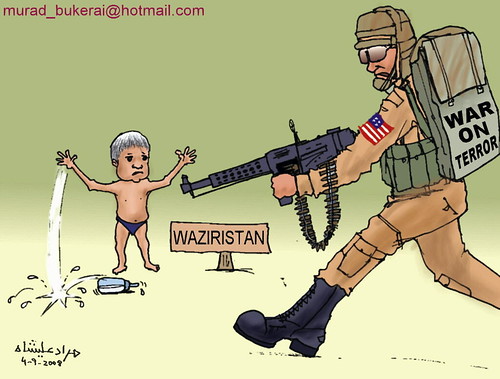
US expands unlawful drone war in Pakistan; violates letter, spirit of all US, UN war laws


The US is at unlawful war with Pakistan, having bombed over 50 sites and killing over 400. the Pakistan government rejects this violation of their nation, but just as the US has no respect for the laws limiting war to a narrow definition of self-defense in Afghanistan, Iraq, rhetoric for more war with Iran, and torture, they have no respect for peace in Pakistan.

Americans receive propaganda in support of US government murder and Crimes Against Peace, such as in this piece from the NY Times that say whatever BS seems most palatable without mentioning US and international law. Other propaganda encourage escalation of this unlawful war. President Obama’s escalation of the unlawful war in Afghanistan will concentrate troops on Pakistan’s border.
Our Founding Fathers warned Americans as stringently as is possible to write that encroachment of law becomes tyranny. Our long-term tax cost for these wars is over $3 trillion, with the US responsible for over a million deaths (and multiples of that number living in such misery and sadness they wish for death).
The war in Pakistan may also have nasty Black Operations attached to it, without oversight, that might include attacks in Pakistan blamed on “terrorists” (and here) to capitulate the government as its objective. The US has a history of overthrowing governments when resources are at stake, such as CIA Operation Ajax that overthrew Iran’s democracy in 1953 when they tried to negotiate oil profits. That coup kept Iran under a US-friendly dictator until 1979. The US followed this "defeat of control" by sponsoring an invasion of Iran from 1980-1988.
So what should we do?
Gandhi and Martin Luther King advocated public understanding of the facts and non-cooperation with evil. I’m among hundreds who advocate:
  1. Understand the laws of war. These were legislated after WW2 and are crystal-clear that only self-defense, in a narrow legal meaning, can justify war. This investment of your time takes less than an hour and empowers you to legally stand for ending these Wars of Aggression.
  2. Refuse and end all orders and acts associated with these unlawful wars. Those involved with US military, government, and law enforcement have an oath to protect and defend the US Constitution. Unlawful acts only move forward with sufficient cooperation and public tolerance. Stop cooperating with the most vicious crime a nation can commit: war. Stop tolerating it.
  3. Prosecute the war leaders for obvious violation of the letter and spirit of US war laws. You can only understand how these wars are specifically unlawful by investing the time to do so. Because the crimes are so broad and deep, I recommend Truth and Reconciliation (T&R) to exchange full truth and return of stolen US assets for non-prosecution. This is the most expeditious way to understand and end all unlawful and harmful acts. Those who reject T&R either by volunteering their name and/or responding when named are subject to prosecution after the window of T&R closes.
Following is the 10-mnute video from PuppetGov: Obama and the War Criminals. It's outstanding; please share it.
As always, please share this article with all who can benefit. If you appreciate my work, please subscribe by clicking under the article title (it’s free). Please use my archive of work to help build a brighter future.


Bookmark and Share

Wednesday, December 9, 2009

Kent State Dean Criticizes Campus Speech Policies: 'Your First Amendment Rights End Where Somebody Else's Sensitivity Begins


In the enactment, enforcement, and defense of unconstitutional and illiberal campus policies, the dirty work often falls to the various deans of academic and student affairs. Depressingly, FIRE all too often sees administrators who hold disciplinary influence over their students acting on the mistaken idea that students have the right not to be offended or have their views challenged. Too often, administrators simply condone the false sense of entitlement this idea breeds, protecting feelings instead of protecting serious argument and incisive parody.

Mark Weber, Dean of Library and Media Services at Kent State University in Ohio, is a notable exception. He takes aim at the sacred cows of "sensitivity" and "civility" in a recent newsletter article, "None Dare Call It Censorship." In the article he also discusses the various ways FIRE has been combating campus ills since 1999.

In particular, Weber focuses on how a culture of censorship is often encouraged by universities' harassment policies, which "pay lip service to academic freedom and the right of the individual to free speech" but restrict speech anyway in the name of "civility" or "sensitivity." Moreover, the policies often "establish the alleged victim's sensitivity as the standard to determine if the tenets of the policies' restrictions on freedom of speech have been violated." In other words, these policies often rely on a subjective standard alone, not an objective standard, to determine whether harassment really occurred. Torch readers can read the rest of Weber's article here.

FIRE is always pleased to see an academic leader who won't stand for such restrictive policies. We are here to support administrators who are ready to defend free speech and remedy the deficiencies in their own schools' policies. We encourage administrators to examine our new, short handbook, Correcting Common Mistakes in Campus Speech Policies, free online in HTML and PDF form.

Source: FIRE
Bookmark and Share

Monday, December 7, 2009

Five Good Reasons to Avoid a War with Iran


As America's founding fathers clearly understood war is a serious business and should only be engaged in when there is a threat to vital national interests. The US Constitution stipulates that there must be a declaration of war from congress, a safeguard inserted in the document to prevent presidents from going to war without a clear national consensus behind them. Nevertheless, even though the federal government has fought many wars in the past hundred years only two were preceded by an actual declaration by Congress, World War I and World War II. Every other war has been both illegal and unconstitutional, including the current involvement in Iraq, Afghanistan, and on various fronts in the so-called global war on terror. Given this legacy of nearly constant and unconstitutional conflict, another Middle Eastern war would only confirm in the minds of many that the United States has become a rogue nation, continuously at war as if it were a natural state. It would also increase concerns that Washington is committed to an expanding confrontation with the Muslim world, a perception, true or false, that can only have bad consequences for the American people.


Read The Rest Here


Bookmark and Share

Friday, December 4, 2009

Sprint’s 50 Million Customers Have Been Geo-Tracked 8 Million Times–in the Last Year


Chris Soghoian caught a remarkable admission at a surveillance conference in October. Sprint’s Manager of Electronic Surveillance revealed that law enforcement has used Sprint’s geotracking function 8 million times in the thirteen months prior to his comment.

Sprint Nextel provided law enforcement agencies with its customers’ (GPS) location information over 8 million times between September 2008 and October 2009. This massive disclosure of sensitive customer information was made possible due to the roll-out by Sprint of a new, special web portal for law enforcement officers.

The evidence documenting this surveillance program comes in the form of an audio recording of Sprint’s Manager of Electronic Surveillance, who described it during a panel discussion at a wiretapping and interception industry conference, held in Washington DC in October of 2009.

[snip]

[M]y major concern is the volume of requests. We have a lot of things that are automated but that’s just scratching the surface. One of the things, like with our GPS tool. We turned it on the web interface for law enforcement about one year ago last month, and we just passed 8 million requests. So there is no way on earth my team could have handled 8 million requests from law enforcement, just for GPS alone. So the tool has just really caught on fire with law enforcement. They also love that it is extremely inexpensive to operate and easy, so, just the sheer volume of requests they anticipate us automating other features, and I just don’t know how we’ll handle the millions and millions of requests that are going to come in.

Now, as he documents in extensive detail, using cell phone location to get the geolocation of someone is just one of a number of uses of legal surveillance techniques that is eluding public reporting.

But that’s by design. Even assuming many of these uses of Sprint’s geo-tracking capabilities are multiple requests for the same person, there are a whole lot of people whose physical location is being tracked.

Probably a bunch of people who bought acetone and hyrdogen peroxide for home improvement uses.

Anyway, click through for a bunch more numbers and discussion, as well as MP3s of this admission.

Source: Orwell's Dream


Bookmark and Share

Is Obama Really Hypocritical on Signing Statements? Yup.


Was I unfair in calling Barack Obama “hypocritical” in issuing his (otherwise sensible and constitutional) signing statements last week? Hypocrisy is a strong charge. On the other hand, Obama explicitly denounced the “theory of George Bush that he can make laws as he is going along” by using signing statements and then flatly promised not to use any such statements when in office. See for yourself.


So maybe hypocrite is not so hyperbolic in this context. Is there any defense for Obama? Not really.

It is true that his entire OLC team has been on the record in favor of certain signing statements and the President’s power to ignore unconstitutional statutes. On the other hand, a high-profile ABA Task Force, including folks like Harold Koh and Kathleen Sullivan, did categorically denounce ALL signing statements of the kind that President Obama recently produced (he’s already got six so far, about one per month). The ABA as a whole has adopted the report and ABA Presidents routinely denounced President Bush’s use of such signing statements as “contrary to the rule of law” and ignoring “fundamental principles” of separation of powers. (In other words, they sounded like Obama used to, before he became President). Charlie Savage of the NYT won a Pulitzer for writing about Bush’s supposedly abusive use of signing statements during the Bush era. Will this same crowd go after President Obama as well? Well, four days have passed (and four months have passed since Obama’s first signing statements back in March as John Elwood at Volokh has documented) and, as far as I can tell, Koh, Sullivan, and the ABA remain mum.

Source: Opinio Juris

Bookmark and Share

Thursday, December 3, 2009

Romanian Constitutional Court decision against data retention


The decision of the Romanian Constitutional Court (CCR) against the data retention law was finally published in the Official Monitor on 23 November 2009.

The motivation of the court, which was made public only with a few days before its publication in the Official Monitor, shows an interesting argument from a Court with no prior jurisprudence in the field of privacy protection. Thus, the court not only criticizes several aspects of the text of the law, but declares the whole law as unconstitutional because it breaches the right to corespondence and to privacy.

Even though only several articles were mentioned in the motion of unconstitutionality, the Court went further and examined art 20 of the law that could have been interpreted as an open door for the secret services to access the retain data under any circumstances and without a judicial approval, an issue that was raised by EDRi-member APTI starting with the public consultations in 2007.

CCR notes that the principle of limited collection of personal data is emptied through this new regulation that obliges a continuos retention of traffic data for 6 month."The legal obligation that foresees the continuous retention of personal data transforms though the exception from the principle of effective protection of privacy right and freedom of expression, into an absolute rule. The right appears as being regulated in a negative manner, its positive role losing its prevailing character."

CCR also makes a comparison with article 91^1 of the Penal Procedure Court (CPP) dealing with audio and video interceptions in crime cases, that was considered constitutional in an earlier ruling. The text of the CPP allows the video interception only in a specific case and person, only with judicial supervision, only for the future and for a period that may not exceed 120 days under any circumstances . The Court concludes that basically, this data retention law deletes the right to privacy in terms of electronic communications: "Therefore, the regulation of a positive obligation that foresees the continuous limitation of the privacy right and secrecy of correspondence makes the essence of the right disappear by removing the safeguards regarding its execution."

The court is underlining the fact, already pointed out by European civil organizations even during the adoption of the data retention directive, that the law considers all citizens as potential criminals: "This (data retention) equally addresses all the law subjects, regardless of whether they have committed penal crimes or not or whether they are the subject of a penal investigation or not, which is likely to overturn the presumption of innocence and to transform a priori all users of electronic communication services or public communication networks into people susceptible of committing terrorism crimes or other serious crimes."

Finally, the court quotes the ECHR case of Klass and others vs Germany (1978) considering that "taking surveillance measures without adequate and sufficient safeguards can lead to 'destroying democracy on the ground of defending it .'"

According to art 147 of the Romanian Constitution, the legal provisions on data retention are now suspended. The Government and Parliament have 45 days to "fix" the unconstitutional provisions. But taking into consideration the CCR reasoning, there are little chances that any text that would ask for a six month blanket data retention would be considered as constitutional in Romania. Moreover, there is currently only an interim government and a new one is unlikely to appear in the next weeks (at least not until the second round of presidential election, which is scheduled for 6 December).

Constitutional Court Decision no 1258 of 8 October 2009 (unofficial English translation, 23.11.2009)
http://www.legi-internet.ro/english/jurisprudenta-it-romania/decizii-i...

Constitutional Court Decision no 1258 of 8 October 2009 (only in Romanian, 23.11.2009)
http://www.ccr.ro/decisions/pdf/ro/2009/D1258_09.pdf

APTI's comments on draft data retention law (only in Romanian, 9.05.2007)
http://www.apti.ro/webfm_send/24

Romania: Data retention law declared unconstitutional (21.10.2009)
http://www.edri.org/edrigram/number7.20/romania-data-retention-law-unc...

Art 147 of the Romanian Constitution
http://www.cdep.ro/pls/dic/site.page?den=act2_2&par1=5#t5c0s0a147


Source: European Digital Rights

Bookmark and Share

Tuesday, December 1, 2009

The case against military tribunals


It's a violation of the Constitution to use the panels without a declaration of war -- and just calling it a 'war' on terror doesn't count.


In the uproar caused by Atty. Gen. Eric H. Holder Jr.'s announcement that the alleged planners of the 9/11 attacks are to be tried in U.S. District Court in New York City, and the suspects in the attack on the U.S. destroyer Cole will go on trial before military tribunals at Guantanamo Bay, Cuba, the public discourse has lost sight of the fundamental principles that guide the government when it makes such decisions. Unfortunately, the government has lost sight of the principles as well.

When President George W. Bush spoke to Congress shortly after 9/11, he did not ask for a declaration of war. Instead, Republican leaders offered and Congress enacted an Authorization for the Use of Military Force. The authorization was open-ended as to its targets and its conclusion, and basically told the president and his successors that they could pursue whomever they wanted, wherever their pursuits took them, so long as they believed that the people they pursued had engaged in acts of terrorism against the United States. Thus was born the "war" on terror.

Tellingly, and perhaps because we did not know at the time precisely who had planned the 9/11 attacks, Congress did not declare war. But the use of the word "war" persisted nonetheless. Even after he learned what countries had sponsored terrorism against us and our allies with governmental assistance, Bush did not seek a declaration of war against them. Since 9/11, American agents have captured and seized nearly 800 people from all over the globe in connection with the attacks, and now five have been charged with planning them.

Virtually all of those seized who survived interrogation have been held at Guantanamo Bay. Bush initially ordered that no law or treaty applied to these detainees and that no judge could hear their cases, and thus he could detain whoever he decided was too risky to release and whoever he was satisfied had participated in terrorist attacks against the U.S. He made these extra-constitutional claims based, he said, on the inherent powers of the commander in chief in wartime. But in the Supreme Court, he lost all five substantive challenges to his authority brought by detainees. As a result, some detainees had to be freed, and he and Congress eventually settled for trying some before military tribunals under the Uniform Code of Military Justice and subsequent legislation.

The casual use of the word "war" has lead to a mentality among the public and even in the government that the rules of war could apply to those held at Guantanamo. But the rules of war apply only to those involved in a lawfully declared war, and not to something that the government merely calls a war. Only Congress can declare war -- and thus trigger the panoply of the government's military powers that come with that declaration. Among those powers is the ability to use military tribunals to try those who have caused us harm by violating the rules of war.

The last time the government used a military tribunal in this country to try foreigners who violated the rules of war involved Nazi saboteurs during World War II. They came ashore in Amagansett, N.Y., and Ponte Vedra Beach, Fla., and donned civilian clothes, with plans to blow up strategic U.S. targets. They were tried before a military tribunal, and President Franklin D. Roosevelt based his order to do so on the existence of a formal congressional declaration of war against Germany.

In Ex Parte Quirin, the Supreme Court case that eventually upheld the military trial of these Germans -- after they had been tried and after six of the eight defendants had been executed -- the court declared that a formal declaration of war is the legal prerequisite to the government's use of the tools of war. The federal government adhered to this principle of law from World War II until Bush's understanding of the Constitution animated government policy.


The recent decision to try some of the Guantanamo detainees in federal District Court and some in military courts in Cuba is without a legal or constitutional bright line. All those still detained since 9/11 should be tried in federal courts because without a declaration of war, the Constitution demands no less.

That the target of the Cole attackers was military property manned by the Navy offers no constitutional reason for a military trial. In the 1960s, when Army draft offices and college ROTC facilities were attacked and bombed, those charged were quite properly tried in federal courts. And when Timothy McVeigh blew up a federal courthouse in Oklahoma City; and Omar Abdel Rahman attempted in 1993 to blow up the World Trade Center, which housed many federal offices; and when Zacarias Moussaoui was accused in the 9/11 attacks,all were tried in federal courts. The "American Taliban," John Walker Lindh, and the notorious would-be shoe bomber, Richard Reid, were tried in federal courts. Even the "Ft. Dix Six," five of whom were convicted in a plot to invade a U.S. Army post in New Jersey, were tried in federal court. And the sun still rose on the mornings after their convictions.

The framers of the Constitution feared letting the president alone decide with whom we are at war, and thus permitting him to trigger for his own purposes the military tools reserved for wartime. They also feared allowing the government to take life, liberty or property from any person without the intercession of a civilian jury to check the government's appetite and to compel transparency and fairness by forcing the government to prove its case to 12 ordinary citizens. Thus, the 5th Amendment to the Constitution, which requires due process, includes the essential component of a jury trial. And the 6th Amendment requires that when the government pursues any person in court, it must do so in the venue where the person is alleged to have caused harm.

Numerous Supreme Court cases have ruled that any person in conflict with the government can invoke due process -- be that person a citizen or an immigrant, someone born here, legally here, illegally here or whose suspect behavior did not even occur here.

Think about it: If the president could declare war on any person or entity or group simply by calling his pursuit of them a "war," there would be no limit to the government's ability to use the tools of war to achieve its ends. We have a "war" on drugs; can drug dealers be tried before military tribunals? We have a "war" on the Mafia; can mobsters be sent to Gitmo and tried there? The Obama administration has arguably declared "war" on Fox News. Are Glenn Beck, Bill O'Reilly and I and my other colleagues in danger of losing our constitutional rights to a government hostile to our opinions?

I trust not. And my trust is based on the oath that everyone who works in the government takes to uphold the Constitution. But I am not naive. Only unflinching public fidelity to the Constitution will preserve the freedoms of us all.

Andrew P. Napolitano, a former judge of the Superior Court of New Jersey, is the senior judicial analyst at the Fox News Channel. His next book is "Lies the Government Told You: Myth, Power, and Deception in American History."

Source: LA Times

Bookmark and Share

United against the state


There is a new alliance between the left and right in America, inspired by the threat to liberty – can the same happen here?

The New York Times has revealed an interesting new alliance between US conservatives and liberals that has formed against the criminalisation of the public by a slew of vaguely drafted criminal laws, brought in by the federal government.

Given the rancour in the American public discourse, the two sides making common ground on this issue is truly a "remarkable phenomenon," as the director of the National Association of Criminal Defense Lawyers, Norman Reimer, put it.

The left and right have bent to a point where there is now agreement on many issues. In the area of criminal justice, the whole idea of less government, less intrusion, less regulation has taken hold.

Both sides seem to blame each other for the trend of punitive laws, the implications of which few seem to understand. Still, the new consensus is important and one hopes something similar is emerging here.

Liberals blame the climate created by the Bush administration, while someone like Edwin Meese, arch conservative and attorney general under President Reagan, suggests that "liberal ideas of extending the power of the state" were to blame for an out-of-control criminal justice system. "Our tradition has always been," he said, "to construe criminal laws narrowly to protect people from the power of the state."

The right-wing Heritage Foundation, where Meese was speaking, suggests that there are some 4,400 criminal offenses in the federal code, which lack a requirement that the prosecution proves traditional criminal intent.

This chimes with the 3,000 new criminal offences created by Labour in Britain, sometimes by statutory instruments that go undebated in parliament, and especially of the erosion of the important legal concept of innocence.

On both sides of the Atlantic, a generation of politicians grew up in the incredibly tolerant conditions of the sixties and seventies but then displayed a surprising authoritarian streak when they came to power. The rebels of the permissive age often began to imitate the disciplinarian traits of an older generation but – oddly – without showing its reflex respect for liberty.

In Britain, a supposedly left government kept in step with a decidedly right-wing government in the United States, but is that really so surprising? When you dig deep into the political instincts of people like Blair, Blunkett, Clarke, Straw and Reid what you find are the trace elements of neo-conservatism, as well as the more frequently identified statism of their youthful creed. New Labour was a distinctly odd hybrid, fashioned by people with an ideological past for an age where few cared about the details of politics as long as they could spend.

We are at a different moment now and it will be interesting to see what James Purnell says about personal power at a Demos event this week because of course the whole drive of the government which he belonged to has been to remove power from the individual in favour of the state. This is something which has to be admitted by people like Purnell before Labour's rehabilitation can begin.

Something of an alliance is beginning to form here but it is perhaps less organised and activist. I often find myself joining progressive and conservative politicians on platforms to talk about the erosion of civil liberties and the growth in state power. To be honest, it would be hard pressed to slide a piece of paper between Tony Benn and David Davis on so many of these issues, or for that matter Sir Ken Macdonald and Dominic Grieve. This is because one of the great divides in our post-ideological politics is now about the power of the state. Do you trust the state and give it every sort of power at the expense of parliament and the people, or do you believe that increasing state powers are not just a menace to individual liberty but a cast-iron guarantee of bad government?

This is one of the core issues of the next election and it needs to be much better articulated by the opposition parties. One of the duties of the next government must be to repeal many of the badly drafted laws brought in during the last 12 years as well doing away with established opinion that increasingly holds that we are all potentially criminals; that we all have something to hide. "Show me the man," said Stalin's head of police Lavrenty Beria, "and I'll find the crime." It's strange to discover a noted liberal lawyer from Boston, Harvey Silverglate quoting this at the beginning of a talk about his new book, Three Felonies a Day: How the Feds Target the Innocent, but it is the measure of the times on both sides of the Atlantic that democrats on the left and the right can shake their heads at what has been allowed to happen.

Source: The Guardian

Bookmark and Share

Monday, November 30, 2009

Why do you trust government? Have you no Patriotism?

"Government is not reason; it is not eloquence. It is force. And force, like fire, is a dangerous servant and a fearful master." George Washington


All of the abuses listed in the video are real. Bush created them, and Obama has now moved to extend and expand those abuses. Rest assured, more are on the way, and many are here that we do not even know about.

ON WHAT GROUNDS DO YOU INSIST ON PUTTING YOUR "BLIND TRUST" IN GOVERNMENT, ITS REPRESENTATIVES, OR BUREACRACIES AND AGENCIES? How do you go on claiming patriotism and quoting the founding fathers, while you ignore the numerous and repetitive warnings from them to keep government under an ever vigilant watchful eye? Do I think that every individual in government is bad? Of course not. However, we seem to fail to realize that government is a beast ever yearning to grow all-powerful, despite the intentions of those who make up its many offices. As history shows, governments always find their way to that end.

Sadly, it is partisanship and media-created cults of personality that largely facilitate this. I sincerely hope that you all wake up and consider the consequences of letting your emotions lead your politics. Thanks to this, and the other half of Americans asleep in front of American Idol, we now serve a fearful master.

Having given this some thought, and upon reflection of the founding fathers quotes concerning government, I have this to say:

Why do you insist on seeing government as a benign force, especially if your guy is in office? It is a creature of such an untrustworthy nature, that it must be set into bondage and bound in chains at the very moment of its birth. If at any time during its life it becomes freed of those chains, it will most assuredly set about on a horrible path, destroying everything that is good and just, continuing on until, having destroyed society and freedom, it ultimately destroys itself.
Bookmark and Share

Bearing False Witness


Ever wonder how politicians like Harry Reid can say, with a straight face, that the United States income tax is a “voluntary” tax? Here is a video of Mr. Reid explaining how the US tax system is voluntary. Mr. Reid is no dummy. He knows what he is talking about. He is speaking the truth. He is just not telling the whole truth. The whole truth, which Mr. Reid will not share with us plebes, is there that the US income tax system is a voluntary system, but it begins with employers “voluntarily,” under the threat of draconian federal fines and imprisonment, saying false things about their employees. If you are an employer and refuse to lie about your employee to the IRS , you could be imprisoned. That is how voluntary it is. To truly understand Mr. Reid’s voluntary system, it is important to first recognize that the Internal Revenue Code is a statute. Statutes are positive, man-made, law. In evaluating the rights and obligations of individuals under positive, man-made statutes, words and definitions are vitally important. For example, if the definition of “employee” in the Code was “green bananas,” and you are an employer who has 40 hard-working, honest employees but no green bananas on your payroll, you have no employees as defined by the Code. To employ a more nuanced example, if the Code defined employee as “a person of American Indian descent,” only the poor Native American on the payroll would be an employee as defined by the Code. The other 39 non-Native American employees would not be Code-defined employees. The IRS, through its 3 million-word Code, successfully compels employers to “voluntarily” withhold income from their employees and pay it to the federal government and further compels them to file year-end W-2 and 1099 statements claiming that their employees’ income derives from federally taxable activities. Even though millions of employers do this every quarter, the question remains, are all these employees “green bananas” (individuals whose income derives from federally taxable activities) as defined by the Code? The Code of course provides a powerful incentive, fines and imprisonment, if employers fail to tell the IRS that their employee is a green banana subject to the federal income tax. So here’s how Mr. Reid’s voluntary system works. The withholding provisions that apply to workers are found in chapters 21 and 24 of the Code. For instance, in chapter 24, Section 3402, entitled “Income tax collected at source,” requires all “employers” who pay “wages” to “employees” to withhold a percentage of those wages and send them to the federal government. Section 3402 requires all “employers” paying “wages” to withhold from those wages a percentage of those wages as determined by Treasury Secretary (and failed tax protestor) Timothy Geithner: § 3402. Income tax collected at source (a) Requirement of withholding (1) In general Except as otherwise provided in this section, every employer making payment of wages shall deduct and withhold upon such wages a tax determined in accordance with tables or computational procedures prescribed by the Secretary. If, after reading the foregoing section, an employer is not sufficiently persuaded to deduct money from his employee’s paycheck and send it to the federal government, the Code provides a panoply of incentives. Section 7201 threatens to fine (up to $500,000) and imprison (up to 5 years) any employer who willfully tries to evade “or defeat” any tax imposed by the Code. That’s right, defeat. If an employer reads the Code and willfully fights to “defeat” it with things like truth and sound arguments, it could be a crime. Land of the free? Home of the brave? More like, speak up and they will throw you in the clink. In addition, section 6662 threatens to fine an employer who underwithholds or fails to withhold. So the Code provides employers with strong incentive to tell the IRS that their employees are “employees” as defined by the Code and that their wages are “wages” as referenced in section 3402. So what, you might ask. What is untruthful about any of that? Or you may be one of those who thinks that all tax protestors, including the brave and intelligent Irwin Schiff, father to Austrian economist and candidate for Senate Peter Schiff, are simply skinflint crackpots. They should just shut up and pay their fair share to abet the killing of Third World brown people and bail out silk-stocking Wall Street bankers. After all, everyone knows that we are all obligated to pay federal income taxes and also knows that things like roads, bridges and police did not exist before the 1913 Fabian Socialist income tax. Here is the rub. The most relevant, most important definitions of “green bananas” (the people whose activities are subject to the withholding called for in 3402), the definitions of “employee” and “wages”, are also contained in chapter 24, subtitle C of the Code, in section 3401. Here is where an employer can discover whether any of their employees are actually “employees” as referenced in section 3402, and whether these employees’ pay actually qualifies as the “wages” subject to the withholding mandated under section 3402: (a) Wages For purposes of this chapter, the term “wages” means all remuneration (other than fees paid to a public official) for services performed by an employee for his employer, including the cash value of all remuneration (including benefits) paid in any medium other than cash; The definition of wages begs the question, “who is an employee”? The answer is also found in section 3401: (c) Employee For purposes of this chapter, the term “employee” includes an officer, employee, or elected official of the United States, a State, or any political subdivision thereof, or the District of Columbia , or any agency or instrumentality of any one or more of the foregoing. The term “employee” also includes an officer of a corporation. Pretty narrow definition. Clearly doesn’t include any free market employee. Strange, but true. In future pieces I will discuss the history and development of the Code. So you see, when Mr. Reid says that the income tax system is voluntary, what he means is that employers, after reading section 3402 and perhaps reading the narrow definitions of wages and employees in section 3401, and finally reviewing the draconian sanctions under sections 7201 and 6662, “voluntarily” send a portion of their employees’ paychecks to the IRS and further provide the IRS with W-2’s and 1099’s reporting that their employees (regardless of whether or not they are in fact employed by the federal government or otherwise engaged in any federally taxable activities) have earned taxable wages. The poor free market employer is therefore coerced by the IRS into falsely informing the IRS that his free market employee is an employee as defined by section 3401(c). This is how Mr. Reid’s voluntary system starts, with a false employer statement that effectively throws employees down an IRS rabbit hole where the fundamental rights contained in the Fourth Amendment and Fifth Amendment do not exist. Innocent employees, unschooled in statutory construction, uneducated in the history of law, logic and often grammar, are faced with the choice of fighting an 800 pound gorilla or living a life of quiet desperation. Those who do fight, like Irwin Schiff, end up political prisoners at 81 years old, having done nothing but attempt to expose a coercive and violent fraud. Libertarians and Austrian economists are not surprised to learn that the current withholding system, clearly theft based on coerced false statements, was the WWII brainchild of Chicago school monetarist Milton Friedman along with members of the Federal Reserve-cheerleader Brookings Institution, the US Senate and the US Treasury. The issue gets even more interesting, however, because the Rubik’s Cube-complex Code contains thousands of definitions, even some broader, all-encompassing definitions of “employer” and “employee,” particularly in section 3121, Subtitle C, Chapter 21 relating to FICA and FUTA insurance withholding. See, e.g. 26 U.S.C. § 3121(b) (employer defined for purposes of FICA and FUTA taxes) and § 3121(d)(2) (employer defined for purposed of FICA and FUTA taxes). Even these broad definitions, however, harmlessly fall to the floor like the angry bullets aimed at Neo in the Matrix when met with other definitions, also in section 3121, that appear to be purposely drafted to miss their target: (e) State , United States , and citizen For purposes of this chapter— (1) State The term “State” includes the District of Columbia , the Commonwealth of Puerto Rico , the Virgin Islands , Guam , and American Samoa . (2) United States The term “ United States ” when used in a geographical sense includes the Commonwealth of Puerto Rico , the Virgin Islands , Guam , and American Samoa . An individual who is a citizen of the Commonwealth of Puerto Rico (but not otherwise a citizen of the United States ) shall be considered, for purposes of this section, as a citizen of the United States . 26 U.S.C. § 3121(e). Applying all of the definitions contained in sections 3121, it is clear that FICA and FUTA insurance taxes apply to each and every and all kinds of employment relationships, but only in Samoa . Nowhere does section 3121 define or reference any of the 50 States. You can search the Code for yourself here. It is therefore fair to say that Mr. Reid’s income tax is a voluntary system that begins with employers lying about their employees and their taxable income and further that the insurance withholding (FICA and FUTA) provisions in the Code have no “geographical” application within the 50 sovereign states and that non-government, free market employers within the 50 States who pay FICA and FUTA withholding to the IRS do so “voluntarily” in spite of the very clear and very narrow definition of both “State” and “United States” contained in section 3121. Just being patriotic, I guess. Wow, that Irwin Schiff sure is a nutbar, huh? Who would be so silly to go to prison for revealing a truth that could crash the empire and set free future generations? But don’t try this at home, kids. Peter Hendrickson, author of Cracking the Code, tried to present these arguments in a criminal trial in Michigan in October of 2009. The judge in Mr. Hendrickson’s case refused to allow Mr. Hendrickson to provide the jury with access to the actual statutes so the jury could read the law themselves. The judge apparently believes that the plain language of these statutes might confuse the jurors. Welcome to the USSA.Source: Strike At The Root
Bookmark and Share

Friday, November 6, 2009

Why the hate-crime law weakens our country


President Barack Obama has signed into law the Hate Crimes Prevention Act. Actually, he signed into law the 2010 National Defense Authorization Act, which included the hate-crime legislation.

Sen. Harry Reid slipped the hate-crime legislation into the defense authorization bill to avoid having to have senators consider the controversial bill on its own.

It's for good reason that Democratic legislators wanted to hide under a rock while passing this terrible piece of legislation. It may help them with the far-left wing of their party. But weakening and damaging our country is not something to be proud of. And that is exactly what this new law does.

The bill adds on extra penalties to violent crimes when it is deemed they were motivated by gender, sexual orientation or disability. It's the first major expansion of hate-crime legislation originally passed in 1968, targeted then to crimes aimed at race, color, religion and national origin.

After signing this new law, Obama celebrated it by saying that in this nation we should "embrace our differences."

But law isn't about embracing our differences. It is about providing equal and nonarbitrary protection to all citizens.

Equal protection for every individual American under the law is what the Fourteenth Amendment to our Constitution, passed after the Civil War, guarantees. That this nation takes this guarantee seriously – that there are no classes of individuals that are treated differently under the law – has been a justifiable obsession of blacks.

A society in which all life is not valued the same, where murder of one citizen is not the same as murder of another citizen, is a horror which black Americans have known too well.

So it is a particular irony that this major expansion of the politicization of our law has been signed by our first black president.

What could it possibly mean that the penalty for the same act of violence – for murder – may be different depending on what might be deemed to be the motivation?

Can you imagine a football game where the penalty for roughing the passer is 20 yards rather than 15 if the referee concludes that the violence perpetrated was motivated because the quarterback was homosexual?

Is it not a sign of our own pathology that we now have codified that it is worse to murder a homosexual than someone who has committed adultery, even with your husband or wife, or who has slandered or robbed? Isn't the point murder?

It should be clear that hate-crime legislation has nothing to do with improving our law but rather with creating favored political classes. This should be hateful to everyone who cares about a free society – particularly to those, such as blacks, who have been so victimized by politicization of law.

The social breakdown that produces the disproportionate violence in black America is the product of the same moral relativism and politicization of law that has produced hate-crime bills.

We already have a source that instructs against murder and to love your neighbor as yourself. But this has been banned from our schools and our public spaces. So once again, in what is becoming our godless nation, we mistake the disease for the cure.

Source: The Dallas Morning News


Bookmark and Share

Thursday, November 5, 2009

The Case for Treason: Has our Government grown Despotic?


(originally posted in July)

We are living in dangerous, uncertain times. The economic collapse deepens each day, wars are raging all around us, terrorism is now a household word in America, flu pandemics are being declared, and under the influence of all of these concerns, government is tightening the bands around our civil liberties in a most permanent way. The question is, "how much is too much?"

This is somewhat of a complex problem. It is my greatest hopes that many of you will read this entire article, and take the time to digest what I put forth here. I believe that it was inevitable that our government become tyrannical. The permission we have given to our politicians has created a class of citizens above ourselves. This has happened quite contrary to the idea that these very citizens now placed above us, who run our country on their own whims and in secrecy from us, were intended to be our servants.

The one protection put into the Constitution to prevent this from fully happening was the Bill of Rights. It is IMPERITIVE that we understand that those first ten amendments were the result of the bickering and outright opposition raised by the anti-federalists during the Constitutional debates in 1788. The anti-federalists argued that there were no provisions that would effectively secure the individual rights of Americans in the original Constitution. The resultant ten amendments outline our precious individual rights, and only in conjunction with each other do those rights prevent government from growing fully despotic. That is why there is major cause for alarm today as we see these civil rights being legislated away in Congress and abused on the streets.

During those debates surrounding the ratification of the Constitution in 1788, many voices were heard in favor of, and opposing this radical new government that would govern the United States. One of the loudest voices of opposition was Patrick Henry. It is not that he was not loyal to America, no, not in the least. In fact, his opposition was based upon his very dedication to liberty and freedom. It was in the designs of our then forming government that Henry seen the makings of despotism. If we take a close look at a few points made by Henry, and compare them to our modern dilemma, we can see not only how correct his concerns were, but how factually prophetic they have become.

Most telling of these speeches was the one made by Patrick Henry on June 5, 1788. He objected to the overreaching authority of the proposed federal government specifically because he feared the abuse of power by our Representatives.

"But we are told that we need not fear, because those in power being our Representatives, will not abuse the powers we put in their hands: I am not well versed in history, but I will submit to your recollection, whether liberty has been destroyed most often by the licentiousness of the people, or by the tyranny of rulers? I imagine, Sir, you will find the balance on the side of tyranny."

Henry could envision the flaws in a Representative democracy based upon the inevitability of men to become corrupt. Do we not see this today? Yes, we certainly do. Our Representatives, many of whom have been in Washington for three or four decades, repeatedly deny our voices any merit. They pass massive bills without even reading them. They alter bills at the last minute before votes. They attach amendments to bills that are completely unrelated, (such as the current unConstitutional Hate Crimes bill being attached to the "must pass" Defense Fund bill for 2010.) They propose, and often pass, bills that fly in complete defiance to the Constitution and Bill of Rights (Patriot Act, Military Commissions Act, John Werner Act, and proposed H.R. 45, H.R. 2159, H.R. 2647, Cap and Trade, etc.) The nation's people screamed in opposition to the "bail outs", yet they overwhelmingly passed it, only to benefit certain banks while leaving the rest of us to continue to suffer in worsening conditions.

How does this happen? How can the Bill of Rights guarantee a right to privacy, yet the Patriot Act says you don't have it? How can it guarantee a right to due process, yet the Patriot Act says you don't have that either? How are our rights to privacy, private property, due process, keep and bear arms, free speech, and other rights protected by the Constitution continually under assault by these Representatives?

Patrick Henry was keen to point this problem out over 200 years ago, "However uncharitable it may appear, yet I must tell my opinion, that the most unworthy characters may get into power and prevent the introduction of amendments: Let us suppose (for the case is supposeable, possible, and probable) that you happen to deal these powers to unworthy hands; will they relinquish powers already in their possession, or agree to amendments? Two-thirds of the Congress, or of the State Legislatures, are necessary even to propose amendments: If one-third of these be unworthy men, they may prevent the application for amendments; but what is destructive and mischievous is, that three-fourths of the State Legislature, or of State Conventions, must concur in the amendments when proposed: In such numerous bodies, the must necessarily be some designing bad men: To suppose that so large a number as three-fourths of the States will concur, is to suppose they will possess genius, intelligence, and integrity, approaching to miraculous...It is, Sir, a most fearful situation, when the most contemptible minority can prevent the alteration of the most oppressive Government."

Although today's situation involves the passing of bills, as our government simply does not see the need to amend the Constitution in order to change or override it, Henry's words still ring true. A small contemptible minority are in control, and they do not hear our voices. Even our president now tells us that he will not obey our laws. Obama's signing statement given while signing the recent war funding bill strictly pertained to his ignoring of restrictions put on the executive branch within the bill. He signed the law, as he was telling us he himself would not follow it. Amazing.

When government ceases to listen to us; ceases to give us redress to our grievances, what can we do? The federal government has grown beyond belief. We actually do not even know how big it is! So much of it is now kept secret from the American People, and new bureaucracies are created all the time, expanding the federal while indebting us in taxes to pay for it all.

As Henry put it, "My great objection to this Government is, that it does not leave us the means of defending our rights; or, of waging war against tyrants: It is urged by some Gentlemen, that this new plan will bring us an acquisition of strength, an army, and the militia of the States: This is an idea extremely ridiculous: Gentlemen cannot be in earnest. This acquisition will trample on your fallen liberty: Let my beloved Americans guard against that fatal lethargy that has pervaded the universe: Have we the means of resisting disciplined armies, when our only defence, the militia is put into the hands of Congress?"

As Henry clearly points out, without a Second Amendment, there is no security for liberty.

Today, many Americans fear the government. They are continually trying to disarm us, and in many ways have succeeded incrementally. Now, especially under the Obama administration, they are criminalizing dissent. The MIAC report of Homeland Security, H.R. 2159, H.R. 2647, and on and on. Anyone who speaks out against government is basically considered a terrorist, including gun owners, tax protesters, Constitutionalists, etc. (I have posted the links to these government documents so many times, if you have any doubts as to the truth to what I am saying, read previous blogs and check the links for yourself.) These fears are well grounded, for many of us know that tyranny is upon us once again in this great nation.


The most chilling of Henry's statements concerning this matter was driven by his sharp understanding of the history of liberty and tyranny,

"The Honorable Gentleman who presides, told us, that to prevent abuses in our Government, we will assemble in Convention, recall our delegated powers, and punish our servants for abusing the trust reposed in them. Oh, Sir, we should have fine times indeed, if to punish tyrants, it were only sufficient to assemble the people. Your arms wherewith you could defend yourselves, are gone; and have no longer a aristocratical; no longer democratical spirit. Did you ever read of any revolution in any nation, brought about by the punishment of those in power, inflicted by those who had no power at all? You read of a riot act in a country which is called on of the freest in the world, where a few neighbours cannot assemble with the risk of being shot by a hired soldiery, the engines of despotism. We may see such an act in America. A standing army we shall have also, to execute the execrable commands of tyranny: And how are you to punish them? Will you order them to be punished? Who shall obey these orders? Will your Mace-bearer be a match for a disciplined regiment? In what situation are we to be?

The clause before you gives a power of direct taxation, unbounded and unlimited: Exclusive power of Legislation in all cases whatsoever, to ten miles square; and over all places purchased for the erection of forts, magazines, arsenals, dock-yards, etc. What resistance could be made? The attempt would be madness. You will find all the strength of this country in the hands of your enemies: Those garrisons will naturally be the strongest places in the country. Your militia is given up to Congress also in another part of this plan: They will therefore act as they think proper: All power will be in their own possession: You cannot force them to receive their punishment: Of what service would militia be to you, when most probably you will not have a single musket in the State; for as arms are to be provided by Congress, they may or may not furnish them.

Let me here call your attention to that part which gives the Congress power, "To provide for organizing, arming, and disciplining the militia, and for governing such part of them as may be employed in the service of the United States, reserving to the States respectively, the appointment of the officers, and the authority of training the militia, according to the discipline prescribed by Congress." By this, Sir, you see that their control over our last and best defence, is unlimited. If they neglect or refuse to discipline or arm our militia, they will be useless.
[auth. note: today they have criminalized our militia]: The States can do neither, this power being exclusively given to Congress; The power of appointing officers over men not disciplined or armed, is ridiculous; So that this pretended little remains of power left to the States, may, at the pleasure of Congress, be rendered nugatory.

Our situation will be deplorable indeed: Nor can we ever expect to get this government amended, since I have already shewn, that a very small minority may prevent it; and that small minority interested in the continuance of the oppression: Will the oppressor let go of the oppressed? Was there ever an instance? Can the annals of mankind exhibit one single example, where rulers overcharged with power, willingly let go the oppressed, though solicited and requested most earnestly?"


Now is the time for each one of us to sit down, and quietly ask ourselves, what is really happening here? With this new administration building upon the Patriot Act type of legislation set before it, we are in big trouble. We now have a "no-fly" list with over a million names on it of Americans who are not allowed to move about freely, though they have not been charged with a crime and given due process of law. We have a president talking about "preventative detention", which is indefinite imprisonment without any due process or representation. We have a chief of staff, Emanuel, talking about a mandatory, forced civilian service for all Americans beginning in middle school, and who is also pushing for those million plus Americans stripped of their mobility to be stripped of their Second Amendment rights without due process as well.

Right now, this month, we have foreign troops in the U.S. participating in FEMA's martial law exercise NLE 09 (don't believe it? google it: NLE 09). That means, under martial law, you could have foreign troops in your living room barking orders at your family in broken English.

It is actually dangerous to be outspoken about tyranny now. Dissent is criminalized. Militia activity is demonized and criminalized. Is Patrick Henry's vision of an America where neighbors could not assemble without risk of being shot by hired soldiery becoming a reality?

If we do not heed these warnings, the very arguments that gave birth to our Bill of Rights, we shall surely perish as subjects, not a free people. These rights have been infringed, and are under continuous assault RIGHT NOW!

STAND UP AND SHOUT "NO, WE WILL NOT ALLOW OUR CIVIL RIGHTS TO BE TAKEN AWAY UNDER ANY CIRCUMSTANCES!"

Its time to Fire Washington, and put some people on that hill that know what being American is all about.

Source: The Fading American Dream: The Constitution Circumvented


Bookmark and Share

Thursday, October 22, 2009

Obama's Intrusions On Personal Liberty Aim To Make Bush's Look Tame


In the last weeks of the Bush-Cheney administration, FBI Director Robert Mueller and then-Attorney General Michael Mukasey rushed into law such unbounded expansions of the FBI's domestic surveillance powers that I was stunned. Years ago, I had often and critically reported on J. Edgar Hoover's ravenous invasions of Americans' personal privacy rights, including mine; but these new FBI guidelines, taking effect last Dec. 1, are unsparingly un-American.

As described by the Electronic Frontier Foundation, an ever-watchful guardian of the Constitution, these Attorney General's Guidelines for Domestic FBI Operations authorize the FBI — without going to a court — "to open investigative 'assessments' of any American without any factual predicate or suspicion. Such 'assessments' allow the use of intrusive techniques to surreptitiously collect information on people suspected of no wrongdoing and no connection with any foreign entity. These inquiries may include the collection of information from online sources and commercial databases."

The press has largely been uninterested in this suspension of the Bill of Rights — but we know a lot about David Letterman.

President Barack Obama has expressed no objections to these radical revisions of the Constitution, a founding document he used to educate students about at the University of Chicago. His attorney general, Eric Holder, said calmly during his Senate confirmation hearing: "The guidelines are necessary because the FBI is changing its mission ... from a pure investigating agency to one that deals with national security."

It was the same Eric Holder who said, while George W. Bush was president: "I never thought that I would see the day when a president would act in direct defiance of federal law by authorizing warrantless NSA (National Security Agency) surveillance of American citizens."

But then-Sen., and now President, Obama approves of the all-seeing NSA — in keeping with his lack of interest in reforming the perilous health of our founding values as they are being systematically infected by the FBI.

It was only on Sept. 29 that we citizen civilians were able to actually, though partially, look inside the 258-page "FBI Domestic Investigations and Operations Guidelines (DIOG)." For months, the Electronic Frontier Foundation had been trying, through the Freedom of Information Act, to find out if we'll have any privacy left. At last, the lurking report came heavily censored.

According to the Associated Press (Oct. 1), Electronic Frontier Foundation attorney David Sobel is "more concerned with what the FBI removed from its guidelines for public consumption than what it disclosed." He added that this heavily "edited version blacked out descriptions of how the FBI pursues investigative 'assessments' of Americans without any evidence of wrongdoing — and how it uses informants in political, civil and religious organizations …"

I ask again: Is this America?

The Electronic Frontier Foundation is going back to court to get the Obama administration to remember why we — and they — are Americans …

On "Inside the FBI" (www.fbi.gov/inside/archive/inside011609.htm) on Jan. 16, the FBI's leading attorney, General Counsel Valerie Caproni, talks about surveilling college students interning at technology businesses for links to terrorists. "Are they a bunch of English majors and music majors? If so, they're probably not stealing high technology. On the other hand, if they're engineering or computer science people, then you might be more interested in them."

It's "enough to open an investigation," she continued. For example, "if someone comes in (to the FBI) and says 'Charlie seems to be acting really hinky, and he's staying in labs after hours and I saw him taking papers home.'"

This "hinky" student, Charlie, could be a grind, obsessively trying to get to the top of his class. But according to the FBI's Caproni, why not see what his contacts are? What sites does he visit a lot on the Web?

Source: HTRNews

Bookmark and Share

Saturday, September 12, 2009

Surveillance cameras in Pennsylvania town prompt privacy concerns

A security camera is mounted on a utility pole in Lancaster, Pennsylvania.

A security camera is mounted on a utility pole in Lancaster, Pennsylvania. Photograph: Carolyn Kaster/AP

Horses drawing buggies regularly clop down the roads approaching Lancaster, Pennsylvania a peaceful city in the heart of Amish country that had only three murders last year and relatively low crime.

But if the community sounds reminiscent of the past, it also has some distinctly modern technology: 165 surveillance cameras that will keep watch over thousands of residents around the clock.

When it is complete, the surveillance system will be bigger than those in large cities such as Philadelphia, San Francisco and Boston. And the fact that it will be monitored by ordinary citizens has raised privacy concerns.

"They are using fear to sell the cameras as much as possible," said Charlie Crystle, a member of a fledgling citizens group that opposes the cameras and is trying to raise public awareness about them. "There's just a huge potential for personal and political abuse."

Officials in the city of 54,000 say the cameras have deterred crimes and helped solve them.

The white, domed cameras sit atop utility poles in public spaces, business districts and some residential areas. They are monitored 18 to 24 hours a day by employees of the Lancaster Community Safety Coalition, a non-profit board with workers who report suspected crimes to police.

Lancaster is the seat of Lancaster county, a popular and peaceful tourist destination known for having one of the nation's largest Amish populations. Horses and buggies are common on surrounding roads.

The safety coalition, directed by city councilman Joseph Morales, screens prospective monitors and provides training about racial profiling and how to spot trouble. The group has seven monitors, all paid. The coalition does not release their names.

Monitors sit in a room with two large plasma screens and six smaller ones, each divided into views of different cameras. A joystick allows them to zoom in or move the cameras if they see something unusual. If they do, they call police.

"What they are typically seeing is people in their everyday life going through their business," Morales said. "They're looking for anything out of the ordinary."

A special commission recommended the $2.7m (£1.6m) camera system in 2001 in response to a spike in some crimes. Police chief Keith Sadler strongly supports having citizens monitor the cameras because he does not have the manpower to do it with a force of 159 officers, about 20 fewer than two years ago.

"In this economy, nobody has the luxury to take cops off the street," Sadler said. "You are probably watched more by non-police agencies than you are by us."

Lancaster has seen some declines in property crimes since the cameras went up, but those numbers have fluctuated — along with the totals for violent crimes.

Despite inconclusive statistical evidence, police and the commission say the cameras are providing officers with a new tool. Last year, commission workers called police 492 times and provided video to police 305 times. That work led to 82 arrests and 86 citations, as well as 18 charges pending.

Police also credit the cameras with helping to solve a murder in which a man was shot outside a restaurant and the shooting was caught on tape.

Other small cities have also invested in surveillance cameras, though not as heavily as Lancaster.

In Wilmington, Delaware, the city of about 73,000 developed a network of 21 publicly owned cameras and networked them with more than 200 private cameras owned by businesses.

That city also has 37 neighbourhood cameras, and the combined system is monitored by a non-profit group, which refers calls to the police.

Wilkes-Barre, a north-eastern Pennsylvania city even smaller than Lancaster, is planning to install 150 cameras this year, also monitored by a non-profit.

Some research has cast doubt on just how much surveillance systems reduce crime.

A January study by the University of California found that cameras did not reduce homicide in San Francisco but did help reduce the number of burglaries and some thefts. A New York University study found that cameras did not do much to deter crime in some public housing projects.

Those findings and others are part of why Crystle and other critics do not think the effort is worth the risk in a small town like Lancaster.

He also points to examples such as Cambridge, Massachusetts, where officials decided in February against adding surveillance cameras because of privacy concerns.

Crystle and others in Lancaster say they have done nothing to warrant being watched. Nick Boots, who owns a barber shop near a camera, said he thinks the city is using fear to gain support for the cameras.

"Through the fear of the perceived threat, people are willing to give up certain rights," Boots said. "You got to think of Lancaster now being like an open-air prison. Who's the warden?"

Others praise the project, including Francisco Cruz, 65, owner of Cruz Barber Shop, who said he's seen less drug dealing and fewer prostitutes outside his shop since cameras went up.

"I don't care if they put one right here in the shop," Cruz said.

The American Civil Liberties Union also objects to the project, especially since it covers the entire city — not just high-crime areas.

"When you have a blanket network of surveillance, you are no longer about solving crime," said ACLU attorney Mary Catherine Roper, citing studies that show cameras mainly help solve just small crimes. "Now you're talking about a surveillance community."

Source: The Guardian


Bookmark and Share

Sunday, September 6, 2009

Hate-speech law violates Charter rights, tribunal rules


A federal law governing hate speech violates Canadians' charter rights to freedom of expression, the Canadian Human Rights Tribunal has ruled.

The development could give more ammunition to those who complain that the Canadian Human Rights Commission, which refers cases to the tribunal, is engaging in censorship by attempting to restrict what people say on the Internet.

The decision, released in Ottawa Wednesday, also seems to call into question whether the tribunal should be involved at all in policing online content through Section 13 of the Canadian Human Rights Act.

“This case raises questions about the substance of the law itself,” said Michael Geist, a University of Ottawa law professor who holds the Canada Research Chair in Internet and E-commerce Law. “This will only build the momentum for another examination of how we approach this.”

At issue was a complaint lodged with the tribunal against Marc Lemire, webmaster of freedomsite.org. Ottawa lawyer Richard Warman alleged that the messages posted on the site were discriminatory and exposed minority groups to “hatred and contempt,” key language under Section 13 of the law.

Mr. Lemire responded by requesting that the law be “declared inoperative” because it is inconsistent with the Charter of Rights and Freedoms. Tribunal member Athanasios Hadjis agreed. He wrote in the ruling that the law was originally intended to be “remedial, preventative and conciliatory in nature,” rather than a means to hand out penalties.

Section 13 defines it as “discriminatory” for an individual or group “to communicate telephonically or to cause to be so communicated … any matter that is likely to expose a person or persons to hatred or contempt” based on characteristics such as race, religion, sexual orientation, and so on.

Advocates call the law a necessary control on hate speech in an age where the Internet makes the spread of messages easier and faster. Opponents say it's censorship and has no place in a free society.

The tribunal's decision, which will likely be appealed, is not binding beyond Mr. Lemire's case. However, it moves the debate forward, said University of Windsor law professor Richard Moon.

“It creates a new situation in which all the different legal and political actors have to think about what their response is,” Prof. Moon said.

In 2008, Prof. Moon wrote a report for the CHRC about the role of Section 13 in the Internet age that said the law should be repealed. He wrote that Internet use means that “any attempt to exclude all racial or other prejudice from the public discourse would require extraordinary intervention by the state.”

But Mr. Warman, who brought the case, disagrees.

“There is no unlimited right to speech,” he said. “The fact is, this was a hate website and it attracted hate.”

Mr. Warman cited postings by a visitor to freedomsite.org that, in a separate case, the tribunal called “as vile as one can imagine and not only discriminatory, but threatening to the victims.”

Mr. Lemire said webmasters are not responsible for content on message boards.

“It's not for the state to … decide what beliefs we can have,” he said. “People shouldn't be put through a six-year-long hearing even if they're Nazis, even if they're communists, even if they're racists.”

Bernie Farber, the CEO of the Canadian Jewish Congress, said all hate speech is a potential trigger.

“Racist war, from the ethnic cleansing in Cambodia, to the Balkans, to Darfur, to the Holocaust, did not start in a vacuum,” he said.

“Hateful words do have an effect. … The Internet cannot and should not be a wild frontier where anything goes.”

Source: The Globe and Mail

Bookmark and Share

Thursday, September 3, 2009

Canadian Hate Speech Laws Ruled Unconstitutional


The Canadian Human Rights Tribunal on Wednesday ruled that Section 13, Canada's much maligned human rights hate speech law, violates the Charter right to free expression because it carries the threat of punitive fines.

The shocking decision by Tribunal member Athanasios Hadjis leaves several hate speech cases in limbo, and appears to strip the Canadian Human Rights Commission of its controversial legal mandate to pursue hate on the Internet, which it has strenuously defended against complaints of censorship.

It also marks the first major failure of Section 13(1) of the Canadian Human Rights Act, an anti-hate law that was conceived in the 1960s to target racist telephone hotlines, then expanded in 2001 to the include the entire Internet, and for the last decade used almost exclusively by one complainant, activist Ottawa lawyer Richard Warman.

Mr. Warman's first big loss is a victory for the respondent Marc Lemire, webmaster of freeedomsite.org and a prominent figure in the Canadian far right.

Typically for the messy state of Canada's perennial hate speech debate, public reaction to the ruling yesterday was polarized, running the spectrum from glowing praise for the "bold" Mr. Hadjis, to criticism that his "outrageous" conclusion is "vulnerable on judicial review."

All sides seem to agree, however, that the stage is set for pitched battle in federal court, where CHRT rulings can be appealed. Another less likely outcome is for Parliament itself to repeal or amend Section 13, a law that even supporters say needs updating in the age of the Internet.

Neither the CHRC nor Mr. Warman would comment.

"No matter what happens, this decision is going to federal court," Mr. Lemire said. "This is the beginning of the end for Section 13 now. This law is 32 years old. Not a single person has ever won until today. But did I really win? I have given up six years of my life. The process is the punishment."

Mr. Warman, a former investigator for the CHRC, brought a complaint against Mr. Lemire in 2003, after monitoring his website for almost a year. He alleged that postings on the discussion forum, mostly written by others, contravened Section 13 in that they were "likely to expose" identifiable groups to "hatred or contempt." Mr. Warman later urged the CHRC investigators to expand their investigation to other websites he believed Mr. Lemire was involved with, but to "hold off on informing" Mr. Lemire "until the police take a good look at it." No criminal charges were ever filed.

In all but one case, Mr. Hadjis decided that these postings either did not contravene Section 13(1), or that Mr. Lemire cannot be held responsible for what others posted on his website.

Mr. Hadjis found Mr. Lemire violated the law in one case, by posting an article called "AIDS Secrets", written by an American neo-Nazi, which Mr. Hadjis found was "rife with hyperbole and moral condemnation. Homosexuals, and Blacks to a lesser extent, are denigrated as purveyors of a "killer" that is on the loose, agonizingly destroying the lives of American children and adults alike."

Even with this finding, however, Mr. Hadjis declined to make any order against Mr. Lemire. As a statutory tribunal, Mr. Hadjis does not have the legal authority to officially declare a law unconstitutional. But if he finds it would be unconstitutional to enforce it, he can do as he has done, which is to "simply refuse to apply these provisions."

Part of his motivation was that virtually all the offending material was removed either before or shortly after Mr. Lemire received word of the complaint against him.

"Mr. Lemire had not only "amended" his conduct by removing the impugned material, but sought conciliation and mediation as soon as he learned of the complaint against him," Mr. Hadjis wrote. "The problem had thus already been eliminated, yet the complaint continued to be processed."

Section 13(1) remains valid Canadian law, despite this ruling. Its constitutionality was last upheld by the Supreme Court of Canada in a 1990 split decision, before the Internet age.

That decision, about neo-Nazi John Ross Taylor, upheld the law as a justifiable limit on free expression largely because of its remedial, non-punitive purpose. But Mr. Hadjis found that that, today, the law "has become more penal in nature," and this renders it an unjustifiable limit on freedom of expression.

Ever since a 1998 amendment to allow the Tribunal to levy fines up to $10,000 -- payable to the government -- the pursuit of Section 13(1) cases "can no longer be considered exclusively remedial, preventative and conciliatory in nature," he wrote.

He cited Mr. Warman's request for a $7500 penalty against Mr. Lemire. Mr. Warman has won over a dozen other Section 13(1) cases, many leading to similar fines, payments to himself, and legal restrictions on Internet activity.

This criticism about a punitive law masquerading as a remedial one echoes that of Richard Moon, a law professor hired by the CHRC last year to provide an expert analysis of their online hate speech mandate. In essence, his advice was that it could not be done fairly, and so should not be done at all.

Prof. Moon said Wednesday's decision is "obviously a significant moment in the history of Section 13, but it seems like it is in some important sense inconclusive."

He said the ruling has no weight as legal precedent, and could theoretically be ignored by future tribunals, but in practice it is impossible to ignore, and it hints at a fundamental problem with the law.

"As soon as the Supreme Court confirmed that the scope of Section 13 was narrow, and confined to extremely hateful messages, then it was highly unlikely that we were going to have a kind of regular human rights process that involves conciliation between the parties," he said. "That was always something that we could have foreseen."

"We still believe Section 13 is constitutional. There seems to be some major difference of opinion within the Tribunal itself," said Bernie Farber, CEO of the Canadian Jewish Congress, referring to previous constitutional challenges of Section 13 that went the other way.

Marvin Kurz, legal counsel to B'nai Brith, which was an intervenor in this case along with the CJC and others, echoed Mr. Farber's question about why Mr. Hadjis did not simply "read out" the penalty section -- that is, ignore it, but allow the actual hate speech section to stand.

"Not only did he not do it, but he failed to explain why he did not consider the alternative," Mr. Kurz said. "It's like if the police act wrongly in a criminal case, you don't throw out the criminal law. That's what he's done here, and that doesn't make sense to me."

Ezra Levant, a blogger who has led the campaign against human rights hate speech law, said the ruling "shows that the CHRC has been acting illegally for many years," and it forces the Conservative government to make a "new kind of decision" about whether to appeal.

"If they launch an appeal, they are casting their lot with the censors," he said.

Pearl Eliadis, a human rights lawyer and a defender of Section 13, played down the importance of the ruling, and said Mr. Hadjis "just got it wrong. With respect, it's constitutionally not within the normal way that these provisions are dealt with." She said he should have simply ignored the offending penalty section and upheld the law.

Bruce Ryder, a constitutional law professor at York University, said Mr. Hadjis was correct to find that the penalty provision "exacerbated the chilling effect" on freedom of expression. But he said Mr. Hadjis' reasoning "broke down at the end," and he should have simply rejected the penalty provision.

He also wondered how Mr. Lemire was acquitted over the posting of an article that explicitly denied the Holocaust, which he called "outrageous and inconsistent with jurisprudence," and makes the entire ruling "vulnerable on judicial review."

Mark Steyn, a conservative author who was the target of a prominent hate speech complaint over his writing in Maclean's, said Mr. Hadjis' realized "that there is no future for Section 13 because of the damage done to it by the dress-up Nazis of the CHRC and and the sordid racket of Richard Warman."

"It makes explicit that section 13 has no friends," he said.

Source: National Post

Bookmark and Share