Showing posts with label Military Tribunals. Show all posts

Friday, December 4, 2009

Obama in Bush Clothing


If hypocrisy is the homage that vice pays to virtue, then the flip-flops on previously denounced anti-terror measures are the homage that Barack Obama pays to George Bush. Within 125 days, Obama has adopted with only minor modifications huge swaths of the entire, allegedly lawless Bush program.

The latest flip-flop is the restoration of military tribunals. During the 2008 campaign, Obama denounced them repeatedly, calling them an "enormous failure." Obama suspended them upon his swearing-in. Now they're back.

Of course, Obama will never admit in word what he's doing in deed. As in his rhetorically brilliant national-security speech yesterday claiming to have undone Bush's moral travesties, the military commissions flip-flop is accompanied by the usual Obama three-step: (a) excoriate the Bush policy, (b) ostentatiously unveil cosmetic changes, (c) adopt the Bush policy.

Cosmetic changes such as Obama's declaration that "we will give detainees greater latitude in selecting their own counsel." Laughable. High-toned liberal law firms are climbing over each other for the frisson of representing these miscreants in court.

What about disallowing evidence received under coercive interrogation? Hardly new, notes former prosecutor Andrew McCarthy. Under the existing rules, military judges have that authority, and they exercised it under the Bush administration to dismiss charges against al-Qaeda operative Mohammed al-Qahtani on precisely those grounds.

On Guantanamo, it's Obama's fellow Democrats who have suddenly discovered the wisdom of Bush's choice. In open rebellion against Obama's pledge to shut it down, the Senate voted 90 to 6 to reject appropriating a single penny until the president explains where he intends to put the inmates. Sen. James Webb, the de facto Democratic authority on national defense, wants the closing to be put on hold. And on Tuesday, Democratic Senate Majority Leader Harry Reid said, no Gitmo inmates on American soil -- not even in American jails.

That doesn't leave a lot of places. The home countries won't take them. Europe is recalcitrant. Saint Helena needs refurbishing. Elba didn't work out too well the first time. And Devil's Island is now a tourist destination. Gitmo is starting to look good again.

Observers of all political stripes are stunned by how much of the Bush national security agenda is being adopted by this new Democratic government. Victor Davis Hanson (National Review) offers a partial list: "The Patriot Act, wiretaps, e-mail intercepts, military tribunals, Predator drone attacks, Iraq (i.e., slowing the withdrawal), Afghanistan (i.e., the surge) -- and now Guantanamo."

Jack Goldsmith (The New Republic) adds: rendition -- turning over terrorists seized abroad to foreign countries; state secrets -- claiming them in court to quash legal proceedings on rendition and other erstwhile barbarisms; and the denial of habeas corpus -- to detainees in Afghanistan's Bagram prison, indistinguishable logically and morally from Guantanamo.

What does it all mean? Democratic hypocrisy and demagoguery? Sure, but in Washington, opportunism and cynicism are hardly news.

There is something much larger at play -- an undeniable, irresistible national interest that, in the end, beyond the cheap politics, asserts itself. The urgencies and necessities of the actual post-9/11 world, as opposed to the fanciful world of the opposition politician, present a rather narrow range of acceptable alternatives.

Among them: reviving the tradition of military tribunals, used historically by George Washington, Andrew Jackson, Winfield Scott, Abraham Lincoln, Arthur MacArthur and Franklin Roosevelt. And inventing Guantanamo -- accessible, secure, offshore and nicely symbolic (the tradition of island exile for those outside the pale of civilization is a venerable one) -- a quite brilliant choice for the placement of terrorists, some of whom, the Bush administration immediately understood, would have to be detained without trial in a war that could be endless.


The genius of democracy is that the rotation of power forces the opposition to come to its senses when it takes over. When the new guys, brought to power by popular will, then adopt the policies of the old guys, a national consensus is forged and a new legitimacy established.

That's happening before our eyes. The Bush policies in the war on terror won't have to await vindication by historians. Obama is doing it day by day. His denials mean nothing. Look at his deeds.

Source: Washinton Post


Bookmark and Share

Tuesday, December 1, 2009

The case against military tribunals


It's a violation of the Constitution to use the panels without a declaration of war -- and just calling it a 'war' on terror doesn't count.


In the uproar caused by Atty. Gen. Eric H. Holder Jr.'s announcement that the alleged planners of the 9/11 attacks are to be tried in U.S. District Court in New York City, and the suspects in the attack on the U.S. destroyer Cole will go on trial before military tribunals at Guantanamo Bay, Cuba, the public discourse has lost sight of the fundamental principles that guide the government when it makes such decisions. Unfortunately, the government has lost sight of the principles as well.

When President George W. Bush spoke to Congress shortly after 9/11, he did not ask for a declaration of war. Instead, Republican leaders offered and Congress enacted an Authorization for the Use of Military Force. The authorization was open-ended as to its targets and its conclusion, and basically told the president and his successors that they could pursue whomever they wanted, wherever their pursuits took them, so long as they believed that the people they pursued had engaged in acts of terrorism against the United States. Thus was born the "war" on terror.

Tellingly, and perhaps because we did not know at the time precisely who had planned the 9/11 attacks, Congress did not declare war. But the use of the word "war" persisted nonetheless. Even after he learned what countries had sponsored terrorism against us and our allies with governmental assistance, Bush did not seek a declaration of war against them. Since 9/11, American agents have captured and seized nearly 800 people from all over the globe in connection with the attacks, and now five have been charged with planning them.

Virtually all of those seized who survived interrogation have been held at Guantanamo Bay. Bush initially ordered that no law or treaty applied to these detainees and that no judge could hear their cases, and thus he could detain whoever he decided was too risky to release and whoever he was satisfied had participated in terrorist attacks against the U.S. He made these extra-constitutional claims based, he said, on the inherent powers of the commander in chief in wartime. But in the Supreme Court, he lost all five substantive challenges to his authority brought by detainees. As a result, some detainees had to be freed, and he and Congress eventually settled for trying some before military tribunals under the Uniform Code of Military Justice and subsequent legislation.

The casual use of the word "war" has lead to a mentality among the public and even in the government that the rules of war could apply to those held at Guantanamo. But the rules of war apply only to those involved in a lawfully declared war, and not to something that the government merely calls a war. Only Congress can declare war -- and thus trigger the panoply of the government's military powers that come with that declaration. Among those powers is the ability to use military tribunals to try those who have caused us harm by violating the rules of war.

The last time the government used a military tribunal in this country to try foreigners who violated the rules of war involved Nazi saboteurs during World War II. They came ashore in Amagansett, N.Y., and Ponte Vedra Beach, Fla., and donned civilian clothes, with plans to blow up strategic U.S. targets. They were tried before a military tribunal, and President Franklin D. Roosevelt based his order to do so on the existence of a formal congressional declaration of war against Germany.

In Ex Parte Quirin, the Supreme Court case that eventually upheld the military trial of these Germans -- after they had been tried and after six of the eight defendants had been executed -- the court declared that a formal declaration of war is the legal prerequisite to the government's use of the tools of war. The federal government adhered to this principle of law from World War II until Bush's understanding of the Constitution animated government policy.


The recent decision to try some of the Guantanamo detainees in federal District Court and some in military courts in Cuba is without a legal or constitutional bright line. All those still detained since 9/11 should be tried in federal courts because without a declaration of war, the Constitution demands no less.

That the target of the Cole attackers was military property manned by the Navy offers no constitutional reason for a military trial. In the 1960s, when Army draft offices and college ROTC facilities were attacked and bombed, those charged were quite properly tried in federal courts. And when Timothy McVeigh blew up a federal courthouse in Oklahoma City; and Omar Abdel Rahman attempted in 1993 to blow up the World Trade Center, which housed many federal offices; and when Zacarias Moussaoui was accused in the 9/11 attacks,all were tried in federal courts. The "American Taliban," John Walker Lindh, and the notorious would-be shoe bomber, Richard Reid, were tried in federal courts. Even the "Ft. Dix Six," five of whom were convicted in a plot to invade a U.S. Army post in New Jersey, were tried in federal court. And the sun still rose on the mornings after their convictions.

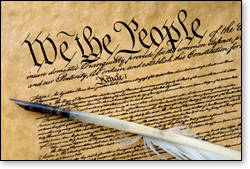
The framers of the Constitution feared letting the president alone decide with whom we are at war, and thus permitting him to trigger for his own purposes the military tools reserved for wartime. They also feared allowing the government to take life, liberty or property from any person without the intercession of a civilian jury to check the government's appetite and to compel transparency and fairness by forcing the government to prove its case to 12 ordinary citizens. Thus, the 5th Amendment to the Constitution, which requires due process, includes the essential component of a jury trial. And the 6th Amendment requires that when the government pursues any person in court, it must do so in the venue where the person is alleged to have caused harm.

Numerous Supreme Court cases have ruled that any person in conflict with the government can invoke due process -- be that person a citizen or an immigrant, someone born here, legally here, illegally here or whose suspect behavior did not even occur here.

Think about it: If the president could declare war on any person or entity or group simply by calling his pursuit of them a "war," there would be no limit to the government's ability to use the tools of war to achieve its ends. We have a "war" on drugs; can drug dealers be tried before military tribunals? We have a "war" on the Mafia; can mobsters be sent to Gitmo and tried there? The Obama administration has arguably declared "war" on Fox News. Are Glenn Beck, Bill O'Reilly and I and my other colleagues in danger of losing our constitutional rights to a government hostile to our opinions?

I trust not. And my trust is based on the oath that everyone who works in the government takes to uphold the Constitution. But I am not naive. Only unflinching public fidelity to the Constitution will preserve the freedoms of us all.

Andrew P. Napolitano, a former judge of the Superior Court of New Jersey, is the senior judicial analyst at the Fox News Channel. His next book is "Lies the Government Told You: Myth, Power, and Deception in American History."

Source: LA Times

Bookmark and Share