
As others have commented,
ad nauseam, the response from the proponents of AGW essentially boils down to the following main components:
- The mail (often there is only one, not several thousand threads of multiple mails and it's usually only mail, rather mail, code, data and commentary) was hacked and that's frightfully naughty. Aren't hackers nasty? Particularly when they are Russian.
This does not merit any response beyond laughter.
- The science is peer reviewed and it withstood that process.
Still an appeal to authority and, more importantly, dealt with damningly
here.
- This is but one part of the literature, it's only a handful of bad apples and the structure is utterly unchanged even without it.
This is the main charge that our great friend George Monbiot lays out
here and that must be tackled. That is what, with your permission, I shall make a hesitant attempt to start the process to do.
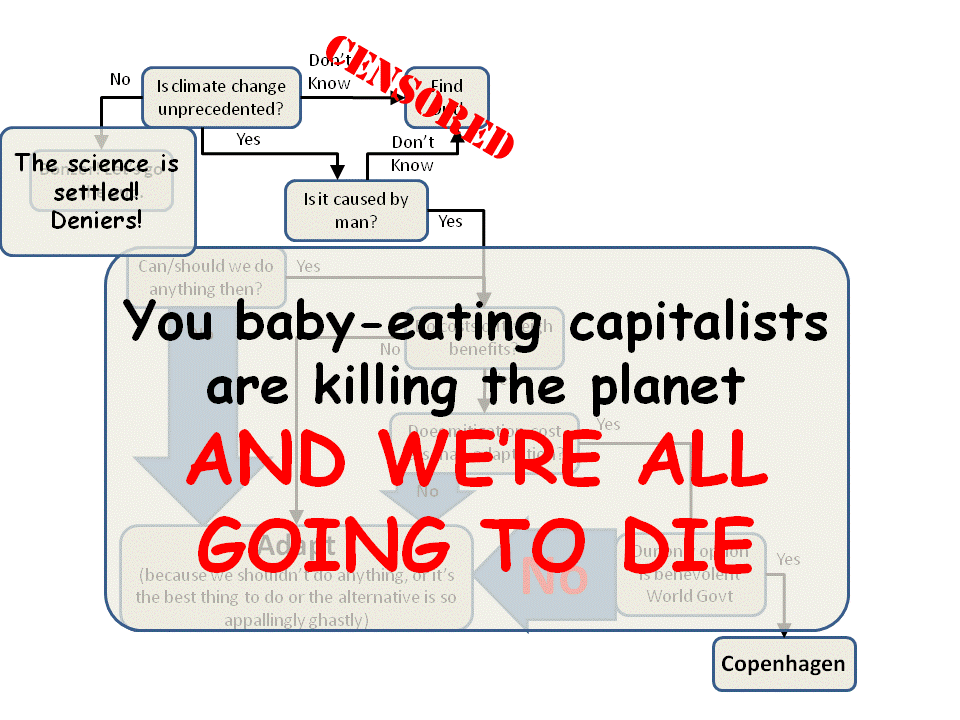
Firstly, we must understand how the whole thing hangs together, because the edifice of AGW is very definitely not just pure science, boffins in white coats in labs and so forth. It spans the whole gamut from real pure science, through the applied sciences and Engineering, passing through economics and finally ending up in the dark arts of Politics and Diplomacy. That's a lot to take in, so I have created a handy diagram that explains. Never let it be said that your polymathematic Pedant-General makes you do the hard work.
Let's start at the top, and bear with me.

- If the climate and recent changes are not unprecedented, then there's nothing to do. Let's go to the pub.
- If it is unprecedented, then we need to know why. If we don't know if it is unprecedented or if we don't know why, we need to stop here until we can find out.
- If it is unprecedented but it's not us, then we need to question seriously if there is anything that we can do about it and the answer to that is very very likely to be "no".
- If it is us, we then to move into economics. Will the damage outweigh the benefit?
- And even if the damage does outweigh the benefit, we still need to consider if the cost of stopping the climate change at source is less than the cost of adapting to the problem to minimise the damage.
- And even if the mitigation does cost less than adaptation, we need to ask if our only option for mitigation is to subborn all our freedom to a putative benevolent world government.
Only if you can answer "yes" all the way down that chain can you get to Copenhagen. One misstep and you are looking at adaptation, either because we shouldn’t do anything, or it’s the best thing to do or the alternative is so appallingly ghastly, depending on which route you took to get there.
It is also useful to plot where you and your friends sit on this decision tree:

- Whilst I wouldn't wish to claim to speak for our diabolical host, I suspect that he is in the box labelled, if not actually, "in the pub".
- Steve McIntyre et al are in the "Find Out" box.
- Interestingly, although the "Hockey Team" declare themselves to be at least on the "yes it is caused by man", they appear both to have been buggering about at the bottom in the politics and policy bits and yet the leak makes it clear that actually they are indeed right there in the "Find Out" box with the very chap they hate so much. They really don't actually know. They want to like to think they do, but they know that actually they don't.
- Next, we get down to the economics and again, we find that there is a disconnect between stated and actual positions. The blogfather Tim Worstall—whatever his private views—maintains a carefully studied neutrality on the science, erring always on the side of "let's grant that it is correct". But he then falls off the "critical path" at the economics. If it's not clear that the downside of GW (whether "A" or not) are worse than the upside, it's similarly not at all clear that we have to do something (or that what we are already doing is not already enough). More importantly, the worse the climate situation is, the greater the cost of mitigation and the more attractive it is to go for adaptation. This is the oddity with the Stern Report. If his numbers are correct, we're either doing enough for mitigation already or we shouldn't be doing it at all. As the shrieking gets louder, the costs of mitigation inevitably rise and the argument gets stronger AGAINST mitigation.
- Finally we get to the politics and the Bjorn Lomborg position. Even if it is all ghastly, there are many more important things to do with our resources. Millions really actually will die from preventable water-borne diseases, malnutrition and malaria and we really actually can do something about those. Buggering about with the climate, although it definitely will be expensive, is desperately uncertain both in terms of its effectiveness and the lives it will save. That's not a good trade off.
Simples.
Except of course it is and it isn't. If you do really accept the heavily-lauded consensus, then the decision tree changes quite a bit. Think about it in first aid terms. If it is the case that the climate is changing in an unprecedented manner and that change is driven predominantly by manmade CO
2 emissions, then we really shouldn't be muddling about with adapting to effects: we should address the cause and that inevitably means finding a way to reduce manmade CO
2 emissions. The problem with this is that everything becomes a bit too clearcut and the diagram now looks like this:
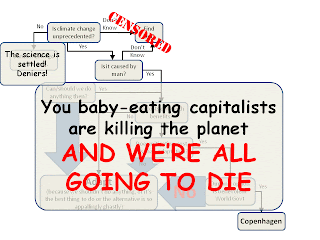
Because there is a skip from the straight science, straight to politics and policy, the science becomes absolutely essential.
As a result, no dissent can be tolerated because the wheels come off very quickly as soon as you have to make your way through the rest of the decision tree.
Suggesting that it's not unprecedented is straight denial and even doubt has to be censored.
But what of George's Knights Carbonic? How can this small number of scientists with "clever mathematical techniques", or "fudge factors" according to taste, affect the whole scientific foundation layer.
Richard North
suggests historical parallels, but his analysis does not pull back the curtain, "Wizard of Oz"-style, on the Knights Carbonic.
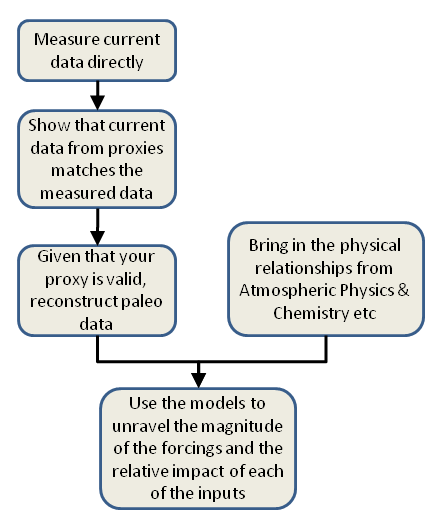
Permit me to try. Here's how the process works:

Temperatures, CO
2 levels, sun spot numbers et al are gathered currently using all the sophistication that we have today. We have the real measured data but only for a short (and geologically utterly insignificant) period.
Next, we try to see if we can find other things, with a longer history, that might be useful for telling us what those key measurements might have been if we had been there at the time with all our technology to measure them. We need proxies and we need to show that those proxies are a good match with the current data.
Once we have done that, we can then use the proxy data to fill back the history. At this stage, we can also say whether or not we believe the current data to be exceptional even without reading the entrails from the GCMs etc.
Now we can add some light seasoning of the real physics and chemistry that determine how things actually work, thermodynamics, mechanics, spectral absorption of different gasses and the lot.
Finally, we bake all the ingredients together in the models to try and tie all the inputs (CO
2 levels, solar activity, orbital wobbles etc) with the outputs (particularly temperature, but also climate generally, plus sea levels etc). In particular you are trying to identify how the each thing interacts with everything else, given all the control theory horrors of signal delays (introduced by thermal capacity of the oceans that delays temperature rises by the massive amount of energy required to do so) and feedback couplings (that the solvency of CO
2 in water changes with temperature, so the oceans absorb and release CO
2 in response to temperature).
But this is where the game is. If the temperature today is NOT unprecedented, in particular relative to the MWP, then we have a big fat data point that says the unprecedented current level of atmospheric CO
2 probably isn't tremendously relevant to climate. Or rather, there is some other input signal that is just as important that we are overlooking and therefore the impact of CO
2 will be being overstated.
This is not about whether we are warmer than we were 100 years ago. That is undeniable. 30 years ago, almost every Christmas in Scotland was white. Memories of sledging after Christmas lunch cannot be false consciousness. That stopped in about 1980 and has not happened since. The question is whether or not we are warmer than we were when they spoke Norse in Perth. That we are denied post-prandial sledging tells us nothing about that.
This is where CRUdGate is so important. Just look at where CRU and more generally Phil Jones and Michael Mann have - and have had - an influence on the process:

The Harry Read Me file shows just how badly knackered the HadCRUT temperature series really is. HADCRUT is one of a tiny number of recognised ("peer reviewed" even?) global temperature sources. All of them feed off each other and the people implicated in the emails are linked to some of the others. RealClimate's Gavin Schmidt, for example, is a protege of the team, is extensively mentioned in the audit trail of shame and works for NASA's GISS - one of the other of this tiny number of recognised ("peer reviewed" even?) global temperature sources.
So that's goosed the first box.
"Hide the Decline" reveals the fact that the second box doesn't work properly, especially for the tree-ring proxies. Since there is almost no-one of any stripe publishing in the field of paleodendroclimatology (sod the trillions of dollars to be squandered, I want that on a triple word score) who is not very deeply implicated in this leak, it is clear that the failings of this step have been censored.
There is then ample evidence of the attempt to wipe the MWP from the dendro data and we now know that MBH relied on just 12 trees in North America and, when that was challenged, just 1 tree—one lone tree—in Yamal, Siberia.
In any event, the whole paleo data thing is probably onto a hiding to nothing as we can't trust the two steps that got it there. So (I'm being a bit flippant here) any genuine proxy data (ice cores, lake sediments etc) is knackered because it's trying to be matched to goosed temperature data. That's not to say that there aren't pre-existing shenanigans there too though. So even if you haven't actually attempted to censor your failings (and the mails contain plenty of evidence that this has indeed been happening), your results are going to be goosed anyway.
By this stage, you don't have to touch the actual hard science because, since all your input data is garbage, your models are going to be garbage no matter how carefully you understand the basic physics.
Lastly and as a slight aside, why so little from the MSM? That one is easy. You need to have a decent analytical brain just to deal with the chain of events. You need to have a decent analytical brain, a mathematical/scientific mind and a good grasp of some very hard statistics to understand what is being done to massage the numbers and to see how significant it is to the chain of events.
Slice your average environment correspondent through the middle and you're going to find a left-leaning liberal arts graduate who is utterly out of his/her depth. Their world view is being swept from underneath them and they are being shown—in ways that they do not really and have never had to understand—that the guys they thought were the goodies are in fact "at it" and that those they have spent a decade disparaging as deniers were in fact spot on.
I would find that hard to report too.
Source: The Devil's Kitchen








 Posts


