Showing posts with label Climate Change. Show all posts

Friday, December 11, 2009

BBC Exposes 'Fudge Factor' in ClimateGate Global Warming Computer Programming Code


By Jeff Poor

Even the BBC didn't let this scoop get away.

A segment on the Dec. 3 broadcast of BBC's "Newsnight," showed the implications of the story behind the so-called "ClimateGate" scandal are more than just e-mails concealing data, but an incompetence analyzing the data by way of faulty computer code.

John Graham-Cumming, a British programmer known for the open source "POPFile email filtering program" explained how the University of East Anglia's Climatic Research Unit (CRU) had wholesale problems with its computer programming analyzing climate change data, with billion, if not even trillions of dollars, on the line.

"This is the source code from the Climatic Research Unit," Susan Watts, science editor at the BBC explained. "John Graham-Cumming is a software engineer. He's not a skeptic on climate change, but he is shocked by what he's seen in the programming. He compared it with the code in the same language written by NASA."

Graham-Cumming criticized the CRU programming for its lack of professionalism and showed faults with it.

"Well, if you look at the NASA stuff, it's really professional," Graham-Cumming said. "You can look at it, you can see the history. If you look at -- what's done here by these alleged CRU files - it's not the thing you'd expect to see in certainly a commercial industry. You would not see this sort of source code because it's not clearly documented. There's not audit history of what's happened to it. So it would be below the standard in any commercial software. "

According to the author of "The Geek Atlas," the programmer even included steps to skip over errors, which shows some of the data analyzed by the East Anglia CRU is completely neglected.

"The programming language actually has a problem," Graham-Cumming said. "And they put in some code to deal with that error. Unfortunately, in doing so they produced another error. And the upshot of this is the error occurs - the underlying error, they will skip over data that they're trying to plot without any warning to the end user. So in some sense there is data that is being lost."

The programmer, unnamed in the BBC segment, even documented his lack of programming skills.

"So in here, he says some things like, ‘Something is very wrong - it's my programming ability, isn't it,'" Graham-Cumming explained. "‘You know, once again, it's further confirmation my abilities are below what is required here.'"

Watts questioned if someone was betting billions or trillions of dollars, should they "be comfortable with" it and Graham-Cumming explained it wasn't.

"I don't think I would be comfortable with that because it is not obvious what it is doing, why it is doing it," Graham-Cumming said. "It needs to be made clear."

Source: News Busters

Bookmark and Share

Climategate reaches the British House of Lords


There is the issue of the science, which I had previously taken as given; but many people’s faith is being tested. We are often told that the science is settled. I suppose that is what the Inquisition said to Galileo. If so, why are we spending millions of pounds on research? The science is far from settled. – Lord Turnbull Dec 8th 2009

House of Lords, 8 December 2009: Lord Turnbull: My Lords, on first reading the Committee on Climate Change’s latest progress report, I found it an impressive document. It was broad in scope and very detailed. But the more I dug into it the more troubled I became. Below the surface there are serious questions about the foundations on which it has been constructed. There are questions in four areas-the framework created by the Climate Change Act 2008, the policy responses at EU and UK level, the estimate of costs and finally the scientific basis on which the whole scheme of things rests. I will consider each in turn.

Unlike many of those involved in the climate change field, I have no pecuniary interest to declare, but I am a founder trustee of the Global Warming Policy Foundation, which seeks to bring rationality, objectivity and, above all, tolerance to the debate.

I have long been in the camp of what might be called the semi-sceptics. I have taken the science on trust, while becoming increasingly critical of the policy responses being made to achieve a given CO2 or global warming constraint. First, let us look at the Climate Change Act, which has been highly praised, even today, as the most comprehensive and ambitious framework anywhere in the world-a real pioneering first for the UK. However, it has serious flaws. It starts by imposing a completely unworkable duty on the Secretary of State to reduce greenhouse gas emissions by 80 per cent by 2050, even though many of the actions required lie outside his control. It would have been better, as the noble Lord, Lord Crickhowell, and I argued, for the duty to be connected to what the Secretary of State can control, such as his own actions and policies, and not the outcome, which he cannot.

In the Act’s passage through Parliament, the target was raised from 60 per cent to 80 per cent, with little discussion of its costs or feasibility. It is a simple arithmetic calculation to show that if the UK economy continues to grow at its historic trend rate, we will need, only 40 years from now, to produce each £1,000 of GDP with only 8 per cent of the carbon we use today. That is a cut of [92] per cent. Many observers think that this is implausible. A recent report by the Institution of Mechanical Engineers reported that the rate of improvement in carbon intensity/productivity would need to quadruple from the 1.3 per cent achieved in the five years up to the recession to around 5.5 per cent. It would need to be even higher at the end of the period to make up for what the noble Lord, Lord May, calls falling behind the run rate.

Professor Dieter Helm has pointed out that the measurement system used in the Kyoto framework and in the UK’s carbon accounts is a misleading guide to what is really being achieved. The carbon accounts use the territorial method-that is, the emissions from UK territory. In this way, the UK is able to claim that CO2 emissions have been reduced, but that is a misleading way of measuring a nation’s carbon footprint and its impact on the world. It should include the carbon in its imports. If this was done it would show that we are going backwards, since we would be forced to take responsibility for the manufacturing that we have outsourced to such countries as China but are still consuming. The current method is, of course, politically very convenient as it allows us to label China as the world’s largest emitter. The embedded carbon calculation is, I accept, far more complicated, but it is far more honest.

Benches in the House of Lords Chamber are coloured red. In contrast, the House of Commons is decorated in green. Image from Wikipedia.

Another flaw in the framework is that the targets are unconditional. It is a legal duty, irrespective of what other countries achieve. Some, including me, argue that there should be two targets: one of which is a commitment, and a higher one which we will argue for internationally but only undertake as part of an agreement. Ironically, this is precisely the approach that the EU is taking with its 20 per cent reduction target by 2020, which would be raised to 30 per cent as part of an international agreement. The danger is that by going it alone we could face a double whammy, paying for decarbonising our own economy, yet still having to pay for the costs of raising our sea defences if others do not follow suit.

Secondly, let us consider the specific policies that have been adopted. Current EU policy follows two inconsistent paths. On the one hand, the ETS seeks to establish a common price for CO2, against which various competing technologies can be measured. The market share of each is determined by the relative costs. This is attractive to economists, since it allows the cost per tonne of CO2 abated to be equalised at the margin, thereby ensuring that the cost of achieving any CO2 target is minimised. The problem is that, despite its theoretical attractions, the ETS is failing. It provides no clear signal on the price of carbon on which investors can base their decisions. The committee, in this report, estimates that the ETS CO2 price in 2020 will be around €22 per tonne. The committee has rightly identified the central contradiction in its own report: the carbon price will be too low and too uncertain to stimulate the low-carbon investments needed to validate the committee’s projections.

At the same time, the EU is following a different approach under its 20:20:20 plan-to achieve a 20 per cent reduction in CO2 by 2020, with 20 per cent of energy coming from renewables. In this way, it predetermines a market share for a technology-renewables-rather than letting the merit order decide. The danger is that in pressing to achieve this target, which implies that over 30 per cent of electricity generation will come from renewables, some renewables capacity will be created which will be more expensive than other responses.

There is also a lack of clarity about the true cost of wind power, once we factor in the cost of retaining a large amount of underutilised conventional capacity, and the extension of the grid. The noble Lord, Lord Reay, has said more than enough on that so I do not need to follow that line of argument.

There is illogicality in the treatment of nuclear energy in the climate change levy. It is ridiculous that nuclear power, as a low-carbon source, is still in the taxable box. For 50 years, a major experiment has been conducted just 20 miles off our coast. France has generated three-quarters of its electricity from nuclear power. The French believe that it has been a huge success, delivering electricity which is secure, cheap and stable in price. France’s carbon intensity is 0.3 of a tonne per $1,000 of GDP, compared to 0.42 in the UK, 0.51 in Germany-so much for it being a market leader-and 0.63 in the US. However, the French option has barely been considered in this country.

As part of the EU plan, 10 per cent of road fuel is mandated to come from biofuels, but by the time this was enacted the credibility of first-generation biofuels had collapsed. Finally, our policy framework lacks balance. It is almost exclusively focused on mitigation through CO2 reduction, The Institution of Mechanical Engineers has argued for what it calls a MAG approach, with effort being committed not just to mitigation but to adaptation and geo-engineering.

Thirdly, there is the issue of cost. All we had to go on at the time when the target was set more ambitiously was the estimate by the noble Lord, Lord Stern, of 1 per cent of GDP. Many people were sceptical at the time and probably even more are now, including, it seems, the noble Lord, Lord Stern, himself. It was reported in the press last week that he now thinks that it might be 2 per cent, but could rise to 5 per cent. I hope he will clarify this when he speaks to us shortly.

In the document that we have before us, the committee says that it previously estimated that costs in 2020 would be about 1 per cent of GDP. That is consistent with its view that it might get to 2 per cent by 2050. In the new report it simply reaffirms the 1 per cent figure in just one paragraph in 250 pages. That is it. I have to say to the noble Lords, Lord Krebs and Lord May, that I do not think that that is adequate. It is difficult to relate these figures to what we are observing on the ground about the difficulties and costs of bringing on stream different technologies such as offshore wind and CCS.

One of the problems bedevilling the debate is the lack of transparency over the huge cross-subsidies that are being created by the renewables obligation and the regime for feed-in tariffs. There is no assurance that their extent is commensurate with the benefits in CO2 abated. My electricity costs me 11p per kilowatt hour. If I erected a wind turbine, I could sell the power I produced to the grid for a whopping 23p. I think I would go out and buy a gizmo which linked my inward meter to my outward meter. That excess cost is averaged over the bills of consumers as a whole, but how much is it in total, or for individual consumers? Here I differ from the noble Lord, Lord May. The whole issue of cost must be given far more attention. The Government cannot ask people to make radical changes to their lifestyle without being more open about the costs that they are being asked to bear.

I accept that “do nothing” is not the right option. Some measures, such as energy efficiency, heat recovery from waste and biomass, and stopping deforestation are probably justified on their own merits. More nuclear power which, in turn, would open the way for electrification of our transport fleet would enhance security of supply. Other measures may be justified as pure insurance, given the uncertainty that we face. But what is badly needed is a consistent metric that allows us to judge whether any given objective is being achieved at minimum cost. The recent book by Professor MacKay, the newly appointed scientific adviser at DECC, provides an excellent starting point. I also very much welcome the intervention by the noble Earl, Lord Selborne, debunking the waste hierarchy and the act of faith that that embodies.

There is the issue of the science, which I had previously taken as given; but many people’s faith is being tested. We are often told that the science is settled. I suppose that is what the Inquisition said to Galileo. If so, why are we spending millions of pounds on research? The science is far from settled. There are major controversies not just about the contribution of CO2, on which most of the debate is focused, but about the influence of other factors such as water vapour, or clouds-the most powerful greenhouse gas-ocean currents and the sun, together with feedback effects which can be negative as well as positive.

Worse still, there are even controversies about the basic data on temperature. The series going back one, 10 or 100,000 years are, in the genuine sense of the word, synthetic. They are not direct observations but are melded together from proxies such as ice cores, ocean sediments and tree rings.

Given the extent to which the outcome is affected by the statistical techniques and the weightings applied by individual researchers, it is essential that the work is done as transparently as possible, with the greatest scope for challenge. That is why the disclosure of documents and e-mails from the Climatic Research Unit is so disturbing. Instead of an open debate, a picture is emerging of selective use of data, efforts to silence critics, and particularly a refusal to share data and methodologies.

It is essential that these allegations are independently and rigorously investigated. Naturally, I welcome the appointment of my old colleague, Sir Muir Russell, to lead this investigation; a civil servant with a physics degree is a rare beast indeed. He needs to establish what the documents really mean and recommend changes in governance and transparency which will restore confidence in the integrity of the data. This is not just an academic feud in the English department from a Malcolm Bradbury novel. The CRU is a major contributor to the IPCC process. The Government should not see this as a purely university matter. They are the funders of much of this research and their climate change policies are based on it.

We need to purge the debate of the unpleasant religiosity that surrounds it, of scientists acting like NGO activists, of propaganda based on fear, for example, the quite disgraceful government advertisement which tried to frighten young children-the final image being the family dog being drowned-and of claims about having “10 days to save the world”. Crude insults from the Prime Minister do not help.

The noble Lords, Lord Krebs and Lord May, and their eminent colleagues on the CCC have a choice. They can take the policy framework as given, the policy responses as given, the costs as given, and the science as given, and then proceed to churn out more and more sophisticated projections, or-as I hope-they can apply the formidable intellectual firepower they command and start to find answers to many of the unsolved questions.

Source: Whats Up With That

Bookmark and Share

The Fiction Of Climate Science


by Gary Sutton

Many of you are too young to remember, but in 1975 our government pushed "the coming ice age."

Random House dutifully printed "THE WEATHER CONSPIRACY … coming of the New Ice Age." This may be the only book ever written by 18 authors. All 18 lived just a short sled ride from Washington, D.C. Newsweek fell in line and did a cover issue warning us of global cooling on April 28, 1975. And The New York Times, Aug. 14, 1976, reported "many signs that Earth may be headed for another ice age."

OK, you say, that's media. But what did our rational scientists say?

In 1974, the National Science Board announced: "During the last 20 to 30 years, world temperature has fallen, irregularly at first but more sharply over the last decade. Judging from the record of the past interglacial ages, the present time of high temperatures should be drawing to an end…leading into the next ice age."

You can't blame these scientists for sucking up to the fed's mantra du jour. Scientists live off grants. Remember how Galileo recanted his preaching about the earth revolving around the sun? He, of course, was about to be barbecued by his leaders. Today's scientists merely lose their cash flow. Threats work.

In 2002 I stood in a room of the Smithsonian. One entire wall charted the cooling of our globe over the last 60 million years. This was no straight line. The curve had two steep dips followed by leveling. There were no significant warming periods. Smithsonian scientists inscribed it across some 20 feet of plaster, with timelines.

Last year, I went back. That fresco is painted over. The same curve hides behind smoked glass, shrunk to three feet but showing the same cooling trend. Hey, why should the Smithsonian put its tax-free status at risk? If the politicians decide to whip up public fear in a different direction, get with it, oh ye subsidized servants. Downplay that embarrassing old chart and maybe nobody will notice.

Sorry, I noticed.

It's the job of elected officials to whip up panic. They then get re-elected. Their supporters fall in line.

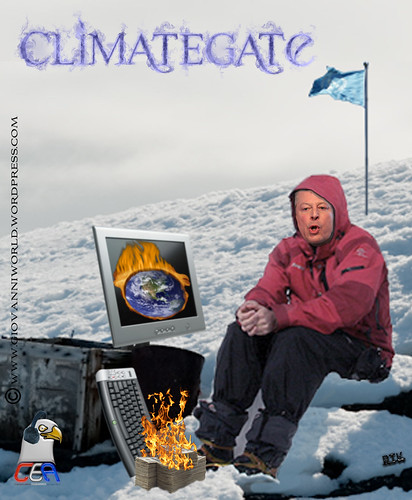
Al Gore thought he might ride his global warming crusade back toward the White House. If you saw his movie, which opened showing cattle on his farm, you start to understand how shallow this is. The United Nations says that cattle, farting and belching methane, create more global warming than all the SUVs in the world. Even more laughably, Al and his camera crew flew first class for that film, consuming 50% more jet fuel per seat-mile than coach fliers, while his Tennessee mansion sucks as much carbon as 20 average homes.

His PR folks say he's "carbon neutral" due to some trades. I'm unsure of how that works, but, maybe there's a tribe in the Sudan that cannot have a campfire for the next hundred years to cover Al's energy gluttony. I'm just not sophisticated enough to know how that stuff works. But I do understand he flies a private jet when the camera crew is gone.

The fall of Saigon in the '70s may have distracted the shrill pronouncements about the imminent ice age. Science's prediction of "A full-blown, 10,000 year ice age," came from its March 1, 1975 issue. The Christian Science Monitor observed that armadillos were retreating south from Nebraska to escape the "global cooling" in its Aug. 27, 1974 issue.

That armadillo caveat seems reminiscent of today's tales of polar bears drowning due to glaciers disappearing.

While scientists march to the drumbeat of grant money, at least trees don't lie. Their growth rings show what's happened no matter which philosophy is in power. Tree rings show a mini ice age in Europe about the time Stradivarius crafted his violins. Chilled Alpine Spruce gave him tighter wood so the instruments sang with a new purity. But England had to give up the wines that the Romans cultivated while our globe cooled, switching from grapes to colder weather grains and learning to take comfort with beer, whisky and ales.

Yet many centuries earlier, during a global warming, Greenland was green. And so it stayed and was settled by Vikings for generations until global cooling came along. Leif Ericsson even made it to Newfoundland. His shallow draft boats, perfect for sailing and rowing up rivers to conquer villages, wouldn't have stood a chance against a baby iceberg.

Those sustained temperature swings, all before the evil economic benefits of oil consumption, suggest there are factors at work besides humans.

Today, as I peck out these words, the weather channel is broadcasting views of a freakish and early snow falling on Dallas. The Iowa state extension service reports that the record corn crop expected this year will have unusually large kernels, thanks to "relatively cool August and September temperatures." And on Jan. 16, 2007, NPR went politically incorrect, briefly, by reporting that "An unusually harsh winter frost, the worst in 20 years, killed much of the California citrus, avocados and flower crops."

To be fair, those reports are short-term swings. But the longer term changes are no more compelling, unless you include the ice ages, and then, perhaps, the panic attempts of the 1970s were right. Is it possible that if we put more CO2 in the air, we'd forestall the next ice age?

I can ask "outrageous" questions like that because I'm not dependent upon government money for my livelihood. From the witch doctors of old to the elected officials today, scaring the bejesus out of the populace maintains their status.

Sadly, the public just learned that our scientific community hid data and censored critics. Maybe the feds should drop this crusade and focus on our health care crisis. They should, of course, ignore the life insurance statistics that show every class of American and both genders are living longer than ever. That's another inconvenient fact.

Source: Forbes

Bookmark and Share

Thursday, December 10, 2009

Let the Copenhagen wealth transfer begin


Source: National Post - Adrian MacNair

Part of the problem with the climate change issue is that it isn’t seen as an ongoing review of scientific models and theories about human impact on planetary warmth. It has taken on a political and religious tone which makes any attempt to peer review the consensus subject to ridicule. We know that dissidents of the consensus evidence were shunned and blacklisted according to the hacked [or leaked] Climatic Research Unit emails from the University of East Anglia. Those who have challenged the prevailing urgency of action have been mocked, ridiculed, and relegated to the status of apostates.

Canada received it’s first Fossil of the Day “award” Monday at the UN Climate Change Conference in Copenhagen, Denmark, for its “unwavering commitment to stand firm in its inaction”. Levying shame-inducing awards on people, organizations, and countries, has been the hallmark tactic of the climate zealots for years now. By designating such a prize, on an entire country no less, it has all of the intent of telling us that this isn’t a debate between adults. It’s between an adult, and a petulant child.

Copenhagen and Global Warming: Ten Facts and Ten Myths on Climate Change


By Prof. Robert M. Carter
Global Research, December 9, 2009
James Cook University, Queensland, Australia

Ten facts about climate change

1. Climate has always changed, and it always will. The assumption that prior to the industrial revolution the Earth had a “stable” climate is simply wrong. The only sensible thing to do about climate change is to prepare for it.

2. Accurate temperature measurements made from weather balloons and satellites since the late 1950s show no atmospheric warming since 1958. In contrast, averaged ground-based thermometers record a warming of about 0.40 C over the same time period. Many scientists believe that the thermometer record is biased by the Urban Heat Island effect and other artefacts.

3. Despite the expenditure of more than US$50 billion dollars looking for it since 1990, no unambiguous anthropogenic (human) signal has been identified in the global temperature pattern.

4. Without the greenhouse effect, the average surface temperature on Earth would be -180 C rather than the equable +150 C that has nurtured the development of life.

Carbon dioxide is a minor greenhouse gas, responsible for ~26% (80 C) of the total greenhouse effect (330C), of which in turn at most 25% (~20C) can be attributed to carbon dioxide contributed by human activity. Water vapour, contributing at least 70% of the effect, is by far the most important atmospheric greenhouse gas.

5. On both annual (1 year) and geological (up to 100,000 year) time scales, changes in atmospheric temperature PRECEDE changes in CO2. Carbon dioxide therefore cannot be the primary forcing agent for temperature increase (though increasing CO2 does cause a diminishingly mild positive temperature feedback).

6. The UN Intergovernmental Panel on Climate Change (IPCC) has acted as the main scaremonger for the global warming lobby that led to the Kyoto Protocol. Fatally, the IPCC is a political, not scientific, body.

Hendrik Tennekes, a retired Director of Research at the Royal Netherlands Meteorological Institute, says that “the IPCC review process is fatally flawed” and that “the IPCC wilfully ignores the paradigm shift created by the foremost meteorologist of the twentieth century, Edward Lorenz“.

7. The Kyoto Protocol will cost many trillions of dollars and exercises a significant impost those countries that signed it, but will deliver no significant cooling (less than .020 C by 2050, assuming that all commitments are met).
The Russian Academy of Sciences says that Kyoto has no scientific basis; Andre Illarianov, senior advisor to Russian president Putin, calls Kyoto-ism “one of the most agressive, intrusive, destructive ideologies since the collapse of communism and fascism“. If Kyoto was a “first step” then it was in the same wrong direction as the later “Bali roadmap”.

8. Climate change is a non-linear (chaotic) process, some parts of which are only dimly or not at all understood. No deterministic computer model will ever be able to make an accurate prediction of climate 100 years into the future.

9. Not surprisingly, therefore, experts in computer modelling agree also that no current (or likely near-future) climate model is able to make accurate predictions of regional climate change.

10. The biggest untruth about human global warming is the assertion that nearly all scientists agree that it is occurring, and at a dangerous rate.

The reality is that almost every aspect of climate science is the subject of vigorous debate. Further, thousands of qualified scientists worldwide have signed declarations which (i) query the evidence for hypothetical human-caused warming and (ii) support a rational scientific (not emotional) approach to its study within the context of known natural climate change.

LAYING TEN GLOBAL WARMING MYTHS

Myth 1 Average global temperature (AGT) has increased over the last few years.

Fact 1 Within error bounds, AGT has not increased since 1995 and has declined since 2002, despite an increase in atmospheric CO2 of 8% since 1995.

Myth 2 During the late 20th Century, AGT increased at a dangerously fast rate and reached an unprecedented magnitude.

Facts 2 The late 20th Century AGT rise was at a rate of 1-20 C/century, which lies well within natural rates of climate change for the last 10,000 yr. AGT has been several degrees warmer than today many times in the recent geological past.

Myth 3 AGT was relatively unchanging in pre-industrial times, has sky-rocketed since 1900, and will increase by several degrees more over the next 100 years (the Mann, Bradley & Hughes “hockey stick” curve and its computer extrapolation).

Facts 3 The Mann et al. curve has been exposed as a statistical contrivance. There is no convincing evidence that past climate was unchanging, nor that 20th century changes in AGT were unusual, nor that dangerous human warming is underway.

Myth 4 Computer models predict that AGT will increase by up to 60 C over the next 100 years.

Facts 4 Deterministic computer models do. Other equally valid (empirical) computer models predict cooling.

Myth 5 Warming of more than 20 C will have catastrophic effects on ecosystems and mankind alike.

Facts 5 A 20 C change would be well within previous natural bounds. Ecosystems have been adapting to such changes since time immemorial. The result is the process that we call evolution. Mankind can and does adapt to all climate extremes.

Myth 6 Further human addition of CO2 to the atmosphere will cause dangerous warming, and is generally harmful.

Facts 6 No human-caused warming can yet be detected that is distinct from natural system variation and noise. Any additional human-caused warming which occurs will probably amount to less than 10 C. Atmospheric CO2 is a beneficial fertilizer for plants, including especially cereal crops, and also aids efficient evapo-transpiration.

Myth 7 Changes in solar activity cannot explain recent changes in AGT.

Facts 7 The sun’s output varies in several ways on many time scales (including the 11-, 22 and 80-year solar cycles), with concomitant effects on Earth’s climate. While changes in visible radiation are small, changes in particle flux and magnetic field are known to exercise a strong climatic effect. More than 50% of the 0.80 C rise in AGT observed during the 20th century can be attributed to solar change.

Myth 8 Unprecedented melting of ice is taking place in both the north and south polar regions.

Facts 8 Both the Greenland and Antarctic ice sheets are growing in thickness and cooling at their summit. Sea ice around Antarctica attained a record area in 2007. Temperatures in the Arctic region are just now achieving the levels of natural warmth experienced during the early 1940s, and the region was warmer still (sea-ice free) during earlier times.

Myth 9 Human-caused global warming is causing dangerous global sea-level (SL) rise.

Facts 9 SL change differs from time to time and place to place; between 1955 and 1996, for example, SL at Tuvalu fell by 105 mm (2.5 mm/yr). Global average SL is a statistical measure of no value for environmental planning purposes. A global average SL rise of 1-2 mm/yr occurred naturally over the last 150 years, and shows no sign of human-influenced increase.

Myth 10 The late 20th Century increase in AGT caused an increase in the number of severe storms (cyclones), or in storm intensity.

Facts 10 Meteorological experts are agreed that no increase in storms has occurred beyond that associated with natural variation of the climate system.

Robert M. Carter is a Research Professor at James Cook University (Queensland) and the University of Adelaide (South Australia). He is a palaeontologist, stratigrapher, marine geologist and environmental scientist with more than thirty years professional experience.

Global Research Articles by Robert M. Carter

Source: Aletho News

Thursday, December 3, 2009

UNEP Power Grab Planned For Copenhagen?


For those who have gotten used to watching the Internationalists pushing for limitless power to be vested in the United Nations, the following observation should not be much of a stunner: The upcoming Climate Change Conference in Copenhagen is about power — and we’re not talking about the voltage.

A report at FoxNews.com (“Document Reveals U.N.’s Goal of Becoming Rule-Maker in Global Environmental Talks”) profiles a curious paper — "The UNEP That We Want" — which was drafted two years ago to offer guidance to the United Nations Environment Programme (UNEP) following high-level discussions which included individuals who are highly placed within that organization.

According to FoxNews.com:

The purpose of the paper, put together after an unpublicized day-long session in Switzerland by some of the world's top environmental bureaucrats: to argue for a new and unprecedented effort to move environmental concerns to "the center of political and economic decision-making" around the world — and perhaps not coincidentally, expand the influence and reach of UNEP at the tables of world power, as a rule-maker and potential supervisor of the New Environmental Order.

The positions argued in that paper now appear to be much closer at hand; many of them are embedded in a four-year strategy document for UNEP taking effect next year, in the immediate wake of the much-touted, 11-day Copenhagen conference on "climate change," which starts on Dec. 7, and which is intended to push environmental concerns to a new crescendo.

The major difference is that the four-year UNEP plan expresses its aims in the carefully soporific language that U.N. organizations customarily use to swaddle their objectives. The Swiss document makes its case passionately — and more important, plainly — than any U.N. official document ever would.

In fact, it is hard to overstate the “passionate” nature of the document when it comes to pressing for an extremely radical UNEP agenda. To quote directly from “The UNEP That We Want”:

UNEP has an important—indeed a critical—message, but it is delivering it in the wrong language to the wrong audience. It is attached to the wrong narrative. It will never position itself to do what is needed until it finds the right language and narrative. The force of this message cannot be over-emphasized. UNEP’s success depends on getting this right.

The environment should compete with religion as the only compelling, value-based narrative available to humanity. To do that, however, it will have to make itself relevant well beyond the world of those already concerned with the environment, including very prominently its own formal constituency. Indeed, unless UNEP succeeds in recasting the debate, it is highly likely that the economic community will do it—badly, and on its own terms. It is already happening in the field of climate change.

Thus, according to such recommendations, it would appear that the role envisioned for the UNEP is to become the priesthood of a cult of Gaia. “The environment should compete with religion as the only compelling, value-based narrative available to humanity”? This sort of foolishness would appear to cast the UNEP in the role of waging war against competing faiths. Despite the silly use of buzzwords such as “narrative” (one of those ridiculous post-modern terms which implicitly proclaims that it’s not the facts that matter, but the story you make from them), it appears to this writer that what is being advocating is ‘spinning’ the UNEP message in pseudo-religious phraseology to mask an aggressive ideological agenda which in certain key elements can be reduced to a redistributionist agenda.

Again, to cite “The UNEP That We Want”:

Influencing economic policy means messaging in its language, and stating the case in terms that carry with the economic policy community and the business community that it serves. We believe that the environment argument should be recast in terms of its importance for and potential contribution to Prosperity, Stability and Equity. ...

And Equity is a precondition of both Stability and Prosperity. Unless we greatly increase equity, neither of the other two is an option. Equity is a better way to approach the North-South agenda, the poverty agenda, and the production/consumption agenda than the traditional one. Politically, it carries better than development. UNEP needs to restructure its narrative around these three objectives, relating each of these three goals back to its core areas of competence.

The change of ‘narrative’ identified by Halle has obviously been implemented throughout the push for the redistributionist scheme planned for Copenhagen. Call it “equity” because “Politically, it carries better than development”? The “development” spin has ‘played out’; time to switch codewords. But in the end, it all boils down to UN Secretary General Ban Ki-moon’s plans for a massive — at least $100 billion per year — redistribution of wealth from the First World to the Third World.

FoxNews.com reports that despite the high profile attendees at the meeting which preceded the writing of “The UNEP That We Want,” the author of the document is claiming sole responsibility for the text.

Another important attendee was John Scanlon, listed on UNEP's website as principal advisor to UNEP's Steiner. Among other things, Scanlon is credited in his UNEP biography with being the leader in developing UNEP's new medium-term strategy, "Environment for Development," covering the period from 2010 to 2013. The draft version of the strategy was presented to a UNEP's Governing Council and a meeting of the world's environmental minister's in February 2008, and subsequently approved.

The Swiss paper was written not by Scanlon but by Mark Halle, the Europe-based director of trade and investment for an influential environmental think-tank, the International Institute for Sustainable Development (IISD), which originated in Canada and now operates in some 30 countries. IISD, which still has heavy Canadian government support, bills itself as a research institute promoting policies that are "simultaneously beneficial to the global economy, the global environment and to social well-being."

Even though all of the Swiss participants took part in the brainstorming, the responsibility for the ideas in the paper are his own, Halle emphasized to Fox News, after he was contacted last week about the document. The paper itself says it offers "elements," not a "complete offering," of what UNEP should consider for its role in the years ahead.

Nevertheless, the “equity narrative” has certainly become an important element of the ideological framework leading up to the Copenhagen Conference. For example, at the twelfth conference of the European Association of Development Research and Training Institutes (EADI) (“Global Governance for Sustainable Development”) Chengxin Chen of the Chinese Academy of Social Sciences in the People’s Republic of China presented a paper, “UNEP Institutional Reform With Its Impact on Developing Countries” setting forth the same “equity narrative” advocated by Halle.

The fact is that UNEP does not have and in all likelihood never will have the resources to make much of an impact on the ground through direct, country-level activities. There are better ways to serve its constituency of developing countries. One thing that can be done is to change the narrative, moving away from the “poverty” agenda with its negative connotations to a “prosperity and equity” agenda. This new approach would focus the agenda both on the environmental underpinnings of prosperity and the search for it, and on the patterns of consumption and production that underlie this prosperity. It would help focus the world community on the root causes of environmental stress, on the extraordinary, equity-denying affluence in some parts of the world, and on the consumption patterns on which that affluence depends and which make sustainability hard to reach.

The identification of so-called “developing countries” as the UNEP’s “constituency” is interesting; apparently, the United Nations Environment Programme’s “constituency” does not include the developed world despite the fact that it would claim authority over the whole world. What a surprise.

Thus we return to the point where we began: The Copenhagen Conference is about power — power to be given to the Internationalists which apparently may even use the trappings of Gaia worship if that’s what it takes to force out all competing world views.

Source: The John Birch Society

Bookmark and Share

Wednesday, December 2, 2009

Climategate: Follow the Money


Last year, ExxonMobil donated $7 million to a grab-bag of public policy institutes, including the Aspen Institute, the Asia Society and Transparency International. It also gave a combined $125,000 to the Heritage Institute and the National Center for Policy Analysis, two conservative think tanks that have offered dissenting views on what until recently was called—without irony—the climate change "consensus."

To read some of the press accounts of these gifts—amounting to about 0.0027% of Exxon's 2008 profits of $45 billion—you might think you'd hit upon the scandal of the age. But thanks to what now goes by the name of climategate, it turns out the real scandal lies elsewhere.

Climategate, as readers of these pages know, concerns some of the world's leading climate scientists working in tandem to block freedom of information requests, blackball dissenting scientists, manipulate the peer-review process, and obscure, destroy or massage inconvenient temperature data—facts that were laid bare by last week's disclosure of thousands of emails from the University of East Anglia's Climate Research Unit, or CRU.

But the deeper question is why the scientists behaved this way to begin with, especially since the science behind man-made global warming is said to be firmly settled. To answer the question, it helps to turn the alarmists' follow-the-money methods right back at them.

Consider the case of Phil Jones, the director of the CRU and the man at the heart of climategate. According to one of the documents hacked from his center, between 2000 and 2006 Mr. Jones was the recipient (or co-recipient) of some $19 million worth of research grants, a sixfold increase over what he'd been awarded in the 1990s.

Why did the money pour in so quickly? Because the climate alarm kept ringing so loudly: The louder the alarm, the greater the sums. And who better to ring it than people like Mr. Jones, one of its likeliest beneficiaries?

Thus, the European Commission's most recent appropriation for climate research comes to nearly $3 billion, and that's not counting funds from the EU's member governments. In the U.S., the House intends to spend $1.3 billion on NASA's climate efforts, $400 million on NOAA's, and another $300 million for the National Science Foundation. The states also have a piece of the action, with California—apparently not feeling bankrupt enough—devoting $600 million to their own climate initiative. In Australia, alarmists have their own Department of Climate Change at their funding disposal.

And all this is only a fraction of the $94 billion that HSBC Bank estimates has been spent globally this year on what it calls "green stimulus"—largely ethanol and other alternative energy schemes—of the kind from which Al Gore and his partners at Kleiner Perkins hope to profit handsomely.

Supply, as we know, creates its own demand. So for every additional billion in government-funded grants (or the tens of millions supplied by foundations like the Pew Charitable Trusts), universities, research institutes, advocacy groups and their various spin-offs and dependents have emerged from the woodwork to receive them.

Today these groups form a kind of ecosystem of their own. They include not just old standbys like the Sierra Club or Greenpeace, but also Ozone Action, Clean Air Cool Planet, Americans for Equitable Climate Change Solutions, the Alternative Energy Resources Association, the California Climate Action Registry and so on and on. All of them have been on the receiving end of climate change-related funding, so all of them must believe in the reality (and catastrophic imminence) of global warming just as a priest must believe in the existence of God.

None of these outfits are per se corrupt, in the sense that the monies they get are spent on something other than their intended purposes. But they depend on an inherently corrupting premise, namely that the hypothesis on which their livelihood depends has in fact been proved. Absent that proof, everything they represent—including the thousands of jobs they provide—vanishes. This is what's known as a vested interest, and vested interests are an enemy of sound science.

Which brings us back to the climategate scientists, the keepers of the keys to the global warming cathedral. In one of the more telling disclosures from last week, a computer programmer writes of the CRU's temperature database: "I am very sorry to report that the rest of the databases seems to be in nearly as poor a state as Australia was. . . . Aarrggghhh! There truly is no end in sight. . . . We can have a proper result, but only by including a load of garbage!"

This is not the sound of settled science, but of a cracking empirical foundation. And however many billion-dollar edifices may be built on it, sooner or later it is bound to crumble.

Source: The Wall Street Journal

Bookmark and Share

Tuesday, June 30, 2009

Obama EPA blocks its own report questioning climate change...


Republicans are raising questions about why the EPA apparently dismissed an analyst's report questioning the science behind global warming.

A top Republican senator has ordered an investigation into the Environmental Protection Agency's alleged suppression of a report that questioned the science behind global warming.

The 98-page report, co-authored by EPA analyst Alan Carlin, pushed back on the prospect of regulating gases like carbon dioxide as a way to reduce global warming. Carlin's report argued that the information the EPA was using was out of date, and that even as atmospheric carbon dioxide levels have increased, global temperatures have declined.

"He came out with the truth. They don't want the truth at the EPA," Sen. James Inhofe, R-Okla, a global warming skeptic, told FOX News, saying he's ordered an investigation. "We're going to expose it."

The controversy comes after the House of Representatives passed a landmark bill to regulate greenhouse gas emissions, one that Inhofe said will be "dead on arrival" in the Senate despite President Obama's energy adviser voicing confidence in the measure.

According to internal e-mails that have been made public by the Competitive Enterprise Institute, Carlin's boss told him in March that his material would not be incorporated into a broader EPA finding and ordered Carlin to stop working on the climate change issue. The draft EPA finding released in April lists six greenhouse gases, including carbon dioxide, that the EPA says threaten public health and welfare.

An EPA official told FOXNews.com on Monday that Carlin, who is an economist -- not a scientist -- included "no original research" in his report. The official said that Carlin "has not been muzzled in the agency at all," but stressed that his report was entirely "unsolicited."

"It was something that he did on his own," the official said. "Though he was not qualified, his manager indulged him and allowed him on agency time to draft up ... a set of comments."

Despite the EPA official's remarks, Carlin told FOXNews.com on Monday that his boss, National Center for Environmental Economics Director Al McGartland, appeared to be pressured into reassigning him.

Carlin said he doesn't know whether the White House intervened to suppress his report but claimed it's clear "they would not be happy about it if they knew about it," and that McGartland seemed to be feeling pressure from somewhere up the chain of command.

Carlin said McGartland told him he had to pull him off the climate change issue.

"It was reassigning you or losing my job, and I didn't want to lose my job," Carlin said, paraphrasing what he claimed were McGartland's comments to him. "My inference (was) that he was receiving some sort of higher-level pressure."

Carlin said he personally does not think there is a need to regulate carbon dioxide, since "global temperatures are going down." He said his report expressed a "good bit of doubt" on the connection between the two.

Specifically, the report noted that global temperatures were on a downward trend over the past 11 years, that scientists do not necessarily believe that storms will become more frequent or more intense due to global warming, and that the theory that temperatures will cause Greenland ice to rapidly melt has been "greatly diminished."

Carlin, in a March 16 e-mail, argued that his comments are "valid, significant" and would be critical to the EPA finding.

McGartland, though, wrote back the next day saying he had decided not to forward his comments.

"The administrator and the administration has decided to move forward on endangerment, and your comments do not help the legal or policy case for this decision," he wrote, according to the e-mails released by CEI. "I can only see one impact of your comments given where we are in the process, and that would be a very negative impact on our office."

He later wrote an e-mail urging Carlin to "move on to other issues and subjects."

"I don't want you to spend any additional EPA time on climate change. No papers, no research, etc., at least until we see what EPA is going to do with climate," McGartland wrote.

The EPA said in a written statement that Carlin's opinions were in fact considered, and that he was not even part of the working group dealing with climate change in the first place.

"Claims that this individual's opinions were not considered or studied are entirely false. This administration and this EPA administrator are fully committed to openness, transparency and science-based decision making," the statement said. "The individual in question is not a scientist and was not part of the working group dealing with this issue. Nevertheless the document he submitted was reviewed by his peers and agency scientists, and information from that report was submitted by his manager to those responsible for developing the proposed endangerment finding. In fact, some ideas from that document are included and addressed in the endangerment finding."

The e-mail exchanges and suggestions of political interference sparked a backlash from Republicans in Congress.

Reps. James Sensenbrenner, R-Wis., and Darrell Issa, R-Calif., also wrote a letter last week to EPA Administrator Lisa Jackson urging the agency to reopen its comment period on the finding. The EPA has since denied the request.

Citing the internal e-mails, the Republican congressmen wrote that the EPA was exhibiting an "agency culture set in a predetermined course."

"It documents at least one instance in which the public was denied access to significant scientific literature and raises substantial questions about what additional evidence may have been suppressed," they wrote.

In a written statement, Issa said the administration is "actively seeking to withhold new data in order to justify a political conclusion."

"I'm sure it was very inconvenient for the EPA to consider a study that contradicted the findings it wanted to reach," Sensenbrenner said in a statement, adding that the "repression" of Carlin's report casts doubt on the entire finding.

Carlin said he's concerned that he's seeing "science being decided at the presidential level."

"Now Mr. Obama is in effect directly or indirectly saying that CO2 causes global temperatures to rise and that we have to do something about it. ... That's normally a scientific judgment and he's in effect judging what the science says," he said. "We need to look at it harder."

The controversy is similar to one under the Bush administration -- only the administration was taking the opposite stance. In that case, scientist James Hansen claimed the administration was trying to keep him from speaking out and calling for reductions in greenhouse gases.

Source: Fox Online

Sunday, June 28, 2009

Global warming alarmists out in cold


IT'S snowing in April. Ice is spreading in Antarctica. The Great Barrier Reef is as healthy as ever.

And that's just the news of the past week. Truly, it never rains but it pours - and all over our global warming alarmists.

Time's up for this absurd scaremongering. The fears are being contradicted by the facts, and more so by the week.

Doubt it? Then here's a test.

Name just three clear signs the planet is warming as the alarmists claim it should. Just three. Chances are your "proofs" are in fact on my list of 10 Top Myths about global warming.

And if your "proofs" indeed turn out to be false, don't get angry with me.

Just ask yourself: Why do you still believe that man is heating the planet to hell? What evidence do you have?

So let's see if facts matter more to you than faith, and observations more than predictions.

MYTH 1

THE WORLD IS WARMING

Wrong. It is true the world did warm between 1975 and 1998, but even Professor David Karoly, one of our leading alarmists, admitted this week "temperatures have dropped" since - "both in surface temperatures and in atmospheric temperatures measured from satellites". In fact, the fall in temperatures from just 2002 has already wiped out half the warming our planet experienced last century. (Check data from Britain's Hadley Centre, NASA's Aqua satellite and the US National Climatic Data Centre.)

Some experts, such as Karoly, claim this proves nothing and the world will soon start warming again. Others, such as Professor Ian Plimer of Adelaide University, point out that so many years of cooling already contradict the theory that man's rapidly increasing gases must drive up temperatures ever faster.

But that's all theory. The question I've asked is: What signs can you actually see of the man-made warming that the alarmists predicted?

MYTH 2

THE POLAR CAPS ARE MELTING

Wrong. The British Antarctic Survey, working with NASA, last week confirmed ice around Antarctica has grown 100,000 sq km each decade for the past 30 years.

Long-term monitoring by the US National Oceanic and Atmospheric Administration reports the same: southern hemisphere ice has been expanding for decades.

As for the Arctic, wrong again.

The Arctic ice cap shrank badly two summers ago after years of steady decline, but has since largely recovered. Satellite data from NASA's Marshall Space Flight Centre this week shows the Arctic hasn't had this much April ice for at least seven years.

Norway's Nansen Environmental and Remote Sensing Centre says the ice is now within the standard deviation range for 1979 to 2007.

MYTH 3

WE'VE NEVER HAD SUCH A BAD DROUGHT

Wrong. A study released this month by the University of NSW Climate Change Research Centre confirms not only that we've had worse droughts, but this Big Dry is not caused by "global warming", whether man-made or not.

As the university's press release says: "The causes of southeastern Australia's longest, most severe and damaging droughts have been discovered, with the surprise finding that they originate far away in the Indian Ocean.

"A team of Australian scientists has detailed for the first time how a phenomenon known as the Indian Ocean Dipole - a variable and irregular cycle of warming and cooling of ocean water - dictates whether moisture-bearing winds are carried across the southern half of Australia."

MYTH 4

OUR CITIES HAVE NEVER BEEN HOTTER

Wrong. The alleged "record" temperature Melbourne set in January - 46.4 degrees - was in fact topped by the 47.2 degrees the city recorded in 1851. (See the Argus newspaper of February 8, 1851.)

And here's another curious thing: Despite all this warming we're alleged to have caused, Victoria's highest temperature on record remains the 50.7 degrees that hit Mildura 103 years ago.

South Australia's hottest day is still the 50.7 degrees Oodnadatta suffered 37 years ago. NSW's high is still the 50 degrees recorded 70 years ago.

What's more, not one of the world's seven continents has set a record high temperature since 1974. Europe's high remains the 50 degrees measured in Spain 128 years ago, before the invention of the first true car.

MYTH 5

THE SEAS ARE GETTING HOTTER

Wrong. If anything, the seas are getting colder. For five years, a network of 3175 automated bathythermographs has been deployed in the oceans by the Argo program, a collaboration between 50 agencies from 26 countries.

Warming believer Josh Willis, of NASA's Jet Propulsion Laboratory, reluctantly concluded: "There has been a very slight cooling . . ."

MYTH 6

THE SEAS ARE RISING

Wrong. For almost three years, the seas have stopped rising, according to the Jason-1 satellite mission monitored by the University of Colorado.

That said, the seas have risen steadily and slowly for the past 10,000 years through natural warming, and will almost certainly resume soon.

But there is little sign of any accelerated rises, even off Tuvalu or the Maldives, islands often said to be most threatened with drowning.

Professor Nils-Axel Moerner, one of the world's most famous experts on sea levels, has studied the Maldives in particular and concluded there has been no net rise there for 1250 years.

Venice is still above water.

MYTH 7

CYCLONES ARE GETTING WORSE

Wrong. Ryan Maue of Florida State University recently measured the frequency, intensity and duration of all hurricanes and cyclones to compile an Accumulated Cyclone Energy Index.

His findings? The energy index is at its lowest level for more than 30 years.

The World Meteorological Organisation, in its latest statement on cyclones, said it was impossible to say if they were affected by man's gases: "Though there is evidence both for and against the existence of a detectable anthropogenic signal in the tropical cyclone climate record to date, no firm conclusion can be made on this point."

MYTH 8

THE GREAT BARRIER REEF IS DYING

Wrong. Yes, in 1999, Professor Ove Hoegh-Gulberg, our leading reef alarmist and administrator of more than $30 million in warming grants, did claim the reef was threatened by warming, and much had turned white.

But he then had to admit it had made a "surprising" recovery.

Yes, in 2006 he again warned high temperatures meant "between 30 and 40 per cent of coral on Queensland's Great Barrier Reef could die within a month".

But he later admitted this bleaching had "minimal impact". Yes, in 2007 he again warned that temperature changes of the kind caused by global warming were bleaching the reef.

But this month fellow Queensland University researchers admitted in a study that reef coral had once more made a "spectacular recovery", with "abundant corals re-established in a single year". The reef is blooming.

MYTH 9

OUR SNOW SEASONS ARE SHORTER

Wrong. Poor snow falls in 2003 set off a rash of headlines predicting warming doom. The CSIRO typically fed the hysteria by claiming global warming would strip resorts of up to a quarter of their snow by 2018.

Yet the past two years have been bumper seasons for Victoria's snow resorts, and this year could be just as good, with snow already falling in NSW and Victoria this past week.

MYTH 10

TSUNAMIS AND OTHER DISASTERS ARE GETTING WORSE

Are you insane? Tsunamis are in fact caused by earthquakes. Yet there was World Vision boss Tim Costello last week, claiming that Asia was a "region, thanks to climate change, that has far more cyclones, tsunamis, droughts".

Wrong, wrong and wrong, Tim. But what do facts matter now to a warming evangelist when the cause is so just?

And so any disaster is now blamed on man-made warming the way they once were on Satan. See for yourself on www.numberwatch.co.uk/warmlist.htm the full list, including kidney stones, volcanic eruptions, lousy wine, insomnia, bad tempers, Vampire moths and bubonic plagues. Nothing is too far-fetched to be seized upon by carpetbaggers and wild preachers as signs of a warming we can't actually see.

Not for nothing are polar bears the perfect symbol of this faith - bears said to be threatened by warming, when their numbers have in fact increased.

Bottom line: fewer people now die from extreme weather events, whether cyclones, floods or blinding heatwaves.

Read that in a study by Indur Goklany, who represented the US at the Intergovernmental Panel on Climate Change: "There is no signal in the mortality data to indicate increases in the overall frequencies or severities of extreme weather events, despite large increases in the population at risk."

So stop this crazy panic.

First step: check again your list of the signs you thought you saw of global warming. How many are true? What do you think, and why do you think it?

Yes, the world may resume warming in one year or 100. But it hasn't been warming as the alarmists said it must if man were to blame, and certainly not as the media breathlessly keeps claiming.

Best we all just settle down, then, and wait for the proof -- the real proof. After all, panicking over invisible things is so undignified, don't you think?

Source: Herald Sun

Saturday, June 27, 2009

Climate Bill's Passage Represents 'nothing more than unrestrained exercise of raw political power, arm-twisting and intimidation'


The U.S. House of Representatives narrowly passed global warming bill (219-212 vote) will no doubt be hailed by many as “historic” or “landmark” or “The Bill of the Century.”

This passage of this bill does not signify any great “green revolution” or “growing” climate “awareness” on the part of Congress. Instead, the methods and manner that the Pelosi led House achieved final passage, represents nothing more than unrestrained exercise of raw political power, arm-twisting, intimidation and special interest handouts.

The House of Representatives passed a bill it did not read, did not understand. A bill that is based on crumbling scientific claims and a bill that will have no detectable climate impact (assuming climate fear promoters are correct on the science and the bill is fully implemented – both implausible assumptions).

Proponents of the bill made spectacular claims in their efforts to impress the urgency of the bill on their colleagues. Democratic Congressman G.K. Butterfield reported claim that the bill “'will literally save the planet” reveals just how out of touch scientifically, politically and economically many of the bill's supporters have become.

To illustrate just how delusional some of the supporters of the bill have became, imagine if in 1909 the U.S. Congress passed a bill attempting to predict climate, temperature and the energy mix powering our national economy in the year 2000. (not to mention sanctimonious claims about "saving the Earth.") Any such attempt would have been ridiculed, but somehow in 2009, attempting to control the economy and climate of the year 2100 is seen as reasonable by many.

If we actually faced the man-made “climate crisis” proponents claim, we would all be doomed if we had to rely on this bill save us. A May 2009 scientific analysis of the bill revealed its temperature impact to be “scientifically meaningless."

Sorry Congressman Butterfield, far from “saving the planet”, this bill will instead be nothing more than all economic pain for no climate gain. (See: Analysis: Climate Bill is 'Scientifically Meaningless' – Temp Reduction By 2050 of Only 9/100 of one Degree F )

Many environmental groups opposed the bill because it failed to actually reduce emissions. (See: Obama's global warming plan would result in U.S. burning MORE coal in 2020 & Greenpeace Opposes Waxman-Markey...'bill chooses politics over science' )

President Obama attempted to call the bill a job creator and proponents cited a Congressional Budget Office report to downplay the cost to Americans. But these arguments failed to hold up under the close light of scrutiny. (See: Rebuttal: Obama Tries to Sell Cap-And-Tax as a Jobs Bill ) Even fellow Democrats failed to parrot these mythical claims. Democrat Congressman John Dingell of Michigan was blunt, calling Cap and trade a "great big" tax in April.

Even Obama advisor Warren Buffett failed to tow the rhetorical line on the climate bill. Buffet came out strongly opposed to cap and trade, saying it would be “a huge, regressive tax.”

The climate bill now moves to the Senate where it faces a much tougher road ahead. The best news of the climate bill's passage is that the American public, which has wholeheartedly rejected man-made global warming fears, will now be awakened to what their representatives in Washington are up to.

Rep. Artur Davis, D-Ala., a member of the Congressional Black Caucus who voted against the bill, realized Americans were not concered about global warming, saying: “There is no public outcry to pass this legislation. It's an institutional push.”

Democrat Congressman Mike Doyle of Pennsylvania reported his constituent calls were “running 9-1 against' the climate bill.

Current polling data reveals that the American people “get it” when it comes to man-made global warming fears. Given the wealth of recent polling data showing Americans are growing increasingly skeptical, Congressmen and Senators are simply not hearing any clamor from voters to "act" to "solve" global warming.

In fact, the opposite is true, voters are rebelling against the unfounded climate fears and the so-called "solutions" in growing numbers. Below is a small sampling of recent polling data on global warming.

1) Gallup survey found global warming ranked dead last in the U.S. among ENVIRONMENTAL issues – March 2009

2) Gallup Poll Editor: Gore has 'Failed' -- 'The public is just not that concerned' about global warming – May 2009

3) Zobgy Poll: Only 30% of Americans support cap-and-trade -- 57% oppose – April 2009

4) "Gallup Poll: Record-High 41% of Americans Now Say Global Warming is Exaggerated" - March 11, 2009

5) Rasmussen Poll found Only 34% Now Blame Humans for Global Warming - 'Lowest finding yet' -- 'reversal from a year ago!'

Now that the bill has cleared the house and heads to the Senate (where they will be preparing their own version of a cap-and-trade bill) the American people will awake to the reality that this purely climate symbolic bill with real economic and lifestyle impacts may actually become law.

An American public that is aware of a “non-solution” global warming bill has the potential to literally shut down Washington with phone calls, emails and faxes. Thus far, global warming bills have been a distant possibility somewhere in the future. With the passage of this bill, it is now game on.

Despite the American people's rejection of warming fears and climate taxes, Congress may persist in pushing them for other non-scientific reasons. Hint, hint. See: Dem. Senator calls cap-and-trade 'the most significant revenue-generating proposal of our time.'

Beyond just economics, lifestyles changes will be in order under the new climate regime. As a June 7, 2009 Washington Post editorial stated: “Why does Congress, and not the market, need to dictate these changes?” The Post noted the climate bill “contains regulations on everything from light bulb standards to specs on hot tubs; it will reshape America's economy.” Also see: 19th Century Living: Under climate plan 'Americans allowed to emit same carbon volumes as citizens did in 1867')

In May, House speaker Nancy Pelosi declared “Every aspect of our lives must be subjected to an inventory” in order to battle global warming and reduce our carbon footprints.

In addition, even the two strongest proponents of man-made global warming fears – NASA's James Hansen and UK's James Lovelock -- are now ridiculing the Congressional cap-and-trade approach as “ineffectual” and “verging on a gigantic scam.” Adding to that, Green Party presidential nominee Ralph Nader has also voiced opposition to cap-and-trade. Remember, these are the words of scientists and activists who believe in a looming human caused climate “crisis.”

Americans are becoming aware that the debate is not "over" as more than 700 prominent international scientists publicly dissenting, including many who are reversing their views on climate fears and declaring themselves skeptical. Americans are becoming aware that there has been no significant global warming since 1995, no warming since 1998 and global cooling for the past few years. As Kimberly Strassel of the Wall Street Journal noted in a June 26, 2009 article, the “Democrats are attempting to “quickly jam the climate bill through Congress because global warming tide is shifting.” The article noted that the “Scientific debate roaring back to life” as the “number of skeptics is swelling everywhere.”

As the Senate considers global warming cap-and-trade legislation that will raise energy prices during a massive economic downturn, curious voters will soon be asking their Senators the following basic questions:

1) What impact will this bill have on temperatures? (Answer: "Meaningless")

2) What will the bill cost? (Answer: Trillions)

3) Why are you voting for a bill that will have huge economic impacts and harm the poor and seniors on fixed incomes the most -- but will not have a measurable climate impact?

4) Why are more and more scientists publicly rejecting man-made climate fears and why has the Earth failed to warm as predicted?

The answers to the above questions will likely cause massive angst with many Democrats, particularly in rust belt states.

These questions will have to be answered as all eyes turn to the U.S. Senate. But, never underestimate the ability of Congress to offer non-solutions to problems that don't even exist.

Stay tuned...


Source: The Climate Depot

Inhofe: Dems should celebrate now because Cap and Trade is dead in the Senate


Pelosi and Barack can do-si-do all night long over the House's passage of the Knee-Cap and Trade bill. But Sen. Jim Inhofe (R.Ok) says the party is over when it gets to the Senate.

From this morning's Countywide News.

Passing President Obama’s “cap and trade” energy program would cost the average Oklahoma family $3,200 a year, Sen. Jim Inhofe said Friday, but he’s confident the measure will be killed in the Senate no matter what happens in the House of Representatives.

The Tulsa Republican, a longtime critic of what he considers “this hoax called global warming,” made his latest statements during a morning stop in Shawnee while House members in Washington were preparing to vote on the controversial issue.

“Between the years of 1998 and 2005, I was the only member of the United States Senate who would take on what I call ‘the Hollywood elitists’ and the United Nations on this hoax called global warming and I went through seven years of purgatory on that issue.

“But now I’ve been redeemed and the vast majority of the scientific community has now said Inhofe’s right and the United Nations is wrong and those individuals … have now said ‘no, the science is not there and these are natural cycles.”

At the time of the interview Friday morning, he said House Speaker Nancy Pelosi was only two votes short of winning and predicted that if she brought the question up for a vote, it would indicate she had found them.

“It doesn’t matter,” he declared flatly, “because we’ll kill it in the Senate anyway.”

Asked if he was confident that would be the case, Oklahoma’s senior senator said he was “absolutely certain.” He noted that it would take 60 votes to break an anticipated Republican filibuster over cap and trade and predicted the most the Democrats can muster is about 34.

Sometimes in America preserving the country from utter devastation literally comes down to a handful of patriotic Americans, and if Inhofe is right, millions of us will be watching for the GOP to be those Americans who stand on the tracks and face down this Global Warming freight train speeding out of the House of Representatives.

Source: Examiner.Com