Thursday, July 9, 2009

Snippits and Snappits: PENNILESS AMERICANS HAND OVER LAST DIMES


July 8, 2009
Irish4Palestine

Americans, Do you have a pot to piss in? Or if you are lucky enough to have your own pot, do you find you cannot afford a window to throw it out of?


Are you an American out of work?

Are you a struggling American who lost your home?

Are you living from paycheck to paycheck,
are you wondering how
you will survive until your next paycheck?


Are you wondering how you will send your kids to college? Pay the doctor bill if someone gets sick?

What about that new car you need?

What about a vacation?

What about your retirement?
Well, no need to worry, Obama to the rescue, no not really.

But, you could start by telling him you want to keep
your money in your pocket, instead of paying $23,240 dollars for every Israeli in Israel (1997 figures, so much worse now)

And allowing Obama to give yet another
3 BILLION per year, over the next TEN YEARS, for a total of 30 BILLION of your taxpayer money to Israel.

Just so you know, this is the number they get for the next ten years 30,000000000 now wouldn't Americans be better served by keeping that money for America?

What would 30,000000000 buy Americans? Perhaps funding Universal Health Care for Americans, instead of giving it to Israel?

And that's not all folks, have a look at these numbers of
7 million a day to Israel now read this out today:
TEL AVIV, Israel, July 8 (UPI)

Despite differences between the administration of U.S. President Barack Obama and Israel over Iran and the Middle East peace process, and human-rights groups' allegations of war crimes against the Palestinians, Washington continues to provide the Jewish state with billions of dollars' worth of arms and equipment every year.

And there's no sign that this will change any time soon.

Indeed, Obama has endorsed a military aid package worth up to $30 billion, without conditions, over the next 10 years that was set up by the administration of President George W. Bush in 2007.

That represents a 25 percent increase in the vast U.S. military and security assistance given to Israel during the Bush administration.

With annual military aid of some $2 billion, Israel is the largest recipient of U.S. largesse in the world. source
Feeling a bit sick now are you? Check out these numbers, which only go up to 1997, SO REMEMBER TO ADD ANOTHER 12 YEARS ONTO THESE NUMBERS and take a deep breath:

U.S. Financial Aid To Israel:
Figures, Facts, and Impact
Summary


Benefits to Israel of U.S. Aid
Since 1949 (As of November 1, 1997)

Foreign Aid Grants and Loans
$74,157,600,000

Other U.S. Aid (12.2% of Foreign Aid)
$9,047,227,200

Interest to Israel from Advanced Payments
$1,650,000,000

Grand Total
$84,854,827,200
Total Benefits per Israeli
$14,630

Cost to U.S. Taxpayers of U.S.
Aid to Israel

Grand Total
$84,854,827,200

Interest Costs Borne by U.S.
$49,936,680,000

Total Cost to U.S. Taxpayers
$134,791,507,200

Total Taxpayer Cost per Israeli
$23,240
As I said, these are only up to 1997, so add another 12 years to these figures, now go have a stiff drink, in your pot, without a window to throw it out of..........

AND THE PEOPLE YOU SPONSOR AND ENABLE TO LIVE IN ISRAEL AT SUCH HIGH COST TO YOURSELVES. DO THEY LIVE LIKE GOOD JEWS AND BEHAVE IN A WAY THAT SUITS YOUR GENEROUS AMERICAN GESTURE?
Smoke billows behind hanging laundry outside a Palestinian house which was set on fire by Israeli settlers in the West Bank city of Hebron. Mobs went on a rampage and attacked Palestinians, killing several and sending 8 to hospital. Two homes were destroyed. Jewish settlers fired shots, hurled rocks and set fire to Palestinian homes and fields. NOW, you have been losing everything. These Palestinians also are losing everthing. And the Settlers you sponsor just continue behaving like demons from hell.

NOT A GOOD INVESTMENT!
TELL MR. OBAMA THIS.


Source: Snippits and Snappits: PENNILESS AMERICANS HAND OVER LAST DIMES


Bookmark and Share

Cyclist body slammed by NYPD cop sues for $1.5 million


By Carlos Miller
Life is filled with improbable moments that can change the course of your intended destiny in a split second.

Take the case of Christopher Long who was participating in a Critical Mass bicycle ride through Times Square last summer. The then-29-year-old New Jersey native doesn’t appear to have ever have stepped into a weight room or a courtroom.

In fact, he is probably more comfortable farming organic vegetables than he is framing a legal argument.

It is safe to say that the last thing on his mind that day was that he would be body slammed by a New York City Police Officer, then thrown in jail for 26 hours on charges of assault, resisting arrest and disorderly conduct.

Then there is Patrick Pogan, the NYPD officer in question. He was 22 years old at the time and had been on the force all of three weeks. As a third-generation NYPD cop, Pogan knew he had a lot of power with that badge. And the former high school football player wasn’t going to waste any time to use it.

It is safe to say that the last thing he expected was for someone to be filming the exact spot where he chose to body-slam Long for no apparent reason before conjuring false charges against him.

And as for the videographer, it appears that he was just filming the Critical Mass for his own documenation. It doesn’t appear that he is a member of any activist copwatch group who were out to document abuses by cops against cyclists, as other videographers have done in the past. It doesn’t appear that he is one to rock the boat because he has not even publicly acknowledged documenting the incident.

But it is safe to say that knows right from wrong. Good from bad. Truth from lies. Which is why he chose to upload the video.

Thanks to his video, the charges against Long were dropped. Thanks to his video, Pogan is now the one facing criminal charges. Even prison time.

And thanks to his video, Long is now suing the City of New York for $1.5 million instead of drowning in debt trying to prove his innocence.

It is safe to say that neither one of them pictured this scenario when they woke up that fateful morning.

Source: Photography is Not a Crime

Bookmark and Share

The web needs a highway code

Following the BT/Phorm saga, the government must clear up confusion over consumer protection and monitoring software

BT's announcement that it is dropping its involvement with Phorm "for the moment" is unsurprising. The telecoms giant has a high level of trust among consumers, and pushing forward with the controversial web monitoring and profiling system would have been a very dangerous move for the company. It might have destroyed BT customers' trust in the company had they felt that their web traffic was being intercepted in a way they did not understand. Even with reassurance that there would be an "opt-in" system, Phorm's plans did not take account of public worry of just what this would mean in reality.

The government's role in the affair has been dubious. It has never taken responsibility for ensuring that all players were clear about what protection consumers could expect from the law under the Regulation of Investigatory Powers Act and whether it was enforceable over interceptions of the BT/Phorm kind. Despite constant questioning, the government would only say that "it was a matter for the courts" to decide. The Home Office may have its own use for deep packet inspection for intercepting web traffic, but it is mistaken if it thinks ambiguity in the commercial sector would help the technology develop unhindered.

One of the main opponents of the Phorm-type of monitoring is the web's inventor, Tim Berners-Lee, who branded it as "snooping". He has been appointed as a special adviser to the government. Leaving the government is Lord Carter, the erstwhile communications minister who was a Phorm enthusiast. The Information Commissioner's Office remains in its Alice-in-Wonderland position of backing Phorm's technology, provided it complies with data protection laws – which, of course, is the unresolved issue. Another player is Ed Richards, chief executive of Ofcom. The telecoms watchdog has a regulatory role but also an interest in ensuring some resolution to the parlous position that the media has found itself in regarding advertising.

One of the primary roles for the government is to create certainty for citizens and for business. In this sorry saga it has created uncertainty and it was left to the EU to take a line on the original trials, which were ruled illegal. The government knows that there is now an information superhighway where everyone is busy trying to put up billboards. When roads became very busy with cars, a highway code and a planning system was developed to prevent dangerous situations. What is needed now is a similar clear plan for the web highway.

Source: The Guardian

Bookmark and Share

The dangers of policing risk

The great threat to liberty comes from the habits of a risk-averse, market-led society

The pursuit of liberty is worth it because it is essential for the health of society. It sounds like a simple aspiration, but it is not one we hear articulated much these days. At a time when values

are constantly invoked by politicians, the sense of what these values might be becomes harder to grasp. The idea that liberty – and all the laws, institutions and commitments which go with it – are a sacred value, against which the claims of safety, security and utility must strain to justify themselves, sounds quaint these days.

A new idea has come to prominence. We live in an age in which risk management [pdf] is at the heart of politics. Long before it came to power, New Labour was mesmerised by the private sector's use of data to assess risk and allocate resources. Reading through a splurge of government reports from a decade ago, it is quite clear the ardour for risk management was intense and the vision was utopian. The government's lingering faith in ID cards demonstrates the power this kind of thinking has.

Risk management developed by the private sector produced a range of pre-emptive measures, such as defensive space architecture, smart products which could be immobilised if stolen, surveillance techniques and other things which individuals and companies could do to "design out" crime by manipulating the physical environment. This is known as situational crime prevention and, in the words of one of its proponents, it creates a "fortress society" in which crime becomes harder to commit. And indeed, in a shopping centre or street dedicated to the war against crime and antisocial behaviour the innocent and guilty are treated the same – as potential miscreants. It is an egalitarian theory.

The private sector had become better than the state at shaping habits. It was a subtle form of discipline conducted by market forces which could modify behaviour and penalise the costly. Of course, I do not by this mean the market wanted to make the world better; it was aimed at maximising profits. Databases revealed who was blameless and who entailed a cost on others through risky or unhealthy behaviour. The ability to monitor the world revealed risks which no one realised existed before and pinpointed where accountability lay. Risk, once it becomes apparent, has to be policed: it is an economic necessity. The risk economy could, supposedly, predict the future and pre-empt danger. It was hungry for information, personal information; no amount could ever satisfy it.

Politicians of all hues found this deeply attractive. For the right the behaviour-shaping influences of the market satisfied on many conceptual levels. For New Labour it seemed to offer a solution to what it saw as the unacceptably high social cost of economic individualism without reviving a large state or traditional social disciplines. Data could change society, therefore giving up data was no longer an imposition but a selfless act, a duty to society.

And so society changes. When risk management is trumpeted so loudly it is logical for consumers and voters to lay blame on authorities if something goes wrong: why wasn't everything done? And in turn service providers are encouraged to imagine the worst and hunt down dangers: there is never enough you can do to eliminate risks. There is also a tendency to put expert opinion over principles. Hence we see politicians justifying everything from health and safety rules to anti-terror laws on the grounds that officials demand them. What chance do civil liberties stand?

The language of politics has become suffused with the jargon of business. And the mentality. It becomes a duty of government, to provide "consumer-focused services (pdf)" . Increasingly civil liberties are subject to a cost/benefit analysis. In an age when a small band of terrorists can wreak havoc on a vast scale, it is said, civil liberties entail a "marginal cost": better to wrongly imprison a suspect than let one go if the risk is adjudged to be sufficiently high. Civil liberties do indeed come to be seen as hindrances to the technocrat as he or she goes about the business of battening down the hatches. In his or her risk-obsessed mind everyone is a potential danger – which is another way of concluding that everyone is guilty in advance.

The introduction of market-led thinking into government has changed the relationship between the state and citizen. The behaviour of individuals, when it is at odds with the consensus, comes to be seen as not just selfishness but dangerously antisocial. In rebalancing the criminal justice system towards victims (at the expense of ancient civil liberties such as jury trials, double jeopardy rules and other constraints) it was openly responding to consumer (sorry, voter) demand and shifted the emphasis towards the safety of the community and away from the protection of individuals from miscarriages of justice. The worst of our anti-terror laws are an example of a state run along the principles of risk aversion. Privacy – which is at the heart of any concept of liberty – comes to be seen as selfishness. This is the utilitarianism of management, not the principles of a free society.

An economy supposedly based on the efficient policing of risk collapsed around us. Humans are spectacularly bad at predicting and shaping the future – and the very attempt in an age of doom-saying is bound to mean suppression of freedom. What it means is subservience to an imagined future.

But such thinking should be resisted for other reasons. There are plenty of signs that issues of liberty will be important in the next election. We should be wary of platitudes. The great threat to liberty comes from the habits of a risk-averse society. We should remember that there is more to pubic life than technocratic management. At the end of the road marked 'risk-aversion' is the fortress society. Safety, not liberty, first.

To pretend that the delivery of services, justice and security are ideologically neutral is to conceal the truth. They are laden with ideology. We need more politics, not less. Asserting values over the powerful (but delusive) promises of total safety and fear of the future takes courage. It is the same courage which brought about liberty in the first place. Cowards die many times before their deaths.

Source: The Guardian

Bookmark and Share

Zero tolerance for torture


Over the past two days, Ian Cobain has continued his excellent expose of British complicity in torture in the Guardian. By now, few can doubt that in the eight years since 9/11 the British government has taken some steps that were illegal, others that were indubitably immoral and many more that were unwise.

The apologists for torture constantly propagate their myths to justify their nightmare. If it is not a ticking timebomb in Trafalgar Square, then it is the notion that torture-induced intelligence might thwart another 7/7. No official ever produces evidence that might corral these hypotheticals within the realm of reality – we are left only with the dark assurances of Dick Cheney. (My own experience with classified evidence convinces me that Cheney is straying some distance from the truth.)

Even if there were proof that torture sometimes saved lives, that would hardly win the debate, on either a moral or a utilitarian analysis. Overall, can anyone doubt that the west has been made less safe by our leaders' dabbling in torture and abuse? For example, can anyone honestly gainsay the opinion of an anonymous CIA agent – that for each prisoner mistreated in Guantánamo Bay, we have provoked 10 angry men who wish us harm?

And the ripples of torture taint all those who come in contact with it. As our own investigation continues at Reprieve into the torture of Binyam Mohamed, it becomes clear that the British intelligence services have used many unwitting agents in their own felonies. For example, the Metropolitan police were asked to dig out the information that was fed to Mohamed's Moroccan torturers.

I wonder, though, whether it is not time we began to consider a different question: what positive steps will our government take to renounce the terror of torture? I, for one, don't much care if British officials are ever prosecuted for torture; but I do very much want to contribute to a world where nobody suffers in the torture chamber again.

Pious government assurances that British agents never torture are not enough – for Marwan, the leader of Mohamed's Moroccan abusers, did not handle the razor blade; he stood back and observed.

An official promise that British agents will report back to their superiors when they witness torture is insufficient: the British government knew about Mohamed's torture, did nothing to stop it and continues to suppress the evidence.

There is only one solution: if our politicians promise zero tolerance for drugs or for racism on the football terrace, surely they can accept zero tolerance for torture? Where we see it, we must stop it; where we suspect it, we must investigate it; and where we believe it has happened, we must ensure that the abusers are exposed. If we are to avoid its deadly fruit, the poisoned tree must be torn out by its roots.

Source: The Guardian

Bookmark and Share

The policing of protests has to change


Today's report shows that, following G20, police don't just need to change their tactics but their whole attitude to political protests

The highly critical report into the policing of the G20 demonstrations makes it clear that it is not just the tactics used by the police that must change but the whole attitude to political expression on the streets.

"As a police service," said Chris Allison, assistant commissioner of the Metropolitan police, we have clear duties under the law: to facilitate protest." You will find many senior police officers who say the same, but it is amazing that it took the death of Ian Tomlinson and more than 250 complaints about the G20 operation, including 50 of using excessive force, for this to be articulated in public so clearly.

Allison says he wants to move forward – code that asks people to forget what happened. That won't be possible until we see demonstrations policed with a respect for those expressing their legitimate views. Kettling is clearly an inflammatory tactic, which was responsible for a large amount of the trouble and violence. Despite hard lobbying from senior officers, that must end.

The atmosphere over the G20 summit wasn't helped by a media operation, which predicted violence ahead of the demonstrations and encouraged police officers to think that confrontation was inevitable. This was no doubt designed to deter people from attending, but what it may have done was allow certain police officers to believe that they had the full support of the government whatever they did. This predictive briefing must also end.

At the G20 demonstrations, it certainly looks like some of the rights laid down in the Human Rights Act were breached – those concerning freedom to assemble and protest, and of course privacy. One of the more sinister activities of the modern police is the collection of data and images from Forward Intelligence Teams, which seem to act in an intrusive and overbearing manner. As the Panorama programme, Whatever Happened to People Power, showed last night, Forward Intelligence Teams are filming people who attend perfectly legal meetings and political protests. Often they are collecting their car numbers so that individuals can be tagged on the ANPR system for future monitoring. This must also end.

Today's report, Adapting to Protest (pdf), by Denis O'Connor, the chief inspector of constabularies, is welcome. A key sentence is, "What the review [of policing protest] identifies is that the world is changing and the police need to think about changing their approach to protest." That must be evident after the large number of citizen journalists filmed the police and, in the case of Ian Tomlinson, acquired vital evidence concerning his death.

The police have to understand that every action they take on these occasions is likely to be recorded. They cannot simply close down the cell phone network or interrupt the web as the Iranian and Chinese authorities have done over the last few weeks. In Britain, there is a new generation of protesters who are sophisticated, know their rights and are adept at using modern technology and the internet. To police a demonstration on climate change in the same way as you would the industrial troubles of the 80s is clearly inadequate, particularly as climate change demonstrators have the express support of Ed Miliband, the energy and climate change secretary, who has said that they were essential to maintaining pressure on the government.

It is essential the police bring themselves to an understanding of the legitimate aims of demonstrators, who in most cases could not be more honourably motivated.

Source: The Guardian

Bookmark and Share

The increase of the surveillance society


Following the 9/11 and 7/7 terrorist attacks, there has been an exponential increase in Britain’s surveillance: currently, Britain has a quarter of the world’s security surveillance cameras with around four million cameras in use and we are currently the world’s most watched nation – something which is very unnerving and reflective of the surveillance dystopia envisaged by George Orwell in his fictional work “Nineteen Eighty Four”.

The steady expansion and the overuse of the surveillance in Britain risks undermining the right to privacy; it poses a huge risk to individual liberty; and one more step towards a police state in the United Kingdom. Currently, there are few laws in place to limit the use of CCTV, brought about to “protect national security”: this has lead to a “mission creep” in the use and abuse of surveillance. Local councils have been accused of severely abusing the surveillance in the United Kingdom by using CCTV to prevent fly tipping, dog fouling and, recently, CCTV was used by Poole Borough Council to monitor the actions and whereabouts of a family who were wrongly accused of lying about where they live on a school application form.

Britain’s surveillance society can be closely linked to the works of Jeremy Bentham and Michel Foucault. In 1785, Jeremy Bentham proposed the idea of the Panopticon: the Panopticon is a conceptual prison design that allows the prison guard to watch the prisoners without the prisoners being able to tell when they are being watched, in order to gain significant psychological control. Bentham described the Panopticon as “a new mode of obtaining power of mind over mind, in a quantity hitherto without example”. The French philosopher, Michel Foucault, took up this theme in his 1975 work “Discipline and Punish”, where he pursued the link between surveillance and social control. Thus, comparing the effects of surveillance to the effects of the Panopticon.

Although the use of surveillance clearly has its advantages in terms of fighting crime, its overuse can prove counter-productive and can ultimately be viewed as a challenge to Britain’s liberal democratic status.

Daniel Button

Source: RINF News

Bookmark and Share

Five myths about alcohol


No. 1 - We are drinking more than ever and 1 in 4 people are drinking at hazardous levels

This claim has been made regularly since May of this year, based on data from the Office of National Statistics. The Telegraph's report was entirely typical:
One in four drink too much, official figures show.

Ten million people in England – one in four adults – are putting their health at risk by drinking too much, official figures have shown.

'Too much' is more than 21 units a week for men and 14 units for women. The highly questionable nature of these 'daily limits' has been discussed by my gracious host before; he has also recently touched on the changing way in which these units are counted, all of which reinforce the myth that there is a mounting epidemic of binge-drinking.

Since 2007, the Office of National Statistics has assumed larger glasses are being used and stronger alcohol is being consumed. They now assume that a glass of wine contains 2 units, rather than 1, as it did before. With beer, what used be counted as 1 unit is now counted as 1.5, what used to be 1.5 units is now assumed to be 2 units and what used to be 2.3 units (a large can) is now counted as 3 units.

As you might expect, this has made a dramatic difference to the statistics. The graph below shows the percentage of men and women drinking more than their 21/14 unit weekly 'limit' under the old system*:

Nothing to see here, is there? A downward trend since 2000 is evident for both sexes.

But this is how the same statistics look using the new system:


Wa-hay! Booze Britain! Exactly the same data but very different results.

So which is the correct estimate? The ONS is, in my view, a basically honest institution and it seems fair to estimate 2 units are in the average glass of wine. It is less fair to assume stronger beer at a time when two of the biggest selling lagers - Stella and Becks - have introduced weaker brands.

But wherever the truth may lie, the fact remains that even if the ONS had changed its system 10 years ago, the overall trend would remain downwards.

That consumption has actually been falling recently - albeit slightly - is confirmed by figures for pure alcohol consumption. These show that per capita consumption peaked in 2004 and has since dropped off:
Litres of alcohol per person aged over 14 (PDF)

2002: 11.13

2003: 11.34

2004: 11.59

2005: 11.4

2006: 11.0

2007: 11.2

This data is significant because per capita consumption effectively measures the amount of ethanol consumed by a person, which is what the system of units is supposed to do. But while units have to be clumsily estimated, the per capita system measures what has actually been bought and therefore, one has to assume, been drunk.

According to the Institute of Alcohol Studies - no friends of the booze - total alcohol sales have fallen by 13% since 2001/02**. According to the ONS, the number of teetotallers has risen from 9.5% to 14% since 1992. And pubs are closing at the rate of 53 a week. And per capita consumption of pure alcohol currently stands at 11.2 litres, much less than Luxembourg (15.6 litres) and, indeed, less than 14 other European countries. That's your ‘Booze Britain’ for you.


*These figures are shown in table 2.5 of Statistics on Alcohol, England 2009

** Page 8 of Drinking in Great Britain (PDF)


No.2 - Alcohol is cheaper than it was 20 years ago

This forms the cornerstone of efforts to introduce a minimum price for alcoholic drinks by, amongst others, Fatboy Donaldson:
In his report, Sir Liam noted that over the preceding 20 years, the country’s disposable income had risen faster than alcohol taxation, and alcohol had become ever more affordable.

It is true that alcohol has become more affordable. Everything has become more affordable as a result of rising prosperity. Most people would consider this to be a good thing. But relative to other products alcohol has become less affordable.

When inflation is factored in, British households' disposable income increased from 100 to 208.8 between 1980 and 2008. In other words, people can afford to buy more than twice as much as they could in 1980.

In the same period the affordability of alcohol - thanks to above-inflation tax rises - has only risen from 100 to 175. To imply that alcohol is actually "cheaper" is disingenuous in the extreme.

In fact, as the Office of National Statistics concludes, it is plain wrong:
Between 1980 and 2008, the price of alcohol increased by 283.3%. After considering inflation (at 21.3%), alcohol prices increased by 19.3% over the period.

In real terms, as well as in monetary terms, alcohol is more expensive that it was 20 years ago.


No. 3 - There is a worsening epidemic of underage drinking

Here's The Telegraph again:
Teenage drinking epidemic 'causing misery'

Britain needs to wake up to the epidemic of binge-drinking among teenagers and the misery it is causing thousands of families, one of the country's most senior policemen has warned.

He criticised the drinks industry for targeting the young and exporting its "negative costs on to the streets, hospitals and into the criminal justice system".

But only last week the Trading Standards Institute reported:
A survey of 13,000 young people by the Trading Standards Institute found the number of teenagers who drank weekly fell from 50% in 2005 to 38% this year.

Which backs up what they said in 2007:
Fewer teenagers are drinking regularly - partly because it is becoming harder for youngsters to get hold of alcohol, a Trading Standards survey suggests.

And this is supported by figures from the Office of National Statistics (May 2009):
One in five pupils (20%) [11-15 years] had drunk alcohol in the last seven days, a proportion which has declined from 26% in 2001.

Furthermore:
The proportion of pupils who have never drunk alcohol has risen since 2003, from 39% to 46% in 2007.

Underage drinking - at whatever level - is clearly an issue for parents and the police, and yet, Trading Standards exhibited the same attitude of buck-passing as the copper above:
Trading Standards North West, which carried out the poll, said it intended to write to the firms behind these drinks to "seek clarification of the plans for action to reduce their appeal to young people".

That's right. It's "the firms". Not the police, not the parents, not the shopkeepers and not - heaven forfend - Trading Standards. It's down to the manufacturers to stop people buying their products illegally.


No. 4 - Alcohol-related hospital admissions have risen by 69%

Responsible journalists usually follow this little nugget of information with an important proviso:
The number of people admitted to hospital in England with alcohol-related problems has risen by 69 per cent in five years, to 863,000 in 2007-08, although changes to data collection — which now include secondary diagnoses, such as alcohol-related injuries — have contributed to the surge in cases.

These "changes to data collection" do more than merely "contribute" to the "surge in cases" -they are the overwhelming explanation. The redefinition is sweeping and appears to include anybody who turns up in hospital with a trace of alcohol in their blood, as the ONS explains:
“These figures use a new methodology reflecting a substantial change in the way the impact of alcohol on hospital admissions is calculated. The new calculation includes a proportion of the admissions for reasons that are not always related to alcohol, but can be in some instances (such as accidental injury).”

This covers a multitude of sins. As a helpful commentator recently pointed out, alcohol can be linked to virtually any disease, usually very tenuously. Sure enough, the largest proportion of "alcohol-related" admissions involve people with geriatric diseases:
Overall, the number of alcohol-related admissions increased with age in 2007/08, rising from 49,300 admissions among 16 to 24 year olds to 195,300 admissions of people aged 75 and over.

Only a quarter of the 863,000 admissions are directly attributable to alcohol. Not that any of this was deemed worthy of mention by, for example, The Daily Mail:
Alcohol-related admissions to hospitals in England have soared by more than 50 per cent over the last five years, latest figures revealed last night.

Startling data from the Department of Health showed there were 863,257 drink-related admissions in 2007-08, up sharply from 569,418 in 2003-04 - the year Labour's reforms ushered in round-the-clock drinking.

No. 5 - Lager is cheaper than water

This doozy is a favourite of pretend charity Alcohol Concern and has been repeated many times, particularly by the The Daily Mail:
Drunk for £1: Anger as leading supermarkets sell lager for 22p a can

Supermarkets are selling beer at a cheaper price than water, fuelling concern over their role in Britain's binge-drinking crisis.

Despite repeated public health warnings, Tesco, Sainsbury's and Asda now offer lager at just 22p a can - less per litre than their own brand-mineral water and cola, and cheap enough to allow someone to get drunk for just £1.

Let's ignore for a moment the obvious point that someone wanting to buy water is hardly likely to buy lager on an impulse instead. Let's even ignore the fact that water comes out of the tap for 0.02p per glass.

Instead, let's look at Tesco's own brand lager. Here it is.

It costs 91p for a 4-pack, or 5.2p per 100ml.


And here's Tesco's own brand mineral water.

It costs 13p, or 0.7p per 100ml.

So please can we put this one to bed now?


Eagle-eyed readers will have spotted something about the own-brand lager - it is piss-weak (2% ABV). Frankly, you might as well drink the water. 4 cans of this stuff equates to about a can and a half of Stella. Hardly enough to get "drunk for £1", although that didn't stop the Mail from printing a hilarious account of someone pretending to do just that.

Away from media hysteria and the medical lobby's hyperbole, the facts are plain: we are drinking less than we did 100 years ago, more than we did 50 years ago and less than we did 5 years ago. We are middle-weights in the European drinking league and the fact that we have a lot of knob-heads causing problems in our towns and cities at the weekend is because there a lot of knob-heads in the UK. The reasons for that is a whole other story, but it has nothing to do with advertising, happy hours or the price of lager.

It is doubtful that even the British Medical Association really believes that charging 50p a unit or banning Guiness adverts will make the slightest difference to rates of consumption, but that is not really the objective. The objective is to officially identify drinking as 'bad' in the same way that smoking is 'bad'. From that starting point, all else follows.

Source: The Devils Kitchen

Bookmark and Share

Tuesday, July 7, 2009

The Wall Street White House : How Goldman Sachs and Citi Run the Show


By ANDREW COCKBURN

Robert Hormats, Vice Chairman of Goldman Sachs, is to be installed as Under Secretary of Economics, Business, and Agricultural Affairs. This comes as one more, probably unnecessary reminder of the total control exercised by Wall Street over the Obama administration’s economic and financial policy. True, Hormats is “a talker rather than a decider” according to one former White House official, but he will find plenty of old friends used to making decisions, almost all of them uniformly disastrous for the U.S. and global economy.

Among the familiar Wall Street faces that Hormats will encounter in his new post will that of Deputy Secretary of State Jacob Lew, lately Chief Financial Officer of Citigroup Alternative Investments Group which lost $509 million in the first quarter of 2008 alone. On visits to the White House he is sure to bump into Michael Froman, who also tore a swath through the Citi balance sheet at the alternative investments shop (they specialized in “esoteric” investments such as private highways) but is now Obama’s Deputy National Security Adviser for International Economic Affairs. If Froman is otherwise engaged, Hormats can interface with Froman’s deputy, David Lipton, who was until recently running Citi’s global country risk management effort.

Citigroup is also well represented at Treasury, in the form of Lewis Alexander, formerly the bank’s chief economist and now Counselor to Treasury Secretary Timothy Geithner. Given the role played by all of the above in bankrupting us all, Alexander’s 2007 verdict on the onset of the mortgage crash, “I think that’s not going to spill more broadly into the economy and so I think we’re going to have a normal kind of housing cycle though the middle of this year,” can only have been a recommendation in the eyes of his current employer.

Alexander’s function at Citi may have been merely to endorse the financial depredations of colleagues with economic blather, rather than exercise loss-making functions personally. Not so Deputy Treasury Secretary Neal Wolin, who has moved over to the number two job at the department from the Hartford Insurance Company, where he served as president and chief operating officer of the Property and Casualty Group. Hartford was one of the insurance companies that got suckered by the banks into backing their ruinous investments in real estate and other esoterica, but Wolin’s Treasury has just handed Hartford $3.4 billion of our money in the form of TARP funds.

Hormats’ agricultural responsibilities will of necessity bring him into frequent contact with the Chairman of the Commodity Futures Trading Commission, Gary Gensler – a former Goldman partner. As Assistant Secretary of Treasury in the Clinton Adminsitration Gensler played a key role in greasing the skids for the notorious Commodity Futures Modernization Act of 2000, which set the stage for the great credit default swaps scam that underpinned the recent bubble and subsequent collapse. News of the appointment did generate threats of obstruction in the Senate – any one of the senators could have blocked the appointment had they really wished to do so – but such threats proved predictably hollow. Had they been otherwise, Treasury Chief of Staff Mark Patterson could of course have lent the expertise he gained as Goldman’s lobbyist to overcome the obstacle.

For sheer gall it would be hard to equal the appointment of Gensler, one of the engineers of this catastrophe, but the administration has managed it with the selection of Linda Robertson, formerly a key Enron lobbyist and intimately involved in pushing through the commodity futures act as chief flack for the Federal Reserve. Prior to joining the crooked energy-trading firm, Robertson was an important figure in the Clinton Treasury Department, latterly serving her friend Larry Summers and before him Robert Rubin during their terms as Treasury Secretaries.

Such connection to the key enablers of our bankrupt casino helps explain many of the other hires listed above. Michael Froman was Chief of Staff to Robert Rubin at Treasury before following Rubin to his reward at Citigroup. Most significantly, it was Froman who first introduced Rubin to his Harvard classmate Barack Obama. David Lipton also served in the Rubin Treasury, as deputy under secretary for international affairs. Neal Wolin, on the other hand, appears to have more an acolyte of Summers, who cherished him as Treasury General Counsel from ’99 to ’01. Summers and Robertson were similarly close, and certainly he raised no objection to her fatal submissions on behalf of her paymasters at Enron.

Recent reports suggest that financial industry lobbying in Washington, at $104.7 million for the first three months of 2009, is 8% down on last year. But that is to be expected – why should Wall Street continue paying top dollar for a wholly owned subsidiary?

Source: Counter Punch

Bookmark and Share

Eager to Tap Iraq's Vast Oil Reserves, Industry Execs Suggested Invasion


Two years before the invasion of Iraq, oil executives and foreign policy advisers told the Bush administration that the United States would remain "a prisoner of its energy dilemma" as long as Saddam Hussein was in power.

That April 2001 report, "Strategic Policy Challenges for the 21st Century," was prepared by the James A. Baker Institute for Public Policy and the US Council on Foreign Relations at the request of then-Vice President Dick Cheney.

In retrospect, it appears that the report helped focus administration thinking on why it made geopolitical sense to oust Hussein, whose country sat on the world's second largest oil reserves.

"Iraq remains a destabilizing influence to the flow of oil to international markets from the Middle East," the report said.

"Saddam Hussein has also demonstrated a willingness to threaten to use the oil weapon and to use his own export program to manipulate oil markets. Therefore the US should conduct an immediate policy review toward Iraq including military, energy, economic and political/diplomatic assessments."

The advisory committee that helped prepare the report included Luis Giusti, a Shell Corp. non-executive director; John Manzoni, regional president of British Petroleum; and David O'Reilly, chief executive of ChevronTexaco.

James Baker, the namesake for the public policy institute, was a prominent oil industry lawyer who also served as secretary of state under President George H.W. Bush, and was counsel to the Bush/Cheney campaign during the Florida recount in 2000.

Ken Lay, then-chairman of the energy trading Enron Corp., also made recommendations that were included in the Baker report.

At the time of the report, Cheney was leading an energy task force made up of powerful industry executives who assisted him in drafting a comprehensive "National Energy Policy" for President George W. Bush.

A Focus on Oil

It was believed then that Cheney's secretive task force was focusing on ways to reduce environmental regulations and fend off the Kyoto protocol on global warming.

But Bush's first treasury secretary, Paul O'Neill, later described a White House interest in invading Iraq and controlling its vast oil reserves, dating back to the first days of the Bush presidency.

In Ron Suskind's 2004 book, "The Price of Loyalty," O'Neill said an invasion of Iraq was on the agenda at the first National Security Council. There was even a map for a post-war occupation, marking out how Iraq's oil fields would be carved up.

Even at that early date, the message from Bush was "find a way to do this," according to O'Neill, a critic of the Iraq invasion who was forced out of his job in December 2002.

The New Yorker's Jane Mayer later made another discovery: a secret NSC document dated February 3, 2001 - only two weeks after Bush took office - instructing NSC officials to cooperate with Cheney's task force, which was "melding" two previously unrelated areas of policy: "the review of operational policies towards rogue states" and "actions regarding the capture of new and existing oil and gas fields." [The New Yorker, February 16, 2004]

By March 2001, Cheney's task force had prepared a set of documents with a map of Iraqi oilfields, pipelines, refineries and terminals, as well as two charts detailing Iraqi oil and gas projects, and a list titled "Foreign Suitors for Iraqi Oilfield Contracts," according to information released in July 2003 under a Freedom of Information Act lawsuit filed by the conservative watchdog group Judicial Watch.

A Commerce Department spokesman issued a brief statement when those documents were released stating that Cheney's energy task force "evaluated regions of the world that are vital to global energy supply."

There has long been speculation that a key reason why Cheney fought so hard to keep his task force documents secret was that they may have included information about the administration's plans toward Iraq.

"Conspiracy Theory"

However, both before and after the invasion, much of the US political press treated the notion that oil was a motive for invading Iraq in March 2003 as a laughable conspiracy theory.

Generally, business news outlets were much more frank about the real-politick importance of Iraq's oil fields.

For instance, Ray Rodon, a former executive at Halliburton, the oil-service giant that Cheney once headed, said he was dispatched to Iraq in October 2002 to assess the country's oil infrastructure and map out plans for operating Iraq's oil industry, according to an April 14, 2003 story in Fortune magazine.

"From behind the obsidian mirrors of his wraparound sunglasses, Ray Rodon surveys the vast desert landscape of southern Iraq's Rumailah oilfield," Fortune's story said. "A project manager with Halliburton's engineering and construction division, Kellogg Brown & Root, Rodon has spent months preparing for the daunting task of repairing Iraq's oil industry."

"Working first at headquarters in Houston and then out of a hotel room in Kuwait City, he has studied the intricacies of the Iraqi national oil company, even reviewing the firm's organizational charts so that Halliburton and the Army can ascertain which Iraqis are reliable technocrats and which are Saddam loyalists."

At about the same time as Rodon's trip to Iraq - October 2002 - Oil and Gas International, an industry publication, reported that the State Department and the Pentagon had put together pre-war planning groups that focused heavily on protecting Iraq's oil infrastructure.

The next month, November 2002, the Department of Defense recommended that the Army Corps of Engineers award a contract to Kellogg, Brown & Root to extinguish Iraqi oil well fires.

The contract also called for "assessing the condition of oil-related infrastructure; cleaning up oil spills or other environmental damage at oil facilities; engineering design and repair or reconstruction of damaged infrastructure; assisting in making facilities operational; distribution of petroleum products; and assisting the Iraqis in resuming Iraqi oil company operations."

In January 2003, as President Bush was presenting the looming war with Iraq as necessary to protect Americans, the Wall Street Journal reported that oil industry executives met with Cheney's staff to plan the post-war revival of Iraq's oil industry.

"Facing a possible war with Iraq, US oil companies are starting to prepare for the day when they may get a chance to work in one of the world's most oil-rich countries," the Journal reported on January 16, 2003.

"Executives of US oil companies are conferring with officials from the White House, the Department of Defense and the State Department to figure out how best to jump-start Iraq's oil industry following a war, industry officials say.

"The Bush administration is eager to secure Iraq's oil fields and rehabilitate them, industry officials say. They say Mr. Cheney's staff hosted an informational meeting with industry executives in October [2002], with ExxonMobil Corp., ChevronTexaco Corp., ConocoPhillips and Halliburton among the companies represented.

"Both the Bush administration and the companies say such a meeting never took place. Since then, industry officials say, the Bush administration has sought input, formally and informally, from executives and industry experts on how best to overhaul Iraq's oil sector."

Guarding the Oil Ministry

Despite the Bush administration's denials about oil as a motivation for war, the Bush administration's focus on Iraqi oil was firmly set.

On April 5, 2003, Reuters reported that the State Department's "Future of Iraq" project headed by Thomas Warrick, special adviser to the Assistant Secretary of State for Near Eastern Affairs, held its fourth meeting of the oil and energy-working group.

Documents obtained by Reuters showed that "a clear consensus among expert opinion favoring production-sharing agreements to attract the major oil companies."

"That is likely to thrill oil companies harboring hopes of lucrative contracts to develop Iraqi oil reserves," the news agency reported. "Short-term rehabilitation of southern Iraqi oil fields already is under way, with oil well fires being extinguished by US contractor Kellogg Brown and Root ...

"Long-term contracts are expected to see US companies ExxonMobil, ChevronTexaco and ConocoPhillips compete with Anglo-Dutch Shell, Britain's BP, TotalFinaElf of France, Russia's LUKOIL and Chinese state companies."

After US troops captured Baghdad in April 2003, they were ordered to protect the Oil Ministry even as looters ransacked priceless antiquities from Iraq's national museums and stole explosives from unguarded military arsenals.

Unacceptable Options

In April 2001, the report laid out a series of unacceptable options, including helping Iraq under Saddam Hussein extract more oil by easing embargoes that were meant to hem Hussein in.

"The US could consider reducing restrictions on oil investment inside Iraq," the report said. But if Hussein's "access to oil revenues was to be increased by adjustments in oil sanctions, Saddam Hussein could be a greater security threat to U.S. allies in the region if weapons of mass destruction, sanctions, weapons regimes and the coalition against him are not strengthened."

Iraq is a "key swing producer turning its taps on and off when it has felt such action was in its strategic interest," the report said, adding that there was even a "possibility that Saddam Hussein may remove Iraqi oil from the market for an extended period of time" in order to drive up prices.

"Under this scenario, the United States remains a prisoner of its energy dilemma, suffering on a recurring basis from the negative consequences of sporadic energy shortages," the report said. "These consequences can include recession, social dislocation of the poorest Americans, and at the extremes, a need for military intervention."

The report recommended Cheney move swiftly to integrate energy and national security policy as a means to stop "manipulations of markets by any state" and suggested that his task force include "representation from the Department of Defense."

"Unless the United States assumes a leadership role in the formation of new rules of the game," the report said, "US firms, US consumers and the US government [will be left] in a weaker position."

Two years after the Baker report, the United States - along with Great Britain and other allies - invaded Iraq. Now, more than six years later, the US oil industry finally appears to be in a strong position relative to Iraq's oil riches.

However, the price that has been paid by American troops, Iraqi civilians and the US taxpayers has been enormous.

Source: Truthout


Bookmark and Share

Israel's housing minister calls for segregation


Israel's housing minister called for strict segregation between the country's Jewish and Arab populations last week as he unveiled plans to move large numbers of fundamentalist religious Jews to Israel's north to prevent what he described as an "Arab takeover" of the region.

Ariel Atias said he considered it a "national mission" to bring ultra-Orthodox Jews - or Haredim, distinctive for their formal black and white clothing - into Arab areas, and announced that he would also create the north's first exclusively Haredi town.

The new settlement drive, according to Mr Atias, is intended to revive previous failed efforts by the state to "Judaise", or create a Jewish majority in, the country's heavily Arab north.

Analysts say the announcement is a disturbing indication that the Haredim, who have traditionally been hostile to Zionism because of their strict reading of the Bible, are rapidly being recruited to the Judaisation project in both Israel and the occupied territories.

Mr Atias, of the ultra-Orthodox party Shas, is drawing on a model already successfully developed over the past decade in the West Bank, where the Haredim, the group with the highest birth rate in Israel, have been encouraged to move into separate settlements that have rapidly eaten into large chunks of Palestinian territory.

Several mayors of large northern cities in Israel have appealed to Mr Atias to help them "save" the Jewishness of their communities in a similar manner by recruiting Haredim to swell the numbers of Jews in the north.

Mr Atias revealed his new drive on Thursday as he spoke at an Israeli Bar Association conference in Tel Aviv to discuss land reform plans. He told the delegates: "We can all be bleeding hearts, but I think it is unsuitable [for Jews and Arabs] to live together."

His priority, he said, was to prevent the "spread" of Arab citizens, who comprise one-fifth of the country's population and are mostly restricted to their own overcrowded communities in two northern regions, the Galilee and Wadi Ara.

Referring to the Galilee, where Arab citizens are a small majority of the population, he said: "If we go on like we have until now, we will lose the Galilee. Populations that should not mix are spreading there."

Mr Atias also revealed that mayors of several large northern cities where Arab citizens had started to move into Jewish neighbourhoods had asked him how they could "salvage" their cities.

One, Shimon Lankry, the mayor of Acre, where there were intercommunal clashes last year, met with the minister only last week. "He told me 'Bring a bunch of Haredim and we'll save the city'," Mr Atias said.

"He told me that Arabs are living in Jewish buildings and running them [Jews] out."

The Haredim have a birth rate - estimated at eight children per woman - that is twice that of the Muslim population and are increasingly seen as a useful demographic weapon to stop the erosion of Israel's Jewish majority.

Mr Atias's comments brought swift condemnation from Israel's Arab lawmakers. Mohammad Barakeh, the head of the Communist Party, told the popular Israeli website Ynet: "Racism is spreading throughout the government and Minister Atias is the latest to express it."

The key initiative proposed by Mr Atias is the development of a large Haredi town of 20,000 homes based on an existing small community at Harish in the Wadi Ara, a region close to the West Bank.

Harish was established in the early 1990s by the housing minister of the time, Ariel Sharon, as part of a huge settlement drive inside both Israel and the occupied territories.

Harish and a dozen communities known as "star points" were built on the Green Line - the pre-1967 border between Israel and the West Bank - as a way to erode its political significance.

Most of the communities, however, were located in densely populated Arab areas and failed to attract Israelis.

Until recently the settler population had spurned settling in Israel and has been drawn instead either to Palestinian areas close to Jerusalem or to frontier communities deep in the West Bank.

Cesar Yehudkin of Bimkom, a group of Israeli town planners critical of government planning policy, said the goal of Harish was to occupy a large swathe of land in Wadi Ara to prevent the "natural growth" of Arab localities. "Harish is an attractive option for rapid development because the infrastructure for a large town is already in place," he said.

Mr Atias told Israel's Bar Association that Harish was a vital way to stop "illegal Arab expansion" and that the Haredim "are the only ones willing to live there".

The Israeli media revealed two weeks ago similar plans by Shimon Gapso, the mayor of Upper Nazareth, a Jewish town established 50 years ago in the Galilee region to restrict the growth of the neighbouring Arab city of Nazareth.

He announced that 3,000 homes are to be built next year for the Haredim to increase Jewish dominance of the city, which has seen a steady migration of Arabs from Nazareth and its surrounding villages desperate for a place to live.

Tight planning restrictions on Arab communities mean that there are few places for Arab citizens to build legally and they are excluded from hundreds of Jewish rural communities through vetting committees, Mr Yehudkin said.

Mr Gapso, who is identified with the Yisrael Beiteinu Party of the foreign minister, Avigdor Lieberman, has complained about the "demographic threat" posed by Arabs moving into Upper Nazareth.

He recently told the Israeli media: "As a man of Greater Israel, I think it more important to settle the Galilee than Judea and Samaria [the West Bank]...I urge the settlers to come here."

Some 600 ultra-Orthodox families have already signed up to live in the new Upper Nazareth neighbourhood, which has the backing of Eli Yishai, the interior minister and leader of Shas.

In a related Judaisation drive, Nefesh B'Nefesh, one of the main organisations bringing Jewish immigrants to Israel, announced in December a programme to offer financial incentives to new immigrants to settle in northern Israel.

Source: Institute For Mid East Understanding
Bookmark and Share

Monday, July 6, 2009

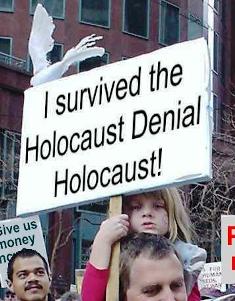
Holocaust Denial And Uncomfortable Truths


It has always been those few who can see through the political correctness and hypocrisy of popular attitudes who are considered dangerous.

"Holocaust denial laws" are now in place in about a dozen countries. Defenders of these laws claim that the expression of unconventional views about the Jewish genocide is "hate speech" and "incitement to violence" and therefore must be suppressed.

But history shows the greatest purveyors of lies, hatred and incitement to violence are those with the power to spread their poison by manipulating popular opinion via the control or complicity of the mass media. Through a purposefully constructed lens of political correctness the despicable becomes normal. It is by this insidious process that tyrants make it normal and acceptable to murder those whom they consider threatening or inferior. We have only to turn on the television to see that process at work.

It is not the unpopular views we should fear but the popular.

When the suppression of free speech serves no purpose other than to silence unconventional opinions we should be alarmed. We should be even more alarmed when to question oppressive laws is to risk vilification, in this case by the smear of "Holocaust denier" and "anti-Semite".

Appropriation of the term "The Holocaust" to the Nazi extermination of the Jews minimises the significance of other genocides, including those that are happening right now. Should these crimes also be closed to opinions that question the accuracy of the official "truth"?

Stifling open discussion and debate also does an injustice to the other millions of victims of the Nazi concentration camps: the Roma, Blacks, Polish and Russian prisoners, Jehovah's Witnesses, homosexuals and the mentally and physically disabled. It sidelines the slave labourers starved, beaten and worked to death in German war industries and the horrors suffered by anyone expressing anti-Nazi views.

It is likely that most people regard the real deniers of the Jewish genocide - the ones who say the extermination crimes never happened at all - in the same light as those who espouse any number of other oddball ideas. Do we need laws to protect us from those who make obviously unsupportable claims?

The real threat posed by "deniers" is that others might be influenced to undertake serious study and uncover embarrassing facts that would refute Israel's "victim" status. This would threaten Israel's moral legitimacy, underpinned by the world's collective shame for looking the other way. All it takes to invoke that shame is the term anti-Semite, either stated or implied.

But opinions that question the widely accepted WWII Jewish genocide history are not anti-Semitic any more than opinions that question the accepted history of the Ukraine genocide (1) are anti-Russian. That we are led to label any deviation from the official history as "Holocaust denial" and "Holocaust denial" as anti-Semitism is no accident. It has come about by the same semantic sleight of hand that would have us believe anti-Zionism and anti-Semitism are one and the same. They are not.

Many Christians are Zionists while many Jews throughout the world, perhaps even the majority, are anti-Zionist. Anti-Zionism has nothing to do with persecution of the Jews. It is simply anti-racism and anti-colonialism as applied to the occupation of Palestine and the subjugation of its indigenous population. (2)

When anyone goes to great lengths to stifle open inquiry and debate on any subject, alarm bells should ring. Invariably the motivation is suppression of uncomfortable truths. The uncomfortable truth of the Jewish genocide is that millions of lives would certainly have been saved had it been the priority of the Zionist leadership to save them. Their priority instead was establishment of the state of Israel. And then, as now, the suffering of Europe's Jews and the world's collective guilt was exploited to that end. (3)

Ironically, when millions of refugees were trying to escape from Europe before the war, and even while the genocide was in progress, prominent leaders of the Zionist movement were "Holocaust deniers". When the truth could no longer remain hidden, the Zionist leadership opposed attempts to save the European Jews though financial and humanitarian aid and emigration. The exception was migration to Palestine, and even the relative few who were saved were selected not according to their plight but according to their perceived value to the future state of Israel.

One proposal by 270 members of the British Parliament, as a part of diplomatic negotiations with Germany during the height of the killings, was to evacuate 500,000 Jews from Europe and resettle them in British colonies. This offer was rejected by the Zionist leaders with the observation, "Only to Palestine!" (3)

It is clear from the statements and actions of the Zionist leadership that they considered the suffering of the European Jews advantageous in securing future international support for the establishment of the Zionist state.

Shocking? That uncomfortable truth is well documented for those who care or dare to study the subject.

Throughout history Jews, like many other minorities, have indeed been persecuted, but the modern state of Israel never was the victim. Since its inception it has been the coloniser, aggressor, tormentor and oppressor. Exploiting the memory of Hitler's victims to perpetuate the myth of "victim Israel" is cynical. To do so while attacking its neighbours and inflicting Nazi-style state terrorism, apartheid and genocide on the Palestinians is cynical in the extreme.

While "deniers" are jailed for expressing unacceptable views, the real criminals - those responsible for the agony and death of millions - manipulate popular opinion to make crimes against humanity, war crimes, contempt for international law and indifference to human suffering seem normal and acceptable. And they do so with impunity.

(1) http://www.bigeye.com/111703.htm
(2) http://pilger.carlton.com/page.asp?partid=519
(3) http://www.jewsagainstzionism.com/
rabbi_quotes/weissmandl.cfm

Source: Countercurrents


Bookmark and Share

Makinh felons of tens of millions of Americans.


U.S. Customs and Border Protection (Customs) has proposed a ruling that would re-define "switchblade" to include all pocket knives that can be opened with one hand. In doing so, they are arbitrarily reversing their own previous rulings. Worse, they are ignoring Congressional intent, will throw thousands out of work, endanger tradesmen and outdoorsmen, and make potential felons of tens of millions of Americans. It is just the latest reason we must pass the Write the Laws Act and prevent unelected bureaucrats from making law.

In 1958, Congress banned the possession of switchblades on federal lands, as well as the interstate sales of switchblades. This was a bad and unnecessary law, but it wasn't ambiguous. Congress was quite specific in defining what they meant by switchblade - "any knife having a blade which opens automatically— (1) by hand pressure applied to a button or other device in the handle of the knife, or (2) by operation of inertia, gravity, or both."

As the lawyers for Knife Rights, Inc. say, "Congress did not ban knives which contain springs. It could have, but did not. Congress did not broadly ban any knife that could be opened with one hand. It could have, but did not. The definition (of 'switchblade') is not nearly that broad."

Yet, Customs is determined to classify these knives as switchblades. While Customs' ruling applies to imports, its interpretation of the law and its definition of "switchblade" will be seen as binding in the federal courts and many state jurisdictions

Even though,

  • there's no evidence these knives are often misused as criminal weapons
  • tens of millions of Americans use these knives at work or outdoors
  • there are numerous instances where one must hold onto an object with one hand and access a knife with the other
  • in case of a fall or other accident, an enclosed pocket knife is much safer than a sheathed knife
  • manufacturers of such knives employ thousands of people

Moreover, this is an abrupt reversal of Customs' own previous rulings. This change is legally dangerous to individual Americans. Words have meanings, and Customs isn't changing the actual words, just how they'll define them. Individuals who think they know what the law says may be innocently unaware of the latest bureaucratic rulings that change the meanings of words.

The good news is there's growing opposition to the ruling . . .

But if the Write the Laws Act was in force, Customs wouldn't have the discretion to arbitrarily re-interpret legislative language. The WTLA says that all bills will have rules "defining the specific conduct to be prohibited" (emphasis added) and prevents bureaucrats from prescribing any rule that goes beyond the legislative language.

The Senate will be considering the Department of Homeland Security Appropriations bill on July 7. The best opportunity to stop Customs is to tell the Senate to amend the bill to prevent Customs from implementing their switchblade ruling. We ask that you:

  • Send a message to Congress telling them to introduce the Write the Laws Act
  • Tell them about how the U.S. Customs and Border Protection switchblade ruling goes against the Congressional intent of the Switchblade Act
  • Remind them this bureaucratic mischief would not occur under the WTLA
  • And finally, instruct them to amend the DHS Appropriations bill to stop the Customs switchblade ruling from going into effect.

To exceed the number of messages DC Downsizers sent Congress last month, we must send 1,884 messages today.

Source: DownsizeDC.Org

Bookmark and Share

NSA Shields Government Networks With More AT&T Secret Rooms


Just a week after the Defense Department announced plans to put the National Security Agency in charge of military cyber defense and attack, the agency’s reach has already expanded to include monitoring of government civilian networks.

The Obama administration has decided to proceed with a classified Bush administration plan to let the NSA monitor traffic going to and from government civilian networks to protect the networks from malicious code and activity, according to a Washington Post story on Friday.

Given the NSA’s involvement in the Bush administration’s warrantless eavesdropping program, critics are concerned that the monitoring of government traffic on private-sector telecommunication networks that are used by the general public would allow the agency to once again spy on large swaths of non-government traffic without a warrant.

AT&T, which was scheduled to launch a pilot project last February to test the monitoring program, has insisted on government assurances that its cooperation is legal. The company, along with other U.S. telecoms, were sued in 2006 for their involvement in the Bush administration’s warrantless eavesdropping scheme before being given retroactive immunity by Congress last year.

In the monitoring program, called Einstein 3, telecommunication companies would route data going to and from government networks through an NSA monitoring box, which would examine the traffic for malicious code or suspicious activity suggestive of a network attack.

But critics are concerned that proper oversight is in place to prevent non-government traffic from being vacuumed into the system. There are also concerns that the content of correspondence sent to and from government officials and workers, including personal communication sent via private e-mail accounts accessed from a government computer, would be collected and scrutinized by the NSA. The classified NSA technology that would be used to monitor the communications is codenamed Tutelage, according to the Post, and is already used on military networks.

Department of Homeland Security officials say that although the technology being used for the project will come from the NSA, DHS will oversee its implementation on private networks.

“We absolutely intend to use the technical resources, the substantial ones, that NSA has,” DHS secretary Janet Napolitano said. “But . . . they will be guided, led and in a sense directed by the people we have at the Department of Homeland Security.”

In May, President Obama declared that the government’s “pursuit of cybersecurity will not include — I repeat, will not include — monitoring private sector networks or internet traffic. We will preserve and protect the personal privacy and civil liberties that we cherish as Americans.”

Ari Schwartz, a vice president of the Center for Democracy and Technology, received a classified briefing of the Einstein program in March, along with other civil liberties advocates, and expressed some faith in Obama’s pledge to protect the public’s privacy.

“There are a number of concerns that come with this process, the main one being how do you go about protecting the system in a way that insures you’re not monitoring private systems,” Schwartz told the Associated Press. “I don’t have a full answer to that question, but the president made that pledge. That makes me more comfortable that it won’t happen.”

Source: Wired


Bookmark and Share