Showing posts with label Israeli Divestment. Show all posts

Tuesday, December 1, 2009

Call for an international campaign against the Jewish National Fund


The Jewish National Fund (JNF) has charitable status in over 50 countries, a status based on the JNF's claim that it preserves and advances Jewish culture, community, civic and political participation, rights and safety. In reality, the JNF was created in 1901 for the purpose of colonizing Palestine through the acquisition and management of land for exclusively Jewish settlement. Today, it continues to play a central role in the violent colonization and occupation of Palestine, and is a key institution in maintaining Israeli apartheid.

Where once the JNF's role was birthing the State of Israel, it is now granted special privileges and an ongoing role in State function, such as their administrative role in the Israeli Land Administration. In turn, the JNF, as a private institution, can hold in trust land and property for the State of Israel, its Jewish population and Jews living outside of Israel and openly discriminates against Palestinian citizens of Israel-preventing Palestinian leasing of JNF land. Far from the charitable organization the JNF claims to be, it is a para-statal organization-enacting functions of the State of Israel as a private organization, but without the attendant legal accountabilities or regulation.

13% of land in '48 (Israel) is controlled directly by the JNF, most of it seized from Palestinians and transferred to the JNF after May 1948.

  • The JNF and Israeli Lands Administration control, through a joint committee, 93% of the land in Israel.
  • By its own description, JNF money is also used for the ‘Judaisation' (equating to ‘de-Arabisation') of the Galilee and the Negev.
  • In addition JNF money is used to finance reservoirs in the West Bank that steal Palestinian water for settler-only use.

Most recently, the JNF has been involved in expanding Israel's colonial project into the Negev-displacing the indigenous Bedouin people from their "unrecognized" villages into "concentration zones" and destroying their economic, cultural and social way of life. More broadly, central to the mission of the JNF is the acquisition of Palestinian land and property in historic Palestine "for the purpose of settling Jews on such lands and properties." This includes JNF involvement in settler enterprises across the West Bank. When the Israeli army razed to the ground the Palestinian villages of the Imwas, Yalu and Beit Nuba villages in 1967 and expelled their inhabitants, the JNF took over the construction of the Canada National Park on the ruins. The JNF today claims to be a global environmental leader and trumpets their slogan of ‘Plant Trees and Bring Water to Israel'-a cover up to the ethnic cleansing and acquisition of Palestinian land and water involved in this process. Donors from around the world are then implicated in these crimes, as are the Canadian government and tax payers in the case of Canada Park.

Beyond this, the JNF is active in countries throughout the world and supports a broader network of Zionist institutions and organizations that support the Israeli military and militant Jewish settlements with direct funds. The JNF and its network of organizations also provide the political support necessary for legitimizing and promoting public policies and aid packages for Israel. Every year they bring thousands of public officials and community leaders to Israel to lobby their support. In individual countries, these organizations censor criticism of Israel and target individuals and organizations with blacklists, violence, imprisonment, deportation, unemployment and other economic hardship.

The JNF does not do what it claims to do. It claims to exist for the well-being of the Jewish people. In reality, its activities and the organizations that it funds exist almost exclusively for the purpose of securing and expanding Israel's colonization of Palestine and the apartheid Israeli State. The JNF claims that Jewish safety depends on a secure Israeli State. But Israel does not make Jews safe. Its violence and racism guarantees instability and fear for those within Israel, the rest of historic Palestine, and endangers the safety of all people, including Jews, far beyond its borders.

We are calling for an international campaign to challenge the legitimacy and actions of the Jewish National Fund. We are calling for sanctions against the JNF as a key institution of Israeli apartheid defined by the UN as a crime against humanity. We are calling for the JNF to pay reparations to the Palestinian people for the catastrophic damages done over the course of the JNF's 107 years of existence as a vehicle for the colonial settlement of Palestine.

Demands: Our abiding demand is to revoke the charitable status of the Jewish National Fund.

From states and the United Nations we call for:

  • Sanctions against the JNF for its participation in Israeli apartheid
  • Boycotting of JNF funded, directly and indirectly, delegations to Israel

From civic society, we call for:

  • Civil suits by those whose property was confiscated by the JNF
  • Jewish divestment from JNF and its subsidiaries
  • An end to grassroots and NGO collaboration with the JNF, particularly by environmental organizations
  • An active boycott of Zionist and Israeli events organized by JNF and its subsidiaries

We will:

  • Take Legal action: challenge the charity status of the JNF and coordinate other judicial review process, support cases against the JNF by Palestinians whose land and property were stolen by the JNF and/or who were dispossessed by the JNF - from 1948 until today,
  • Research and document JNF's activities, use of funds, and impact, support investigation into JNF funding of and participation in para-statal activities, collect testimonies, produce research reports and publications, write articles, publicize findings, collect land deeds, digital stories/videos of testimony and a book of specific cases that highlight JNF role in land confiscation and discrimination as part of a broader system of occupation and colonization
  • Educate: produce printed materials, submit presentations for conferences, organize workshops and public speaking events, coordinate art exhibits, performances and speaking tours, create digital stories based on testimonies
  • Boycott and Disrupt JNF Events: JNF organized fundraisers, delegation, and cultural, educational, sporting and political events
  • Take Direct action: Petitions, letters, poster and sticker campaign, disruption of events, pickets, civil disobedience, demonstrations
  • Produce and leverage mass and grassroots media: submit editorials and article to print and online journals, organize press conferences, buy advertisement, produce grassroots media, produce and/or screen documentaries, produce and participate in public radio and television series, produce poster campaign
  • Support processes of accountability under international law: participate in review processes being organized by civil organizations to hold Israel accountable under human rights and other international law (i.e. review of Israel for its treaty implementation under the Covenant on Economic, Social and Cultural Rights)

Join the Boycott, Divestment and Sanctions Campaign National Committee (BNC)[1], Scottish Palestine Solidarity Campaign, Habitat International Coalition of Cairo and the International Jewish anti-Zionist Network in coordinating this campaign.

For more information, contact us at: jnf.campaign@gmail.com

Source: International Jewish Anti-Zionist Network


Bookmark and Share

Thursday, October 8, 2009

ANOTHER FIRM JOINS THE ‘BOYCOTT LIST


In its Code of Conduct, the Volvo Group commits itself to support and respect the protection of human rights and to ensure that it is not complicit in human rights abuses. However, by providing construction and transportation equipment that facilitates Israel’s occupation, the company violates this Code of Conduct on a daily basis.

With increasing calls for boycott of and divestment from companies that support Israel’s occupation, Volvo Group can expect activists around the world to put pressure on responsible investors to divest from the company and to call on public bus companies not to buy Volvo buses.

Volvo providing armored buses for Israeli settlements
Adri Nieuwhof

Merkavim’s promotional video shows Israeli soldiers boarding an armored bus.
Following reports published by The Electronic Intifada on the use of Volvo equipment in the demolition of Palestinian houses in 2007, the Volvo Group stated that it did not condone the use of its equipment for such purposes. Claiming to have no control over the use of its products, Volvo affirmed that its Code of Conduct decries unethical behavior. In spite of these claims, The Electronic Intifada has found that through its Volvo Buses branch, the Volvo Group is providing armored buses to transport Israeli settlers in the Occupied Palestinian Territories (OPT).

Volvo Buses is co-owner of Merkavim Ltd., an Israeli transport technology company. Another shareholder in the company is Mayer’s Cars and Trucks, the exclusive Israeli representative of companies from the Volvo Group. According to Merkavim’s website, the company was chosen by Volvo as “its major body builder in the Middle East.” However, the Who Profits from the Occupation? project recently reported that Merkavim manufactures an armored version of Volvo’s Mars Defender bus for the Israeli public transport company Egged. Egged uses the Mars Defender to provide bus services for illegal settlements in the occupied West Bank.

Merkavim proudly announced on its website that the Mars Defender offers protection and ultimate comfort when traveling through war zones or routes susceptible to terrorist attacks. In a promotional video the armored bus is shown driving along Israel’s wall in the West Bank and crossing checkpoints (

http://www.merkavim.co.il/upload/defender.wmv, accessed 6 October). In another video on Merkavim’s homepage, Volvo’s Senior Vice-President of Business Region Europe, Lars Blom, declares that “Three core values that are very important to us are quality, environmental care and safety. … [T]he products we are developing with Merkavim also deliver these three core values plus reliability” (http://www.merkavim.co.il/movies_library/merkavim.wmv, accessed 7 October 2009)

According to Merkavim, in the video promoting the bus, the Mars Defender “looks like any other modern bus,” but it is “the world’s most armored bus.” Indeed, the company calls it “the bus that saves lives!” As the narrator explains that the bus is “designed to safeguard the most precious cargo,” the camera pans over Israeli soldiers lining up to board the bus and on patrol with their machine guns at the ready. The video explains that Israel has “adapted its world renowned expertise in military and defense technologies to deal with” the “growing threat” of “terrorists and hostile forces.” It adds that Merkavim “blends this state of the art know-how with its own expertise” to produce the Mars Defender. Built on a Volvo chassis, the Mars Defender’s sides, front, roof and floor are shielded with steel armored panels and it is fitted with bullet- and explosion-proof armored glass windows as well as “run-flat” tires. According to the company, these safety measures allow the bus to withstand “grenades, car bombs, roadside charges and 7.62 caliber armor-piercing bullets.” Merkavim claims that these features are needed because “people trust this bus with their lives.”

The 2004 advisory opinion of the International Court of Justice on Israel’s wall in the West Bank confirmed that settlements violate Article 49 of the Fourth Geneva Convention. Article 49 explicitly states that the Occupying Power is not allowed to deport or transfer parts of its own civilian population into the territory it occupies. Bus services with Volvo subsidiary’s Mars Defender armored buses facilitate the maintaining of illegal settlements in the OPT.

In its Code of Conduct, the Volvo Group commits itself to support and respect the protection of human rights and to ensure that it is not complicit in human rights abuses. However, by providing construction and transportation equipment that facilitates Israel’s occupation, the company violates this Code of Conduct on a daily basis. With increasing calls for boycott of and divestment from companies that support Israel’s occupation, Volvo Group can expect activists around the world to put pressure on responsible investors to divest from the company and to call on public bus companies not to buy Volvo buses.

Source: Dessert Peace


Bookmark and Share

Thursday, August 6, 2009

JOIN US IN BOYCOTTING AHAVA


There is a Jewish teaching: "Thou shall not derive personal pleasure or benefit from any product created through exploitation." AHAVA, an Israeli cosmetics company, is violating the basic principles of international law and Jewish ethics by profiting from the occupation of Palestine. Using resources from the ancient waters of the Dead Sea, AHAVA manufactures beauty products in an illegal Israeli settlement in Occupied Palestine.

AHAVA means love in Hebrew. But there's nothing loving about profiting from occupation. There's nothing loving about stealing resources from our neighbors.

As one of the first practicing women rabbis, as a Jew and as concerned human being, I endorse CODEPINK's new campaign to boycott AHAVA.

For over 40 years, I have been working to promote justice and reconciliation in the Middle East. I have watched more settlements, walls and checkpoints being built, and more Palestinians arrested and ground down by poverty, hunger, illness and oppression. After decades of working for peace through dialogue, I've come to believe that it's time to apply new tactics. It's time for us to listen to the Israeli and Palestinian peace activists who are calling on us to boycott Israeli products made in Occupied Palestine. It's time to take the profit out of the occupation.

Join me in boycotting AHAVA. Pass this message to your friends and neighbors: The fruits of occupation are simply not kosher!

Rabbi Lynn Gottlieb
Cofounder, Shomer Shalom Network for Jewish Nonviolence
Member of CODEPINK

Today, CODEPINK is launching our STOLEN BEAUTY campaign to protest and boycott AHAVA.

Won't you join our boycott?

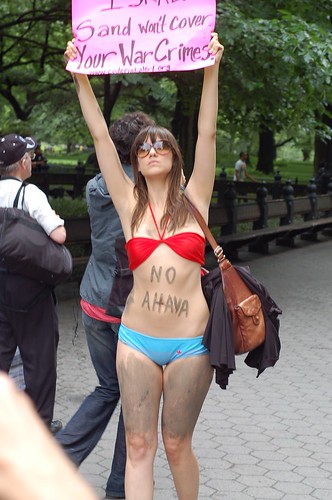
Bikini-clad CODEPINK activists smeared with mud have already rallied in Tel Aviv, New York, Los Angeles, Las Vegas, France , and just yesterday in DC to expose the dirty secrets of AHAVA. You don't have to don a bikini to take part in our boycott, however. Educate yourself about AHAVA's illegal practices at www.stolenbeauty.org , and add your name to our boycott. Sign up to join the team and receive updates about this campaign, and use your voice to help AHAVA come clean. Or visit a store selling AHAVA in your community, following our 10-step action guide.

AHAVA violates international law by labeling their products of "Israeli origin" even though their products are produced in the Occupied West Bank, and they violate the Fourth Geneva Convention by exploiting occupied natural resources for profit. AHAVA tries to put a pretty face on their company, touting their products' purity and even hiring Oxfam Ambassador and 'Sex and the City' star Kristin Davis as their spokesperson. It's up to us to bring their illegal practices to light.

Thank you for helping to bring the ugly truths of this beauty company to light and showing your support for international law and human rights.

Getting Muddy for Justice,

Blaine, Dana, Desiree, Farida, Gael, Gayle, Janet, Jean, Jodie, Medea, Nancy K, Nancy M, Paris, and Rae

P.S. We have six spaces left for the trip to Gaza on September 16-23. Every trip has been an extraordinary experience. For more information and to sign up, click here

Source: Code Pink
Bookmark and Share

Beach day protestors grab headlines in NYC


Beach day protestors grab headlines in NYC
Worldwide Activism, Palestinian Grassroots Anti-Apartheid Wall Campaign, June 25th, 2009

As part of its on-going rebranding campaign, the Israeli Ministry of Tourism held a Tel Aviv Beach Party in Central Park, New York City, on 21 June, 2009. Members of CODEPINK protested at the event and drew both public and media attention away from the effort to celebrate Tel Aviv’s 100th anniversary and to promote the Israeli tourism industry, instead bringing the spotlight onto war crimes and the BDS movement.

The goal of the demonstration was to expose that the beach party as a tool being used to clean up the Israeli reputation. In addition to the Wall, settlements and blockade of Gaza, the recent massacre in Gaza has turned world opinion against the occupiers and has been a blow to their international images.

Protesters were also promoting CODEPINK’s ‘Stolen Beauty’ campaign to boycott Ahava products, part of the global BDS movement. Ahava is an Israeli cosmetics company whose products are made from mud extracted from the Dead Sea, located in the occupied Jordan Valley and effectively closed to Palestinians. The bikini-clad protesters covered themselves in mud to represent both Israel’s dirty policies and to show the dirty side of Ahava products.

The protest was a media success, with conservative media giant, FOX News, covering it and torpedoing the PR goals of the beach day party.


Go here for more photos of the protest.


Source: Stop the Wall
Bookmark and Share

Wednesday, July 29, 2009

Norway examines the ethics of its Israel investments


Norway is reexamining its investments in several Israeli companies, in particular Elbit Systems. Two representatives of the Council on Ethics of the Norwegian finance ministry visited Israel at the beginning of June, in the wake of growing criticism of Israel in Norway in the months following last winter’s Israeli offensive in Gaza. The representatives met with, among others, groups of Palestinians and Israelis who claim that Norway invests in businesses directly involved in the Israeli occupation, which, they say, contradicts its commitment to abide by international law and to a just solution for the area.

The Council on Ethics was established to insure that foreign investments by the Norwegian Government Pension Fund-Global meet its ethical guidelines. At the end of 2008, the fund was invested in about 8,000 international companies, to the tune of 2,275 billion kroner, approximately $365 billion, according to this week’s exchange rate.

Of that amount, the Norwegian investment in Israeli companies totaled some 2.67 billion kroner, about $428 million, with another 627 million kroner in bonds, about $100 million. According to the Central Bank of Norway, the investment in Elbit Systems, which manufactures electronic equipment used by military and other security organizations, was 35 million kroner at the end of 2008, about $5.75 million, a little under a third of 1 percent of the company’s stock. The year 2008 saw a significant increase in the number of Israeli companies whose stock the Norwegian fund purchased, from eight in January to 41 by December.

Nearly two-thirds of the 41 companies are involved in development and building in the occupied territories, including the parts that were annexed to Jerusalem after the 1967 war. Another 11 international companies in which the Norwegians invest are also involved in the activities of Israeli companies on the other side of the Green Line, according to the “Who Profits from the Occupation” project of the Coalition of Women for Peace.

Earlier call for boycott

The Council on Ethics does not usually confirm or deny reports on the checks it conducts. But the examination of Israeli investments became known because representatives of the council met with the Israeli ambassador to Norway in Oslo before their visit to Israel. According to newspaper reports, Norwegian Finance Minister Kristin Halverson announced at the height of Operation Cast Lead, in Gaza last winter, that the pension fund was obligated to examine its Israeli investments.

The fund’s chairwoman, Gro Nystuen, told Haaretz that the Norwegian finance ministry itself published an announcement that investments in Elbit were under scrutiny, information that members of the council are themselves not allowed to volunteer. Finance Minister Halverson is a member of the Socialist Left Party, a partner of the Labor and Center parties in the coalition government. In 2005, when her party was in the opposition, Halverson called for a boycott of Israel. But after voicing a similar statement as a member of the government’s ruling coalition, she then recanted, when the government made clear that this was not official Norwegian policy toward Israel. The Socialist Left Party was among the most persistent political forces demanding the implementation of ethical guidelines for government investments.

The representatives’ June visit to Israel was also not a routine one. According to Nystuen, taking into consideration that Norway invests in 8,000 companies around the world, out of a potential 80,000, it is not possible to visit each relevant country. She said that one of the representatives was planning in any case to participate in a conference taking place in Israel, and so the examination, based on existing materials in writing, was combined with an on-site visit.

People who met the council representatives during their visit in the country said two major Elbit products - surveillance systems for the separation barrier and pilotless aerial vehicles (drones), both of them causes of the reexamination - were under special scrutiny, even though the drones are not included in the Norwegian category of forbidden weapons.

Erik Hagen, who works for the independent news service Norwatch, assumes that other Israeli companies are also under scrutiny. Norwatch is monitoring whether Norway’s foreign business investments match its criteria for human rights, workers rights and protection of the environment. Hagen’s previous reports in Norwatch led to the first exclusion recommended by the Council on Ethics - from the American oil-scouting firm formerly known as Kerr-McGee, which was operating in the Sahara, in territory occupied by Morocco.

The Government Pension Fund-Global, originally the Government Petroleum Fund, is meant to insure that Norway’s oil income will be available for the welfare of future generations; it began operating in the 1990s. The Council on Ethics was established in 2004, when the fact became known that - although Norway is party to the international demand for a ban on land mines - the fund was invested in a Singaporean company that manufactured mines, and the subject became a matter of public debate in Norway.

The council’s members include two lawyers, an economist, a biologist and a philosopher. The council’s ethical guidelines do not rule out investment in companies that produce weapons. A prohibition does, however, apply to producers of nuclear or chemical weapons, cluster bombs, land mines, and incendiary weapons of all types, such as napalm.

According to the guidelines, the fund may not invest in companies that “constitute an unacceptable risk of the Fund contributing to serious or systematic human rights violations, such as murder, torture, deprivation of liberty, forced labor, the worst forms of child labor and other forms of child exploitation, serious violations of individuals’ rights in situations of war or conflict, severe environmental damages, gross corruption or other particularly serious violations of fundamental ethical norms.” The council inspects the nature of the company’s products, and does not examine governments’ policies in countries where the Fund invests. Since its establishment, the council has recommended excluding some 30 companies and the Norwegian finance ministry adopted the majority of these recommendations.

The council has examined its holdings in Israel twice before: in 2006, when the fund was invested in only five Israeli companies, and in 2008 and 2009, when investments in Israel Electric Corporation bonds came under scrutiny. At that time the council decided there was no reason to withdraw its holdings, for it found no evidence that the electric company was involved as a company in the withholding of electric supply to the Gaza Strip. The examination and recommendation processes are likely to take many months; sometimes they can take as much as a year. If the recommendation is to exclude a company, and the Norwegian finance ministry adopts it, the decision will be made public only after the stocks are sold.

Source: Haaretz

Bookmark and Share

Wednesday, July 15, 2009

HeidelbergCement tries to sell W Bank mines as boycott pressures grow


HeidelbergCement, one of the world's largest manufacturers of building materials, has become the target of legal action in Israel because of its activities in the Occupied Palestinian Territories (OPT). The company's subsidiary, Hanson Israel, manufactures ready-made cement, aggregates and asphalt for Israel's construction industry and operates a quarry in the occupied West Bank.

In March, the Israeli human rights organization Yesh Din filed a petition with the Israeli high court demanding a halt to illegal mining activity in West Bank quarries, including Hanson Israel's Nahal Raba quarry. Attorneys representing Yesh Din called upon the court to put an end to this "clearly illegal activity, which constitutes blunt and ugly colonial exploitation of land we [Israel] had forcefully seized."

Yesh Din's attorneys argued that the practice is reminiscent of occupation patterns in ancient times when there were no laws of war and the victor could plunder the occupied territory, enslave its economy and citizens, and transfer the natural resources of the vanquished to its own land. In May, Israel ordered a freeze on the expansion of Israeli-run stone and gravel quarries in the occupied West Bank. The Ministry of Justice asked the court to delay a hearing for six months to study the legal position of the quarries. In addition to its mining activity at Nahal Raba, the Israeli Coalition of Women for Peace reported on the website Who Profits from the Occupation? that Hanson owns two concrete plants in the settlements of Modiin Illit and Atarot, and an asphalt plant south of the Elqana settlement.

Five years ago, the International Court of Justice (ICJ) reaffirmed in its authoritative ruling the right of self-determination of the Palestinian people, that Israel is the occupying power in the Palestinian territories, and the illegality of settlement construction, which includes the construction of industrial sites in the settlements.

Transnational corporations like HeidelbergCement are required by international law to comply with international rules governing corporate responsibility with respect to human rights.

In 2003, the UN Sub-Commission on the Promotion and Protection of Human Rights defined norms on the responsibilities of transnational corporations and other business enterprises with regard to human rights. The norms are framed within the general obligation that "States have the primary responsibility to promote, secure the fulfillment of, respect, ensure respect of and protect human rights recognized in international as well as national law, including ensuring that transnational corporations and other business enterprises respect human rights."

"Transnational corporations and other business enterprises," the UN norms state, also specifically "have the obligation to promote, secure the fulfillment of, respect, ensure respect of and protect human rights recognized in international as well as national law, including the rights and interests of indigenous peoples and other vulnerable groups."

Hanson Israel's concrete and asphalt plants in the OPT -- just like the Israeli settlements -- are contrary to international law. Israel's mining of Palestinian natural resources, mainly for the Israeli market, also violates international law. Through Hanson Israel's operations in the occupied West Bank, HeidelbergCement is involved in Israel's violations of international law and the company acts against the rights and interest of the indigenous Palestinian people.

The UN Norms for transnational corporations are an authoritative guide to corporate social responsibility. Institutional investors and asset managers are increasingly insisting on corporate social responsibility as a requirement for their continued investment. As states fail to meet their obligations to hold Israel accountable for its violations of international law, economic pressure can be used as a tool to hold companies who render aid or assistance to Israel's violations of international law to account.

In early 2008, for example, the Dutch ASN Bank divested from the Irish construction firm Cement Roadstone Holding (CRH), a competitor of HeidelbergCement. CRH owns 25 percent of the Israeli Mashav Group, the holding company for Nesher Cement. According to the Israeli Coalition of Women for Peace, Nesher provided cement for Israel's wall, checkpoints and illegal settlements in the OPT. Activists in Ireland have demanded that CRH end all of its activities that facilitate the Israeli occupation.

The growing global movement for boycott, divestment and sanctions on Israel has brought major investor, the Norwegian Government Pension Fund, under pressure to distance itself from companies benefiting from the Israeli occupation of Palestine. In May, 20 Israeli organizations sent a letter to the pension fund calling for divestment from 15 companies, including HeidelbergCement.

Following a sustained campaign calling for an end of French transportation giant Veolia's complicity with Israeli violations of Palestinian rights, it was reported last month that the corporation planned to abandon its involvement in a light rail project in Jerusalem that would effectively normalize the illegal situation of Israel's settlements.

Although Veolia's headquarters in Paris has remained silent, the company's communications manager in Sweden, Gunhild Saumllvinn, told the Swedish news agency TT on 14 June that heavy criticism of Veolia's participation in the project and the loss of several major contracts is "probably is one of the reasons behind the decision" to withdraw involvement.

It seems that like Veolia, HeidelbergCement is attempting to sell off its Israeli subsidiary. The Israeli business magazine Globes reported in May that the Mashav Group and Engelinvest Group have shown interest in acquiring Hanson Israel. If Mashav buys Hanson, however, Irish firm CRH can expect to be greeted with increased pressure to divest from the Mashav Group, likely achieving a similar end as the Veolia divestment campaign.

Source: IMEU
Bookmark and Share