The cases, filed recently in federal district court in San Jose, Calif. on behalf of nine Facebook users, allege that the new settings are “confusing and materially deceptive” and lessened their privacy.


By Penn Bullock
Remember VeriChip, the Florida company that once dreamed of injecting its human-implantable RFID microchips in everyone from immigrant guest workers to prison inmates?
We haven’t heard much from the company since a dipping stock price nearly got it delisted from the NASDAQ in March. But it’s still alive, and in November it pulled off a seemingly incongruous acquisition. Now called PositiveID, the new company is a merger between VeriChip and Steel Vault, the people behind NationalCreditReport.com.
With a human-implantable microchip maker now running a credit-scoring and identity-theft-protection website, privacy activists are worried again. “The attraction to investors is the potential for synergies,” says Mark Rotenberg, executive director of the Electronic Privacy Information Center in Washington. “You have to anticipate over time there will be an attempt to integrate the services.”
Now, everyone has their activities tracked in the name of a better serviceAnyone who’s a regular Google search user will know that the only way to avoid the company tracking your online activities is to log out of Gmail or whatever Google account you use. Not any more.
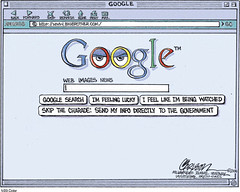
As of last Friday, even searchers who aren’t logged into Google in any way have their data tracked in the name of providing a ‘better service’.
Google CEO Eric Schmidt says privacy isn’t important, and if you want to keep something private, “maybe you shouldn’t be doing it in the first place” (in other words, “innocent people have nothing to hide.”) Bruce Schneier calls bullshit with eloquence: “For if we are observed in all matters, we are constantly under threat of correction, judgment, criticism, even plagiarism of our own uniqueness. We become children, fettered under watchful eyes, constantly fearful that — either now or in the uncertain future — patterns we leave behind will be brought back to implicate us, by whatever authority has now become focused upon our once-private and innocent acts. We lose our individuality, because everything we do is observable and recordable.”
But JWZ has the kicker, when he reminds us that Eric Schmidt’s Google blackballed CNet’s reporters after CNet published personal information about Schmidt’s private life:
Half-baked Homeland Security is spending millions to develop sensors capable of detecting a person’s level of ‘malintent’ as a counterterrorism tool.

In the sci-fi thriller Minority Report, Tom Cruise plays a D.C. police detective, circa 2054, in the department of “pre-crime,” an experimental law enforcement unit whose mission — to hunt down criminals before they strike — relies on the psychic visions of mutant “pre-cogs” (short for precognition) who can see the future. It may be futuristic Hollywood fantasy, but the underlying premise — that we can predict (if not see) a person’s sinister plans before they follow through — is already here.
This past February, the Department of Homeland Security (DHS) awarded a one-year, $2.6 million grant to the Cambridge, MA.-based Charles Stark Draper Laboratory to develop computerized sensors capable of detecting a person’s level of “malintent” — or intention to do harm.
Chris Soghoian, whose post on 8 million times the government has used GPS tracking on Sprint’s customers in the last year, has apparently flushed out the spying policies of many of the nation’s telecoms. Cryptome has them posted–though (as Mary points out) Yahoo has freaked out and initiated take-down proceedings.
Yahoo isn’t happy that a detailed menu of the spying services it provides law enforcement agencies has leaked onto the web.
Shortly after Threat Level reported this week that Yahoo had blocked the FOIA release of its law enforcement and intelligence price list, someone provided a copy of the company’s spying guide to the whistleblower site Cryptome.
The 17-page guide describes Yahoo’s data retention policies and the surveillance capabilities it can provide law enforcement, with a pricing list for these services. Cryptome also published lawful data-interception guides for Cox Communications, SBC, Cingular, Nextel, GTE and other telecoms and service providers.

Sprint Nextel provided law enforcement agencies with its customers’ (GPS) location information over 8 million times between September 2008 and October 2009. This massive disclosure of sensitive customer information was made possible due to the roll-out by Sprint of a new, special web portal for law enforcement officers.
The evidence documenting this surveillance program comes in the form of an audio recording of Sprint’s Manager of Electronic Surveillance, who described it during a panel discussion at a wiretapping and interception industry conference, held in Washington DC in October of 2009.
[snip]
[M]y major concern is the volume of requests. We have a lot of things that are automated but that’s just scratching the surface. One of the things, like with our GPS tool. We turned it on the web interface for law enforcement about one year ago last month, and we just passed 8 million requests. So there is no way on earth my team could have handled 8 million requests from law enforcement, just for GPS alone. So the tool has just really caught on fire with law enforcement. They also love that it is extremely inexpensive to operate and easy, so, just the sheer volume of requests they anticipate us automating other features, and I just don’t know how we’ll handle the millions and millions of requests that are going to come in.
Now, as he documents in extensive detail, using cell phone location to get the geolocation of someone is just one of a number of uses of legal surveillance techniques that is eluding public reporting.
But that’s by design. Even assuming many of these uses of Sprint’s geo-tracking capabilities are multiple requests for the same person, there are a whole lot of people whose physical location is being tracked.
Probably a bunch of people who bought acetone and hyrdogen peroxide for home improvement uses.
Anyway, click through for a bunch more numbers and discussion, as well as MP3s of this admission.