Friday, July 17, 2009

Secret evidence imperils the core values of British justice


To have the basis of a case against you withheld tests the very idea of a fair trial – yet secrecy is seeping across the system

One of the most alarming trends since 9/11 has been an ever-expanding fixation with secrecy in British courts. And at the heart of this is the creeping use of secret evidence: you face a case against you, but the very basis for it is withheld. It is a practice that is entirely antithetical to our most ancient and venerable concepts of a fair trial.

The problem with this debate is that it can go only so far. The government more or less agrees that secrecy is undesirable in legal proceedings, but insists that keeping evidence closed represents the lesser of two evils, and is a necessary tool in the battle to protect national security.

It is difficult to challenge this position, for obvious reasons. Because the material is secret, its contents are immune from outside scrutiny. Neither the person subject to the proceedings nor, in some cases, the court itself – let alone the press – have any idea what this evidence contains. Meaningful engagement with the government's position is difficult or, in most cases, impossible.

There are exceptions, however, when we get glimpses into the quality of evidence that is being kept secret. One was offered by high court judge Sir Robert Owen last week. The court was considering the case of an Egyptian man, known by the initials HAY, whose finances were frozen when the government was notified of his "designation" by the ominously named "1267 Committee" – a UN committee established to identify suspected al-Qaida members.

The effect of the freezing order on HAY's life was described by the court as "draconian": he no longer has access to his bank account and cannot buy food or clothing. For a third party to provide him with money would be a criminal offence.

But, as Owen's judgment makes clear, not even the government has any confidence in the evidence – kept secret – on which the 1267 Committee's decision was based. The only insight his lawyers, and the public, have into the quality of this evidence is that, having conducted its own review, the Foreign Office agrees the sanctions against HAY should be lifted.

For the government to be on the side of the suspect in challenging the validity of secret evidence is, however, rare. In most cases, it is the government that has produced the secret evidence, and the only insight third parties – including the suspects – can hope to get is from their lawyers, who are allowed to see it.

Clive Stafford Smith, who has been privy to secret evidence in the cases of Guantánamo Bay detainees he has represented, says he can make the case against this material using information that is in the public domain.

"After seven years of interrogating people in Guantánamo Bay," Stafford Smith says, "they have whittled 779 prisoners down to 219 – supposedly the worst of the worst. But judges in the US have so far acquitted 84% of the prisoners we have brought before the court."

Stafford Smith's strongest claims against secret evidence, however, can't be discussed, because the evidence is secret. He believes that the motive for keeping much of this material outside the public domain is not to protect national security, but to protect the government's own agents from viable allegations of serious criminal wrongdoing – a claim backed up by reporters who also, not surprisingly, cannot reveal what they have seen.

Journalists are severely limited in their access to genuinely secret material, but special advocates are in the unique position of experiencing both sides of the cases that take place behind closed doors. These special advocates – often barristers with a background in human rights law – have been among the most vociferous opponents of the use of secret evidence.

Ian Macdonald QC, who famously withdrew from his role as a special advocate in 2004, said he had initially signed up to the scheme believing it would allow those whose cases involved necessarily secret evidence to have a fair hearing.

"My role was altered to provide a false legitimacy to indefinite detention without knowledge of the accusations being made and without any kind of criminal charge or trial," Macdonald said at the time. "It is a totally bizarre, ridiculous and odious system."

In 2006 Andrew Nicol QC, now a high court judge but then a special advocate, noticed that one piece of evidence was being used to support two contradictory arguments in separate cases at the Special Immigration Appeal Commission. And in 2007 another special advocate revealed that evidence deemed "highly sensitive" had in fact been published on the internet a year earlier.

It is hard to imagine such basic mistakes being made in open court, given the inevitability of scrutiny by the defence and the press. Not that judges haven't provided some gems of insight into the failings of the security services themselves. Last year a judge quashed a control order, finding that MI5 had assumed "guilt by association".

Claims that this sloppiness is the tip of the iceberg can only be speculation, but these cases do not inspire confidence. The errors made by the security services seem even less sophisticated when rolled out across the legal system, with a report by civil rights group Justice last month describing the use of secret evidence in parole board hearings to deal with what should have been straightforward issues of witness protection.

Secret evidence shows no sign of slowing its creep across the legal system, but cases of suspected terrorism remain at the centre of the problem. Ironically, some of the highest-profile cases are likely to be among the first listed at the UK's new supreme court when it opens for business in October.

The legal teams representing these men – who still have no idea why their lives have been taken under government control – are likely to be greeted by phrases from the Magna Carta when they arrive. Tokens of wisdom such as "To no one will we deny or delay right or justice" are etched into the glass doors of the newly renovated building which, the government says, was specifically designed to inspire an atmosphere of justice, transparency and openness.

The judiciary has neither produced this secret evidence nor justified its use, so it would be unfair to dismiss the new building as meretricious. But the government may well have some explaining to do if it is to continue its push for transparency and secrecy simultaneously, without giving the concept of window-dressing a whole new meaning.

Source: The Guardian

Bookmark and Share

The Criminal Gossip Bureau can ruin your job prospects


It's been a big week for databases, although nobody has managed to make them sexy. On Monday, the pressure group Liberty underlined the failings of the Criminal Records Bureau – more precisely its enhanced check – for the Today programme. It was quite a story: a woman had been turned down for voluntary work, having been "spoken to" (as opposed to "reprimanded" or "warned") by police for leaving her children in the park while she went to the shops. It's one of those stories you can imagine Basil Fawlty popping an eyeball over. And then you think, hang on – I'm popping an eyeball. This is outrageous. She only went to the shops.

This evening Damian Green, the shadow immigration minister, gave a speech to the Centre for Policy Studies, asking if Britain is a free country. He identifies 28 agencies that hold personal data about individuals. In the light of his very credible starting position – that politicians have a duty to create an environment in which "the citizen has some personal space in which the state has no power, interest, or influence" – many of these agencies and their purview do seem … well, bogus is a strong word. Let's start with "a bit much".

The Tories have seized this ground – they are tighter with Liberty than is Labour; and there is no telling whose manifesto will promise the most in terms of individual privacy.

It's not a bad time, therefore, to look at database management as practised by the Criminal Records Bureau, which is as uncontroversial and hi-tech as any similar initiative of the past three terms of government. It is also a massive undertaking – the 1.5m people checked in 2002 had gone up to 4m in 2008-09.

Now, this park lady (who wishes to remain anonymous) was the victim of the enhanced criminal records check – the standard check, everybody agrees, is almost totally unproblematic. It passes on only current and spent convictions, cautions, reprimands, and warnings – which proceed from an admission of guilt (to be cautioned you have to accept a caution). A standard CRB check can also access List 99, a register of people who have been barred from working with children – but basically this check is not open to tittle-tattle. Furthermore, and I believe more important, the CRB is on target to process 95% of its standard-check applicants within 10 days.

The enhanced check, conversely, has come to the attention of Liberty – and not just on behalf of the park lady – because it can include, above and beyond that raft of convictions and warnings, "relevant and proportional information held on that individual", as decided by the chief officer of police. This really could be anything. People are warned when they put in for an enhanced check that it could even flag up other people living at their address.

As another for-instance (if you are of a mind that one shouldn't go to the shops while one's children are in the park), say you have a very loud argument with your partner, and a neighbour calls the police: this information will be logged even if you personally don't make a complaint, and rightly so, because the police are thereby alerted to respond maybe fractionally faster if you were to make a 999 call.

But say this isn't domestic violence, and it's just a very loud argument – it will still end up on your CRB check. This has now entered the realm of gossip: it will be passed on to a prospective employer with no warning to you. When you do find out, you have no right to get it struck from your record; and if your application was for a job in a domestic violence refuge, for instance, you might well find yourself considered unsuitable to work there.

Worse to my mind, however, is the sheer bureaucracy of the enhanced check – the bureau has targets of 90% of applications being processed within 28 days. That sounds good, but it is missed in 10% of cases. And in the Metropolitan police area applicants are quoted six to eight weeks. Moreover you have to re-apply every time you change jobs; or every three years, and after maternity leave, if you stay in the same job. In summer the system is slower because teachers are all being vetted.

This is no victimless matter – people in these "caring professions" are left without income, or even the means to bring in a temporary income, for weeks at a time. Bear in mind that working with children or vulnerable people is rarely well paid in the first place, and you have a system with unjust financial penalties built into the very bureaucracy.

The gossip element will, I believe, be ironed out in time, especially as a new vetting and barring process will be introduced in October that should in the long run obviate the enhanced check. But the way people are treated by government agencies – this high-handed, "well, we do most of you in a month, what are you complaining about?" attitude – is astonishing to people who work outside these altruistic sectors. The Conservatives might have a much bigger vote-winner with their anti-surveillance crusade than it initially appears.

Source: The Guardian

Bookmark and Share

The war on street photography


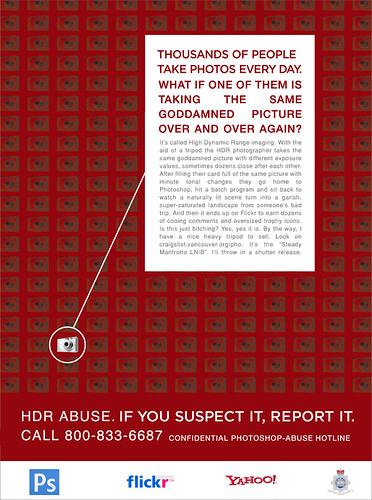
Report HDR Abuse by Airchinapilot.
Photographer Alex Turner has been arrested by Kent police for being "too tall" in an action which must cast further doubt on the collective sanity of Kent Police (see Kingsnorth) and which also suggests that some police forces are now really behaving as if we lived in police state, a phrase that I have been reluctant to use.

In his blog, Turner gives a full account of being stopped by two men in Chatham High Street, after he took a picture of a fish bar called Mick's Plaice, which stands between Specsavers and a shop called Mr Flower and advertises jacket potatoes and an all day breakfast in a colour scheme of bold blue and white. The men said they worked for Medway Council.

"I saw a badge attached to one of the men's waistband and saw the logo of Kent Police. The men asked me why I was taking pictures in the High Street.

I told them photography was a hobby and explained what and who I had taken pictures of and why".

Turner continues, "I asked them under what authority they were making their request. They did not provide a clear answer to this question in that they failed to state the legal authority under which they were making their enquiries."

Because they neither stated their authority nor properly identified themselves, Turner refused to answer their questions. The men summoned uniformed police. Turner took photographs of two officers as they approached him reproduced with blurred faces on his blog – and arrest followed. He was handcuffed held in police van and then questioned by two plain clothes officers. "They spoke about the threat of terrorism. They were keen to seek my agreement with regards to the views they expressed, both about the threat of terrorism and the suspicious nature of people with cameras and especially those who chose not to provide identifying details about themselves when requested to do so."

He was searched while still handcuffed. The officer told him to take of his trainers and patted down the soles of his feet. At some point the officers made a veiled threat about Turner's ability to continue as photographer.

"Whilst sharing their views about the threat of terrorism officer xxxxx [name redacted] stated she had felt threatened by me when I took her picture. I cannot recall exactly what she said but I do recall her referring to my size and implying she found it intimidating at the time (I am 5ft 11in and weigh about 12 stone)."

Turner concludes with this, "I believe the way I was treated was unjustified and wholly disproportionate. I assert that officer xxxxx misused her powers of arrest and demonstrated a poor understanding of the law in relation to arrest, the use of force, the use of detention, photography in public places, obstruction and the ... Terrorism Act 2000. Furthermore I assert that officer xxxxx is unsuitable to act as a police officer or at the very least requires further training if she is intimidated by a male of an unremarkable stature taking a single picture with a camera pointed in her direction."

Clearly something has to be done about the police attitude to photography and filming. This week it was reported that Essex Police photographed residents who attended a peaceful meeting about the future of Southend Airport. The Lib Dem MP Norman Baker who attended the meeting likened the behaviour of the police to "Stasi like spying" and attacked the "gross intrusion into people's civil liberties". The images have subsequently been destroyed and the officer in charge sent a half penitent letter to the local newspaper. The police response underlines how important it is for the public to challenge the use of covert and overt surveillance of law abiding political activity.

In another development, the magazine Amateur Photographer, has sought to clarify whether police have the right to delete photographic images. The Metropolitan Police's guidance suggests that they have the power "to seize and retain any article found during a search that they reasonably suspect is intended to be used in connection with terrorism."

But Rupert Grey, a lawyer working for Swan Turton, one of the best new law firms, told the magazine, "This is correct as far as the powers conferred by section 44 are concerned. But the advice fails to point out that although film and memory cards may be seized as part of a search, officers do not have a legal power to delete images or to destroy film."

He added: "The Association of Chief Police Officers' practice advice on stop and search in relation to terrorism makes this clear; so do guidelines for MPS staff on dealing with media reporters, press photographers and television crews: "Once images are recorded, [the police] have no power to delete or confiscate them without a court order."

Despite being too tall, Alex Turner did not have his pictures deleted.

However, the offence to his rights as a law abiding citizen are shocking and he is due an apology. What is needed now is clear statement from the home secretary on the rights of photographers and the limits of police surveillance.

Source: The Guardian

Bookmark and Share

Cheney ‘ordered CIA to hide plan’


Former US Vice-President Dick Cheney gave direct orders to the CIA to conceal an intelligence programme from Congress, US media reports say.

The existence of the programme, set up after 9/11, was hidden for eight years and even now its nature is not known.

CIA director Leon Panetta is said to have abandoned the project when he learnt of it last month.

He has now told a House committee that Mr Cheney was behind the secrecy, the unnamed US sources say.

There has been no comment from Mr Cheney.

War of words

The claims come amid an increasingly bitter row between the CIA and Congress over whether key information was withheld about other aspects of the agency’s operations.

House Speaker Nancy Pelosi has claimed that the CIA misled her about interrogation methods including waterboarding, while other senior Democrats have quoted Mr Panetta as admitting that his agency regularly misled Congress before he took office.

Details of the newly-revealed secret programme have still not been divulged, but sources say it did not relate to the CIA’s rendition programme, interrogation methods or a controversial domestic surveillance project.

Officials quoted by the New York Times say the programme was launched by anti-terror operatives at the CIA soon after the 2001 attacks, and involved planning and training but never became fully operational.

Another unnamed official told AP it was an embryonic intelligence-gathering effort, aimed at yielding intelligence that would be used to conduct covert operations abroad.

Sources have told a number of US media outlets Mr Cheney personally instructed the CIA to withhold information about the programme from Congress.

Mr Panetta - who took over directorship of the CIA under President Obama’s administration - is said to have learnt about the programme only on 23 June.

The next day he called an emergency meeting with congressional intelligence committees to tell them about its existence and to say that it was being cancelled, the reports say.

Veto threat

The allegations come as Democrats in Congress are trying to push through new rules that would increase the number of members of Congress who are told about covert operations.

The White House is threatening to veto the bill, fearing that operational secrecy could be compromised.

The CIA has not commented on the reports of Mr Cheney’s role.

“It’s not agency practice to discuss what may or may not have been said in a classified briefing,” said spokesman Paul Gimigliano.

“When a CIA unit brought this matter to Director Panetta’s attention, it was with the recommendation that it be shared appropriately with Congress. That was also his view, and he took swift, decisive action to put it into effect.”

A CIA spokesman insisted earlier this week that “it is not the policy or practice of the CIA to mislead Congress.”

SOurce: RINF News

Bookmark and Share

DNA of thousands of innocent people held by police


MORE than ten people have their DNA recorded and stored by Redbridge Police every day, the Guardian can reveal.

A total of 3,654 samples of genetic material were taken in the borough last year - with only 368 of these subsequently being destroyed, a Freedom of Information request as found.

And 2,201 samples have been taken on under-18s since the beginning of 2006 – the vast majority of whom innocent of any crime - prompting fierce complaints from parents.

Elizabeth Canavan, 39, of Merlin Road, Aldersbrook, said she would not want any of her children’s DNA on record.

The mum-of-four said: “I think it’s a bit intrusive and there’s sort of the assumption of guilt there.

“It’s a bit Big Brother when the Government knows even your children’s intricate body chemistry.”

The European Court of Human Rights ruled last December that all DNA samples of innocent people held by police must be destroyed as holding such information “could not be regarded as necessary in a democratic society”.

However, the British Government has since been fighting this ruling.

Paul Donovan, of Dangan Road, Wanstead, told the Guardian that readers were right to be concerned.

The 46-year-old said: “It seems rather worrying as it seems like they are trying to build up some sort of database of youth in the area.

“If a person is convicted of a crime then the police should be able to keep their DNA on record for a specific time but if the charges are dropped or they are found innocent in a court of law then these records must be destroyed.

“Again, it’s the creeping hand of the Big Brother state. We all want to be safer but it’s the old equation of give us your liberty and we’ll give you security and it depends how much liberty we are willing to part with.

“The basic assumption in this country is that you are innocent until proven guilty and this is heading towards the other way around. We shouldn’t be lying back and taking it.”

Borough Commander Chief Supt Peter Terry said: “Since its introduction DNA has provided the police with approximately 400,000 leads to the possible identity of offenders.

“In 2007 – 2008 over 17,000 crimes were detected in which a DNA match was available.

“People cannot be arrested purely to obtain DNA and although samples obtained following arrest can help detect crimes, we do not actively seek to obtain DNA for this purpose.

“These figures relate to all DNA that has been taken on the borough, not just from Redbridge residents or indeed for Redbridge crimes.”

Source: RINF News

Bookmark and Share

Israeli soldiers claim that they were ordered to fire, regardless of the risk to civilians.

By Alex Thomson Israeli soldiers involved in the attacks on Gaza at the start of this year claim that they were ordered to fire, regardless of the risk to civilians. Alex Thomson reports. Israel banned journalists from its invasion of Gaza in December and January, making it hard to verify allegations of indiscriminate firing, the use of phosphorous bombs, and forcing Palestininas to be human shields. Now an Israeli human rights group has produced a disturbing account of what it says happened in Gaza, as told by soldiers.


Bookmark and Share

Bavaria relaxes smoking regulations


"Smokers in Bavaria rejoiced on Wednesday as the state’s parliament loosened the regulations on a smoking ban instituted 18 months ago." The new regulations are said to reflect reality and Bavaria’s “live and let live” attitude. Story HERE.

Funnily enough, we recently commissioned an article by musician and writer Joe Jackson. A supporter of Forest and the campaign to amend the smoking ban, Joe now lives in Berlin. He is currently on tour but took time out to write an 800-word article comparing British pubs and German bars. Here's a taste:

I’ve always loved pubs, but just how awful they are becoming wasn’t completely clear to me until I relocated a couple of years ago to Berlin. While too many English pubs these days are soulless, generic commercial enterprises, staffed by people who clearly don’t give a damn, Berlin bars are often wonderfully idiosyncratic, and operated and patronised by people who clearly love them.

In my neighbourhood there are, for instance, a bar run by a Frank Zappa lookalike who brews his own beer, a surreal dive run by an Albanian refugee who has Gypsy musicians playing on the street outside, a bar where patrons sit outside in an ex-Soviet Army jeep, and the world’s campiest gay bar, whose walls and ceilings are lined with pink fur.

Many bars are just holes in the wall, furnished with flea market junk, but made welcoming with a few candles, a few flowers, some local artwork, good music or good beer. Most allow smoking, though some don’t and others have separate rooms. They also keep their prices reasonable, keep their vodka in the freezer, serve mojitos in the summer and hot chocolate laced with rum in the winter, and open and close whenever they like. And why not? We’re adults, aren’t we?!

Source: Taking Liberties

Bookmark and Share

Wednesday, July 15, 2009

The Surveillance State Threatens All of Us


When you hear the word "security" or "safety" watch out. They are the two buzz words that are most often used by the government, whether federal or local, to fearmonger. Fear can be used to drive bad policies that otherwise would be rejected. It has consequences, internationally, nationally, and locally. Around the world Americans fight wars because they are afraid that if they do not do so they will be attacked by terrorists. Nationally, the Department of Homeland Security grows and grows, compiling extensive data bases on citizens who have done no wrong. Locally, police forces grow larger and larger in spite of falling crime rates. What is certain about the consequence of fear is that those who sell it to increase government powers do so in the full knowledge that it will cost lots of taxpayer money and will also wind up infringing on civil liberties. Make no mistake, the post 9/11 United States is moving gradually towards becoming a police state-lite and no one seems to care very much. But don't worry, it is all happening to make you more safe and secure.

The creep of government and the march of surveillance technology go hand in hand. In Maryland and other states, the push to use ostensibly innocuous technology to enable police to monitor the public has accelerated. There has been some debate in the Washington area about the increasing use of speed cameras, but those who are opposed are usually silenced by the "safety" argument. It is reported that Montgomery County in Maryland has deployed hundreds of cameras and is raking in $53,000 a day in fines. The cameras are sited on busy roads and record the license plates of vehicles going a pre-set speed over the posted limit. Many are located where the speed limit drops, making them electronic speed traps. The fine is mailed to the owner of the car automatically and there is no appeal and no way to determine if the camera was malfunctioning. If the fine is not paid, penalties are added on to it and the offending vehicle has its re-registration blocked.

Governments use "safer" to justify anything and have done so in the past to curtail constitutional rights through abominations like the Patriot Acts and the Military Commissions Act. Burgeoning technologies like speed cameras raise serious personal liberties issue that no one is choosing to address. Why should the government have the ability to monitor the movements of a vehicle belonging to a citizen under any circumstances? Does anyone know for sure that the speed cameras are not sending their information to some data base at the Department of Homeland Security? Maybe they already are. It is difficult to know as there is no real oversight to the process and it is easy to connect data bases. If the cameras are not being multi-tasked yet just wait until someone figures out what a wealth of information they might be collecting. And when they begin recording information on law abiding citizens the government will claim that it is for everyone's safety and security.

Those who might argue that collecting traffic data electronically is not threatening might want to consider that information only has meaning when someone figures out how to use it. The employment of apparently innocuous data bases to police the public has been around for a while. Shortly after 9/11, CIA was sending officers all over the world, many traveling on authentic US passports issued in false names. An officer I know who was returning from Asia presented his passport to the immigration officer at Dulles Airport. The airport flipped through it, slid it through a scanner, punched a couple of numbers and then asked "What kind of car do you own?" All of the fake passports apparently had some linked data bases that were provided to make them appear more authentic, which is referred to as backstopping. In this case, the immigration officer was able to pull up additional information from state of Virginia records relating to the traveling officer who, unaware of the DMV link, was arrested, and spent a few uncomfortable hours in the slammer before being bailed by CIA security. That was in 2002. The all-information all-the-time security state has been much empowered and improved since then and it is to be presumed that there now exists an electronic data base on every citizen.

Local governments have an interest in developing ingenious ways to fine the citizenry to raise money but the more important issue is the government's willingness and ability to electronically monitor people's lives. The National Security Agency already has the technical capability to monitor all telephone calls taking place within the United States in real time. To judge how close we Americans are to complete surveillance it is helpful to look at the example of Europe, where state intrusion has been a fact of life for many years. The United Kingdom, which is now the most constantly and thoroughly technically surveilled country on earth, provides some hint of what the United States might become in a few years. The British government routinely monitors telephone calls and e-mail messages. Cameras provide continuous coverage of the centers of most cities and there is monitoring of all major roads and bridges by CCTV linked to monitors.

To cite only one example, back in March the British media was reporting the disappearance of Claudia Lawrence. Lawrence was working as a chef at a university in York when she disappeared. A BBC report included the following: "It was initially thought Miss Lawrence had disappeared after setting off on the three-mile walk from her home to work the following morning. But she does not appear on any CCTV footage from her normal route."

On the basis of the CCTV, the police ruled out her having walked to work, which means that they were able to reconstruct a three mile route through the city with reasonable assurance that they had not missed Lawrence on the CCTV footage. That the police would be able to do that and no one bats an eyelash for privacy reasons is astonishing, a level of government surveillance that is several generations beyond speed cameras. It is reminiscent of Winston Smith in 1984 whose television was watching him while he was doing exercises in front of it. Maybe George Orwell knew what was coming.

And then there is the real ID. Janice Napolitano, Director of Homeland Security, has backed off from the real ID concept that would have united all relevant data bases on the federal, state, and local levels to create an identity card that would be required for all US citizens and resident aliens. Reportedly, a number of states balked at the expense of integrating their data bases, but there is a fundamental civil liberties issue that is much more important. A huge data base on all citizens incorporating detailed personal information is a formula for control by the state that essentially renders null and void the US constitution. Can Napolitano make a case that the creation of the real ID will end terrorist threats? Of course not. The sponsors of Real ID might be well intentioned and honorable, but they should understand that in the wrong hands electronic invasion of privacy can become another tool taking away individual rights and liberties and transferring control to the government. No one really knows whether a national ID it would really make anyone safer or more secure. Many European countries already have identity documents that are similar to the proposed real ID, yet they have suffered from terrorist attacks and continue to have thousands of illegal immigrants.

The creep towards the technological control of the entire US population continues. It is particularly dangerous because it is largely unregulated, free of any judicial process. There is no sign that the Obama Administration will do anything to stop the development of new technologies and policing imperatives because more government in everyone's lives is really what the Democratic Party is all about. When government officials start talking about everyone's safety the people should be aware that those promises are essentially empty and that exchanging liberty for the promise of security will eventually lead to the loss of both.

Source: Campaign For Liberty
The Surveillance State Threatens All of Us

Shared via AddThis

HeidelbergCement tries to sell W Bank mines as boycott pressures grow


HeidelbergCement, one of the world's largest manufacturers of building materials, has become the target of legal action in Israel because of its activities in the Occupied Palestinian Territories (OPT). The company's subsidiary, Hanson Israel, manufactures ready-made cement, aggregates and asphalt for Israel's construction industry and operates a quarry in the occupied West Bank.

In March, the Israeli human rights organization Yesh Din filed a petition with the Israeli high court demanding a halt to illegal mining activity in West Bank quarries, including Hanson Israel's Nahal Raba quarry. Attorneys representing Yesh Din called upon the court to put an end to this "clearly illegal activity, which constitutes blunt and ugly colonial exploitation of land we [Israel] had forcefully seized."

Yesh Din's attorneys argued that the practice is reminiscent of occupation patterns in ancient times when there were no laws of war and the victor could plunder the occupied territory, enslave its economy and citizens, and transfer the natural resources of the vanquished to its own land. In May, Israel ordered a freeze on the expansion of Israeli-run stone and gravel quarries in the occupied West Bank. The Ministry of Justice asked the court to delay a hearing for six months to study the legal position of the quarries. In addition to its mining activity at Nahal Raba, the Israeli Coalition of Women for Peace reported on the website Who Profits from the Occupation? that Hanson owns two concrete plants in the settlements of Modiin Illit and Atarot, and an asphalt plant south of the Elqana settlement.

Five years ago, the International Court of Justice (ICJ) reaffirmed in its authoritative ruling the right of self-determination of the Palestinian people, that Israel is the occupying power in the Palestinian territories, and the illegality of settlement construction, which includes the construction of industrial sites in the settlements.

Transnational corporations like HeidelbergCement are required by international law to comply with international rules governing corporate responsibility with respect to human rights.

In 2003, the UN Sub-Commission on the Promotion and Protection of Human Rights defined norms on the responsibilities of transnational corporations and other business enterprises with regard to human rights. The norms are framed within the general obligation that "States have the primary responsibility to promote, secure the fulfillment of, respect, ensure respect of and protect human rights recognized in international as well as national law, including ensuring that transnational corporations and other business enterprises respect human rights."

"Transnational corporations and other business enterprises," the UN norms state, also specifically "have the obligation to promote, secure the fulfillment of, respect, ensure respect of and protect human rights recognized in international as well as national law, including the rights and interests of indigenous peoples and other vulnerable groups."

Hanson Israel's concrete and asphalt plants in the OPT -- just like the Israeli settlements -- are contrary to international law. Israel's mining of Palestinian natural resources, mainly for the Israeli market, also violates international law. Through Hanson Israel's operations in the occupied West Bank, HeidelbergCement is involved in Israel's violations of international law and the company acts against the rights and interest of the indigenous Palestinian people.

The UN Norms for transnational corporations are an authoritative guide to corporate social responsibility. Institutional investors and asset managers are increasingly insisting on corporate social responsibility as a requirement for their continued investment. As states fail to meet their obligations to hold Israel accountable for its violations of international law, economic pressure can be used as a tool to hold companies who render aid or assistance to Israel's violations of international law to account.

In early 2008, for example, the Dutch ASN Bank divested from the Irish construction firm Cement Roadstone Holding (CRH), a competitor of HeidelbergCement. CRH owns 25 percent of the Israeli Mashav Group, the holding company for Nesher Cement. According to the Israeli Coalition of Women for Peace, Nesher provided cement for Israel's wall, checkpoints and illegal settlements in the OPT. Activists in Ireland have demanded that CRH end all of its activities that facilitate the Israeli occupation.

The growing global movement for boycott, divestment and sanctions on Israel has brought major investor, the Norwegian Government Pension Fund, under pressure to distance itself from companies benefiting from the Israeli occupation of Palestine. In May, 20 Israeli organizations sent a letter to the pension fund calling for divestment from 15 companies, including HeidelbergCement.

Following a sustained campaign calling for an end of French transportation giant Veolia's complicity with Israeli violations of Palestinian rights, it was reported last month that the corporation planned to abandon its involvement in a light rail project in Jerusalem that would effectively normalize the illegal situation of Israel's settlements.

Although Veolia's headquarters in Paris has remained silent, the company's communications manager in Sweden, Gunhild Saumllvinn, told the Swedish news agency TT on 14 June that heavy criticism of Veolia's participation in the project and the loss of several major contracts is "probably is one of the reasons behind the decision" to withdraw involvement.

It seems that like Veolia, HeidelbergCement is attempting to sell off its Israeli subsidiary. The Israeli business magazine Globes reported in May that the Mashav Group and Engelinvest Group have shown interest in acquiring Hanson Israel. If Mashav buys Hanson, however, Irish firm CRH can expect to be greeted with increased pressure to divest from the Mashav Group, likely achieving a similar end as the Veolia divestment campaign.

Source: IMEU
Bookmark and Share

Friday, July 10, 2009

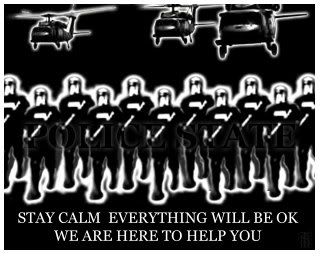
The Makings of a Police State


Aren’t We There?I am starting my new series on a topic that for some reason, or reasons, has been designated as another of those ‘no no’ subjects. Even the mentioning of this topic is enough to get one labeled as an extremist, radical, nutty, kooky…Why do most people react this way? As with other issues here too we are looking at multiple factors.

For the government, the establishment, side of it, the reasons are obvious, and fit any government that is, has been, or was ever considered a police state. Have you ever come across a police state that actually considered itself to be a ‘police state’? Exactly, I didn’t think so. The governing/ruling powers of police states always seek to legitimize their police measures; whether made necessary by external threats, domestic threats, economic threats, security or terrorism threats…there is always a big threat(s) they point to and base their justification upon, and they always, and I mean always, claim that their measures are for the good of the public, for the security of their people, for the protection of their constituents. They portray their dissenters as collaborators in whatever ‘threat’ they claim they are fighting against, and silence their critics either with extreme authoritarian measures, or, if they are able to, by simply labeling them as radical, nutty, and kooky, enough to marginalize them and neutralize their potential effect.

The same holds true for the media side of this phenomena. After all, one of the major characteristics of a police state is social control and indoctrination through control of the media. These states utilize the media to spread their propaganda, to manufacture consent, to evilize chosen enemies, to paint dissent as unpatriotic, the dissenters as the enemies of the state, and of course the critics as the radical and nutty minority.

Now how about the people? Why are the majority of our people so quick to write off even the possibility of us becoming a police state, and do so in a similar manner as the government and media as described above? Aside from being indoctrinated by the establishment’s calculative presentations, most people seem to be guided by their own biased beliefs and misplaced values. It may be from misdirected patriotism, when their love of our nation subconsciously is coupled with the love of whoever may be ruling it. It may be the simple act of denial; just as parents blinded by their parental love and pride refuse to see and acknowledge the negative realities in their children, there are those who willingly put on blinders before their eyes just so that they don’t see the ugly realities inflicting the country they love and value. Maybe it is a case of extreme pride being misdirected towards those misperceived…

Whatever the reasons, the almost uniform response to those who even attempt to raise the police state question seems to be the same. Perhaps this is the reason why the very few outspoken legal experts, historians, and civil liberties activists, carefully, almost timidly, choose their words when it comes to the question of a police state in the USA. What I hear, what I read is usually along the following lines:

    We may be moving toward a police state.

    At this rate we may become a police state.

    Are we on our way to become a police state?

These people talk about a ‘police state’ as if there is this exactly defined state with even more exactly defined prerequisites, so that when this state is reached it can be uniformly declared by all as a police state at the exact same time. However, most of these same people, when I talk with them privately, in a hushed voice tell me that they actually think we are there, or almost there. They are so afraid to come out and say it. They are terrified at the prospect of being attacked, labeled, and marginalized. So this is why you get the careful phrasing, and when you get close, the hushed voices.

Anyhow, I am not known to shy away too much from being labeled, attacked, and/or ostracized. I have serious concerns for my country, where it is today, and where it’s headed. I have questions that I’ve been seeking answers for, which I want to share and discuss with you, openly and loudly, not in whispers. My main question pertaining to a police state is ‘aren’t we there?’ rather than ‘are we there?’ I keep scrutinizing the broad definitions and characteristics of a police state in every encyclopedia and other source I can get my hands on, then I check and compare those aspects with what we have today as a national security state, and every time I do this my checkmark list tells me we seem to be ‘there’ already:

On Invoking, Creating and Maintaining Perpetual Wars:

    Our ambigious unending War on Terror, Wars in Afghanistan and Iraq

On Control and Monitoring Mass Communication:

    NSA’s domestic spying on US Citizens are made legal & advocated as necessary

On Search & Seizures with No Probable Cause or Judicial Oversight:

    FBI’s National Security Letters to be used on American Citizens with its Gag Order Provision

On Controlling & Restricting Citizens’ Mobility:

    TSA’s ever expanding secretive No Fly List with the ‘known’ inclusion of One Million Americans

On Government Operating in Extreme Secrecy:

    Government expenditures of nearly $10 BILLION to maintain tens of millions of secret documents and operations, and unconstitutional uses of Executive Privileges such as State Secrets Privilege

On Control and Usage of Media as Government’s Own Propaganda Machine:

    The American Mainstream Media today is an extension and mouthpiece of the Federal Government

On Silencing & Persecution of Dissent:

    Our government’s well-established record of its treatment of whistleblowers and critics, whether by gag orders or other overt and covert measures

On General Disregard for Human Rights and Related International Laws:

    Our Government’s documented record on Rendition and Torture

I can easily go on and list more items, and justify every single one of them with supporting documents, cases, and reports, but for now the above criteria should suffice for our upcoming discussions and analyses. While I am at it I want to preempt one expected argument I have heard more than once:

    ‘Of course we are not a police state, since you and others can write and talk about these issues without getting arrested or executed. Just look at all these bloggers and independent media…’

First, that’s confusing a totalitarian government with a police state. You don’t have to be a totalitarian state in order to be a police state. In fact police states can and do emerge in democratic countries – with the consent and acceptance of the populace. Totalitarianism is simply an extreme version.

Next, not being ‘there’ yet in this regard does not mean we don’t fulfill most if not all other criteria to be considered a police state. Nations gradually creep towards becoming a police state, in various stages and by various degrees.

Finally, this aspect may actually be an indicator of an even more pathetic situation. Meaning, by having complete control over the mass media and utilizing successful propaganda and indoctrination the government doesn’t even feel the need to go after the irate vigilant minority. They let their PR machine marginalize these voices and ensure their exclusion from the broad medium of communication channels.

Okay, now it is your turn. Don’t be shy, and please don’t censure yourself. Where do you see us as a nation? How do you define a police state? Do you think we are already there?

Source: After Downing Street.Org

Bookmark and Share

Congress Reveals Awareness of Signing Statements And Protests One of Them - Amazing!


The House rebuked President Obama for trying to ignore restrictions to international aid payments, voting overwhelmingly for an amendment forcing the administration to abide by its constraints.

House members approved an amendment by a 429-2 vote to have the Obama administration pressure the World Bank to strengthen labor and environmental standards and require a Treasury Department report on World Bank and International Monetary Fund (IMF) activities. The amendment to a 2010 funding bill for the State Department and foreign operations was proposed by Rep. Kay Granger (R-Texas), but it received broad bipartisan support.

The conditions on World Bank and IMF funding were part of the $106 billion war supplemental bill that was passed last month. Obama, in a statement made as he signed the bill, said that he would ignore the conditions.

They would "interfere with my constitutional authority to conduct foreign relations by directing the Executive to take certain positions in negotiations or discussions with international organizations and foreign governments, or by requiring consultation with the Congress prior to such negotiations or discussions," Obama said in the signing statement.

Senior Democrats and Republicans railed against the notion that the president could ignore a law they had passed and he had signed.

"We do this not just on behalf of this institution, but on behalf of this democracy," said Rep. Barney Frank (D-Mass.). "There's kind of a unilateralism, an undemocratic, unreachable way about these signing statements."

President George W. Bush had used signing statements to ignore a number of provisions in bills that he signed into law, frustrating Democrats in Congress. One Bush signing statement allowed the administration to ignore a provision banning the torture of terror detainees in situations threatening the nation's security.

Frank and Rep. Mark Kirk (R-Texas) said that one way they could get presidents to stop issuing signing statements casting aside laws would be to refuse to fund their priorities. The amendment passed Thursday seeks to nullify Obama's signing statement by withholding funds from any agreement involving the Treasury Department that doesn't follow the conditions set out in the supplemental bill.

"The signal we send to the Treasury is very clear: Ignore statute at your peril," Kirk said.

The U.S. funding for the IMF, which will come in the form of a $108 billion credit line, was a sticking point in negotiations over the war supplemental bill. House Republicans opposed the legislation despite their support for military operations in Iraq and Afghanistan because they viewed the IMF funding as an unnecessary "global bailout." House and Senate leaders included constraints on the IMF and World Bank funding as a way to ensure support from lawmakers skeptical over sending more money abroad, said House Appropriations Chairman David Obey (D-Wis.).

"Sometimes, the only way the votes can be found to provide the funds the admin wants is to provide certain limitations on the money," Obey said Thursday in a floor speech criticizing Obama's signing statement.

The State Department and foreign operations appropriations bill that contained the amendment was expected to win passage late Thursday. Both Democratic and Republican appropriators spoke in support of it during the floor debate Thursday afternoon.

Source: After Downing Street.Org

Bookmark and Share

Nah, It's Not A Hate Crime, The Victims Were White


Akron police say they aren't ready to call it a hate crime or a gang initiation.

But to Marty Marshall, his wife and two kids, it seems pretty clear.

It came after a family night of celebrating America and freedom with a fireworks show at Firestone Stadium. Marshall, his family and two friends were gathered outside a friend's home in South Akron.

Out of nowhere, the six were attacked by dozens of teenage boys, who shouted ''This is our world'' and ''This is a black world'' as they confronted Marshall and his family.

The Marshalls, who are white, say the crowd of teens who attacked them and two friends June 27 on Girard Street numbered close to 50. The teens were all black.

''This was almost like being a terrorist act,'' Marshall said. ''And we allow this to go on in our neighborhoods?''

They said it started when one teen, without any words or warning, blindsided and assaulted Marshall's friend as he stood outside with the others.

When Marshall, 39, jumped in, he found himself being attacked by the growing group of teens.

His daughter, Rachel, 15, who weighs about 90 pounds, tried to come to his rescue. The teens pushed her to the ground.

His wife, Yvonne, pushed their son, Donald, 14, into bushes to keep him protected.

''My thing is,'' Marshall said, ''I didn't want this, but I was in fear for my wife, my kids and my friends. I felt I had to stay out there to protect them, because those guys were just jumping, swinging fists and everything.

''I'm lucky. They didn't break my ribs or bruise my ribs. I thank God, they concentrated on my thick head because I do have one. They were trying to take my head off my spine, basically.''

After several minutes of punches and kicks, the attack ended and the group ran off. The Marshalls' two adult male friends were not seriously hurt.

''I don't think I thought at that moment when I tried to jump in,'' Rachel Marshall said. ''But when I was laying on the ground, I was just scared.''

Marshall was the most seriously injured. He suffered a concussion and multiple bruises to his head and eye. He said he spent five nights in the critical care unit at Akron General Medical Center.

The construction worker said he now fears for his family's safety, and the thousands of dollars in medical bills he faces without insurance.

''I knew I was going to get beat, but not as bad as I did,'' Marshall said. ''But I did it to protect my family. I didn't have a choice. There was no need for this. We should be all getting along. But to me, it seems to be racist.''

Akron police are investigating. Right now, the case is not being classified as a racial hate crime. There were no other reports of victims assaulted by the group that night.

The department's gang unit is involved in the investigation, police said.

''We don't know if it's a known gang, or just a group of kids,'' police Lt. Rick Edwards said.

The Marshalls say they fear retaliation at home or when they go outside. They are considering arming themselves, but they're concerned about the possible problems that come with guns.

For now, they are hoping police can bring them suspects. They believe they can identify several of the attackers.

''This makes you think about your freedom,'' Marshall said. ''In all reality, where is your freedom when you have this going on?''

Source: Ohio.Com News

Bookmark and Share

He’s Out! Holocaust Researcher Germar Rudolf Released On Own Recognizance:


Mild mannered family man walks free after serving 44 months on thought offense charges

Mannheim / Ba-Wü: As announced yesterday the dissident Germar Rudolf from JVA Mannheim prison has been released.

On October 19, 2005, Rudolf was arrested in the United States and deported to Germany. Upon arrival, he was arrested by police authorities and transferred to a prison in Stuttgart-Stammheim in Baden-Württemberg. In March 2007, the Mannheim District Court sentenced Rudolf to two years and six months in prison for inciting hatred, disparaging the dead and libel.

Some turbulent years preceded this. In the early ’90s Rudolf was doing scientific research and appraisal on the Auschwitz gas chamber complex. Since his research results stood in diametric contrast to the commercial and state ordered doctrine this led naturally to collisions with the government authority. Thus in May 1995 because of his appraisal of the gas chambers in Auschwitz, the regional court condemned Germar Rudolf to 14 months prison.

In order to escape this punishment, Rudolf fled to Spain in the spring of 1996 and from there to Great Britain, where Rudolf worked journalistically as a revisionist publishing revisionist material under the umbrella of the Belgian Foundation Vrij Historisch Onderzoek, VHO (Free Historical Research). During these activities, Rudolf acquired the Internet domain www.vho.org which he helped build into one of the largest revisionist websites in the world. In addition Rudolf created the revisionistic book publishing house Castle Hill Publishers.

Around 2004 Rudolf went to the USA where he married a US citizen and subsequently started a family, a request for asylum was denied on the basis that his application was “frivolous”. Germar Rudolf now 44 plans to return back into the USA to live with his American wife and child of four, to what extent he will become again revisionistic or politically active, is undecided……..


Visit Germar’s home page at GermarRudolf.com

Source: Altermedia (Translation)

Bookmark and Share

Jewish group objects to ‘Great Famine’ case


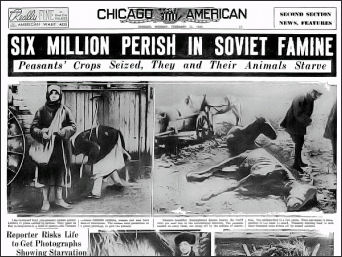
KIEV, Ukraine (JTA) -- A Jewish group in Ukraine is objecting to a criminal case brought over the "Great Famine" committed in the 1930s.

The nation's security service is pressing the case against a list of former Soviet officials accused of committing the Holodomor, which caused the deaths of millions in Ukraine in 1932-33. Most of the names on the list were Jewish.

Ukrainian lawmaker Aleksandr Feldman, leader of the Ukrainian Jewish Committee, said last week that it was "a farce" to press the case.

“All organizers of the Great Famine are dead," he said.

Last July, the Ukrainian Security Service released a list of high-ranking Soviet state and Communist Party officials -- as well as officials from NKVD, the police force of Soviet Russia -- that essentially blamed Jews and Latvians responsible for perpetrating and executing the famine because most of the names on the list were Jewish.

The Ukrainian Jewish Committee called on the secret service to revise the list, which incited interethnic hatred, in order to clear up the “inaccuracy.”

Feldman believes there is a danger that the “Holodomor Affair” materials are being used for political purposes.

In late May, security service head Valentin Nalivaychenko claimed at a meeting with representatives of the World Congress of Ukrainians that “Ukraine has collected enough evidence to bring a criminal case regarding the famine, which was artificially created by the Bolshevik regime and caused mass death of citizens.”

Through the World Congress of Ukrainians, Nalivaychenko turned to leading foreign lawyers with a request to help find out the circumstances connected with preparing and committing the genocide.

Source: Jewish Telegraph Agency

Bookmark and Share

Murdoch papers paid £1m to gag phone-hacking victims


• News of the World bugging led to £700,000 payout to PFA chief executive Gordon Taylor
• Sun editor Rebekah Wade and Conservative communications chief Andy Coulson – both ex-NoW editors – involved
• News International chairman Les Hinton told MPs reporter jailed for phone-hacking was one-off case

Rupert Murdoch's News Group News­papers has paid out more than £1m to settle legal cases that threatened to reveal evidence of his journalists' repeated involvement in the use of criminal methods to get stories.

The payments secured secrecy over out-of-court settlements in three cases that threatened to expose evidence of Murdoch journalists using private investigators who illegally hacked into the mobile phone messages of numerous public ­figures to gain unlawful access to confidential personal data, including tax records, social security files, bank statements and itemised phone bills. Cabinet ministers, MPs, actors and sports stars were all targets of the private investigators.

Today, the Guardian reveals details of the suppressed evidence, which may open the door to hundreds more legal actions by victims of News Group, the Murdoch company that publishes the News of the World and the Sun, as well as provoking police inquiries into reporters who were involved and the senior executives responsible for them. The evidence also poses difficult questions for:

• Conservative leader David Cameron's director of communications, Andy Coulson, who was deputy editor and then editor of the News of the World when, the suppressed evidence shows, journalists for whom he was responsible were engaging in hundreds of apparently illegal acts.

• Murdoch executives who, albeit in good faith, misled a parliamentary select committee, the Press Complaints Commission and the public.

• The Metropolitan police, which did not alert all those whose phones were targeted, and the Crown Prosecution Service, which did not pursue all possible charges against News Group personnel.

• The Press Complaints Commission, which claimed to have conducted an investigation, but failed to uncover any evidence of illegal activity.

The suppressed legal cases are linked to the jailing in January 2007 of a News of the World reporter, Clive Goodman, for hacking into the mobile phones of three royal staff, an offence under the Regulation of Investigatory Powers Act. At the time, News International said it knew of no other journalist who was involved in hacking phones and that Goodman had acted without their knowledge.

But one senior source at the Met told the Guardian that during the Goodman inquiry, officers found evidence of News Group staff using private investigators who hacked into "thousands" of mobile phones. Another source with direct knowledge of the police findings put the figure at "two or three thousand" mobiles. They suggest that MPs from all three parties and cabinet ministers, including former deputy prime minister John Prescott and former culture secretary Tessa Jowell, were among the targets.

Last night, Prescott said: "I think Mr Cameron should be thinking of getting rid of Coulson."

However, a spokeswoman for Cameron said the Tory leader was "very relaxed about the story".

Lib Dem MP Simon Hughes, one of many victims of mobile phone hacking by Rupert Murdoch's News Group Newspapers, comments on the huge out-of-court settlements Link to this video

News International has always maintained it had no knowledge of phone hacking by anybody acting on its behalf.

Murdoch told Bloomberg news last night that he knew nothing about the payments. "If that had happened I would know about it," he said.

A private investigator who had worked for News Group, Glenn Mulcaire, was also jailed in January 2007. He admitted hacking into the phones of five other targets, including the chief ­executive of the Professional Footballers' Association, Gordon Taylor. Among the phones he hacked were those of the Lib Dem MP Simon Hughes, celebrity PR Max Clifford, model Elle MacPherson and football agent Sky Andrew. News Group denied all knowledge of the hacking, but Taylor last year sued them on the basis that they must have known about it.

In documents initially submitted to the high court, News Group executives said the company had not been involved in any way in Mulcaire's hacking of Taylor's phone. They denied keeping any recording or notes of intercepted messages. But, at the request of Taylor's lawyers, the court ordered the production of detailed evidence from Scotland Yard's inquiry in the Goodman case, and from an inquiry by the Information Commissioner's office into journalists who dishonestly obtain confidential personal records.

The Scotland Yard files included paperwork which revealed that, contrary to News Group's denial, Mulcaire had provided a recording of the messages on Taylor's phone to a News of the World journalist who had transcribed them and emailed them to a senior reporter, and that a News of the World executive had offered Mulcaire a substantial bonus for a story specifically related to the intercepted messages.

Several famous figures in football are among those whose messages were intercepted. Coulson was editing the paper at this time. He said last night: "This story relates to an alleged payment made after I left the News of the World two and half years ago. I have no knowledge whatsoever of any settlement with Gordon Taylor.

"The Mulcaire case was investigated thoroughly by the police and by the Press Complaints Commission. I took full responsibility at the time for what happened on my watch but without my knowledge and resigned."

The paperwork from the Information Commission revealed the names of 31 journalists working for the News of the World and the Sun, together with the details of government agencies, banks, phone companies and others who were conned into handing over confidential information. This is an offence under the Data Protection Act unless it is justified by public interest.

Senior editors are among those implicated. This activity occurred before the mobile phone hacking, at a time when Coulson was deputy and the editor was Rebekah Wade, now due to become chief executive of News International. The extent of their personal knowledge, if any, is not clear: the News of the World has always insisted that it would not break the law and would use subterfuge only if essential in the public interest.

Faced with this evidence, News International changed their position, started offering huge cash payments to settle the case out of court, and finally paid out £700,000 in legal costs and damages on the condition that Taylor signed a gagging clause to prevent him speaking about the case. The payment is believed to have included more than £400,000 in damages. News Group then persuaded the court to seal the file on Taylor's case to prevent all public access, even though it contained prima facie evidence of criminal activity.

The Scotland Yard paperwork also provided evidence that the News of the World had been involved with Mulcaire in his hacking of the mobile phones of at least two other football figures. They filed complaints, which were settled this year when News International paid more than £300,000 in damages and costs on condition that they signed gagging clauses.

Taylor declined to make any comment. Goodman, now out of jail, said: "My comment is not even 'no comment'." A spokesman for News International said: "News International feels it is inappropriate to comment at this time."

Last night, John Whittingdale, the Conservative MP who chairs the culture, media and sport select committee, said the revelation "raises a number of questions that we would want to put to News International".

He added: "The fact that other people beyond the royal family had their calls intercepted was well known. But we were absolutely assured by News International that none of their journalists were aware of that, that Goodman was acting alone and that Mulcaire was a rogue agent".

Asked if the committee would reopen the issue, he said: "The committee will want to discuss it very urgently. I think we will do so tomorrow morning, and if we decide that there are further questions to ask, then certainly we would summon back witnesses and ask those questions."

Former Sunday Times editor Andrew Neil described the story last night as "one of the most significant media stories of modern times". "It suggests that rather than being a one-off journalist or rogue private investigator, it was systemic throughout the News of the World, and to a lesser extent the Sun," he said. "Particularly in the News of the World, this was a newsroom out of control.

Source: The Guardian

Bookmark and Share

Fed warns on Congressional scrutiny - AGAIN!


The Federal Reserve warned on Thursday that a growing congressional threat to curtail its independence would destabilise markets and raise the cost of servicing US debt for “current and future generations”.

Ron Paul, the Texas Republican, has gathered the support of a majority of the House of Representatives for a bill that would audit the Fed’s monetary policy decisions. He told a Congressional hearing he wanted the power to prevent the Fed being "secret and clandestine and serving special interests”.


The Fed is struggling to face down a political backlash from different parts of Congress amid scepticism over its policies designed to restart the flow of credit and the award of new powers to curb systemic risks.

Donald Kohn, vice-chairman of the Fed, argued at the House financial services subcommittee hearing that any sense of political interference would negatively affect markets. “Any substantial erosion of the Federal Reserve’s monetary independence likely would lead to higher long-term interest rates as investors begin to fear future inflation,” he said.

Not only did Mr Kohn argue that the Fed should be given the power to regulate large systemically significant companies, but he argued against giving up responsibility for consumer protection, asking Congress to overturn the Obama administration’s proposal to create a new Consumer Financial Protection Agency.

”I would hope that the Congress might think about whether there are ways of strengthening the Federal Reserve’s commitment to consumer regulation as an alternative to creating a new regulator,” he said.

As US authorities have considered how to reform the country’s regulatory regime in the wake of the current economic crisis, the Fed has been drawn into an argument with other regulators over who oversees the US’s largest financial institutions.

The conflict appeared to end with the Obama administration giving power over systemically significant insitutions to the Fed, with additional oversight from a council of regulators including the Federal Deposit Insurance Corporation.

But critics in Congress have not given up an attempt to push all or more of the power to the council, taking it away from the Fed. The hearing on Thursday heard support for that view. Mr Paul’s audit bill now has more than 250 co-sponsors.

Source: FT.Com

Bookmark and Share