Showing posts with label Civil Liberties. Show all posts

Thursday, May 27, 2010

Victory: Charges Against Student Accused of ‘Disorderly Conduct’ for E-Mail

CLEMSON, South Carolina, May 26, 2010—Clemson University has withdrawn “disorderly conduct,” “harassment,” and two other charges against a student who e-mailed an administrator using “language and tone” that another administrator found “unacceptable.” After undergraduate William Kirwan was charged with a variety of offenses in violation of his First Amendment rights, he turned to the Foundation for Individual Rights in Education (FIRE) for help.

“Public university administrators cannot punish students simply because they disapprove of their ‘language and tone,’” said FIRE Vice President Robert Shibley. “We commend Clemson’s leadership for putting an end to this violation as soon as FIRE brought it to their attention.”

Read The Rest At Orwell's Dreams

Bookmark and Share

Tuesday, July 28, 2009

ID cards are a bureaucrat's luxury


In a excellent pamphlet produced by the Centre for Policy Studies, advocating a new Great Reform Act, the author of Yes Minister, Sir Antony Jay, writes that we are "governed by an increasingly self-serving almost unaccountable political class who are even further out of touch with the interests and wishes of the British people than were the rural aristocracy 200 years ago."

These words came to mind when I read that a YouGov poll had found that 79% of the public are opposed to the ID card scheme on the grounds that they want the estimated £5bn cost of the scheme spent on something else. There is no better example of the Labour machine's arrogant detachment from the people than the pursuit of this policy, which was consolidated last week with the announcement of the regulations on fees, fingerprinting, lifelong compulsory notification, data sharing and penalties.

The scheme is unpopular for obvious reasons, it represents an enormous intrusion, a waste of time and a personal cost to everyone. With the economic crisis, four-fifths of a sample polled by YouGov for the Sunday People believe it has to be scrapped. There can be no clearer message to the home secretary, yet on Thursday Alan Johnson proposes to make further ID card announcements in Manchester – where a trial is due to begin in the Autumn – which completely ignore the public's view.

The disconnect between reality and the government's megalomaniac ambitions to manage everyone's identity has never been more sharply drawn and I believe that opposition will spread to expensive schemes in which the unaccountable political class expect to monitor our movements, communications and behaviour. Only last month Johnson was trying to spin a story that the card would be voluntary. This is nonsense: anyone who wants a passport will have to join the national identity register and submit to slew of regulations and penalties.

As Phil Booth, the national coordinator of NO2ID, who has done so much to oppose the card, said "The game is up. The ID scheme is exposed as a bureaucrat's luxury that can now only be imposed by bullying and subterfuge."

Here is another quote from the Jay's pamphlet, which tells the story of New Labour and indeed the way we are governed in one sentence.

"Over the past 200 years or so, central government has sucked authority, decision making and local independence out of local communities, it has sucked money out of the purses and pockets of citizens, and it has created huge government departments and government institutions, a vast proliferation of tribunals, inspectorates, regulatory authorities, quangos, bureaux and councils, taken on an army of consultants, advisory committees, coordinating bodies, tsars, initiatives, action groups and task forces, and printed millions of questionnaires, application forms, guidance notes, instructions, licenses, tick boxes, information pamphlets and leaflets that, between them, spelt the death of trust and common sense and created the bureaucratic nightmare of 21st-century Britain."

From the loins of this beast came the identity card.

Source: The Guardian

Bookmark and Share

Friday, July 17, 2009

Do You Really Want Freedom, Or Are You Just Kidding Yourself?


“The people have always some champion whom they set over them and nurse into greatness. This and no other is the root from which a tyrant springs; when he first appears he is a protector.” ~ Plato “Wherever is found what is called a paternal government, there is found state education. It has been discovered that the best way to ensure implicit obedience is to commence tyranny in the nursery.” ~ Disraeli A recurring theme among some of the libertarians with whom I interact is: How can we bring freedom and liberty to pass more quickly? How can we mobilize our efforts to topple the coercive state, starting now? One might also ask why these pleas always have an inherent collectivist bent. Why must “we” do anything? I’ve written about this quest before, although contrary to popular belief, I am under no illusion that a fully-anarchic, i.e., stateless, society would be a utopia. That’s not even the point! In fact, I don’t even care one way or the other. (I am not an advocate of freedom for utilitarian reasons.) The unspoken belief seems to be that freedom and liberty arise from strategic planning. (After pretty much every essay I get published, I receive a note from some well-meaning soul who has the next can’t-miss new strategy that will topple the State by the end of the week.) While one could argue that much of the prose on Internet sites such as this one is similarly intended, I would disagree. What I attempt to do here, and what I see others doing here, is exploring the fullness of the libertarian paradigm. That paradigm is based upon individual choices made without aggression upon others. It is only when one’s choices infringe directly upon others that anyone should have a genuine concern. Generally speaking then, the focus is within, not without. Education is a primary goal. Philosophy is the primary focus. Borrowing from Stephen Covey, many people seem overly concerned with changing and/or fixing the world, despite the fact that their bedroom closet might more urgently need attention. As an aside, I won’t venture into the fallacy of the commons (or even the tragedy of the commons) right now, because this essay won’t be long enough. Suffice it to say that the bleeding-heart tendency to impose one’s beliefs on everyone else in the name of a third party—the children, the poor, the homeless, the environment, etc.—got old for me years ago. (The subject does deserve some analysis, though. Maybe I’ll attempt to address it in a subsequent essay.) During a recent long run, I got to thinking about this issue: Getting to “real freedom” and all that. Amidst my own pondering, something I’d heard my market anarchist friend and colleague Stefan Molyneux say over and over rang in my thoughts: Freedom begins at home, with you, with that over which you ultimately have the most control. If you are tied to positive obligations that were thrust upon you coercively, from friends, or from family, or dating back to poor childhood lessons, then worrying about the State is a huge waste of time. The vital point: The lessons one uses in direct interaction with those closest to him are reflected back by the society he inhabits, often by the authority paradigm of that society. Stop, in the Name of the Law! While I’m relatively certain that most people were appalled when they read, quite some time ago now, about the 8th grader who was strip-searched for Ibuprofen in California, I fear that if we were to share parenting tactics, our uneasiness with such behavior as that of the vice principal in the story would be more a matter of degree than of morality. More pointedly: Have you ever humiliated one of your children or a supposedly close friend to make a point? Do you remember ever being humiliated by your parents as they strove to establish dominance and authority over you? Have you ever seen an adult humiliated by another adult? Agents of the State act in exactly this way, almost universally. The actions of that police officer in Dallas are but the latest example in long line of repeated scenes form the same shitty movie. Visit almost any airport and you too can “enjoy” similar treatment. There is a reason why people like Manadel al-Jamadi are treated like sub-humans. The belief system that informs people like Dick Cheney and Donald Rumsfeld (and all the thugs who have replaced them) also convinces them that they can take any step, no matter how heinous, to maintain the authority they think they’ve been given—morals and ethics be damned. The same could be said of Officer Robert Powell, the Dallas cop noted in the story linked above. According to Business Daily’s Mark Weisenmiller, quoting from Jane Mayer’s “Dark Side,” Jamidi’s last few minutes on Earth were not pleasant: Jamadi was driven first to an Army base for debriefing, where the US Navy SEALs punched, kicked, and struck him with their rifle muzzles for some 20 minutes. Weisenmiller goes on to say: Jamadi was later interrogated by CIA operatives at Abu Ghraib prison, where he was hung up by his wrists, and subsequently killed. This is an extreme example, but it points to what I believe is a general trend. How can one protect freedom by taking it away from someone else, without regard for basic morality? Here’s a video of a sheriff’s deputy “laying the wood” to a suspect in an undercover drug bust. While most freedom advocates would label such behavior as both heinous and dastardly, I would be willing to bet that there are people reading this column who feel, conversely, that punishment such as spanking, slapping, or other physical infringements are sometimes appropriate. (A relative of mine told me that Plaxico Burress deserves whatever he gets, for the heinous infraction of carrying a gun without the state-mandated paperwork.) My question: How does one decide? Here’s the thing: If you can punish a slave to your heart’s content when he’s “yours,” why wouldn’t he take the same approach when he gets the chance, if and when the tables are turned? It is this psychological phenomenon that made “straw bosses” so effective during the times of chattel slavery in the U.S. Similarly, it is this psychological phenomenon that supports putting the child who is the biggest behavior problem in charge while the teacher is out of the room. Further, and maybe more worrisome is this: At what point does the type of heinous behavior and treatment of prisoners at places like Abu Ghraib become commonplace in detention centers in the U.S. ? (Hell, for all I know, it’s already happening.) At what point will the punishment for previously-minor offenses migrate up towards the death penalty, like some episode of Star Trek gone terribly off-track? We already have people in the U.S. serving prison time for the offense of lying. When an agent of the State believes that his orders justify the most basic mistreatment of his fellow man, it’s only a hop, skip, and jump to enemy combatants on home soil —and I’m not talking about only people who look like Muslims—being treated the same way. If the Milgram Experiments and the Stanford Prison Experiments taught us anything, it’s that people will follow orders—naked authority—to almost any end, despite data and indications (and even signals from conscience) to the contrary. It is this seminal truth that guarantees that the State, any state, no matter how constructed, no matter who is “elected” to run it, no matter what documents supposedly justify its creation and protect those under its control, will, in time, become a bubbling cesspool of rights infringement and totalitarian conduct. He That Treats Others as a Child Will Himself Be Treated Like a Child? Do lessons learned early in one’s life, both in the home and at school, drastically negatively affect the ability of a society to embrace liberty and freedom? Examining childhood lessons, some would say we over-protect our children. I tend to agree. Says one pundit: Fears regarding safety and litigation have resulted in playgrounds that are unchallenging and unappealing to young people. Parents are obsessively concerned with protecting their children and this is leading to their offspring not developing the resilience and physical skills that they need. While one might argue about how much actual resilience is developed on the playground, and I don’t care to do so, few would argue (I hope) with the negative effect of the creeping sheep-like treatment the State gives its citizenry. The State systematically over-protects its citizens, to very negative effect. The State is composed of people with beliefs. How much of this penchant toward over-protection stems from ideas developed during childhood only later to be implemented? One could certainly blame public education for much of this problem, but that might also be a convenient scapegoat. One could also suggest that such behavior—protectionism versus freedom—is endemic in humans. No matter how one learns such lessons, one thing is undeniable: the State treats each of us as children because too many of us believe that such behavior is appropriate. More troubling, we ourselves practice this behavior. For example, focusing on one specific area, and returning again to children and family, almost everyone has heard the phrase: “Spare the rod, spoil the child.” I’ve heard it more times than I care to remember. (In full disclosure, I also believed it, or so I thought, for far longer than I’d care to admit.) I don’t intend to debate the morality of corporal punishment. Instead, I wish to place it in the same moral context as similar punishments meted out by agents of the State. Ironically, while getting my periodic dose of The Blog of Tim Ferriss, of “The 4-Hour Work Week” fame, I came across a fascinating post from a woman who “escaped” from her Amish sect. In the comments of response to her story one can find, among several interesting musings, a discussion of this supposedly Biblically-derived phrase which is generally used to justify physical punishment of children. The fascinating tidbit was this: The Bible doesn’t actually contain that phrase. The sentiment is apparently a paraphrase of Proverbs 13:24, which says: He that spareth his rod hateth his son: but he that loveth him chasteneth him betimes. While I’m certainly no Biblical scholar, it seems to me a bit of a self-fulfilling prophesy to use that single verse as a justification for physical abuse. Back on Ferriss’s blog, a poster simply shown as “Betsy” offered what I believe is the most humane (and libertarian) translation of that verse: “Spare the rod and spoil the child” is actually analogous to the rod of the shepherd. It’s really a beautiful, sentimental teaching that has been totally perverted by some. The poster went on: A good shepherd never beats the sheep, but uses the rod to guide them with a gentle touch. That this homily should justify child abuse is the exact opposite of its intended meaning, which is “by failing to guide your child with love and instilling discipline (not punishment) in a consistent and gentle way, you ruin the child’s chances of successfully functioning in relationships and society as a whole.” Indeed! This sentiment seems to resonate with the non-aggression axiom. How can the thugs with whom so many of us deal claim to be protecting anyone from anything? (They certainly aren’t gently guiding anyone, either.) Here’s the real irony: The people who take actions such as those police officers or that vice principal, on behalf of the State, very likely learned those lessons at home or at school, as children themselves. Each time one teaches those closest to him from this playbook, he deepens the chasm between freedom and the routine acceptance of the State’s naked authority. He also lengthens the time it will take to fill that chasm. Frank Herbert, the author of Dune, is credited with saying: If you think of yourselves as helpless and ineffectual, it is certain that you will create a despotic government to be your master. The wise despot, therefore, maintains among his subjects a popular sense that they are helpless and ineffectual. There is an important corollary to this insight. If you think of others as helpless and ineffectual, you will erect systems—often despotic systems—designed, so you think, to help those people overcome their helplessness. As a result, you will only enslave them. In the effort, you will eventually enslave yourself as well. Please note that this is true no matter the supposedly objective evidence one uses to justify the treatment, be it age, race, gender, culture or something else. Conclusion One of the most interesting theories I have ever heard regarding freedom came from Molyneux during one of many discussions. He asserted that much of the damage to the fabric of voluntary interaction in society stemmed from violent, coercive behavior in the family unit. I admit that this hypothesis initially took me aback. (With apologies to Dune, I guess my imperial conditioning was strong.) Honestly though, the assertion that family violence is all too common is not worthy of much debate. If one can’t see the similarity among how a TSA screener treats an airline passenger; how a teacher or principal treats a student; and how far too many parents treat their children—well, freedom and liberty are much further away than I could ever hope. (Of course, the parent who really wants to prepare his children for well-practiced performance during airport screening can obtain a Playmobil Security Check Point toy. Start them young!) C.S. Lewis was prescient when he said: Of all tyrannies a tyranny sincerely exercised for the good of its victims may be the most oppressive. It may be better to live under robber barons than under omnipotent moral busybodies. The robber baron's cruelty may sometimes sleep, his cupidity may at some point be satiated; but those who torment us for our own good will torment us without end for they do so with the approval of their own conscience. While it’s neither my place nor my goal to advise anyone about how to raise their children, several observations seem reasonable. These observations seem particularly germane to the statist authority paradigm and from where it seems to emanate. Whether it’s letting a child out of the house without prior written permission and accompanying signed documents, selecting the foods your son or daughter can eat, without discussion or education, or (my personal favorite) slapping your child in the mouth for being sassy, the similarities remain clear. Anyone who thinks such practices make sense probably shouldn’t be too aghast if the State seeks to forcibly protect them from transfats. Neither should they be surprised when somebody gets tased for not kowtowing to some random person wearing a uniform. These examples occupy different social contexts but exemplify strikingly similar moral content. Krishnamurti pointed out the truth when he said: Your parents are frightened, your educators are frightened, the governments and religions are frightened of your becoming a total individual, because they all want you to remain safely within the prison of environmental and cultural influences. I’d say it’s about time we each break out of that prison. Sure, the State is a huge problem, but the State is just people. The treatment we practice, the treatment we allow, and the treatments we will receive are inexorably linked. Maybe liberty is a learned behavior and maybe we all need to change the lessons we allow and practice? And now, if you'll excuse me, my bedroom closet needs attention.Source: Strike the Root
Bookmark and Share

It's your business what you do, so long as you don't hurt anybody else


Civil liberties are the focus of this column, and we all agree that civil liberties are good things, right? But we don't all agree about specific liberties and their defenders. Some people snipe at sexual rights and the ACLU, others at self-defense rights and the NRA ... We may believe in liberty, but we don't seem to agree on what it is. So, what is liberty? The answer, is that it's anything peaceful, or, put another way, anything done among consenting adults.

Some people will answer: But, you have no right to smoke grass, own guns, have gay sex, travel without showing ID, or open a business without a license if the government says otherwise! The law tells us what our civil liberties are, and the government, elected by a majority of the people, makes the law.

To put it bluntly: Screw the government, screw the law and screw the majority.

If you want to marry somebody of the same sex, toast the festivities with marijuana bought at an unlicensed bar, and celebrate with a machinegun shoot (well ... I suggest you reverse the order of the shoot and the toast), it ain't nobody's business if you do.

In fact, Ain't Nobody's Business If You Do is the title of a wonderful book written by Peter McWilliams and published in 1996. In the book, the full text of which is now available online, McWilliams wrote, "You should be allowed to do whatever you want with your own person and property, as long as you don't physically harm the person or property of a nonconsenting other."

McWilliams didn't invent this idea. It's an old one, perhaps most closely associated with the philosopher John Stuart Mill, who wrote:

[T]he only purpose for which power can be rightfully exercised over any member of a civilized community, against his will, is to prevent harm to others. His own good, either physical or moral, is not sufficient warrant. He cannot rightfully be compelled to do or forbear because it will be better for him to do so, because it will make him happier, because, in the opinion of others, to do so would be wise, or even right... The only part of the conduct of anyone, for which he is amenable to society, is that which concerns others. In the part which merely concerns himself, his independence is, of right, absolute. Over himself, over his own body and mind, the individual is sovereign.

In the modern context, McWilliams elaborated:

Laws against consensual activities create a society of fear, hatred, bigotry, oppression, and conformity; a culture opposed to personal expression, diversity, freedom, choice, and growth. The prosecution of consensual crimes "trickles down" into ostracizing, humiliating, and scorning people who do things that are not quite against the law but probably should be. "They're different; therefore, they're bad" seems to be the motto for a large segment of our society. We are addicted to normalcy; even if it means we must lop off significant portions of ourselves, we must conform.

There's no need to accept the validity of all these arguments; the validity of any one is sufficient reason to wipe away all the laws against consensual activities.

"A culture opposed to personal expression, diversity, freedom, choice and growth"? Isn't that a bit strong?

Not really. You see, McWilliams died in 2000. A cancer and AIDS patient himself, he was arrested while helping another writer conduct research for a book on growing marijuana for medical purposes. His mother's house was held as collateral for the bond that secured his freedom while awaiting sentencing, and the chief prosecutor in the case threatened to seize the home if McWilliams was found with even a trace of the marijuana he used to control the severe nausea caused by his medication.

Unable to control his nausea, McWilliams choked to death on his own vomit.

Some people would make excuses for the prosecutor in the case. He was just doing his job according to the law, after all.

But a law that would deny a man medicine and cause him to choke to death is evil, and so are those who voluntarily help to enforce such laws.

We make a big deal about the democratic nature of our political system, but there's nothing about 50% plus one that could sanctify laws and actions like those that led to the death of Peter McWilliams. If we recognize that you have the right to do peaceful things -- that is to engage in trade, or to love, or to consume -- by yourself and with other consenting adults, then it doesn't matter if the people intruding into your life are lone wolves or a majority of the population. They're wrong to intrude and they're doing evil by sticking their noses where those noses aren't welcome.

Because it ain't nobody's business if you do.

Unfortunately, governments and our neighbors have grown accustomed to interfering in what isn't their business. Occasionally, they give a hat tip to the philosophical tradition represented by Mill and company by arguing that, if you're allowed to smoke grass or own a gun or operate a storefront without a license, others really are harmed by your subsequent (alleged) lower productivity at work, or the possibility that you'll go postal, or the vague potential for you defraud customers in a way that could allegedly be prevented by an official piece of paper.

This stretches the idea of "harm to others" so far out of shape as to be unrecognizable -- except as a dishonest intellectual dodge. Accepting the argument that what you might do, or what could reduce your utility to society, is any business of the government, leaves absolutely nothing beyond the reach of nosey busybodies with official titles.

It also, incidentally, reduces you to a cog in the machine.

Laws that interfere in your right "to do whatever you want with your own person and property, as long as you don't physically harm the person or property of a nonconsenting other" go too far. They should be defied and sabotaged. Governments that insist on passing such laws are illegitimate and should be dumped. And majorities that put such governments in power? Well, they're just wrong, and should be told to take a hike.

Defending liberty isn't about playing by the rules. It's about judging whether the rules, and the people who enforce them, are worth respecting.

Source: The Examiner

Bookmark and Share

The Criminal Gossip Bureau can ruin your job prospects


It's been a big week for databases, although nobody has managed to make them sexy. On Monday, the pressure group Liberty underlined the failings of the Criminal Records Bureau – more precisely its enhanced check – for the Today programme. It was quite a story: a woman had been turned down for voluntary work, having been "spoken to" (as opposed to "reprimanded" or "warned") by police for leaving her children in the park while she went to the shops. It's one of those stories you can imagine Basil Fawlty popping an eyeball over. And then you think, hang on – I'm popping an eyeball. This is outrageous. She only went to the shops.

This evening Damian Green, the shadow immigration minister, gave a speech to the Centre for Policy Studies, asking if Britain is a free country. He identifies 28 agencies that hold personal data about individuals. In the light of his very credible starting position – that politicians have a duty to create an environment in which "the citizen has some personal space in which the state has no power, interest, or influence" – many of these agencies and their purview do seem … well, bogus is a strong word. Let's start with "a bit much".

The Tories have seized this ground – they are tighter with Liberty than is Labour; and there is no telling whose manifesto will promise the most in terms of individual privacy.

It's not a bad time, therefore, to look at database management as practised by the Criminal Records Bureau, which is as uncontroversial and hi-tech as any similar initiative of the past three terms of government. It is also a massive undertaking – the 1.5m people checked in 2002 had gone up to 4m in 2008-09.

Now, this park lady (who wishes to remain anonymous) was the victim of the enhanced criminal records check – the standard check, everybody agrees, is almost totally unproblematic. It passes on only current and spent convictions, cautions, reprimands, and warnings – which proceed from an admission of guilt (to be cautioned you have to accept a caution). A standard CRB check can also access List 99, a register of people who have been barred from working with children – but basically this check is not open to tittle-tattle. Furthermore, and I believe more important, the CRB is on target to process 95% of its standard-check applicants within 10 days.

The enhanced check, conversely, has come to the attention of Liberty – and not just on behalf of the park lady – because it can include, above and beyond that raft of convictions and warnings, "relevant and proportional information held on that individual", as decided by the chief officer of police. This really could be anything. People are warned when they put in for an enhanced check that it could even flag up other people living at their address.

As another for-instance (if you are of a mind that one shouldn't go to the shops while one's children are in the park), say you have a very loud argument with your partner, and a neighbour calls the police: this information will be logged even if you personally don't make a complaint, and rightly so, because the police are thereby alerted to respond maybe fractionally faster if you were to make a 999 call.

But say this isn't domestic violence, and it's just a very loud argument – it will still end up on your CRB check. This has now entered the realm of gossip: it will be passed on to a prospective employer with no warning to you. When you do find out, you have no right to get it struck from your record; and if your application was for a job in a domestic violence refuge, for instance, you might well find yourself considered unsuitable to work there.

Worse to my mind, however, is the sheer bureaucracy of the enhanced check – the bureau has targets of 90% of applications being processed within 28 days. That sounds good, but it is missed in 10% of cases. And in the Metropolitan police area applicants are quoted six to eight weeks. Moreover you have to re-apply every time you change jobs; or every three years, and after maternity leave, if you stay in the same job. In summer the system is slower because teachers are all being vetted.

This is no victimless matter – people in these "caring professions" are left without income, or even the means to bring in a temporary income, for weeks at a time. Bear in mind that working with children or vulnerable people is rarely well paid in the first place, and you have a system with unjust financial penalties built into the very bureaucracy.

The gossip element will, I believe, be ironed out in time, especially as a new vetting and barring process will be introduced in October that should in the long run obviate the enhanced check. But the way people are treated by government agencies – this high-handed, "well, we do most of you in a month, what are you complaining about?" attitude – is astonishing to people who work outside these altruistic sectors. The Conservatives might have a much bigger vote-winner with their anti-surveillance crusade than it initially appears.

Source: The Guardian

Bookmark and Share

Friday, July 10, 2009

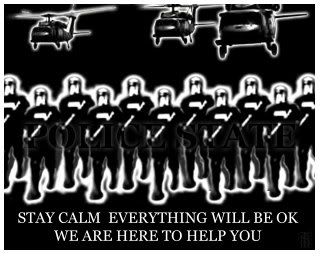
The Makings of a Police State


Aren’t We There?I am starting my new series on a topic that for some reason, or reasons, has been designated as another of those ‘no no’ subjects. Even the mentioning of this topic is enough to get one labeled as an extremist, radical, nutty, kooky…Why do most people react this way? As with other issues here too we are looking at multiple factors.

For the government, the establishment, side of it, the reasons are obvious, and fit any government that is, has been, or was ever considered a police state. Have you ever come across a police state that actually considered itself to be a ‘police state’? Exactly, I didn’t think so. The governing/ruling powers of police states always seek to legitimize their police measures; whether made necessary by external threats, domestic threats, economic threats, security or terrorism threats…there is always a big threat(s) they point to and base their justification upon, and they always, and I mean always, claim that their measures are for the good of the public, for the security of their people, for the protection of their constituents. They portray their dissenters as collaborators in whatever ‘threat’ they claim they are fighting against, and silence their critics either with extreme authoritarian measures, or, if they are able to, by simply labeling them as radical, nutty, and kooky, enough to marginalize them and neutralize their potential effect.

The same holds true for the media side of this phenomena. After all, one of the major characteristics of a police state is social control and indoctrination through control of the media. These states utilize the media to spread their propaganda, to manufacture consent, to evilize chosen enemies, to paint dissent as unpatriotic, the dissenters as the enemies of the state, and of course the critics as the radical and nutty minority.

Now how about the people? Why are the majority of our people so quick to write off even the possibility of us becoming a police state, and do so in a similar manner as the government and media as described above? Aside from being indoctrinated by the establishment’s calculative presentations, most people seem to be guided by their own biased beliefs and misplaced values. It may be from misdirected patriotism, when their love of our nation subconsciously is coupled with the love of whoever may be ruling it. It may be the simple act of denial; just as parents blinded by their parental love and pride refuse to see and acknowledge the negative realities in their children, there are those who willingly put on blinders before their eyes just so that they don’t see the ugly realities inflicting the country they love and value. Maybe it is a case of extreme pride being misdirected towards those misperceived…

Whatever the reasons, the almost uniform response to those who even attempt to raise the police state question seems to be the same. Perhaps this is the reason why the very few outspoken legal experts, historians, and civil liberties activists, carefully, almost timidly, choose their words when it comes to the question of a police state in the USA. What I hear, what I read is usually along the following lines:

    We may be moving toward a police state.

    At this rate we may become a police state.

    Are we on our way to become a police state?

These people talk about a ‘police state’ as if there is this exactly defined state with even more exactly defined prerequisites, so that when this state is reached it can be uniformly declared by all as a police state at the exact same time. However, most of these same people, when I talk with them privately, in a hushed voice tell me that they actually think we are there, or almost there. They are so afraid to come out and say it. They are terrified at the prospect of being attacked, labeled, and marginalized. So this is why you get the careful phrasing, and when you get close, the hushed voices.

Anyhow, I am not known to shy away too much from being labeled, attacked, and/or ostracized. I have serious concerns for my country, where it is today, and where it’s headed. I have questions that I’ve been seeking answers for, which I want to share and discuss with you, openly and loudly, not in whispers. My main question pertaining to a police state is ‘aren’t we there?’ rather than ‘are we there?’ I keep scrutinizing the broad definitions and characteristics of a police state in every encyclopedia and other source I can get my hands on, then I check and compare those aspects with what we have today as a national security state, and every time I do this my checkmark list tells me we seem to be ‘there’ already:

On Invoking, Creating and Maintaining Perpetual Wars:

    Our ambigious unending War on Terror, Wars in Afghanistan and Iraq

On Control and Monitoring Mass Communication:

    NSA’s domestic spying on US Citizens are made legal & advocated as necessary

On Search & Seizures with No Probable Cause or Judicial Oversight:

    FBI’s National Security Letters to be used on American Citizens with its Gag Order Provision

On Controlling & Restricting Citizens’ Mobility:

    TSA’s ever expanding secretive No Fly List with the ‘known’ inclusion of One Million Americans

On Government Operating in Extreme Secrecy:

    Government expenditures of nearly $10 BILLION to maintain tens of millions of secret documents and operations, and unconstitutional uses of Executive Privileges such as State Secrets Privilege

On Control and Usage of Media as Government’s Own Propaganda Machine:

    The American Mainstream Media today is an extension and mouthpiece of the Federal Government

On Silencing & Persecution of Dissent:

    Our government’s well-established record of its treatment of whistleblowers and critics, whether by gag orders or other overt and covert measures

On General Disregard for Human Rights and Related International Laws:

    Our Government’s documented record on Rendition and Torture

I can easily go on and list more items, and justify every single one of them with supporting documents, cases, and reports, but for now the above criteria should suffice for our upcoming discussions and analyses. While I am at it I want to preempt one expected argument I have heard more than once:

    ‘Of course we are not a police state, since you and others can write and talk about these issues without getting arrested or executed. Just look at all these bloggers and independent media…’

First, that’s confusing a totalitarian government with a police state. You don’t have to be a totalitarian state in order to be a police state. In fact police states can and do emerge in democratic countries – with the consent and acceptance of the populace. Totalitarianism is simply an extreme version.

Next, not being ‘there’ yet in this regard does not mean we don’t fulfill most if not all other criteria to be considered a police state. Nations gradually creep towards becoming a police state, in various stages and by various degrees.

Finally, this aspect may actually be an indicator of an even more pathetic situation. Meaning, by having complete control over the mass media and utilizing successful propaganda and indoctrination the government doesn’t even feel the need to go after the irate vigilant minority. They let their PR machine marginalize these voices and ensure their exclusion from the broad medium of communication channels.

Okay, now it is your turn. Don’t be shy, and please don’t censure yourself. Where do you see us as a nation? How do you define a police state? Do you think we are already there?

Source: After Downing Street.Org

Bookmark and Share

Thursday, July 9, 2009

Cyclist body slammed by NYPD cop sues for $1.5 million


By Carlos Miller
Life is filled with improbable moments that can change the course of your intended destiny in a split second.

Take the case of Christopher Long who was participating in a Critical Mass bicycle ride through Times Square last summer. The then-29-year-old New Jersey native doesn’t appear to have ever have stepped into a weight room or a courtroom.

In fact, he is probably more comfortable farming organic vegetables than he is framing a legal argument.

It is safe to say that the last thing on his mind that day was that he would be body slammed by a New York City Police Officer, then thrown in jail for 26 hours on charges of assault, resisting arrest and disorderly conduct.

Then there is Patrick Pogan, the NYPD officer in question. He was 22 years old at the time and had been on the force all of three weeks. As a third-generation NYPD cop, Pogan knew he had a lot of power with that badge. And the former high school football player wasn’t going to waste any time to use it.

It is safe to say that the last thing he expected was for someone to be filming the exact spot where he chose to body-slam Long for no apparent reason before conjuring false charges against him.

And as for the videographer, it appears that he was just filming the Critical Mass for his own documenation. It doesn’t appear that he is a member of any activist copwatch group who were out to document abuses by cops against cyclists, as other videographers have done in the past. It doesn’t appear that he is one to rock the boat because he has not even publicly acknowledged documenting the incident.

But it is safe to say that knows right from wrong. Good from bad. Truth from lies. Which is why he chose to upload the video.

Thanks to his video, the charges against Long were dropped. Thanks to his video, Pogan is now the one facing criminal charges. Even prison time.

And thanks to his video, Long is now suing the City of New York for $1.5 million instead of drowning in debt trying to prove his innocence.

It is safe to say that neither one of them pictured this scenario when they woke up that fateful morning.

Source: Photography is Not a Crime

Bookmark and Share

The dangers of policing risk

The great threat to liberty comes from the habits of a risk-averse, market-led society

The pursuit of liberty is worth it because it is essential for the health of society. It sounds like a simple aspiration, but it is not one we hear articulated much these days. At a time when values

are constantly invoked by politicians, the sense of what these values might be becomes harder to grasp. The idea that liberty – and all the laws, institutions and commitments which go with it – are a sacred value, against which the claims of safety, security and utility must strain to justify themselves, sounds quaint these days.

A new idea has come to prominence. We live in an age in which risk management [pdf] is at the heart of politics. Long before it came to power, New Labour was mesmerised by the private sector's use of data to assess risk and allocate resources. Reading through a splurge of government reports from a decade ago, it is quite clear the ardour for risk management was intense and the vision was utopian. The government's lingering faith in ID cards demonstrates the power this kind of thinking has.

Risk management developed by the private sector produced a range of pre-emptive measures, such as defensive space architecture, smart products which could be immobilised if stolen, surveillance techniques and other things which individuals and companies could do to "design out" crime by manipulating the physical environment. This is known as situational crime prevention and, in the words of one of its proponents, it creates a "fortress society" in which crime becomes harder to commit. And indeed, in a shopping centre or street dedicated to the war against crime and antisocial behaviour the innocent and guilty are treated the same – as potential miscreants. It is an egalitarian theory.

The private sector had become better than the state at shaping habits. It was a subtle form of discipline conducted by market forces which could modify behaviour and penalise the costly. Of course, I do not by this mean the market wanted to make the world better; it was aimed at maximising profits. Databases revealed who was blameless and who entailed a cost on others through risky or unhealthy behaviour. The ability to monitor the world revealed risks which no one realised existed before and pinpointed where accountability lay. Risk, once it becomes apparent, has to be policed: it is an economic necessity. The risk economy could, supposedly, predict the future and pre-empt danger. It was hungry for information, personal information; no amount could ever satisfy it.

Politicians of all hues found this deeply attractive. For the right the behaviour-shaping influences of the market satisfied on many conceptual levels. For New Labour it seemed to offer a solution to what it saw as the unacceptably high social cost of economic individualism without reviving a large state or traditional social disciplines. Data could change society, therefore giving up data was no longer an imposition but a selfless act, a duty to society.

And so society changes. When risk management is trumpeted so loudly it is logical for consumers and voters to lay blame on authorities if something goes wrong: why wasn't everything done? And in turn service providers are encouraged to imagine the worst and hunt down dangers: there is never enough you can do to eliminate risks. There is also a tendency to put expert opinion over principles. Hence we see politicians justifying everything from health and safety rules to anti-terror laws on the grounds that officials demand them. What chance do civil liberties stand?

The language of politics has become suffused with the jargon of business. And the mentality. It becomes a duty of government, to provide "consumer-focused services (pdf)" . Increasingly civil liberties are subject to a cost/benefit analysis. In an age when a small band of terrorists can wreak havoc on a vast scale, it is said, civil liberties entail a "marginal cost": better to wrongly imprison a suspect than let one go if the risk is adjudged to be sufficiently high. Civil liberties do indeed come to be seen as hindrances to the technocrat as he or she goes about the business of battening down the hatches. In his or her risk-obsessed mind everyone is a potential danger – which is another way of concluding that everyone is guilty in advance.

The introduction of market-led thinking into government has changed the relationship between the state and citizen. The behaviour of individuals, when it is at odds with the consensus, comes to be seen as not just selfishness but dangerously antisocial. In rebalancing the criminal justice system towards victims (at the expense of ancient civil liberties such as jury trials, double jeopardy rules and other constraints) it was openly responding to consumer (sorry, voter) demand and shifted the emphasis towards the safety of the community and away from the protection of individuals from miscarriages of justice. The worst of our anti-terror laws are an example of a state run along the principles of risk aversion. Privacy – which is at the heart of any concept of liberty – comes to be seen as selfishness. This is the utilitarianism of management, not the principles of a free society.

An economy supposedly based on the efficient policing of risk collapsed around us. Humans are spectacularly bad at predicting and shaping the future – and the very attempt in an age of doom-saying is bound to mean suppression of freedom. What it means is subservience to an imagined future.

But such thinking should be resisted for other reasons. There are plenty of signs that issues of liberty will be important in the next election. We should be wary of platitudes. The great threat to liberty comes from the habits of a risk-averse society. We should remember that there is more to pubic life than technocratic management. At the end of the road marked 'risk-aversion' is the fortress society. Safety, not liberty, first.

To pretend that the delivery of services, justice and security are ideologically neutral is to conceal the truth. They are laden with ideology. We need more politics, not less. Asserting values over the powerful (but delusive) promises of total safety and fear of the future takes courage. It is the same courage which brought about liberty in the first place. Cowards die many times before their deaths.

Source: The Guardian

Bookmark and Share

Monday, July 6, 2009

Makinh felons of tens of millions of Americans.


U.S. Customs and Border Protection (Customs) has proposed a ruling that would re-define "switchblade" to include all pocket knives that can be opened with one hand. In doing so, they are arbitrarily reversing their own previous rulings. Worse, they are ignoring Congressional intent, will throw thousands out of work, endanger tradesmen and outdoorsmen, and make potential felons of tens of millions of Americans. It is just the latest reason we must pass the Write the Laws Act and prevent unelected bureaucrats from making law.

In 1958, Congress banned the possession of switchblades on federal lands, as well as the interstate sales of switchblades. This was a bad and unnecessary law, but it wasn't ambiguous. Congress was quite specific in defining what they meant by switchblade - "any knife having a blade which opens automatically— (1) by hand pressure applied to a button or other device in the handle of the knife, or (2) by operation of inertia, gravity, or both."

As the lawyers for Knife Rights, Inc. say, "Congress did not ban knives which contain springs. It could have, but did not. Congress did not broadly ban any knife that could be opened with one hand. It could have, but did not. The definition (of 'switchblade') is not nearly that broad."

Yet, Customs is determined to classify these knives as switchblades. While Customs' ruling applies to imports, its interpretation of the law and its definition of "switchblade" will be seen as binding in the federal courts and many state jurisdictions

Even though,

  • there's no evidence these knives are often misused as criminal weapons
  • tens of millions of Americans use these knives at work or outdoors
  • there are numerous instances where one must hold onto an object with one hand and access a knife with the other
  • in case of a fall or other accident, an enclosed pocket knife is much safer than a sheathed knife
  • manufacturers of such knives employ thousands of people

Moreover, this is an abrupt reversal of Customs' own previous rulings. This change is legally dangerous to individual Americans. Words have meanings, and Customs isn't changing the actual words, just how they'll define them. Individuals who think they know what the law says may be innocently unaware of the latest bureaucratic rulings that change the meanings of words.

The good news is there's growing opposition to the ruling . . .

But if the Write the Laws Act was in force, Customs wouldn't have the discretion to arbitrarily re-interpret legislative language. The WTLA says that all bills will have rules "defining the specific conduct to be prohibited" (emphasis added) and prevents bureaucrats from prescribing any rule that goes beyond the legislative language.

The Senate will be considering the Department of Homeland Security Appropriations bill on July 7. The best opportunity to stop Customs is to tell the Senate to amend the bill to prevent Customs from implementing their switchblade ruling. We ask that you:

  • Send a message to Congress telling them to introduce the Write the Laws Act
  • Tell them about how the U.S. Customs and Border Protection switchblade ruling goes against the Congressional intent of the Switchblade Act
  • Remind them this bureaucratic mischief would not occur under the WTLA
  • And finally, instruct them to amend the DHS Appropriations bill to stop the Customs switchblade ruling from going into effect.

To exceed the number of messages DC Downsizers sent Congress last month, we must send 1,884 messages today.

Source: DownsizeDC.Org

Bookmark and Share

NSA Shields Government Networks With More AT&T Secret Rooms


Just a week after the Defense Department announced plans to put the National Security Agency in charge of military cyber defense and attack, the agency’s reach has already expanded to include monitoring of government civilian networks.

The Obama administration has decided to proceed with a classified Bush administration plan to let the NSA monitor traffic going to and from government civilian networks to protect the networks from malicious code and activity, according to a Washington Post story on Friday.

Given the NSA’s involvement in the Bush administration’s warrantless eavesdropping program, critics are concerned that the monitoring of government traffic on private-sector telecommunication networks that are used by the general public would allow the agency to once again spy on large swaths of non-government traffic without a warrant.

AT&T, which was scheduled to launch a pilot project last February to test the monitoring program, has insisted on government assurances that its cooperation is legal. The company, along with other U.S. telecoms, were sued in 2006 for their involvement in the Bush administration’s warrantless eavesdropping scheme before being given retroactive immunity by Congress last year.

In the monitoring program, called Einstein 3, telecommunication companies would route data going to and from government networks through an NSA monitoring box, which would examine the traffic for malicious code or suspicious activity suggestive of a network attack.

But critics are concerned that proper oversight is in place to prevent non-government traffic from being vacuumed into the system. There are also concerns that the content of correspondence sent to and from government officials and workers, including personal communication sent via private e-mail accounts accessed from a government computer, would be collected and scrutinized by the NSA. The classified NSA technology that would be used to monitor the communications is codenamed Tutelage, according to the Post, and is already used on military networks.

Department of Homeland Security officials say that although the technology being used for the project will come from the NSA, DHS will oversee its implementation on private networks.

“We absolutely intend to use the technical resources, the substantial ones, that NSA has,” DHS secretary Janet Napolitano said. “But . . . they will be guided, led and in a sense directed by the people we have at the Department of Homeland Security.”

In May, President Obama declared that the government’s “pursuit of cybersecurity will not include — I repeat, will not include — monitoring private sector networks or internet traffic. We will preserve and protect the personal privacy and civil liberties that we cherish as Americans.”

Ari Schwartz, a vice president of the Center for Democracy and Technology, received a classified briefing of the Einstein program in March, along with other civil liberties advocates, and expressed some faith in Obama’s pledge to protect the public’s privacy.

“There are a number of concerns that come with this process, the main one being how do you go about protecting the system in a way that insures you’re not monitoring private systems,” Schwartz told the Associated Press. “I don’t have a full answer to that question, but the president made that pledge. That makes me more comfortable that it won’t happen.”

Source: Wired


Bookmark and Share

Saturday, July 4, 2009

OUR RESPONSE TO HUNGARY REJECTING A HOLOCAUST DENIAL LAW TO THEIR CONTITUTION - GOOD


By My Hate Speech

With Hungary rejecting a proposed constitutional "Holocaust Denial" law we thought we would clarify a few points. The Mainstream Media always uses negative catch phrases such as "Holocaust Denial" or "Holocaust Deniers". This label is used by those who control the MSM so they can keep reminding us that there is no need to question it, even though history is not a science, and those who would question it are supposedly crazy, and therefore we do not need to engage them in open debate or conversation.

In reality what the mainstream media refers to as "Holocaust Denial" or "Holocaust Deniers", would be correctly termed, if you want to add a category, as Revisionist Historians. We at My Hate Speech refer to them as historians. Why? Because all history is revised, from the Civil War, to the Slave Trade, to Ancient Rome, and Ancient Greece. As new documents come to lite, through historical research, scientific research, or by pure accident, history is always open to revision because History, unlike Mathematics, is not a science.

In Math you do not need to ask why 2+2 equals 4. You just need to know that is what it is. You do not need to know why A squared x B squared = C squared, you just need to memorize it and apply it. But the Study of History requires its students to always ask the question why, so that we may come closer to, but never reaching a historical fact.

So what do Historians who doubt the "Official Version" of the Holocaust believe?

Claims about "Holocaust Deniers" Fact
They deny that Jews were persecuted WRONG. They do NOT deny this
They deny that Jews were deprived of civil rights WRONG. They do NOT deny this
They deny that Jews were deported WRONG. They do NOT deny this
They deny the Jews were herded into ghettos WRONG. They do NOT deny this
They deny the existence of concentration camps WRONG. They do NOT deny this
They deny that Jews were put to forced labor WRONG. They do NOT deny this
They deny the existence of crematoria in concentration camps WRONG. They do NOT deny this
They deny that Jews died for a great number of reasons: epidemics, malnutrition, diseases, mistreatment WRONG. They do NOT deny this
They deny that other minorities were also persecuted as well, such as gypsies and political dissenters WRONG. They do NOT deny this
They deny that the treatment of the Jews was unjust WRONG. They do NOT deny this
They deny the victims their dignity WRONG. They do NOT deny this
They deny the victims to be remembered WRONG. They do NOT deny this
They deny to show compassion for the victims WRONG. They do NOT deny this
They deny that there was a plan to murder all Jews This is what they claim
They deny that Jews were murdered systematically This is what they claim
They deny the existence of gas chambers for mass murder This is what they claim
They deny that six million Jews died in the Holocaust This is what they claim

Learn more about it here


It is amazing to us that in today's age, when you look back on all the persecution that has gone on throughout European History, such as persecutions against scientist like Galileo, religious persecutions by all sides, and witch trials, that such events are still more than alive in Democracies today. In countries Like Germany, Austria, and France, just to name the main culprits, you can be sent to Jail or have your life completely ruined if you question or present evidence of a contradictory nature regarding historical events.

We have all heard the saying that "It is the victor who writes history." This why history is always being revised. Only in places like the former Soviet Union, Communist China, and North Korea has history been so extremely legislated, just to name the big ones. But these governments were and are not Democracies. So why then would Democracies attempt to legislate history. Possibly because when you realize that it is "the Victor who writes history," they need to demonize an enemy so that the eyes of future generations will not see their own crimes and culpability in those events.

Another reason could be, regarding the Holocaust, is that it is a major industry worth billions of
dollars. Jewish Professor Norman Finkelstien writes of this in his book, "The Holocaust Industry." Which we highly recommend you read. Take for instance the recent Holocaust Book to come out, "Angel Girl," which even Oprah jumped on the bandwagon with. Despite it being revealed that the account was fake, and it being practically pulled from the shelves, there is still a possible movie deal in the works.

Much of the Holocaust has allready been revised to some extent, but most people are not aware of it and still continue to report wartime propaganda as fact, confuse several facts as if they were the same incident, or just twist them around. Just watch a skit of Jay Leno's "Man on The Street" and you can see how that is done with history that is actually closer to home. Even the famous Nazi Hunter Simon Weisenthal said that no extermination camps existed in Germany. Jewish Professor Deborah Lipstadt, Professor of Modern Jewish and Holocaust Studies at Emory University has also stated this. It is only in the East, which happen to be in the Soviet occupied zones, See Map, where extermination camps are said to have existed. Yet most people believe they were all over Germany. Despite this, year after year, gullable people leaving Dachau always seem to explain how awful it was that people were exterminated in gas chambers there, even though there is a sign to the left of the gas chambers, which were used to fumigate typhus carrying lice from bedding and clothing, that states no one was ever gassed there.

Despite the revision done on the subject, every year in Germany, France and Austria, people are fined and jailed for simply discussing an aspect of history.

So a BIG thumbs up and kudos to countries like Hungary and Spain, who have rejected such laws, because they realize Freedom of Speech, Thought and Expression are what truly makes democratic nations democratic. Who also realize that laws forbidding such expression, found in Draconian Holocaust Denial Laws, not only violate their own constitutions, but also violate article 19 of the Universal Declaration of Human Rights, of which all Western Nations are bound by. It states;

"Everyone has the right to freedom of opinion and expression; this right includes freedom to hold opinions without interference and to seek, receive and impart information and ideas through any media and regardless of frontiers." - Article 19

Believe in what you choose to believe in. Some people regardless of the facts will still cling to their beliefs, and good for them as well. As Voltaire so aptly put it, "Think for yourselves and let others enjoy the privilege to do so, too."

Bookmark and Share

New Orleans still illegally confiscating guns


The ACLU, not exactly known for being sympathetic to the right to keep and bear arms, is going to bat for a New Orleans man who had his gun confiscated. From the Associated Press:

The American Civil Liberties Union of Louisiana filed the federal lawsuit Thursday on behalf of Errol Houston Jr., who was arrested last year following a traffic stop. The lawsuit says the district attorney's office declined to prosecute Houston but has refused to return his .40-caliber firearm.

Why? After all:

"Mr. Houston has done nothing wrong. There are no criminal charges against him. His firearm, which he is and was entitled to carry, has been confiscated for no reason..."

District Attorney Leon Cannizzaro is not pleased:

Cannizzaro said he doesn't know why one of his predecessors refused to prosecute Houston, whom he said had a gun under the floor board of his car when police stopped him.

"I have a serious question as to why this charge was refused in the first place," he said.

With all due respect, Mr. DA, and it appears very little is due, that's not your call. As an officer of the court, sworn to uphold the law, you don't get to disregard it, or to make up edicts of your own.

This is the kind of authoritarian mentality that leads to "terror watch list" gun bans, to prior restraints, and to "no rights" lists where suspicion trumps all.

This is supposed to be America, Mr. Cannizzaro. If Mr. Houston is a menace to society, he needs to be charged, convicted and segregated from it. If you can't do that, our criminal justice system presumes his innocence.

Perhaps we ought to be assessing the danger of having a DA who ignores that, and who presumes to be a law unto himself.

Source: The Examiner

Bookmark and Share

Friday, July 3, 2009

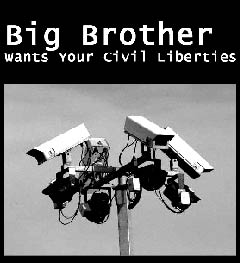
Big brother is watching


The furore around the Chinese government’s Green Dam software has raised the issue of the way modern technology is used to monitor our daily lives. Here, we list seven of the technologies that can be used to keep track of your movements.

CCTV

Closed-circuit television cameras were first used in Germany in 1942 to remotely monitor the launch of V2 rockets. Since then, CCTVs have become one of the most contentious pieces of technology in public use. The government and law enforcement agencies claim the use of video monitoring technology can help reduce crime and improve public safety; critics argue that the cameras serve only to displace crime to unmonitored areas, and do not act as a deterrent. With more than four million CCTV units in the UK, the network of cameras captures the average person around 25 times a day.

RFID tags

Radio frequency identification chips are already widely used in supermarkets and shops for the purpose of stock control, but some people fear their use could be widened to monitor the habits and behaviour of ordinary citizens. At the moment, these tags, which are little bigger than a grain of sand, are embedded into pints of milk and library books. When paired with an RFID reader, the tags can help to provide detailed information about items, such as their location, or how many there are. Although most people are happy for RFID tags to be used in stores to monitor stock levels, they’re less happy about the idea of the chips still sending out a signal once they leave the shop. On a benign level, such tracking capabilities would mean a store would know that people in Hertfordshire prefer blue cashmere jumpers, while those in Aberdeen favour the brown versions. But on a more sinister level, it could also enable them to glean an unprecedented insight into our personal lives, and target their brands to us accordingly. To those people who fear a “surveillance culture”, the ability to tag and track everything from our food to our clothes would be the next step on an already slippery slope.

Telecoms technology

The recent election protests in Iran have raised some interesting questions about the technology used by the country’s government to not only censor and control the spread of information, but monitor the ways in which citizens have been communicating and mobilising. It now appears that some of the technology the Iranian authorities have been using to listen in on phone calls made on fixed-line phones and mobile handsets was sold to the government by Nokia Siemens, a joint venture between the Finnish phone maker and the German technology giant. Nokia Siemens said it believed the product was being used by the government to monitor calls, but some experts have speculated that it could also be used for a practice known as “deep packet inspection” – a process that enables agencies to block communications, as well as monitor the nature of conversations and even covertly alter this for the purpose of propaganda and disinformation. Nokia Siemens, rocked by this association with a repressive regime, have pointed out that Iran is not the only country using its monitoring technology – many Western governments, including the UK and US, apparently use it for “lawful intercepts”…

Email monitoring software

Who is reading your emails? Chances are, if you work for a big company, your boss could be keeping an eye on how many messages you send in the course of a day. According to recent research by Forrester, 44 per cent of companies read outgoing mail, using a combination of digital scanning software and real people. The primary concern for businesses appears to be the dissemination of inappropriate or commercially sensitive information rather than time-wasting, but with more and more distractions available at our office computers, from Facebook and Twitter to online shopping, many more businesses may decide to start monitoring just how their employees spend their work time.

Information-gathering technology

Gunwharf Quays shopping centre in Portsmouth shot to fame last year when it was revealed that surveillance software was monitoring the signals given off by shoppers’ mobile phones to track their movements. The technology allowed researchers to tell when someone entered the shopping centre, what stores they visited, how long they spent in each one, and what time they left. It could even tell what route they took, and the country they were visiting from. Although all monitoring is anonymous – it does not identify the owner of the phone, rather than handset’s unique IMEI network number – it raised some concerns from privacy campaigners. While, at its most innocuous, this sort of information could help business and shopping centres pinpoint areas of high footfall or congestion, and redesign the space accordingly, or spot a surge in late shoppers that could prompt them to extend store opening hours, it also implies that this technology could be extended to minutely measure purchasing habits and retail behaviour. Perhaps that scene from Minority Report, in which Tom Cruise is bombarded by tailored, personalised advertising as he passes every hording, is not too far away.

Targeted advertising

One of the most contentious issues facing businesses and consumers at the moment is targeted advertising. With companies struggling to find a profitable business model in the digital age, a greater premium is being placed on targeting products, services and content directly to people on the basis of their specific likes, dislikes and needs. Phorm’s Webwise technology is a good example of this new way of thinking – it works by scanning users’ browsing history, and matching keywords found in these websites to targeted adverts, provided by other companies, which match the interests of web users. Phorm has stressed that the entire process is anonymised, so that interests cannot be directly traced to a named individual, but that has still lead some web users, as well as technology luminaries such as Sir Tim Berners-Lee, to be suspicious of the concept. Sir Tim likened commercial traffic monitoring by internet service providers as akin to “allowing them to put a television camera in your living room”.

GPS-enabled phones

Most modern mobile phones have a small GPS chip inside them, which means your location can be pinpointed to within a few hundred metres by the network of satellites floating in orbit. Of course, most people will use this technology in combination with the mapping software loaded on to their phone to make it easier to find their way around; some phones are now so sophisticated that they can provide real-time turn-by-turn directions, just like a satnav. The inclusion of GPS chips in handsets has also opened up a new world of location-based services – now that your phone “knows” where you are, it can feed that information in to, say, your phone’s search engine to provide data, links and recommendations for local amenities for whichever area you find yourself in. The flip side of that, of course, is that with the right kind of software installed on your phone, it’s possible to remotely monitor your location for less innocuous reasons. Services such as Google Latitude and Sniff are opt-in, consensual examples of this sort of technology, although some worry that in time, these kinds of monitoring software will be commonplace and non-negotiable, rather than a matter of personal choice.

Claudine Beaumont

Source: RINF News

Bookmark and Share

Wednesday, July 1, 2009

City requires Facebook passwords from job applicants


If you’re planning to apply for a job with the city of Bozeman, prepare to clean up your Facebook page.


As part of routine background checks, the city asks job applicants to provide their usernames and passwords for their social-networking sites. And it has been doing it for years, city officials said.

“Please list any and all, current personal or business Web sites, Web pages or memberships on any Internet-based chat rooms, social clubs or forums, to include, but not limited to: Facebook, Google, Yahoo, YouTube.com, MySpace, etc.,” states a city waiver form applicants are asked to sign. Three lines are provided for applicants to list log-in information for each site.

City officials maintain the policy is necessary to ensure employees’ integrity and protect the public’s trust, but the American Civil Liberties Union of Montana says they may be crossing the line.

“I would guess that they’re on some shaky legal ground with this and we would certainly welcome (the opportunity) to look at something specific from somebody who’s impacted,” Executive Director Scott Crichton said Thursday.

He said Bozeman’s policy is unprecedented as far as he knows. ACLU’s legal counsel in Washington, D.C., had never heard of another city asking for log-in information for social networking sites as part of a job application.

“It’s like saying, ‘Let me look through your e-mails,’” Crichton said.

“The city certainly has access to publicly accessible information, but it gets pretty questionable when they start asking for password-protected things that are created to create privacy for communications between your friends and family,” he said. “That seems to be going too far.”

City Manager Chris Kukulski said the city checks the sites in order to ensure that employees who might be handling taxpayer money, working with children in recreation programs or entering residents’ homes as an emergency services worker are reputable and honest.

“It’s just one of the tools, like all the other tools, that we’ve used to do a thorough background check,” Kukulski said.

The city also checks credit reports, criminal history, references and past employment, among other things.

“We have to do some due diligence,” Kukulski said.

News of the city’s policy went ‘round the world via the Internet Thursday, triggering outrage and prompting comments by media outlets and bloggers. Celebrity gossip columnist Perez Hilton even weighed in on the news.

“Big Brother much?” he wrote. “We’ve heard of employers looking up potential employees on Facebook, but this seems a bit extreme.”

The Guardian, a major daily newspaper in London, named the city of Bozeman its “civil liberties villain of the week” on its Web site.

City Attorney Greg Sullivan said in light of concerns being expressed by the public, officials are looking at ways to alter the policy so that they might view an applicant’s online information without asking for log-in codes.

“We’ve already begun that discussion,” Sullivan said Thursday afternoon.

For example, city officials said they could ask applicants to log into their Facebook page and show it to a city official during the application process, or add the city as a “friend” so the officials could view the applicant’s page.

Bozeman has checked job applicants’ social networking sites for about three years, said Human Resources Director Pattie Berg. HR staff or supervisors in the department in which the job is sought are charged with reviewing the sites.

However, Bozeman’s city commissioners are exempt from the policy because elected officials aren’t subjected to the same background check as city employees, said Chuck Winn, assistant city manager.

City administrators first enacted the policy for police and fire department job applicants, said Mark Lachapelle, deputy chief of investigations for the Bozeman Police Department. The policy wasn’t presented to the Bozeman City Commission because the commission typically isn’t charged with setting personnel policies.

Winn said that in his former position as fire chief, he was sometimes responsible for looking at potential firefighters’ social-networking sites. He said he primarily looked for illegal activity.

“It’s not about taste or anything,” Winn said.

In at least one instance, an applicant’s social-networking site figured into disqualifying the person for a job, Winn and Lachapelle said. Lachapelle said information from the site was one of several components that contributed to the decision. He declined to discuss the case more specifically, citing privacy concerns.

Source: Bozeman Daily Chronicle