Scott Rensberger in Bosnia (Photo from Rensberger's blog)
By Carlos Miller After being treated like a child molester by a cop in a shopping mall, award-winning videographer Scott Rensberger reached up to snap a picture of the offending officer.
The officer did what many officers would do in that situation; he lifted his hand in front of the camera to block the photo. Contact was made.
Stand up for thuggery! Hundreds of Portland, Oregon police officers and supporters surround City Hall during a protest march on behalf of Officer Chris Humphreys, who was placed on administrative leave (that is, paid vacation) following repeated use of unnecessary force -- including the lethal beating of a terrified and helpless 145-lb. man who suffered from schizophrenia.
Violence "is unpredictable, chaotic and thoughtless" by its nature, observed Peter Taylor in a recent op-ed column published in The Oregonian. "It doesn't like to be confined and doesn't lend itself to cooperation.... It is saddening to see the effects of violence on its victims, those who witness it and, yes, also those who wield it against others."
As the final clause in that sentence suggests, Taylor's point is not to sympathize with victims of "unpredictable, chaotic and thoughtless" violence, but rather to defend those who often employ it. Taylor is an officer with the Portland Police Bureau, and his column was intended to explain why he -- along with several hundred others -- took part in a protest march and rally outside Portland's City Hall in defense of Officer Chris Humphreys.
Along with his comrades, Officer Taylor wore a customized t-shirt containing the slogan: "I am Chris Humphreys." He used the same rallying cry to wrap up his op-ed column. And like his comrades, Taylor -- either through invincible innate ignorance, or as a result blindness induced through cult-like devotion to his professional clique (these are not mutually exclusive possibilities) -- cannot understand that this description is an indictment.
By Carlos Miller Rolando Ruiz clearly had his hands on the hood of a police car when a Minneapolis police officer walked up behind him and applied his Taser gun to his neck, forcing Ruiz to fall down in an incident caught on a dash cam.
The two men then fall out of view for several seconds but Ruiz’s screams do not stop, giving the impression that the officer is continually tasing him.
Ruiz was arrested for allegedly throwing a brick through the windshield of a cop car. He is now suing for $75,000 in damages.
By Carlos Miller He was 15 years old. A special needs student. And his shirt wasn’t tucked in.
For that, Marshawn Pitts was severely beaten by a police officer in the hallway of his school. And it was all caught on surveillance video.
The suburban Chicago police officer first shoved him against a wall. Then when the scrawny teen tried to stand back up, the officer began pummeling him with his fists.
Th brawny officer then sat on top of the teen, shoving his face into the floor in what is called a “face-down take-down,”a controversial hold that is illegal in eight states because it has resulted in at least 20 deaths, according to the CBS news report.
Pitts ended up with a broken nose, a swollen lip and cuts to his face.
All for an untucked shirt.
But it was in bad taste for CBS to title their news report “a painful lesson” because it insinuates the teen deserved the beating, which he did not.
The incident occurred in May 2009 at the Academy of Learning at Dolton, which is a school that specializes in special needs students. Pitts has a learning disability stemming from a previous head injury.
The name of the Dolton police officer, who works as a school resource officer, has not been published. I’m betting it is not the first time he’s done that.
Like Glenn, I write a lot about civil liberties, which have been at the heart of the national conversation since the beginning of the War On Terror and the expansion of the national security state. But my interest in civil liberties predates 9/11 and until then was usually pointed at the far more prosaic issues of police and prosecutorial misconduct (and the inevitable conclusions any study of those things brings to the issue of the death penalty). Nowadays, the theme of civil liberties seem to be a sub-plot to a James Bond flick rather than "To Kill A Mockingbird." And yet, I think the two are intertwined much more closely that we think. In our apparent acceptance of torture as a legal method of interrogation, the bar of civilized official behavior has been lowered to the point where we are accepting torture in everyday life as if it's nothing. Indeed, we are using it as a form of entertainment.
I'm speaking of the ever more common use of the Taser, an electrical device used by police and other authorities to drop its victims to the ground and coerce instant compliance. The videos of various incidents make the rounds on the internet and you can see by the comments at the YouTube site that a large number of Americans find tasering to be a sort of slapstick comedy, the equivalent of someone slipping on a banana peel, with a touch of that authoritarian cruelty that always seems to amuse a certain kind of person. "Don't tase me bro" is a national catch phrase.
Tasers aren't benign however. They kill people. Nobody knows exactly why some people die from being tasered, and they certainly don't know how to tell in advance which ones are at risk. But there have been hundreds of deaths similar to the one below, which nobody can adequately explain:
A Detroit teenager who police say fled a traffic stop Friday died after being subdued with a Taser. He is the second Michigan teen to die following a Taser stun in less than a month. Warren Police say they don't know why the 15-year-old bailed out of a Dodge Stratus he was riding in during the stop on Eight Mile near Schoenherr, leading officers on a half-block chase that ended in an abandoned house on Pelkey in Detroit. The car was stopped for having an expired license plate. In the scuffle, officers shocked the teen one time with a Taser, police said. Shortly after, he became unresponsive and died.
Taser International has successfully defended themselves in lawsuits by attributing the deaths to drug use and if that doesn't work do to the fact that drugs were not present in the victim, they rely on an unrecognized medical condition called "excited delirium", a disease that only afflicts people who die in police custody. Juries apparently find this convincing. Taser has only lost one case.
But that isn't the real problem, although it may eventually be the path by which tasers are banned for use in civilized countries. As awful as the possibility of death is, tasers would be a blight on any free people even if they weren't so often deadly. Tasers were sold to the public as a tool for law enforcement to be used in lieu of deadly force. Presumably, this means situations in which officers would have previously had to use their firearms. It's hard to argue with that, and I can't think of a single civil libertarian who would say that this would be a truly civilized advance in policing. Nobody wants to see more death and if police have a weapon they can employ instead of a gun, in self defense or to stop someone from hurting others, I think we all can agree that's a good thing.
But that's not what's happening. Tasers are routinely used by police to torture innocent people who have not broken any law and whose only crime is being disrespectful toward their authority or failing to understand their "orders." There is ample evidence that police often take no more than 30 seconds to talk to citizens before employing the taser, they use them while people are already handcuffed and thus present no danger, and are used often against the mentally ill and handicapped. It is becoming a barbaric tool of authoritarian, social control.
Last week there were three taser episodes that made the rounds on the internet. (There may have been more, but these were the three most discussed.) The first was of a drunken, belligerent man at a baseball game who after 41 seconds of discussion was tasered while sitting in his seat. Indeed, the video shows that the taser threw him down onto the cement steps where he rolled down several. Since this scene must have happened literally thousands of times over the years, you have to wonder what they must have done in the past. Somehow I doubt they pulled out a gun and shot them.
The second incident was this sad tale of a man who allegedly refused to come out of a store restroom. Police blew pepper spray under the door, kicked it open and instantly tasered the man. It was only afterward that they discovered he was deaf. Police tried to book the man anyway, but the magistrate refused to accept the charges.
It was the third incident, however, that should get civil libertarians' serious attention. It featured an Idaho man on a bicycle who happened to ride past a police stop in progress on the side of the road. He had nothing to do with the stop, but was pulled over by the police and told to produce his ID. He said, correctly, that he had no legal obligation to produce ID and the police insisted he must. The situation escalated and he demanded that they call a supervisor to the scene when the police said they were going to arrest him. He ended up being tasered seven times -- you can hear him moaning in pain on the tape at the end. (In an especially creepy moment, the police try to confiscate the tape of the incident.)
Now, many people will say that he should have just showed his ID, that it's stupid to confront police, that like Henry Louis Gates you get what you deserve if you mouth off to the cops. And on a pragmatic level this is certainly true (although I would reiterate what I wrote here about a free people not being required to view the police in the same way they view a criminal street gang, which is to say in fear.) But the fact remains that there is no law against riding a bicycle without ID, and there is no law against mouthing off to the police. Certainly, there can be no rationale behind using a weapon designed to replace deadly force seven times against someone under these circumstances.
These are just three incidents that happened last week. There's nothing special about them. They happen every day. Even this horrific scene, which is so shockingly authoritarian (excuse the pun) that it makes you feel sick, is not unusual:
A former Southern Virginia University and Brigham Young University adjunct professor of political philosophy and jurisprudence, Dr. Lowery entered the Utah Third District courtroom alone on November 22, 2004, to make oral argument before Judge Anthony Quinn. Two Salt Lake County Deputy Sheriffs sat at the back of the courtroom, one on each side of the door. Other deputies were in the foyer of the courtroom. No members of the public were present.
Dr. Lowery suffered from major depression, bipolar disorder, paranoia disorder, delusional disorder, and psychotic disorder. Judge Quinn granted one of Dr. Lowery's motions made under the Americans with Disabilities Act, Title II, which allowed for reasonable modifications of court rules, policies, or practices in order to accommodate Dr. Lowery's multiple mental disabilities.
Near the end of his oral argument, the traumatic content of the argument moved Dr. Lowery into moderate mania, and he characterized a previous crabbed ruling by Quinn as "bullshit."
Impatient for the speech to end, Judge Quinn took that as an opportunity to order the bailiffs to take the professor into custody and cool him off.
The plaintiff's state of agitation was caused by his mental disabilities. The deputy sheriffs' approach only caused the situation to escalate. As five or more Salt Lake County deputy sheriffs/bailiffs seized Lowery from behind, he shouted, "I am cooled off; I deserve to be heard. I deserve to be heard, your Honor, and you are violating my access to due process at this very moment. I am not violent and --"
Judge Quinn interrupted him with ordering the bailiffs to take Dr. Lowery to a holding cell. A split second later -- unclear whether following the judge's orders or acting on his own accord, a bailiff sent 50,000 volts of incapacitating electricity into the lower back of the unsuspecting professor. As the courtroom video shows, nothing in Dr. Lowery's behavior suggests that the bailiffs had any reasonable motive to believe they or the judge were in physical danger.
Yet the taser gun fired more than once.
The repeated electric shocks blew Dr. Lowery over the podium, and he landed face down on the floor, with two bailiffs on his back. The electric blasts caused Dr. Lowery's bowels to empty twice. He screamed, "Help me!" while he complied with a bailiff's order to stay on his belly, neither capable nor willing to offer resistance. Then, suddenly, he went unconscious.
Remembering they were still on camera, the bailiffs shouted at Dr. Lowery to not resist again (though his resistance was only instinctive) and threatened him with more electrocution. When they realized that he could no longer hear them, they dragged the man across the floor, put him in a chair, and massaged his heart. One bailiff called for paramedics. [...]
Since no one but the victim and the abusers were in the courtroom, this crime remained unknown to the public until recently.
Here's the Youtube of the event. You can see for yourself if there was justification for the reaction of the judge or the police.
Representatives of the government torture innocent citizens into unconsciousness, on camera, in United States courtrooms with tasers. They use them on prisoners and on motorists and on political protesters and bicycle riders, on mentally ill and handicapped people and on children And it's happening with nary a peep of protest.
America's torture problem is much bigger than Gitmo or the CIA or the waterboarding of Khalid Sheikh Mohammed. The government is torturing people every day and killing some of them. Then videos of the torture wind up on Youtube where sadists laugh and jeer at the victims. It's the sign of profound cultural illness.
Do make sure you're sitting down. Something quite extraordinary has happened. The police have issued an abject apology for two deaths in their custody, and announced that the officer responsible will be prosecuted. How to put this momentous announcement into context? How to throw it into the sharp relief which is deserves? Well, according to monitoring carried out by the organisation Inquest, there have been 954 deaths in police custody in England and Wales since 1990 – the figure includes shootings – with nary a successful prosecution for murder or manslaughter.
And so to this historic case, which has seen top brass abandon their traditionally minimalist statements on such tragedies, unless of course they take the bizarre decision to pretend that the victim had leapt over a ticket barrier or some such. The deaths have caused "immense sadness", according to the relevant force's chief superintendent. "We will certainly take any lessons we can get from this process, and make sure we put them in place so this sort of thing never happens again. We understand the upset that this has caused the public and members of our staff … There is a sense of shock and sadness at the news of the death of two of our police dogs."
Ah yes. Forgive my getting your hopes up. It's the case of those two dogs who expired in a car outside Nottingham police headquarters earlier this month, having been left in the vehicle on a searingly hot afternoon. Following an urgent RSPCA investigation, the officer responsible will face animal cruelty charges. The force's own inquiry apparently continues.
A horrible business, evidently, and we must pass on our condolences to those who knew the animals. Indeed, the police have established a tribute area, where they and members of the public have laid wreaths.
But after we've done that, I'm afraid we must contrast Plod's reaction with, say, that to the death of Ian Tomlinson, who died of abdominal bleeding at the G20 protests in March, shortly after being struck by a Met officer. The police have sweetly judged this to be something worth offering their "sincere regret" about, but refuse to comment further, while the Independent Police Complaints Commission continues one of its famously fast-paced investigations. It would be funny if it weren't so bleeding wretched.
The contrast has not been lost on some of the families with relatives who have died in police custody. At a recent meeting of their number, a speaker read out the Nottingham chief super's expressions of anguish. One attendee says the room went quiet as everyone wondered to which death in custody such expressions of frank remorse related. When the dog punchline was revealed, how they didn't laugh.
There isn't quite the space to reproduce the official police comments on all those 954 deaths, but let's challenge any copper who fancies a grim afternoon to delve among them and produce a statement as abjectly apologetic or anguished as the one concerning the two dogs.
Of course, there's a point to be made about some people's prioritising of animal injustice, where its human equivalent elicits less concern in them. In 2006, more money was given to a single Devon donkey sanctuary than to all the most prominent charities dealing with violence and abuse of women.
For today, though, these are diversions, because there is something so undeliciously neat about the dog tale that you could be forgiven for thinking it was a staged satire. In an alternate reality, the police would have offered a variation on that cliched explanation for a death in custody – the suspect kicked himself down the nick stairs – perhaps suggesting that the dogs were involved in some sort of asphyxiation game gone tragically wrong.
If the story had failed to catch on, they might have floated a version of the theory that the Met put to Ian Tomlinson's family in the days after his death – namely, that the officer who struck him could have been a member of the public "dressed in police uniform".
This idle speculation could go on for ever, or at least until the IPCC completes its inquiries into the G20 cases, which increasingly seems a similar time frame. Nicole Fisher, the protester who was filmed being struck by a police sergeant, told the home affairs committee that the IPCC had informed her that they expected it would take "between 12 and 18 months" to complete their inquiry. Considering it was such a "distressing" and high-profile case of assault, ran the committee's report, "we cannot imagine why this amount of time is needed".
An obvious solution suggests itself. A crack team of RSPCA investigators must be seconded to the IPCC to teach the latter how to bring in an investigation in under 18 months. Or would that upset the fine equilibrium of this most credible of public bodies, in whose official logo the "I" is helpfully greyed out? After all, a third of the IPCC's investigators are former police officers. Given their continuously triumphant record, one can't help feeling that's a little like a third of the RSPCA's investigators being former circus lion tamers.
By Carlos Miller Boise police already had the suspect handcuffed when they rammed a Taser gun into his anus and fired.
Then they placed the Taser gun against his genitals and threatened to do the same.
At the time, the domestic violence suspect was lying face down with three officers on top of him, according to the Idaho Statesmen.
He couldn’t even breathe.
It was all caught on tape. Here is the exchange that took place:
Cop: Do you feel this?
Suspect: Yes, sir.
Cop: Do you feel that? That’s my …
Suspect: Okay
Cop: … Taser up your ass.
Suspect: Okay
Cop: So don’t move.
Suspect: I’m trying not to. I can’t breathe.
Cop: Now do you feel this in your balls?
Suspect: I do, sir. I’m not going to move. I’m not gonna move.
Cop: Now I’m gonna tase your balls if you move again.
(A full minute goes by)
Cop: Okay, I’m gonna take this Taser out of your asshole now. Are you going to fight with me?
Suspect: No, not at all, sir.
Cop: (to another cop) So far, for the last two minutes, he’s been cooperative. But then my Taser’s in his ass.
Not only was the exchange documented on the cop’s own tape recorder, the suspect ended up with burns on the inside of his right buttock. These were evident in photographs taken ten and 13 days after the incident.
Also, another cop who taped an interview with the suspect at the jail later that night ended up erasing the taped interview.
So you would think the first cop would be prosecuted for sexual assault? Or maybe the second cop be charged with tampering with evidence?
After all, we have a case in Florida where a group of 14-year-old boys are going to be tried as adults because they sodomized one of their classmates with broomsticks and hockey sticks.
But the rules are different when you are a cop.
After an internal investigation, police determined that the first officer violated the department’s use-of-force policy. And the second officer also violated department policy when he erased the taped interview.
Both officers have been “disciplined”, according to police.
But details of the discipline were not released. And neither were the names of the cops.
After all, police say, this is an “internal personnel matter.”
That’s right, nothing to see here. Move along now.
In fact, we would probably not have even heard of this story if it wasn’t for Boise’s Community Ombudsman, Pierce Murphy, who happens to be a former cop. His job is to investigate complaints of misconduct against cops.
Although he never names the cops, he did provide an extensive and graphic 43-page report on his findings.
The officers all told Murphy that the suspect was fighting, resisting and using profanity the entire time they were dealing with him, yet he notes that none of this is evident in the audio recording.
The Complainant was not completely still in response to the orders from police to stop moving. The Complainant was moving his torso and his legs in a manner consistent with trying to breathe more easily. The Complainant’s movements were not consistent with trying to escape from the police, attempting to head butt them, trying to kick any officer, or assaulting the officers.
Discussion of Finding: Consistent statements from the Complainant, Officer #1, Officer #2, Officer #6, and Officer #7. Although Officer #4 described the Complainant as “fighting” with the officers, yelling profanities, not doing what was commanded, kicking, and attempting to head butt them, the audio recording does not support her contention. No yelling of profanity by the Complainant can be heard. When the officers first entered the residence, the Complainant exclaimed, “God damn it. What the fuck?” The Complainant used no profanity after this. Officer #3 also stated that the Complainant was kicking. However, no officer can be heard on the recordings telling the Complainant to, “Stop kicking,” or, “If you kick again, I’ll tase you.” Instead, between the two of them, Officer #3 and Officer #4 told the Complainant several times to, “Stop moving,”.
Murphy also determined that the officers could have killed the suspect by piling on top of him like they did.
In the course of this investigation, it was clear that the involved officers were familiar with the concept of Positional Asphyxia as it relates to prisoners who are hobbled. However, none of the officers seemed to be aware of the possible danger posed by Positional Asphyxia to the Complainant in this case. This was a situation where a heavy, not terribly physically fit, middle-aged man had engaged in heavy physical exertion at the door. He was then placed face-down on the ground and handcuffed with his hands behind his back and the weight of three officers on his body. This may have had the effect of restricting the expansion of the Complainant’s chest and diaphragm, thus inhibiting the ability of the Complainant to get adequate oxygen and exhale sufficient carbon dioxide to compensate for the physical exertion in which he had just engaged.
Around the nation, many in-custody deaths have been attributed to Positional Asphyxia. The following is taken from an article appearing in the June, 1995, National Law Enforcement Technology Center Bulletin produced by the US Department of Justice, National Institute of Justice.
But despite the sodomy, the torture, the destruction of evidence and even the attempted manslaughter, Murphy’s recommendation was that these officers simply needed more training.
By Carlos Miller By now you surely heard the story of the black Harvard professor who forgot his key, so had to break into his own house, which resulted in police being dispatched and him being arrested.
Henry Louis Gates Jr. didn’t get arrested for breaking and entering, but for disorderly conduct after he asked the cop for his name and badge number. We know they hate that.
And anybody who reads this blog knows that disorderly conduct is one of the most abused charges cops use against people. It is, in fact, the default charge when police can’t think of an actual crime being committed.
Disorderly conduct was one of the original nine charges I was slapped with after my arrest for photographing cops against their wishes two years ago. It was also one of the ones that were dropped.
Just as it was in Gates’ case.
Gates believed he was profiled because he is black and he may be right. He also believes that if he were a white professor, he would not have been arrested.
But if that white professor had asked for the cop’s name and badge number, there is a good chance he would have also been arrested.
After all, contempt of cop knows no color barriers.
But the thousands of stories that have been written on this incident so far have focused on the race issue.The media has turned this into a black vs white issue when it’s really more than that.
It’s actually a class issue. That dumb cop made the mistake of arresting a Harvard professor. One who is friends with the president of the United States.
Had it been any Joe Blow, whether he was white or black, life would have gone on as if nothing had happened.
Where was the national media and the president when a white guy getting a Taser gun stuck up his ass by a white cop?
Or when a white girl who got a gun pressed against her face by a Hispanic officer because she was involved in some minor fender bender with his son?
Or when a white grandmother got Tasered by a white cop because she refused to sign a speeding ticket?
Or when a white middle-aged lesbian who got beat up by a white cop because she hosted a liberal political fundraiser?
Or when the two white reporters who were arrested by a Hispanic cop for doing their job?
It’s true that black people get harassed on a much more disproportionally level than non-blacks. Anybody who denies that is naive.
Let’s not forget the black teenage girl who got attacked by a white cop because she flipped a shoe at him.
Or the black EMT who was strangled by a white cop (after the cop pulled over the white driver for not yielding to him).
Or the black motorist who was beat up by a white cop who had the audacity to lie about the whole thing, even though he knew it was recorded on a dash cam video.
And let’s not ever forget the black unarmed man who was shot and killed by a white cop earlier this year in an incident that was caught on a cell phone video.
But not even the Oscar Grant shooting generated this much response from the national media, much less a comment from the president. Granted, President Barack Obama had not taken office yet during the Grant shooting, but judging by the coverage it received outside of San Francisco, he probably would not have been asked his opinion on it by one of the beltway media whores.
Obama has been criticized for stating that this cop “acted stupidly,” mostly by white people and especially that white cop, for “interfering with a local issue” but he was asked his opinion and he gave it. He did not use his executive power to influence anything. Gates’ charges had already been dropped. I found his comments refreshing, but then again, I voted for him.
Nevertheless, Obama’s comments prompted the arresting officer, Sgt. James Crowley, to insist that he is not racist and that he will not apologize for arresting Gates.
We will probably never know if he is racist or not, but what we do know is that he arrested Gates after the professor demanded his name and badge number.
He even admits that Gates could have avoided arrest by shutting his mouth and going back into his house.
Crowley also said that arresting Gates “was something I really didn’t want to do,” but that “the professor could have resolved the issue at any time by quieting down and going back into his house.”
And that is the real problem. The fact that we, as citizens, are expected to not question police officers. And if we do, then we should expect to be arrested, Tasered or even killed.
By Carlos Miller A New Mexico police chief said he was only trying to protect a 14-year-old girl when he used his Taser gun on her last week, leaving a huge gash on her head that required 18 staples and six stitches.
One of the Taser’s prongs penetrated her skull, sending 50,000 volts of electric current into her brain.
The girl, who has epilepsy, now has trouble walking up stairs and keeping her balance.
Tucumcari Police Chief Roger Hatcher said he had no choice because the girl was about to run into traffic.
But that was before the dash cam video was released which shows there was no traffic when he chased her into the street. And he didn’t even pull the trigger until they were on the other side of the street.
Now he is saying that he had to Tase her because he “didn’t know where she was going to go.”
Thanks to his valiant efforts, Kailee Martinez now might have permanent brain damage.
The incident started when Kailee and her mother were having an argument over explicit messages and photos the girl was sending to older men through her cell phone.
Police say Kailee assaulted her mother. Her mother then took Kailee to the police department in an attempt to control the girl or talk some sense into her or maybe just to scare her.
Big mistake.
Kailee took off running like the stubborn teen that she is. Chief Hatcher chased her into a local park.
She continued to walk away. He pulled out his Taser and threatened to shoot her. She started running. He shot her.
I guess that will teach her not to send explicit messages and photos to older men. Or maybe that will just teach her not to trust police.
On the bright side, the incident smoothed things over between Kailee and her mother. Now mom is more upset at the chief than at her daughter.
Hatcher is currently on paid administrative leave.
The incident makes you wonder whether or not police need more training in dealing with teens. We’ve all seen the video of the King County Sheriff’s deputy savagely attacking a 15-year-old for flipping a sneaker at him.
It makes you wonder how they treat their own kids.
By Carlos Miller So I’m reading the latest article on another cop abusing another citizen on another surveillance video. This one is in Florida, as if that’s a surprise.
A Sarasota cop has arrested a 21-year-old man for drunkness. He has him handcuffed and placed in the back of a squad car. He has already pulled into the enclosed sally port area of the jail, which pretty much means the suspect is going nowhere.
The handcuffed suspect then squeezes out the back window and falls flat on his face.
The suspect then manages to get up, but the cop then kicks him twice where he falls down again.
The cop then walks up to him and plants his foot on the man for five minutes. As if he is some type of Herculean warrior.
A couple of other cops stroll over to see what the commotion is, then casually move on with their business. They’ve probably seen it before.
After all, Officer Christopher Childers has had five excessive force complaints against him since joining the force in 2000. None of them stuck but what do you expect when cops investigate cops?
The most recent complaint came in 2006 from a man who said Childers slammed him face down on the floor and kicked him. Ernest Wilson told police in an e-mail that “Childers is a loose cannon just waiting to go off.”
So it’s pretty much the same old, same old as I’m reading this article.
Except for the fact the Sarasota Herald-Tribune decided to interview an “expert on policing issues” for this story. As if they couldn’t make up their own mind what they saw in the video.
And this is what that “expert” told them:
The video did not capture sound, so it is difficult to say whether the officer felt threatened by Perez, or whether Perez was attempting to escape, said Maria “Maki” Haberfeld, a professor at John Jay.
You have to be kidding me.
First of all, who the hell calls themselves “Maki”? Second of all, if Officer Childers felt threatened by a handcuffed man who was unable to stand up, much less fight, then that cop has no business being on the force.
And attempting to escape?
Since when do cops leave the back windows of their squad cars open when they are transporting prisoners? And he was already in the enclosed sally port. If he was that much of an escape threat, then why did the other two cops walk away?
The suspect, Juan Perez, was pretty much trashed that night. He had a blood alcohol content three times the legal limit.
But he was not violent.
Perez, a native of Guatemala who does not speak English, was arrested that night on charges of disorderly intoxication and obstructing an officer without violence.
In an affidavit on the incident, Childers wrote that he arrived at Second Street and Links Avenue to find Perez waving both arms over his head and “blurting out in Spanish.”
Paramedics had left the area and a security officer was trying to calm down Perez, who was bleeding from the mouth and ears and appeared to be intoxicated, according to Childers’ report.
Childers said he handcuffed Perez when he refused to stop moving, and Perez moved away, so Childers “redirected the defendant to the grass.”
….
Perez admits his memory of that afternoon is hazy, but he says he did not resist. He says the officer started yelling at him, squirted him with pepper spray and took him to the ground.
Perez said Childers stepped on the back of his head, and then its side, causing his nose and lips to bleed and scraping the side of his face. He said he had bruises on both sides of his torso, as well as on several spots on his thighs. The scrapes on his face can be seen in his jail photo.
By Carlos Miller Life is filled with improbable moments that can change the course of your intended destiny in a split second.
Take the case of Christopher Long who was participating in a Critical Mass bicycle ride through Times Square last summer. The then-29-year-old New Jersey native doesn’t appear to have ever have stepped into a weight room or a courtroom.
In fact, he is probably more comfortable farming organic vegetables than he is framing a legal argument.
It is safe to say that the last thing on his mind that day was that he would be body slammed by a New York City Police Officer, then thrown in jail for 26 hours on charges of assault, resisting arrest and disorderly conduct.
Then there is Patrick Pogan, the NYPD officer in question. He was 22 years old at the time and had been on the force all of three weeks. As a third-generation NYPD cop, Pogan knew he had a lot of power with that badge. And the former high school football player wasn’t going to waste any time to use it.
It is safe to say that the last thing he expected was for someone to be filming the exact spot where he chose to body-slam Long for no apparent reason before conjuring false charges against him.
And as for the videographer, it appears that he was just filming the Critical Mass for his own documenation. It doesn’t appear that he is a member of any activist copwatch group who were out to document abuses by cops against cyclists, as other videographers have done in the past. It doesn’t appear that he is one to rock the boat because he has not even publicly acknowledged documenting the incident.
But it is safe to say that knows right from wrong. Good from bad. Truth from lies. Which is why he chose to upload the video.
Thanks to his video, the charges against Long were dropped. Thanks to his video, Pogan is now the one facing criminal charges. Even prison time.
And thanks to his video, Long is now suing the City of New York for $1.5 million instead of drowning in debt trying to prove his innocence.
It is safe to say that neither one of them pictured this scenario when they woke up that fateful morning.
Today's report shows that, following G20, police don't just need to change their tactics but their whole attitude to political protests
The highly critical report into the policing of the G20 demonstrations makes it clear that it is not just the tactics used by the police that must change but the whole attitude to political expression on the streets.
"As a police service," said Chris Allison, assistant commissioner of the Metropolitan police, we have clear duties under the law: to facilitate protest." You will find many senior police officers who say the same, but it is amazing that it took the death of Ian Tomlinson and more than 250 complaints about the G20 operation, including 50 of using excessive force, for this to be articulated in public so clearly.
Allison says he wants to move forward – code that asks people to forget what happened. That won't be possible until we see demonstrations policed with a respect for those expressing their legitimate views. Kettling is clearly an inflammatory tactic, which was responsible for a large amount of the trouble and violence. Despite hard lobbying from senior officers, that must end.
The atmosphere over the G20 summit wasn't helped by a media operation, which predicted violence ahead of the demonstrations and encouraged police officers to think that confrontation was inevitable. This was no doubt designed to deter people from attending, but what it may have done was allow certain police officers to believe that they had the full support of the government whatever they did. This predictive briefing must also end.
At the G20 demonstrations, it certainly looks like some of the rights laid down in the Human Rights Act were breached – those concerning freedom to assemble and protest, and of course privacy. One of the more sinister activities of the modern police is the collection of data and images from Forward Intelligence Teams, which seem to act in an intrusive and overbearing manner. As the Panorama programme, Whatever Happened to People Power, showed last night, Forward Intelligence Teams are filming people who attend perfectly legal meetings and political protests. Often they are collecting their car numbers so that individuals can be tagged on the ANPR system for future monitoring. This must also end.
Today's report, Adapting to Protest (pdf), by Denis O'Connor, the chief inspector of constabularies, is welcome. A key sentence is, "What the review [of policing protest] identifies is that the world is changing and the police need to think about changing their approach to protest." That must be evident after the large number of citizen journalists filmed the police and, in the case of Ian Tomlinson, acquired vital evidence concerning his death.
The police have to understand that every action they take on these occasions is likely to be recorded. They cannot simply close down the cell phone network or interrupt the web as the Iranian and Chinese authorities have done over the last few weeks. In Britain, there is a new generation of protesters who are sophisticated, know their rights and are adept at using modern technology and the internet. To police a demonstration on climate change in the same way as you would the industrial troubles of the 80s is clearly inadequate, particularly as climate change demonstrators have the express support of Ed Miliband, the energy and climate change secretary, who has said that they were essential to maintaining pressure on the government.
It is essential the police bring themselves to an understanding of the legitimate aims of demonstrators, who in most cases could not be more honourably motivated.
A case of mistaken identity has landed several Mesa police officers in a federal lawsuit brought by a woman claiming they harassed her and unlawfully entered her home while searching for a man who used to live there.
In the lawsuit which was transferred to U.S. District Court on June 11, Beth Hovland says she grew tired of the repeated harassment that began in January 2008 and ended last fall, when police claimed to have an arrest warrant and threatened her with jail outside her home for nearly an hour.
"It's scary the power they have," Hovland said in an interview. "I would hope they would live under their oath and protect and serve, and do their job properly. I had to uproot my family and move away from this."
Named in the suit are the city and the police department; Officers Glen Heslip, Galvin Tanner, Daniel Beutel; and Detectives Rich Elmore, Isaac Brenneman and Ron Davis. Each have denied the claims in court documents.
Hovland claims the harassment began in January 2008, when a probation officer showed up looking for a man wanted on outstanding warrants.
"I explained that I didn't know him," Hovland said of the man who previously lived at the home she was renting.
Several hours later, Hovland's daughter called her at work stating "police officers had surrounded her house and were yelling this person's name and demanding he come out," she states in her lawsuit.
Officers were seen from her backyard exiting the back door of the unoccupied home, the lawsuit states.
Last July 20, two police officers knocked on Hovland's door and again asked where the wanted man was. They questioned her for about a half-hour.
"Beth made it clear to the officers that she has never known this person and requested that her address be taken off any future searches for this individual," the lawsuit states.
The following month, detectives Davis and Elmore returned to the home, telephoned inside and spoke to Hovland's son and ordered him to come outside. The son stated he couldn't come outside because his mother wasn't home.
The detectives "forced" their way into the garage and made their way through to the kitchen door from the garage. "They had neither a warrant nor legal reason to force their way into Beth's home," the lawsuit states.
However, Hovland was home and folding laundry, when she came out and found Davis and Elmore standing "uninvited" in her kitchen.
"Beth had a confrontational encounter with the detectives that lasted nearly two hours. She repeatedly demanded the detectives show a search warrant to enter the house and demanded they leave if they did not have a warrant," the lawsuit states.
Police returned three hours later, accompanied by detective Brenneman and questioned Hovland for 20 minutes, as they argued over a car mirror she claims the officers broke while in her garage.
About 11:30 p.m. August 27, Hovland was awoken by officers Buetel, Heslip and Tanner at her front door. The officers claimed to have a warrant for Hovland's arrest on an outstanding red-light camera ticket, which she said was dismissed.
Buetel gave Hovland two choices: go to jail and pay the fine or go to jail and see the judge. She also claims she was subjected to taunts and threats outside her home.
Despite the incident, "no warrant existed for Beth Hovland's arrest," the lawsuit states.
The officers had the woman stand outside for about 55 minutes, which aggravated a knee condition because she's under doctors' orders not to stand longer than 10 minutes.
In her initial claim against the city, Hovland's attorney, Keith Knowlton, offered to settle the incidents for $150,000. However the plaintiffs have rescinded that offer.
"People who have been wronged by the police need to come forward. If officers feel they can get away with things, they will," Knowlton said.
His name is Juan E. Mendez and he has killed four people in his 25-year career, wounded a few others and was even jailed for a night on felony charges back in the 1990s.
But has been able to maintain a prosperous career at the Miami Police Department.
In 2002, he was named the Deadliest Cop in Florida. And it appears he still maintains that title although I am going to have to do some more research to confirm that.
Either way, he has cost taxpayers hundreds of thousands in settlements. Check out the story on NBCMiami.
By Carlos Miller You have to wonder about the IQ of some officers. Or at least the maturity level.
Here you have an officer who is 52 years old; a 20 year veteran with the New York Police Department who moves down to Florida and gets a job with the Tarpon Springs Police Department.
Jeffrey Robinson is also black, so he has probably been on the receiving end of racial slurs before. Especially from those he has arrested. So you would think he would learn to ignore it.
Think again.
On January 28, Robinson arrested a homeless man on trespassing charges. John Bilawsky used racial slurs against him during the ride to jail.
On February 8, Robinson is apparently still bothered by these slurs so he enters the storage room of the Pinellas County Jail and removes Bilawsky’s bicycle, slashes it tires and places it back into the storage room.
You would think that after 11 days of plotting revenge, he would have noticed that there is a video camera in the storage room.
He didn’t.
The video showed him removing the bike, then replacing it with wobbly wheels. After an internal investigation, he resigned to avoid being fired.
Footage captures police using aggressive techniques to arrest Faisal Al-Ani, who died of heart failure in Southend police station
Newly obtained CCTV footage has revealed how police officers carried a bruised and apparently limp man into custody moments before he died, contradicting an initial statement by the investigating police watchdog that he had "walked into the police station" and then collapsed.
The footage, shown to Faisal Al-Ani's inquest and released by the coroner after legal requests by the Guardian, also shows three officers pinning him to the ground while arresting him in Southend-on-Sea town centre. The restraint techniques used by the officers against Al-Ani, a 43-year-old suffering from an acute psychotic illness, were criticised in a report commissioned by the Independent Police Complaints Commission.
On Monday, the jury at Al-Ani's inquest at Southend civic centre returned a narrative verdict that was broadly supportive of police actions, finding that the force used by the police to restrain Al-Ani had been appropriate even though officers deviated from standard techniques, but that they had failed to take appropriate care of his physical welfare.
Al-Ani, who died of heart failure, was seen acting strangely in the High Street in Southend, Essex, around 9pm on 31 July 2005, the night he died. The father of six had a history of mental illness and was exhibiting symptoms consistent with a psychotic episode.
Three police community support officers witnessed him gesturing wildly, staring up at the sky and becoming involved in an aggressive altercation with some teenagers.
Two police constables and an inspector attended the scene. CCTV footage captured them approaching Al-Ani, who initially appeared to offer to shake an officer's hand. The officers walked him around the corner and, as he began resisting, wrestled him to the ground.
Al-Ani was held on the ground for about 10 minutes as officers tried to cuff him. The footage shows officers using several restraint techniques that were critised in a report written by a police trainer for the IPCC. The report said the officers had showm "little concern for [Al-Ani's] welfare".
The report was particularly cricital of an officer who placed his leg and knee across Al-Ani's back, very close to his neck, for a prolonged period of time. "This is a position that has a high risk for injury to the upper spine and is in contravention to all guidance," the report said.
The two-week inquest heard that officers could deviate from standard guidance in some circumstances. The jury said Al-Ani had posed a risk of injury or harm to himself or a police officer, and decided that officers took appropriate steps in restraining him.
Al-Ani was placed in the back of a waiting patrol car. Moments later, CCTV cameras recorded the car stopping at a green light en route to the police station, where it paused for several minutes.
Police said the journey to the police station was halted because Al-Ani became extremely violent and kicked out the rear nearside window, leaving his foot sticking out. The officers in the car said they punched Al-Ani several times and struck him with a baton in self-defence. At the time, Al-Ani's hands were cuffed behind his back.
Al-Ani's family say that despite the verdict, it is still not clear what happened to him in the car. They say none of the independent witnesses at the inquest said they saw broken glass or feet sticking out of the window.
"We've heard the police officers' account, but no one really knows what went on in that car," said Al-Ani's mother, Marie. "All I know is that when my son came out of that car he had to be carried out, and it didn't look like he was moving."
Al-Ani's last moments were captured by an outdoor camera overlooking a ramp leading up to the police station.
The IPCC initially said Al-Ani "arrived at the police station and walked into the custody suite waiting area where he collapsed". Four months later, after viewing CCTV images of him being carried into the police station, they corrected the mistake.
Today, the IPCC said in a statement their error had been made "in good faith" and that after noticing the mistake, investigators issued a correction and "apologised directly to the family".
Al-Ani's family said that the day after his death, they were told by an Essex police family liaison officer that he had walked into the station. "I asked her: did he walk into the police station? And she said yes," said Marie al-Al-Ani. "I was concerned how he got there. She said he walked into the police station and then he collapsed at the custody desk."
Essex police said they are not able to verify whether the family liaison officer said this.
The Crown Prosecution Service said that in 2007 there was "insufficient evidence" to press charges over Al-Ani's death. The IPCC concluded that the actions of the officers were "reasonable" and they should not face disciplinary action over the incident.
Marie Al-Ani said the IPCC's investigation into her son's death had been "a shambles" that left many unanswered questions. "I feel that the IPCC is biased toward the police," she said. "If it had not been for that CCTV footage that showed Faisal carried into the police station, we would have believed them when they said he walked in."
The family are aggrieved that a CCTV camera overlooking the area where Al-Ani was placed inside the police station was said not to have been recording when he was taken into the custody area. They claim IPCC investigators failed to notice police had taken more than 24 hours to write accounts of his arrest and death.
In a statement, Essex police said it extended its condolensces to the Al-Ani family, and said the inquest had supported the actions of its officers. Chief Superintendent Dave Folkard, who runs Essex police's complaints department, said Al-Ani had posed a danger to the public, and officers moved "swiftly and positively" to prevent harm to anyone.
The IPCC's inadequate response to Faisal al-Ani's 2005 death in police custody leaves little hope for the family of Ian Tomlinson
An inquest jury has returned their verdict as to how my clients' father, Faisal al-Ani, came by his death while in the custody of Essex police on 31 July 2005. They found that he died of an acute cardiac dysrhythmia during a period of prolonged restraint by police against a background of, among other things, acute psychotic illness and heart problems. While they found that the force used on him was appropriate, they found that insufficient account was taken of his physical welfare.
Faisal al-Ani was 43 and a father of six. In the previous two years he had suffered two psychotic episodes and an abnormal heart rhythm. On the evening of his death, al-Ani was seen behaving strangely in Southend town centre; it appears he had once again succumbed to psychotic illness. One of the Police Community Support Officers who observed his behaviour commented that he did not even seem to recognise the police; he certainly never acknowledged or spoke to them.
Following a brief scuffle, al-Ani was purportedly arrested "for public order" and led away. After a few steps he braced his legs and hunched his shoulders. What happened to him as a result of this display of so-called "aggressive resistance" is captured on CCTV. Three police officers throw him to the ground and hold him down for about 10 minutes while they try to cuff him. An officer appears to kneel on his neck and they use various "pain compliance techniques" such as yanking his cuffed wrist and kneeling on a baton across the backs of his knees. He is then taken by car to the nearby police station. Police claim that, although handcuffed, he became "violent" again on the journey and had to be dealt with by means of punches and baton strikes. He collapsed of a cardiac arrest somewhere en route. He was left lying face down in cuffs at the station for several minutes before any treatment was offered. Paramedics came quickly but could not revive him.
Apparently, up to 30% of those whom the police encounter each day have mental health problems, which is why police are trained in identifying and dealing with mental illness. They are also trained – among other things – not to kneel on people's necks or subject them to prolonged restraint in the prone position. Yet this inquest was told by the restraining officers and a police trainer that regardless of this training, the level of force used, including these dangerous techniques, could be justified with the aim of securing "control and compliance", even though al-Ani had been implicated in a relatively minor matter and probably never even understood their intentions. Unfortunately the jury appear to have accepted this reasoning in their verdict.
Regardless of the jury's views the circumstances of this avoidable death must form part of the wider debate on policing in this country that has finally been kick-started by the violent actions of police officers filmed at the G20 protests – including the incident involving Ian Tomlinson, who subsequently died.
I hope the outcome of that debate will be that we, as a society, decide it is unwise to place so much power in the hands of individuals who all-too-frequently demonstrate that they are not equal to the responsibility. If we cannot go that far then we absolutely must make sure that a robust system of checks and balances exists in the form of a genuinely independent and fearless police watchdog. Unfortunately, the Independent Police Complaints Commission simply does not meet that brief.
The al-Ani family have the unenviable perspective of having already seen, almost to its conclusion, the process that has just begun for the Tomlinson family. The stories that have been reported in the Tomlinson case about violent policing and an inept IPCC seemingly unable to bring any real scepticism to their dealings with police were dismally familiar to the al-Ani family's experience. In their case, a catalogue of basic errors and misjudgments by the IPCC have at best left them unable to trust any of the information they gathered, and at worst have denied the inquest jury a full picture of the circumstances of this death.
These failings may reflect a culture within the IPCC that is skewed by its close links with police and the many seconded, retired or former police officers on the payroll. Whatever the reason, the IPCC has failed to do its job in this case and in too many others. In the process, it has compounded rather than alleviated public concerns about the kind of policing we too frequently see in mobile phone or CCTV footage.
By Carlos Miller A King County Sheriff’s deputy who viciously beat a teenage girl in a holding cell may wind up facing federal charges for the incident that was caught on video.
And that could result in a longer prison term for Paul Schene, who attacked the 15-year-old girl after she flipped her sneaker at him.
Schene said the sneaker caused him “injury and pain” - which is why he pounced on her and kicked her and punched her and dragged her down by the hair before planting his knee on her back and punching her a couple more times.
The girl was charged with third-degree assault, which is a Class C felony in Washington, punishable by up to five years in prison.
After the video emerged, Schene was charged with fourth-degree assault, which is a gross misdemeanor, punishable by up to a year in jail.
Apparently, the gross discordance wasn’t lost on the U.S. Justice Department, which rejected a plea deal conjured by prosecutors that would have allowed Schene to serve between six to nine months in jail if he resigned from the sheriff’s office.
If the Justice Department decides to indict Schene, he could serve up to three-and-a-half years in prison, according to the Seattle Post Intelligencer.
His trial is set for September 9. He remains on paid administrative leave.
Schene has been involved in two-officer involved shootings during his eight-year career, including shooting a mentally ill man 11 times in the back during a 2006 traffic stop.
Shortly after the shooting, he was stopped for driving under the influence after mixing alcohol with prescription medicine. He received a deferred sentence and was placed on probation.
As Injustice Everywhere (formerly Injustice in Seattle) could tell us, justice in King County is far from just. And the fact that it needs the feds to step in to ensure that justice gets served should be a complete embarrassment to them.
Of the more than 100 comments in the Seattle P.I. article, the following came from somebody who claims to be former King County deputy Joseph Pellegrini.
As a former deputy (and whistle blower) with the King County Sheriff’s Office, I would just like to clarify the difference between “excessive force” (the use of more force than necessary to effect a lawful action) and “unnecessary force” (the use of force when no force is necessary or lawful)… and from what I saw on the video footage, the deputy in question clearly used unnecessary force… Even if the deputy in question legitimately felt he needed to control or restrain the young girl after she had flipped her shoe(s) at him, all the deputy had to do was simply close the door to the holding cell… She was already in custody! There was absolutely no reasonable excuse for the deputy to use any force whatsoever… So, PLEASE, tell me why this “deputy” is still being paid on administrative leave and has not terminated already? Again, way to go, King County Sheriff’s Office! What a disgrace.
Pellegrini was fired from the King County Sheriff’s Office for complaining about fellow deputies who were instructing rookies to profile people based on race and income. In a 2005 Seattle P.I. article, he stated the following:
“They seem to protect their own at any cost. That’s the cost of someone’s career like mine,” said Pellegrini, 37. “They have these renegade deputies running around in the field. It’s a can of worms and they don’t want to open it up. They don’t want to clean house, or they aren’t able to clean house.”
That can of worms looks like its beginning to spill over.
By Carlos Miller Knowing that his actions were being recorded, Steven Jackson of the Prince George’s County Police Department grabbed a 24-year-old man out of his car and punched him twice before tackling him to the ground.
But that didn’t stop Jackson from claiming on his report that it was the man who struck him first, then tackled him into traffic.
Jackson not only proved to be a boldface liar, but a dimwitted idiot as well.
After all, he specifically told Shawn Leake that he was being “visually recorded” during the May 25, 2008 traffic stop.
Didn’t he think a defense attorney would subpoena the tape?
After watching the tape, prosecutors dropped all charges against Leake, including assault on a police officer, reckless conduct and failure to obey a lawful order.
Jackson obviously doesn’t think about the consequences of his overly aggressive actions because three months after this incident, he shot and killed an unarmed man for carrying an open container of beer.
In that incident, Jackson claimed that he “feared for his life” - which has become such a cliche in these unjust killings.
But three witnesses, including Espina’s son, say he was not resisting when he was beaten and shot. An autopsy revealed that Espina suffered blunt force injuries to his face and arms.
Jackson is still on paid administrative leave for the August 16, 2008 shooting, suggesting that the Prince George’s County Police Department is a lot more thorough in its investigations than the Miami Beach Police Department, which allowed an officer to return to duty just four days after shooting an unarmed man - only to kill again.
Or perhaps the Prince George’s County Police Department was just hoping people would forget about the controversial shooting.
Little did they know that Jackson would make the news again for the incident in which he pulled Leake over for having illegal tints.
During the traffic stop, Jackson had some type of issue with Leake’s insurance documents and ordered him to step out of the car.
Leake inquired why he needed to step out of the car, which infuriated Jackson.
“Step out of the car now, or I’ll have you out of the car,” Jackson can be heard saying.
“You yelling, but you have to give me a reason to step out of the car,” Leake replied.
When Jackson grabs and starts yanking him out the car, you can hear Leake saying something about his leg being stuck on the steering wheel.
Jackson punches him twice, then grabs him by his neck and tackles him down where they fall out of frame.
However, Jackson claimed in his report that Leake “immediately took a combative stance and struck me with a closed fist uppercut to my face.”
He also said that Leake “continued to fight me and even tackled me to the ground into the next lane of oncoming traffic.”
Jackson was in such a state of denial that after he handcuffed Leake, he accused him of hitting him.
“You hit me in my [expletive] lip,” Jackson says.”I did not hit you, man,” Leake replies. ‘
“I was trying to get out of the car. My leg was stuck to the thing.”
“Dude, it’s all on tape,” Jackson said.
Leake replies, “You hit yourself when you tried to knock me out.
"In a Democracy there is no right not to be offended. Anyone ought to be free to say whatever they like. If someone says things that are offensive, gratuitous and stupid, one has to assume there will be others able to demonstrate that what someone said was offensive, gratuitous and stupid."
"The holocaust is an ideological club, used to hold Germany in a vice like grip. In the early nineties these organisations discovered an opportunity to shake down European Governments and now they have run amok. They are pursuing blackmail and therefore they should be indicted and tried as criminals before the courts."
Noam Chomsky
"If we don't believe in freedom of expression for people we despise, we don't believe in it at all. "
Pettions
Below are links to various petitions we support. If you see one that interests you then please take action.
Make Congress Read Their Bills Before Voting
Make Congress read every word of every bill they create before they vote on it. Urge your Representative and your Senators to sponsor DownsizeDC.org's “Read the Bills Act” (RTBA).
TWIC - A Backdoor Real ID Card
Real ID is dying. But the Department of Homeland Security has a new plan to subject every American to a national ID card anyway. They plan to pick off one occupational field at a time, starting with the maritime industry. One man is fighting back. Meet him, and help stop this backdoor Real ID plan.
Make Congress pass DownsizeDC.org's “One Subject at a Time Act”
Most Americans probably believe a bill has to have majority support in Congress before it can become the law of the land. Sadly, this common sense expectation is totally wrong. Congressional leaders routinely pass laws that a majority opposes. DownsizeDC.org believes every bill should have to stand or fall on its own merits. Toward this end we have crafted the “One Subject at a Time Act” (OSTA).
End Bureaucratic "Legislation without Representation" with the "Write the Laws Act"
Unelected bureaucrats create tens-of-thousands of new dictates each year. Making rules is the job of Congress, not bureaucrats. DownsizeDC.org has drafted the “Write the Laws Act” to end bureaucratic “legislation without representation."
Bring John Shadegg's 'Enumerated Powers Act' to a Vote
t's time for Congress to, "Cite it, chapter and verse." Where do they derive their authority? When they pass new laws or spend taxpayer money, they should be required to point to specific language in the Constitution. The Enumerated Powers Act would require them to do precisely that. Help us bring this bill to a vote.
Top 11 Reasons You Should Fight Hate Laws
Unless we resist now, a thought crimes bureaucracy like those regulating Australia, Canada and Europe will soon rule America. In these nations, federal hate laws have destroyed citizens' rights to free speech. Punishment of politically incorrect bias is the ultimate goal of this legislation.
A national hate law would shatter Americans' First Amendment rights, which are now sadly unique among Western democracies. We would lose our precious freedom to express politically incorrect ideas, moral judgments, or whatever personal convictions the reigning thought police deem "hateful."
Think this can't happen in America? Think again.
Hostile work environment law and campus speech bans already severely curtail free expression in American workplaces and universities. A US federal hate law would follow the examples of Europe, Canada, and Australia where Christian pastors have been indicted simply for quoting politically incorrect Scripture in their sermons. Iceland's Orwellian hate law, for example, promises two years' jail if you verbally "insult" a person on the basis of their nationality, skin color, race, religion, or sexual orientation.
If a federal hate law were passed, free expression across the political spectrum would be threatened. What would happen to blasphemous art like Piss Christ or South Park, to Ann Coulter or Al Franken, to Christians protesting sodomy or homosexuals attacking the Bible? Every American, from left-leaning feminists to red state Republicans, should protest "anti-hate" legislation. If Rosie O'Donnell were an Icelander, she could have been prosecuted for verbal "assault" for her recent statement that radical Christianity is as dangerous as radical Islam. Political activists in nations with hate laws have already been indicted for criticizing Islam, Zionism, and homosexuality. Hate laws threaten your freedom to speak your mind, no matter what's on it.
Here are some of the most powerful, bipartisan reasons to fight this legislation.
1. Speech bans are a political weapon used by those in power to silence their opponents and politically unpopular minorities.
Hate laws empower the government to enforce the orthodoxy of whoever happens to be in charge. The government can define which biases or "hatreds" are unacceptable and which are okay. For instance, hate laws in our PC age allow women to derogate men but would silence men from legitimate (though possibly hurtful) speech like a discussion of biological gender differences.
In 2004 Swedish feminist Joanna Rytel wrote a hate-filled screed published in a major daily. Her article describes white men as arrogant, sex-obsessed and exploitative, explaining that Rytel just wants to "puke" on them. Stockholm authorities refused to indict Rytel under their hate law, saying it was passed to protect ethnic minorities, not white Swedes. This is one example of speech bans' uneven enforcement; they are used to punish certain kinds of hate and allow others.
Because almost every exercise of free speech offends someone, government officials would end up enforcing speech bans on the basis of their own bias. Speech bans simply can't be evenhanded unless everyone is shut up altogether.
In the real world, speech can and does wound. That's a cost of life. We naturally resent painful realities like economic competition, unfair comments, and hard work. But in each case, the cures we've tried were far worse than the sickness. Speech bans might censor some hurtful speech but would empower government to silence minorities and strip the intellectual marketplace of legitimate and needed expression-the kind that creates positive, social change precisely because it is minority and challenges the sins of the group.
2. Hate speech bans don't work.
Genuine racism and false hatreds exist in this world. Bans on hate speech, however, won't solve the problem. If you only break off a tick's body, its head will burrow deep beneath the skin. The only effective response to bad ideas is the truth. We should combat falsehoods with more and freer discussion, not less.
3. Hate laws aren't necessary.
ADL claims an epidemic of hate sweeps America that can only be fought with stiffened penalties for bias-driven crimes. Yet the FBI's 2005 Uniform Crime Report shows alleged hate crimes form a tiny 1/15 of 1 percent of all crime in America. Law enforcers' time would be far better spent fighting the 99.85 percent of crime that's happening every minute across our nation rather than getting entangled in discerning and testifying against the perceived motivations of a tiny minority of criminals.
Hate laws would require vast government bureaucracies, complicate law enforcement, and distract police and prosecutors from dealing with actual physical crimes. Government and law enforcement should focus on criminal acts, not words or motivations, in a nation where someone is murdered every 22 minutes, raped every 5, robbed every 49 seconds and burgled every 10 seconds. Discerning and prosecuting criminal motivations would only be a good plan if law enforcers had God's omniscience and time to waste. Ours have neither.
4. Hate speech bans are unconstitutional.
Because the First Amendment underwrites our most precious civil liberty, the US Supreme Court has repeatedly ruled against speech bans. In 1972 the Court declared, "[A]bove all else, the First Amendment means that government has no power to restrict expression because of its message, its ideas, its subject matter, or its contents." (Police Department of Chicago v. Mosley, 408 U.S. 92)
Some forms of speech are restricted; these include threats and "fighting words" that incite "an immediate breach of peace." But these restrictions are (and must remain) extremely narrow and content-neutral-the government is not allowed to censor speech based on the viewpoint it expresses but only on whether it constitutes an immediate threat. Hate laws, however, would punish the viewpoints expressed in speech, in violation of the Constitution.
International use of ADL-designed hate laws shows that the first kinds of speech to be sanctioned are extreme right, white nationalist speech and Holocaust reductionism. The average person is slow to defend such speech. But hate laws quickly broaden to punish forms of expression the average citizen would never dream of stifling. Sweden's 2002 modified hate law, for example, explicitly exposes Christian sermons to prosecution!
All forms of controversial political and religious speech are potentially vulnerable to prosecution under hate laws. This contradicts Supreme Court Justice Holmes Jr. who said in 1929, "[I]f there is any principle of the Constitution that more imperatively calls for attachment [loyal defense] than any other, it is the principle of free thought-not free thought for those who agree with us but freedom for the thought we hate."
5. Speech bans will be used against the very minorities they were meant to protect.
Speech bans silence some to protect the feelings of others. But when the government has power to silence expression that power can be wielded against the very people who once enjoyed its protection. Liberals, the champions of unrestrained speech in the 1960s, now vote as a bloc in Congress to support speech restrictions. Yet already in countries such as Canada, England and Australia, leftist critics of Islam have become the victims of hate laws, indicted for religious "hate speech."
Leftist artists Rowan Atkinson and Salman Rushdie realize hate laws don't just threaten white nationalists like David Duke but liberals as well- they recently fought for revision of Britain's hate law because it could be used to outlaw art that blasphemes or criticizes religion. Atkinson and Rushdie are just a few of hate laws' leftist critics who know that persons of all political persuasions have a stake in defeating this legislation.
6. Speech bans chill legitimate and valuable speech.
Under the threat of possible indictment, many people will refrain from discussing controversial but important ideas. Speech bans are often broad and vague, leaving citizens unsure what might get them hauled into court.
This is what has happened in American workplaces, where hostile work environment law has left many employees unsure what they can say. Many Americans avoid all controversial speech and voluntarily refrain from exercising First Amendment rights at work. Hate laws would extend this dangerous minefield to the national political scene.
Legal philosopher Edmond Cahn points out that speech bans would leave our bookshelves empty. "[T]he officials could begin by prosecuting anyone who distributes the Christian gospels, because they contain many defamatory statements not only about Jews but also about ChristiansThen the officials could ban Greek literature for calling the rest of the world "barbarians." Roman authors could be suppressed because when they were not defaming the Gallic and Teutonic tribes, they were disparaging the ItaliansThen there is Shakespeare, who openly affronts the French, the Welsh, the Danes" (Beyond the Burning Cross, E. Cleary, Random House, 1994)
7. Speech bans greatly reduce the possibility of healthy, democratic change.
Criminalizing speech that expresses "hate" or "bias" would require us to outlaw history's most valuable speech, especially the political and religious speech that threatens social stasis and ignites progress.
Aggressive speech is often the only tool available to political, social, or religious minorities whose access to government lobbying and mass media is limited. Those agitating for social change often need to use inflammatory and even "hateful" language to startle the public into hearing their message. Socrates compared himself to a horsefly biting the lazy flanks of his republic. We should certainly know enough by now to prefer the annoyance of stinging speech (even when we don't see its value) to a tyrannical majority that plods, unchallenged, toward slavery.
Americans are so used to our mudslinging, no-holds-barred political discourse that we find it hard to envision the way freedom of speech could disappear. But the freedom we enjoy is extremely rare in history, and quickly lost. Free expression for intellectuals is the first thing to go when tyrants rise to power; the history of oppressive regimes makes it clear that freedom of political speech is a delicate exception and the overarching tendency is for majorities or elites to get power and silence all opposition.
8. The government's interest in reducing violent crime does not outweigh our interest in preserving civil liberty.
Hate law advocates including the ADL argue that hateful speech incites violence, and appeal to the government's interest in reducing violent crime. But it would be unfair to ban, for instance, white racist speech or Christian sermons against homosexuality without also banning the plethora of other speech that might incite crime. Gangsta rap and videogames would be open to censure; we would also have to ban pornography, especially sadomasochistic porn, which certainly inspires violence against women.
Yet bans against these kinds of speech have been repeatedly declared unconstitutional. The government has an interest in lowering violent crime of all stripes but has always found the value of the First Amendment to be greater. It's unjust to argue that a few kinds of speech must be banned because they possibly incite violence (e.g., criticism of Jewish actions or homosexuality) yet permit huge categories of speech (violent sexual entertainment) that do the same. This would happen, however, under hate laws' unequal and partial enforcement. The ADL is not truly driven by the desire to reduce violent crime but rather to enforce a social and political orthodoxy.
Instead of passing a hate law that would shatter the First Amendment and impossibly complicate law enforcement, people concerned with hate-driven crimes should focus on improving our existing justice system and making sure hard crimes don't go unpunished.
9. Speech bans are offensively paternalistic.
They presume we can't think for ourselves, reject racist or hateful ideas for ourselves, or deal with the hurt caused by others' free expression. Are we such children that we need the government to cover our ears? Speech bans especially condescend toward the minorities they portray as helpless victims whose feelings must be sheltered from ideas they can't combat in a free intellectual market.
10. Speech bans permit government to do something an individual could not morally do.
Frederic Bastiat's classic treatise on The Law says government exists only to prevent injustice by defending our basic rights to person, liberty, and property. Government does not exist to guarantee our economic outcomes, redistribute our wealth, or protect our psyches. Speech bans would empower government to silence individuals by force. This is immoral whether it's one person silencing another person or the government silencing a fringe group of dissenters. Human fallibility requires at least enough humility to allow others to question, challenge, and dissent from our ideas. John Stuart Mill explains, "If all mankind minus one, were of one opinion, and only one person were of the contrary opinion, mankind would be no more justified in silencing that one person, than he, if he had the power, would be justified in silencing mankind."
11. Speech bans deny self-determination and individual freedom by criminalizing self-expression.
By censoring speech, hate laws censor thought and restrict our access to ideas. This is the essence of mind control. They deny the personal growth that comes from sharing ideas-including hateful, prejudiced, or false ideas-and having them challenged in a free intellectual marketplace.
Hate law speech bans have been repeatedly declared unconstitutional and would rend the very foundation of our freedom and democracy. Far from combating hate, The Local Law Enforcement Hate Crimes Prevention Act is actually the most hateful and enslaving legislation to ever reach Congress; it would invade states' rights in law enforcement, enabling a hate crimes bureaucracy to police our thoughts and expression. Government could censor by force all speech that dissents from the reigning orthodoxy. Every American must speak up now in defense of the freedom for which our forefathers gave their very lives.
Freedom of expression is one of the most fundamental rights that individuals enjoy. It is fundamental to the existence of democracy and the respect of human dignity. It is also one of the most dangerous rights, because freedom of expression means the freedom to express one's discontent with the status quo and the desire to change it. As such, it is one of the most threatened rights, with governments - and even human rights groups - all over the world constantly trying to curtail it.
Make your voice heard today or it will be silenced tomorrow.
Johann Wolfgang von Goethe
"None are more hopelessly enslaved than those who falsely believe they are free."
Patrick Henry
"The Constitution is not an instrument for the government to restrain the people, it is an instrument for the people to restrain the government. . . lest it come to dominate our lives and interests."
Fredrick Douglas
"Those who profess to favor freedom, and yet depreciate agitation, are men who want crops without plowing up the ground. They want rain without thunder and lightning. They want the ocean without the awful roar of its waters. This struggle may be a moral one; or it may be a physical one; or it may be both moral and physical; but it must be a struggle! Power concedes nothing without a demand. It never did, and it never will. Find out just what people will submit to, and you have found out the exact amount of injustice and wrong which will be imposed upon them; and these will continue until they are resisted with either words or blows, or with both. The limits of tyrants are prescribed by the endurance of those whom they oppress."
Edward R. Murrow
"We must not confuse dissent with disloyalty. When the loyal opposition dies, I think the soul of America dies with it."
Abraham Lincoln
"“To sin by silence when they should protest makes cowards of men.”
Abbie Hoffman
"You measure democracy by the freedom it gives its dissidents, not the freedom it gives its assimilated conformists."
Martin Luther King Jr.
"An individual who breaks a law that conscience tells him is unjust, and who willingly accepts the penalty of imprisonment in order to arouse the conscience of the community over its injustice, is in reality expressing the highest respect for the law. "


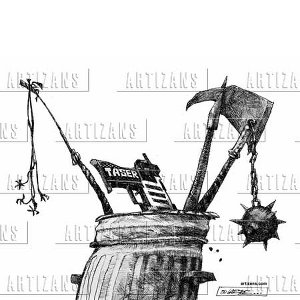





 Posts
Posts

