Showing posts with label Civil Rights. Show all posts

Thursday, May 27, 2010

Yet More Reasons (As If We Needed Any) to Abolish the TSA


What would enrage you enough to “kick a wall, throw a suitcase or make a pithy comment to a screener” at an airport? How about the screener’s electronically denuding and then leering at your wife? What if the gizmo whereby he stripped also her exposed both her and the month-old child she didn’t yet realize she was carrying to carcinogenic rays? Fast-forward a few years: now, as your toddler struggles with a congenital deformity, you learn your wife’s virtual strip-search at the airport may have been responsible. How many walls, suitcases and screeners will escape your wrath then?

Beware: the Transportation Security Administration (TSA), keeper of blacklists to which it secretly adds folks it has never charged with any crime, let alone tried in a court of law, and from which its victims have little recourse, maintains yet another list, this time of “people who make its screeners feel threatened… A TSA report says the database can include names, birth dates, Social Security numbers, home addresses and phone numbers of people involved in airport incidents, including aggressors, victims and witnesses.”

Read The Rest At Orwell's Dreams

National Police Misconduct NewsFeed Daily Recap For 05-26-10


Here are the 29 police misconduct reports recorded in our National Police Misconduct News Feed yesterday, Wednesday the 26th of May, 2010:

  • The once-police chief of Jacksonville North Carolina has been sentenced to life in prison after being convicted of 1st degree murder in the 1972 shooting death of a US Marine sergeant. The chief, George Hayden, killed William Miller with two shots to the back of the head with an M-16 after Miller’s then wife lured him into an ambush so that she and Hayden wouldn’t lose custody of Miller’s daughter when they got married just a few months later due to a fraud case Miller was building against Hayden at the time.
  • The state of New Jersey and two New Jersey transit cops will have to split up paying a $760,000 judgment that was awarded to the woman who was raped by the two officers. The pair were convicted of official misconduct and sentenced to 3 years in prison for talking the woman into following them after she had asked for help and then forcing her to have sex in the weeds under an overpass under threat of arrest.
Read The Rest At: Orwell's Dreams

Saturday, December 12, 2009

ACLU: Obama creating ‘a sweeping immunity doctrine for torturers’


WASHINGTON -- The nation's pre-eminent civil rights organization ACLU on Thursday slammed President Obama for shielding the Bush administration from accountability for its "dangerous torture policy," and insisted that this "lack of transparency" severely threatens the future of constitutional liberty in the United States.

"The Bush administration constructed a legal framework for torture," Jameel Jaffer, Director of ACLU's National Security Project, said in a conference call with reporters. "Now the Obama administration is constructing a legal framework for impunity."

While he credited Obama for having disavowed torture under his watch, Jaffer said that "on every front, the administration is actively obstructing accountability by shielding Bush officials from civil liability, criminal investigation and even public scrutiny for their role in authorizing torture."

"It's the last month of 2009, and not a single torture victim has had his day in court," said ACLU Attorney Ben Wizner. "Not a single court in a torture case has ruled on the legality of the Bush administration’s torture policies."

In response to a question from Raw Story, Jaffer said refusing to prosecute past acts of torture sets "an extremely dangerous precedent" in the legal system. "Torture victims can be denied their day in court solely based on assertions made by their torturers," he said.


"We still don't have a definitive binding determination that what went on in the last eight years was illegal," he added. "And without that kind of determination, it will be all too easy for an unscrupulous lawyer in an unscrupulous future administration to write another memo saying that there is no legal prohibition against monstrous conduct."

"Torture is not an issue where there should be one person on both sides of the table on Hardball -- torture is universally prescribed as clearly illegal."

The Obama administration has evaded transparency by "seeking to cover up details of enhanced interrogation programs," said Alex Abdo, ACLU's attorney for torture FOIA lawsuits, citing the president's refusal to release photos, memos and documentation that detail instances of torture -- largely under the pre-text of state secrets.

"The effect of the Obama administration's argument across these civil cases is the creation of a sweeping immunity doctrine for torturers," said Abdo, citing as one example Obama's defense of torture memo author John Yoo.

"The government can engage in torture, declare it a state secret or a matter of national security, and by virtue of that declaration avoid any accountability for conduct that the entire world and the United States have always recognized as illegal in all instances," he said.

"We're frustrated by the growing gap between Obama administration's rhetoric on accountability and the reality," Jaffer said.

"I think there is an obvious connection between what the president is saying about the commitment we've got to human rights and the work we're doing here inside the United States to hold people accountable for the violations of both domestic and international law," Jaffer said, referring to Obama's acceptance of the Nobel Prize today.

Last week, ACLU Legislative Counsel Michelle Richardson told Raw Story that Obama's support for key Patriot Act provisions is "a major travesty."

Source: The Raw Story

Bookmark and Share

Thursday, November 5, 2009

Dash cam video catches yet another Taser-happy cop


By Carlos Miller

Rolando Ruiz clearly had his hands on the hood of a police car when a Minneapolis police officer walked up behind him and applied his Taser gun to his neck, forcing Ruiz to fall down in an incident caught on a dash cam.

The two men then fall out of view for several seconds but Ruiz’s screams do not stop, giving the impression that the officer is continually tasing him.

Ruiz was arrested for allegedly throwing a brick through the windshield of a cop car. He is now suing for $75,000 in damages.

Source: Photography is Not A Crime

Bookmark and Share

Friday, July 17, 2009

Do You Really Want Freedom, Or Are You Just Kidding Yourself?


“The people have always some champion whom they set over them and nurse into greatness. This and no other is the root from which a tyrant springs; when he first appears he is a protector.” ~ Plato “Wherever is found what is called a paternal government, there is found state education. It has been discovered that the best way to ensure implicit obedience is to commence tyranny in the nursery.” ~ Disraeli A recurring theme among some of the libertarians with whom I interact is: How can we bring freedom and liberty to pass more quickly? How can we mobilize our efforts to topple the coercive state, starting now? One might also ask why these pleas always have an inherent collectivist bent. Why must “we” do anything? I’ve written about this quest before, although contrary to popular belief, I am under no illusion that a fully-anarchic, i.e., stateless, society would be a utopia. That’s not even the point! In fact, I don’t even care one way or the other. (I am not an advocate of freedom for utilitarian reasons.) The unspoken belief seems to be that freedom and liberty arise from strategic planning. (After pretty much every essay I get published, I receive a note from some well-meaning soul who has the next can’t-miss new strategy that will topple the State by the end of the week.) While one could argue that much of the prose on Internet sites such as this one is similarly intended, I would disagree. What I attempt to do here, and what I see others doing here, is exploring the fullness of the libertarian paradigm. That paradigm is based upon individual choices made without aggression upon others. It is only when one’s choices infringe directly upon others that anyone should have a genuine concern. Generally speaking then, the focus is within, not without. Education is a primary goal. Philosophy is the primary focus. Borrowing from Stephen Covey, many people seem overly concerned with changing and/or fixing the world, despite the fact that their bedroom closet might more urgently need attention. As an aside, I won’t venture into the fallacy of the commons (or even the tragedy of the commons) right now, because this essay won’t be long enough. Suffice it to say that the bleeding-heart tendency to impose one’s beliefs on everyone else in the name of a third party—the children, the poor, the homeless, the environment, etc.—got old for me years ago. (The subject does deserve some analysis, though. Maybe I’ll attempt to address it in a subsequent essay.) During a recent long run, I got to thinking about this issue: Getting to “real freedom” and all that. Amidst my own pondering, something I’d heard my market anarchist friend and colleague Stefan Molyneux say over and over rang in my thoughts: Freedom begins at home, with you, with that over which you ultimately have the most control. If you are tied to positive obligations that were thrust upon you coercively, from friends, or from family, or dating back to poor childhood lessons, then worrying about the State is a huge waste of time. The vital point: The lessons one uses in direct interaction with those closest to him are reflected back by the society he inhabits, often by the authority paradigm of that society. Stop, in the Name of the Law! While I’m relatively certain that most people were appalled when they read, quite some time ago now, about the 8th grader who was strip-searched for Ibuprofen in California, I fear that if we were to share parenting tactics, our uneasiness with such behavior as that of the vice principal in the story would be more a matter of degree than of morality. More pointedly: Have you ever humiliated one of your children or a supposedly close friend to make a point? Do you remember ever being humiliated by your parents as they strove to establish dominance and authority over you? Have you ever seen an adult humiliated by another adult? Agents of the State act in exactly this way, almost universally. The actions of that police officer in Dallas are but the latest example in long line of repeated scenes form the same shitty movie. Visit almost any airport and you too can “enjoy” similar treatment. There is a reason why people like Manadel al-Jamadi are treated like sub-humans. The belief system that informs people like Dick Cheney and Donald Rumsfeld (and all the thugs who have replaced them) also convinces them that they can take any step, no matter how heinous, to maintain the authority they think they’ve been given—morals and ethics be damned. The same could be said of Officer Robert Powell, the Dallas cop noted in the story linked above. According to Business Daily’s Mark Weisenmiller, quoting from Jane Mayer’s “Dark Side,” Jamidi’s last few minutes on Earth were not pleasant: Jamadi was driven first to an Army base for debriefing, where the US Navy SEALs punched, kicked, and struck him with their rifle muzzles for some 20 minutes. Weisenmiller goes on to say: Jamadi was later interrogated by CIA operatives at Abu Ghraib prison, where he was hung up by his wrists, and subsequently killed. This is an extreme example, but it points to what I believe is a general trend. How can one protect freedom by taking it away from someone else, without regard for basic morality? Here’s a video of a sheriff’s deputy “laying the wood” to a suspect in an undercover drug bust. While most freedom advocates would label such behavior as both heinous and dastardly, I would be willing to bet that there are people reading this column who feel, conversely, that punishment such as spanking, slapping, or other physical infringements are sometimes appropriate. (A relative of mine told me that Plaxico Burress deserves whatever he gets, for the heinous infraction of carrying a gun without the state-mandated paperwork.) My question: How does one decide? Here’s the thing: If you can punish a slave to your heart’s content when he’s “yours,” why wouldn’t he take the same approach when he gets the chance, if and when the tables are turned? It is this psychological phenomenon that made “straw bosses” so effective during the times of chattel slavery in the U.S. Similarly, it is this psychological phenomenon that supports putting the child who is the biggest behavior problem in charge while the teacher is out of the room. Further, and maybe more worrisome is this: At what point does the type of heinous behavior and treatment of prisoners at places like Abu Ghraib become commonplace in detention centers in the U.S. ? (Hell, for all I know, it’s already happening.) At what point will the punishment for previously-minor offenses migrate up towards the death penalty, like some episode of Star Trek gone terribly off-track? We already have people in the U.S. serving prison time for the offense of lying. When an agent of the State believes that his orders justify the most basic mistreatment of his fellow man, it’s only a hop, skip, and jump to enemy combatants on home soil —and I’m not talking about only people who look like Muslims—being treated the same way. If the Milgram Experiments and the Stanford Prison Experiments taught us anything, it’s that people will follow orders—naked authority—to almost any end, despite data and indications (and even signals from conscience) to the contrary. It is this seminal truth that guarantees that the State, any state, no matter how constructed, no matter who is “elected” to run it, no matter what documents supposedly justify its creation and protect those under its control, will, in time, become a bubbling cesspool of rights infringement and totalitarian conduct. He That Treats Others as a Child Will Himself Be Treated Like a Child? Do lessons learned early in one’s life, both in the home and at school, drastically negatively affect the ability of a society to embrace liberty and freedom? Examining childhood lessons, some would say we over-protect our children. I tend to agree. Says one pundit: Fears regarding safety and litigation have resulted in playgrounds that are unchallenging and unappealing to young people. Parents are obsessively concerned with protecting their children and this is leading to their offspring not developing the resilience and physical skills that they need. While one might argue about how much actual resilience is developed on the playground, and I don’t care to do so, few would argue (I hope) with the negative effect of the creeping sheep-like treatment the State gives its citizenry. The State systematically over-protects its citizens, to very negative effect. The State is composed of people with beliefs. How much of this penchant toward over-protection stems from ideas developed during childhood only later to be implemented? One could certainly blame public education for much of this problem, but that might also be a convenient scapegoat. One could also suggest that such behavior—protectionism versus freedom—is endemic in humans. No matter how one learns such lessons, one thing is undeniable: the State treats each of us as children because too many of us believe that such behavior is appropriate. More troubling, we ourselves practice this behavior. For example, focusing on one specific area, and returning again to children and family, almost everyone has heard the phrase: “Spare the rod, spoil the child.” I’ve heard it more times than I care to remember. (In full disclosure, I also believed it, or so I thought, for far longer than I’d care to admit.) I don’t intend to debate the morality of corporal punishment. Instead, I wish to place it in the same moral context as similar punishments meted out by agents of the State. Ironically, while getting my periodic dose of The Blog of Tim Ferriss, of “The 4-Hour Work Week” fame, I came across a fascinating post from a woman who “escaped” from her Amish sect. In the comments of response to her story one can find, among several interesting musings, a discussion of this supposedly Biblically-derived phrase which is generally used to justify physical punishment of children. The fascinating tidbit was this: The Bible doesn’t actually contain that phrase. The sentiment is apparently a paraphrase of Proverbs 13:24, which says: He that spareth his rod hateth his son: but he that loveth him chasteneth him betimes. While I’m certainly no Biblical scholar, it seems to me a bit of a self-fulfilling prophesy to use that single verse as a justification for physical abuse. Back on Ferriss’s blog, a poster simply shown as “Betsy” offered what I believe is the most humane (and libertarian) translation of that verse: “Spare the rod and spoil the child” is actually analogous to the rod of the shepherd. It’s really a beautiful, sentimental teaching that has been totally perverted by some. The poster went on: A good shepherd never beats the sheep, but uses the rod to guide them with a gentle touch. That this homily should justify child abuse is the exact opposite of its intended meaning, which is “by failing to guide your child with love and instilling discipline (not punishment) in a consistent and gentle way, you ruin the child’s chances of successfully functioning in relationships and society as a whole.” Indeed! This sentiment seems to resonate with the non-aggression axiom. How can the thugs with whom so many of us deal claim to be protecting anyone from anything? (They certainly aren’t gently guiding anyone, either.) Here’s the real irony: The people who take actions such as those police officers or that vice principal, on behalf of the State, very likely learned those lessons at home or at school, as children themselves. Each time one teaches those closest to him from this playbook, he deepens the chasm between freedom and the routine acceptance of the State’s naked authority. He also lengthens the time it will take to fill that chasm. Frank Herbert, the author of Dune, is credited with saying: If you think of yourselves as helpless and ineffectual, it is certain that you will create a despotic government to be your master. The wise despot, therefore, maintains among his subjects a popular sense that they are helpless and ineffectual. There is an important corollary to this insight. If you think of others as helpless and ineffectual, you will erect systems—often despotic systems—designed, so you think, to help those people overcome their helplessness. As a result, you will only enslave them. In the effort, you will eventually enslave yourself as well. Please note that this is true no matter the supposedly objective evidence one uses to justify the treatment, be it age, race, gender, culture or something else. Conclusion One of the most interesting theories I have ever heard regarding freedom came from Molyneux during one of many discussions. He asserted that much of the damage to the fabric of voluntary interaction in society stemmed from violent, coercive behavior in the family unit. I admit that this hypothesis initially took me aback. (With apologies to Dune, I guess my imperial conditioning was strong.) Honestly though, the assertion that family violence is all too common is not worthy of much debate. If one can’t see the similarity among how a TSA screener treats an airline passenger; how a teacher or principal treats a student; and how far too many parents treat their children—well, freedom and liberty are much further away than I could ever hope. (Of course, the parent who really wants to prepare his children for well-practiced performance during airport screening can obtain a Playmobil Security Check Point toy. Start them young!) C.S. Lewis was prescient when he said: Of all tyrannies a tyranny sincerely exercised for the good of its victims may be the most oppressive. It may be better to live under robber barons than under omnipotent moral busybodies. The robber baron's cruelty may sometimes sleep, his cupidity may at some point be satiated; but those who torment us for our own good will torment us without end for they do so with the approval of their own conscience. While it’s neither my place nor my goal to advise anyone about how to raise their children, several observations seem reasonable. These observations seem particularly germane to the statist authority paradigm and from where it seems to emanate. Whether it’s letting a child out of the house without prior written permission and accompanying signed documents, selecting the foods your son or daughter can eat, without discussion or education, or (my personal favorite) slapping your child in the mouth for being sassy, the similarities remain clear. Anyone who thinks such practices make sense probably shouldn’t be too aghast if the State seeks to forcibly protect them from transfats. Neither should they be surprised when somebody gets tased for not kowtowing to some random person wearing a uniform. These examples occupy different social contexts but exemplify strikingly similar moral content. Krishnamurti pointed out the truth when he said: Your parents are frightened, your educators are frightened, the governments and religions are frightened of your becoming a total individual, because they all want you to remain safely within the prison of environmental and cultural influences. I’d say it’s about time we each break out of that prison. Sure, the State is a huge problem, but the State is just people. The treatment we practice, the treatment we allow, and the treatments we will receive are inexorably linked. Maybe liberty is a learned behavior and maybe we all need to change the lessons we allow and practice? And now, if you'll excuse me, my bedroom closet needs attention.Source: Strike the Root
Bookmark and Share

It's your business what you do, so long as you don't hurt anybody else


Civil liberties are the focus of this column, and we all agree that civil liberties are good things, right? But we don't all agree about specific liberties and their defenders. Some people snipe at sexual rights and the ACLU, others at self-defense rights and the NRA ... We may believe in liberty, but we don't seem to agree on what it is. So, what is liberty? The answer, is that it's anything peaceful, or, put another way, anything done among consenting adults.

Some people will answer: But, you have no right to smoke grass, own guns, have gay sex, travel without showing ID, or open a business without a license if the government says otherwise! The law tells us what our civil liberties are, and the government, elected by a majority of the people, makes the law.

To put it bluntly: Screw the government, screw the law and screw the majority.

If you want to marry somebody of the same sex, toast the festivities with marijuana bought at an unlicensed bar, and celebrate with a machinegun shoot (well ... I suggest you reverse the order of the shoot and the toast), it ain't nobody's business if you do.

In fact, Ain't Nobody's Business If You Do is the title of a wonderful book written by Peter McWilliams and published in 1996. In the book, the full text of which is now available online, McWilliams wrote, "You should be allowed to do whatever you want with your own person and property, as long as you don't physically harm the person or property of a nonconsenting other."

McWilliams didn't invent this idea. It's an old one, perhaps most closely associated with the philosopher John Stuart Mill, who wrote:

[T]he only purpose for which power can be rightfully exercised over any member of a civilized community, against his will, is to prevent harm to others. His own good, either physical or moral, is not sufficient warrant. He cannot rightfully be compelled to do or forbear because it will be better for him to do so, because it will make him happier, because, in the opinion of others, to do so would be wise, or even right... The only part of the conduct of anyone, for which he is amenable to society, is that which concerns others. In the part which merely concerns himself, his independence is, of right, absolute. Over himself, over his own body and mind, the individual is sovereign.

In the modern context, McWilliams elaborated:

Laws against consensual activities create a society of fear, hatred, bigotry, oppression, and conformity; a culture opposed to personal expression, diversity, freedom, choice, and growth. The prosecution of consensual crimes "trickles down" into ostracizing, humiliating, and scorning people who do things that are not quite against the law but probably should be. "They're different; therefore, they're bad" seems to be the motto for a large segment of our society. We are addicted to normalcy; even if it means we must lop off significant portions of ourselves, we must conform.

There's no need to accept the validity of all these arguments; the validity of any one is sufficient reason to wipe away all the laws against consensual activities.

"A culture opposed to personal expression, diversity, freedom, choice and growth"? Isn't that a bit strong?

Not really. You see, McWilliams died in 2000. A cancer and AIDS patient himself, he was arrested while helping another writer conduct research for a book on growing marijuana for medical purposes. His mother's house was held as collateral for the bond that secured his freedom while awaiting sentencing, and the chief prosecutor in the case threatened to seize the home if McWilliams was found with even a trace of the marijuana he used to control the severe nausea caused by his medication.

Unable to control his nausea, McWilliams choked to death on his own vomit.

Some people would make excuses for the prosecutor in the case. He was just doing his job according to the law, after all.

But a law that would deny a man medicine and cause him to choke to death is evil, and so are those who voluntarily help to enforce such laws.

We make a big deal about the democratic nature of our political system, but there's nothing about 50% plus one that could sanctify laws and actions like those that led to the death of Peter McWilliams. If we recognize that you have the right to do peaceful things -- that is to engage in trade, or to love, or to consume -- by yourself and with other consenting adults, then it doesn't matter if the people intruding into your life are lone wolves or a majority of the population. They're wrong to intrude and they're doing evil by sticking their noses where those noses aren't welcome.

Because it ain't nobody's business if you do.

Unfortunately, governments and our neighbors have grown accustomed to interfering in what isn't their business. Occasionally, they give a hat tip to the philosophical tradition represented by Mill and company by arguing that, if you're allowed to smoke grass or own a gun or operate a storefront without a license, others really are harmed by your subsequent (alleged) lower productivity at work, or the possibility that you'll go postal, or the vague potential for you defraud customers in a way that could allegedly be prevented by an official piece of paper.

This stretches the idea of "harm to others" so far out of shape as to be unrecognizable -- except as a dishonest intellectual dodge. Accepting the argument that what you might do, or what could reduce your utility to society, is any business of the government, leaves absolutely nothing beyond the reach of nosey busybodies with official titles.

It also, incidentally, reduces you to a cog in the machine.

Laws that interfere in your right "to do whatever you want with your own person and property, as long as you don't physically harm the person or property of a nonconsenting other" go too far. They should be defied and sabotaged. Governments that insist on passing such laws are illegitimate and should be dumped. And majorities that put such governments in power? Well, they're just wrong, and should be told to take a hike.

Defending liberty isn't about playing by the rules. It's about judging whether the rules, and the people who enforce them, are worth respecting.

Source: The Examiner

Bookmark and Share

Thursday, July 2, 2009

The Role of “The People” in Protecting Inalienable Rights


It is interesting to know that many of the attendees at the Constitutional Convention held in 1787 were OPPOSED to including a Bill of Rights in the Constitution. Why would this be so? The chief concern was that if a written bill of rights were included, the people would, over time, think that these rights were the ONLY rights they had. They were wise enough to know that the people would not understand how vast this body of “inalienable” rights was, and would therefore allow the government (especially the federal government) to dictate, and invade, the sacred domain of self-government that was to remain with the people.

As a result, the Bill of Rights was not included in the original Constitution, but was later introduced by James Madison in 1789 to the First United States Congress as a series of amendments to the Constitution.

The Bill of Rights, which are now defined as the first ten amendments to the Constitution, are understood to protect such rights as freedom of speech, freedom of the press, and freedom of religion. Also included (among others) are the freedom of assembly, the right to keep and bear arms, and protections against unreasonable search and seizure. It is critical to understand that this in no way limits the extent of the rights of “the people.” What has been generally lost is an understanding of the purpose and meaning to the 9th Amendment which states:

“The enumeration in the Constitution of certain rights shall not be construed to deny or disparage others retained by the people.”

Obviously, the founders were referring to these other “unspoken and unwritten” rights which the people possessed, even if the Bill of Rights did not explicitly detail those rights.

In addition, “the people” (that is us) have lost an understanding of our role in the governing process. An understanding of the purpose and intent of the 10th Amendment is also critical to understand the “vision” of the founders. The 10th amendment states:

“The powers not delegated to the United States by the Constitution, nor prohibited by it to the States, are reserved to the States respectively, or to the people.”

Therefore, there has existed, and still exists, a vast realm of rights (also referred to as “natural rights”) that we, the people, possess that are not defined by the Constitution or its amendments. In order to gain an understanding of these rights, let me ask a few questions about only one of the important areas of our lives, our physical health.

Despite no specific mention in the Constitution or its amendments, do humans have an individual right to choose their form of medicine or medical treatments? Do we have an individual right to choose “alternative” forms of medicine (such as Native American medicine, ancient Chinese medicine, or ancient Ayurvedic medicine, as examples? On the other hand, can we be forced to only accept what our government states is “legal” medical treatment according to current governmental regulations? Does the Federal government have any constitutional authority to even speak on the subject?

A study of the history of “acceptable” medicine in this country reveals that “chiropractic” treatments were for many decades “illegal,” as government authorities (dominated by the American Medical Association) had not yet deemed it “safe.” Some of the greatest breakthroughs in medical history were not “legal” according to existing governmental authorities. This reality is even more evident today as new breakthroughs in alternative medicine are being discovered every day. Does it make sense to allow a government bureaucracy (which is obviously subject to control by special interest groups) to make such an important decision for YOU, as your choice of medical treatment? Or is this potential life or death decision part of “the peoples” inalienable rights to make choices for themselves, without having to resort to “permission” from some government authority?

Hopefully, this discussion will help to clarify how we, the people, must not allow governments to invade those sacred realms of personal decisions and responsibilities, collectively referred to as our “inalienable rights.” In upcoming articles I will continue to uncover how the Founders were attempting to give us our freedom, if only we would accept it.

Source: 10th Amendment Center

Wednesday, July 1, 2009

Top Torture Lawyers Still in Government


We’ve heard of John Yoo and Alberto Gonzales, and maybe even Jay Bybee. Some of us recall John Ashcroft, Michael Mukasey, and even David Addington. Michael Haynes, Stephen Bradbury, and Douglas Feith occasionally make the news. If I had any say about it all 40 of these facilitators of torture would be universally known — plus the eight more that readers of this article will call to my attention and angrily accuse me of trying to cover for by only being aware of 40. I would also make universally known the fact that two of the worst now work for President Barack Obama.

Even if you haven’t read them, you probably know that the Justice Department under Bush-Cheney produced memos pretending to legalize torture, gruesome memos stipulating exactly how many times a particular victim could “legally” be tortured with a particular technique. John Yoo and Jay Bybee wrote the worst of these memos. But the memos take the form of responses to inquiries from a guy named John Rizzo. Yes, Mr. Rizzo, you may slam that guy against a wall. No, Mr. Rizzo, you may not drown that one unless you have a doctor present. And so on. The memos are all headlined thus: “MEMORANDUM FOR JOHN A. RIZZO.”

So, Yoo and Bybee didn’t invent the torture techniques out of their own sadistic imaginations. They replied to Rizzo’s requests for “legal” permission to use detailed techniques. What if those requests from Rizzo had been turned into news headlines, rather than the Justice Department’s responses? Would activists then be focused on demanding Rizzo’s, rather than Yoo’s, removal from one of our prestigious institutions of higher learning? That’s actually a very easy question to definitively answer, and the answer is no. Rizzo doesn’t work in academia: he is still, until he retires this summer the top lawyer at the CIA.

Retirement is what counts as accountability these days in Washington. Future consiglieri are hereby put on notice: you back torture and death squads and drone strikes and you’ll be forced to retire with the LA Times printing a profile on your great influence and wonderful taste in expensive suits. Rizzo served as top lawyer at the CIA for years, without the title, because the Senate wouldn’t approve him. Serving as the “Acting So-and-So” is what now counts as compliance with the Constitution. Senators are hereby put on notice: you fail to confirm an appointee, and he or she will get the job without the title.

Rizzo oversaw in detail the use of illegal detention, rendition, and torture at sites around the world. He requested Justice Department memos to cover his actions. He illegally sanctioned the destruction of videotapes demonstrating what he had done. He brazenly testified before Congress that torture was not torture. He authorized torture prior to receiving the Office of Legal Counsel (OLC) memos. After receiving the memos, he authorized torture that far exceeded what they pretended to allow. He lied to the Justice Department, claiming that a captive (Abu Zubaydah) was not cooperative in the absence of torture. He ignored warnings that all of this was illegal, but made clear his awareness of guilt by requesting the memos and destroying the tapes.

And Rizzo didn’t do all of this alone. He had help from another top lawyer at the CIA, Jonathan M. Fredman. Fredman now works in the Obama administration in the Office of the Director of National Intelligence, with — as far as I know — no plans to leave. According to the Senate Armed Services Committee:

“On October 2, 2002, Jonathan Fredman, who was chief counsel to the CIA’s Counter Terrorist Center, attended a meeting of GTMO staff. Minutes of that meeting indicate that it was dominated by a discussion of aggressive interrogation techniques including sleep deprivation, death threats, and waterboarding, which was discussed in relation to its use in SERE training. Mr. Fredman’s advice to GTMO on applicable legal obligations was similar to the analysis of those obligations in OLC’s first Bybee memo. According to the meeting minutes, Mr. Fredman said that ‘the language of the statutes is written vaguely. . . . Severe physical pain described as anything causing permanent damage to major organs or body parts. Mental torture [is] described as anything leading to permanent, profound damage to the senses or personality.’ Mr. Fredman said simply ‘It is basically subject to perception. If the detainee dies you’re doing it wrong.’”

People like Rizzo and Fredman should not be working for our government a single day longer. They should be impeached. They should be prosecuted. They should be given fair trials and be imprisoned if convicted. And all existing information on what they did should be made public. Fed up with waiting for Congress or the Justice Department to act, a coalition of groups headquartered at http://DisbarTortureLawyers.com has gone ahead and filed complaints with bar associations to have torture lawyers disbarred and to call attention to the need for further accountability. Having already filed complaints against 12 torture lawyers, Disbar Torture Lawyers filed three more on Monday. Two of these were against Rizzo and Fredman.

Disbar Torture Lawyers held a press conference on Monday at the National Press Club, with remarks by Kevin Zeese, who filed the complaints, by Bruce Fein, a former Reagan administration lawyer, and by Shahid Buttar, Director of the Bill of Rights Defense Committee. I was not in town but am certain we can count on the Washington Post to give the story all the coverage it deserves.

Source: Dick and Sharons LA Progressive

Monday, June 29, 2009

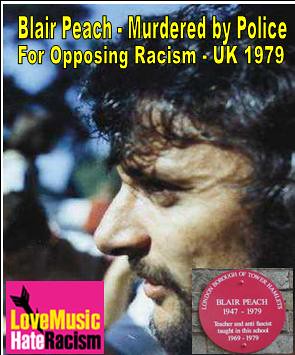
Met police chief willing to release Blair Peach report


The report on the controversial death of the anti-racist campaigner Blair Peach should finally be published more than 30 years after he died in a demonstration in west London. The commissioner of the Metropolitan police, Sir Paul Stephenson, agreed today that it should be made public after an unanimous call to do so by the Metropolitan Police Authority.

The decision was welcomed by Peach's family and partner, although no date has been set for the release of the report, which looked into allegations that Peach died at the hands of the police. The organisation Inquest, which has campaigned on the issue, expressed concerns that key details might be redacted.

Celia Stubbs, who was Peach's partner, said: "I'm totally bowled over, I was really cynical about it and I really didn't expect a result like this today." She said she felt that recent publicity given to the case by the Guardian, in which it was likened to the death of Ian Tomlinson during the G20 demonstrations on 1 April, had been a factor in the decision.

Jenny Jones, an MPA member, proposed a motion calling on the police to publish the full report, written by the former commander John Cass, before the end of the year. The report has remained secret despite requests for disclosure by Blair's family and friends, and an attempt by them last year to have access to it under freedom of information laws. Inquest has also written to Stephenson supporting the family's call for disclosure of the report, but had no response until today.

Jones told a meeting of the MPA, chaired by London's mayor, Boris Johnson, and with Stephenson in attendance, that the Met had declined to publish the report, suggesting that this was partly for the sake of the family. "It is embarrassing keeping it secret," said Jones. After other members voiced their support for publication, the mayor said it was clear that everyone was in favour of such a move.

"My starting point is a desire to publish," said Stephenson, saying that he aimed to do so "as soon as I possibly can". He said legal advice would have to be taken, but he was committed to such a course. "The reasons [not to publish] would have to be overwhelming not to do so."

Philip Peach, Blair's brother, who was at the meeting, welcomed the decision but said it would now be necessary to see how much of it was released. "I could never understand why it wasn't disclosed originally," he said.

Deborah Coles, co-director of Inquest, said: "The whole basis on which the Cass report has been withheld from the Peach family for 30 years has been widely discredited and yet the secrecy continues. Ian Tomlinson's death at the G20 protest and the similarities between the two cases makes the need to disclose this report even more urgent, and is in both the family and public interest." She said a key issue would be whether the report was published in its entirety.

It was partly as a result of the response to Peach's death and the way it was investigated that Inquest was set up in 1981. "Sadly, the need for the organisation remains as urgent today," said Coles. "Non-disclosure of evidence has been one of the most problematic issues following deaths in custody and has seriously undermined family and public confidence in the police complaints system."

Peach, a teacher and an anti-racist campaigner from New Zealand, died from a blow to the head at a demonstration against the National Front in Southall, west London, in April 1979. Cass was reported to have recommended the prosecution of police officers, but no charges were ever brought.

• This article was amended on 26 June 2009. The original reported the commissioner of the Metropolitan police, Sir Paul Stephenson, as saying that the case for publication of the report on Blair Peach's death was "overwhelming". This has been corrected.

Source: The Guardian