Showing posts with label Police Corruption. Show all posts

Thursday, August 13, 2009

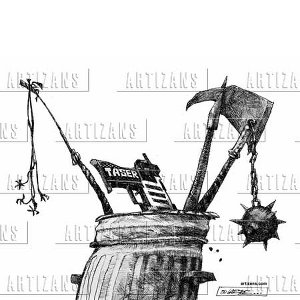
Tasers and Torture


Like Glenn, I write a lot about civil liberties, which have been at the heart of the national conversation since the beginning of the War On Terror and the expansion of the national security state. But my interest in civil liberties predates 9/11 and until then was usually pointed at the far more prosaic issues of police and prosecutorial misconduct (and the inevitable conclusions any study of those things brings to the issue of the death penalty). Nowadays, the theme of civil liberties seem to be a sub-plot to a James Bond flick rather than "To Kill A Mockingbird." And yet, I think the two are intertwined much more closely that we think. In our apparent acceptance of torture as a legal method of interrogation, the bar of civilized official behavior has been lowered to the point where we are accepting torture in everyday life as if it's nothing. Indeed, we are using it as a form of entertainment.

I'm speaking of the ever more common use of the Taser, an electrical device used by police and other authorities to drop its victims to the ground and coerce instant compliance. The videos of various incidents make the rounds on the internet and you can see by the comments at the YouTube site that a large number of Americans find tasering to be a sort of slapstick comedy, the equivalent of someone slipping on a banana peel, with a touch of that authoritarian cruelty that always seems to amuse a certain kind of person. "Don't tase me bro" is a national catch phrase.

Tasers aren't benign however. They kill people. Nobody knows exactly why some people die from being tasered, and they certainly don't know how to tell in advance which ones are at risk. But there have been hundreds of deaths similar to the one below, which nobody can adequately explain:

A Detroit teenager who police say fled a traffic stop Friday died after being subdued with a Taser. He is the second Michigan teen to die following a Taser stun in less than a month. Warren Police say they don't know why the 15-year-old bailed out of a Dodge Stratus he was riding in during the stop on Eight Mile near Schoenherr, leading officers on a half-block chase that ended in an abandoned house on Pelkey in Detroit. The car was stopped for having an expired license plate. In the scuffle, officers shocked the teen one time with a Taser, police said. Shortly after, he became unresponsive and died.

Taser International has successfully defended themselves in lawsuits by attributing the deaths to drug use and if that doesn't work do to the fact that drugs were not present in the victim, they rely on an unrecognized medical condition called "excited delirium", a disease that only afflicts people who die in police custody. Juries apparently find this convincing. Taser has only lost one case.

But that isn't the real problem, although it may eventually be the path by which tasers are banned for use in civilized countries. As awful as the possibility of death is, tasers would be a blight on any free people even if they weren't so often deadly. Tasers were sold to the public as a tool for law enforcement to be used in lieu of deadly force. Presumably, this means situations in which officers would have previously had to use their firearms. It's hard to argue with that, and I can't think of a single civil libertarian who would say that this would be a truly civilized advance in policing. Nobody wants to see more death and if police have a weapon they can employ instead of a gun, in self defense or to stop someone from hurting others, I think we all can agree that's a good thing.

But that's not what's happening. Tasers are routinely used by police to torture innocent people who have not broken any law and whose only crime is being disrespectful toward their authority or failing to understand their "orders." There is ample evidence that police often take no more than 30 seconds to talk to citizens before employing the taser, they use them while people are already handcuffed and thus present no danger, and are used often against the mentally ill and handicapped. It is becoming a barbaric tool of authoritarian, social control.

Last week there were three taser episodes that made the rounds on the internet. (There may have been more, but these were the three most discussed.) The first was of a drunken, belligerent man at a baseball game who after 41 seconds of discussion was tasered while sitting in his seat. Indeed, the video shows that the taser threw him down onto the cement steps where he rolled down several. Since this scene must have happened literally thousands of times over the years, you have to wonder what they must have done in the past. Somehow I doubt they pulled out a gun and shot them.

The second incident was this sad tale of a man who allegedly refused to come out of a store restroom. Police blew pepper spray under the door, kicked it open and instantly tasered the man. It was only afterward that they discovered he was deaf. Police tried to book the man anyway, but the magistrate refused to accept the charges.

It was the third incident, however, that should get civil libertarians' serious attention. It featured an Idaho man on a bicycle who happened to ride past a police stop in progress on the side of the road. He had nothing to do with the stop, but was pulled over by the police and told to produce his ID. He said, correctly, that he had no legal obligation to produce ID and the police insisted he must. The situation escalated and he demanded that they call a supervisor to the scene when the police said they were going to arrest him. He ended up being tasered seven times -- you can hear him moaning in pain on the tape at the end. (In an especially creepy moment, the police try to confiscate the tape of the incident.)

Now, many people will say that he should have just showed his ID, that it's stupid to confront police, that like Henry Louis Gates you get what you deserve if you mouth off to the cops. And on a pragmatic level this is certainly true (although I would reiterate what I wrote here about a free people not being required to view the police in the same way they view a criminal street gang, which is to say in fear.) But the fact remains that there is no law against riding a bicycle without ID, and there is no law against mouthing off to the police. Certainly, there can be no rationale behind using a weapon designed to replace deadly force seven times against someone under these circumstances.

These are just three incidents that happened last week. There's nothing special about them. They happen every day. Even this horrific scene, which is so shockingly authoritarian (excuse the pun) that it makes you feel sick, is not unusual:

A former Southern Virginia University and Brigham Young University adjunct professor of political philosophy and jurisprudence, Dr. Lowery entered the Utah Third District courtroom alone on November 22, 2004, to make oral argument before Judge Anthony Quinn. Two Salt Lake County Deputy Sheriffs sat at the back of the courtroom, one on each side of the door. Other deputies were in the foyer of the courtroom. No members of the public were present.

Dr. Lowery suffered from major depression, bipolar disorder, paranoia disorder, delusional disorder, and psychotic disorder. Judge Quinn granted one of Dr. Lowery's motions made under the Americans with Disabilities Act, Title II, which allowed for reasonable modifications of court rules, policies, or practices in order to accommodate Dr. Lowery's multiple mental disabilities.

Near the end of his oral argument, the traumatic content of the argument moved Dr. Lowery into moderate mania, and he characterized a previous crabbed ruling by Quinn as "bullshit."

Impatient for the speech to end, Judge Quinn took that as an opportunity to order the bailiffs to take the professor into custody and cool him off.

The plaintiff's state of agitation was caused by his mental disabilities. The deputy sheriffs' approach only caused the situation to escalate. As five or more Salt Lake County deputy sheriffs/bailiffs seized Lowery from behind, he shouted, "I am cooled off; I deserve to be heard. I deserve to be heard, your Honor, and you are violating my access to due process at this very moment. I am not violent and --"

Judge Quinn interrupted him with ordering the bailiffs to take Dr. Lowery to a holding cell. A split second later -- unclear whether following the judge's orders or acting on his own accord, a bailiff sent 50,000 volts of incapacitating electricity into the lower back of the unsuspecting professor. As the courtroom video shows, nothing in Dr. Lowery's behavior suggests that the bailiffs had any reasonable motive to believe they or the judge were in physical danger.

Yet the taser gun fired more than once.

The repeated electric shocks blew Dr. Lowery over the podium, and he landed face down on the floor, with two bailiffs on his back. The electric blasts caused Dr. Lowery's bowels to empty twice. He screamed, "Help me!" while he complied with a bailiff's order to stay on his belly, neither capable nor willing to offer resistance. Then, suddenly, he went unconscious.

Remembering they were still on camera, the bailiffs shouted at Dr. Lowery to not resist again (though his resistance was only instinctive) and threatened him with more electrocution. When they realized that he could no longer hear them, they dragged the man across the floor, put him in a chair, and massaged his heart. One bailiff called for paramedics. [...]

Since no one but the victim and the abusers were in the courtroom, this crime remained unknown to the public until recently.

(Read on if you can stomach it.)

Here's the Youtube of the event. You can see for yourself if there was justification for the reaction of the judge or the police.

Representatives of the government torture innocent citizens into unconsciousness, on camera, in United States courtrooms with tasers. They use them on prisoners and on motorists and on political protesters and bicycle riders, on mentally ill and handicapped people and on children And it's happening with nary a peep of protest.

America's torture problem is much bigger than Gitmo or the CIA or the waterboarding of Khalid Sheikh Mohammed. The government is torturing people every day and killing some of them. Then videos of the torture wind up on Youtube where sadists laugh and jeer at the victims. It's the sign of profound cultural illness.

Source: Salon

Bookmark and Share

Tuesday, July 28, 2009

At last, a crack team to take on cops who kill: the RSPCA


Do make sure you're sitting down. Something quite extraordinary has happened. The police have issued an abject apology for two deaths in their custody, and announced that the officer responsible will be prosecuted. How to put this momentous announcement into context? How to throw it into the sharp relief which is deserves? Well, according to monitoring carried out by the organisation Inquest, there have been 954 deaths in police custody in England and Wales since 1990 – the figure includes shootings – with nary a successful prosecution for murder or manslaughter.

And so to this historic case, which has seen top brass abandon their traditionally minimalist statements on such tragedies, unless of course they take the bizarre decision to pretend that the victim had leapt over a ticket barrier or some such. The deaths have caused "immense sadness", according to the relevant force's chief superintendent. "We will certainly take any lessons we can get from this process, and make sure we put them in place so this sort of thing never happens again. We understand the upset that this has caused the public and members of our staff … There is a sense of shock and sadness at the news of the death of two of our police dogs."

Ah yes. Forgive my getting your hopes up. It's the case of those two dogs who expired in a car outside Nottingham police headquarters earlier this month, having been left in the vehicle on a searingly hot afternoon. Following an urgent RSPCA investigation, the officer responsible will face animal cruelty charges. The force's own inquiry apparently continues.

A horrible business, evidently, and we must pass on our condolences to those who knew the animals. Indeed, the police have established a tribute area, where they and members of the public have laid wreaths.

But after we've done that, I'm afraid we must contrast Plod's reaction with, say, that to the death of Ian Tomlinson, who died of abdominal bleeding at the G20 protests in March, shortly after being struck by a Met officer. The police have sweetly judged this to be something worth offering their "sincere regret" about, but refuse to comment further, while the Independent Police Complaints Commission continues one of its famously fast-paced investigations. It would be funny if it weren't so bleeding wretched.

The contrast has not been lost on some of the families with relatives who have died in police custody. At a recent meeting of their number, a speaker read out the Nottingham chief super's expressions of anguish. One attendee says the room went quiet as everyone wondered to which death in custody such expressions of frank remorse related. When the dog punchline was revealed, how they didn't laugh.

There isn't quite the space to reproduce the official police comments on all those 954 deaths, but let's challenge any copper who fancies a grim afternoon to delve among them and produce a statement as abjectly apologetic or anguished as the one concerning the two dogs.

Of course, there's a point to be made about some people's prioritising of animal injustice, where its human equivalent elicits less concern in them. In 2006, more money was given to a single Devon donkey sanctuary than to all the most prominent charities dealing with violence and abuse of women.

For today, though, these are diversions, because there is something so undeliciously neat about the dog tale that you could be forgiven for thinking it was a staged satire. In an alternate reality, the police would have offered a variation on that cliched explanation for a death in custody – the suspect kicked himself down the nick stairs – perhaps suggesting that the dogs were involved in some sort of asphyxiation game gone tragically wrong.

If the story had failed to catch on, they might have floated a version of the theory that the Met put to Ian Tomlinson's family in the days after his death – namely, that the officer who struck him could have been a member of the public "dressed in police uniform".

This idle speculation could go on for ever, or at least until the IPCC completes its inquiries into the G20 cases, which increasingly seems a similar time frame. Nicole Fisher, the protester who was filmed being struck by a police sergeant, told the home affairs committee that the IPCC had informed her that they expected it would take "between 12 and 18 months" to complete their inquiry. Considering it was such a "distressing" and high-profile case of assault, ran the committee's report, "we cannot imagine why this amount of time is needed".

An obvious solution suggests itself. A crack team of RSPCA investigators must be seconded to the IPCC to teach the latter how to bring in an investigation in under 18 months. Or would that upset the fine equilibrium of this most credible of public bodies, in whose official logo the "I" is helpfully greyed out? After all, a third of the IPCC's investigators are former police officers. Given their continuously triumphant record, one can't help feeling that's a little like a third of the RSPCA's investigators being former circus lion tamers.

Source: The Guardian

Bookmark and Share

Saturday, July 25, 2009

Idaho police sodomize man with Taser


By Carlos Miller
Boise police already had the suspect handcuffed when they rammed a Taser gun into his anus and fired.

Then they placed the Taser gun against his genitals and threatened to do the same.

At the time, the domestic violence suspect was lying face down with three officers on top of him, according to the Idaho Statesmen.

He couldn’t even breathe.

It was all caught on tape. Here is the exchange that took place:

Cop: Do you feel this?

Suspect: Yes, sir.

Cop: Do you feel that? That’s my …

Suspect: Okay

Cop: … Taser up your ass.

Suspect: Okay

Cop: So don’t move.

Suspect: I’m trying not to. I can’t breathe.

Cop: Now do you feel this in your balls?

Suspect: I do, sir. I’m not going to move. I’m not gonna move.

Cop: Now I’m gonna tase your balls if you move again.

(A full minute goes by)

Cop: Okay, I’m gonna take this Taser out of your asshole now. Are you going to fight with me?

Suspect: No, not at all, sir.

Cop: (to another cop) So far, for the last two minutes, he’s been cooperative. But then my Taser’s in his ass.

Not only was the exchange documented on the cop’s own tape recorder, the suspect ended up with burns on the inside of his right buttock. These were evident in photographs taken ten and 13 days after the incident.

Also, another cop who taped an interview with the suspect at the jail later that night ended up erasing the taped interview.

So you would think the first cop would be prosecuted for sexual assault? Or maybe the second cop be charged with tampering with evidence?

After all, we have a case in Florida where a group of 14-year-old boys are going to be tried as adults because they sodomized one of their classmates with broomsticks and hockey sticks.

But the rules are different when you are a cop.

After an internal investigation, police determined that the first officer violated the department’s use-of-force policy. And the second officer also violated department policy when he erased the taped interview.

Both officers have been “disciplined”, according to police.

But details of the discipline were not released. And neither were the names of the cops.

After all, police say, this is an “internal personnel matter.”

That’s right, nothing to see here. Move along now.

In fact, we would probably not have even heard of this story if it wasn’t for Boise’s Community Ombudsman, Pierce Murphy, who happens to be a former cop. His job is to investigate complaints of misconduct against cops.

Although he never names the cops, he did provide an extensive and graphic 43-page report on his findings.

The officers all told Murphy that the suspect was fighting, resisting and using profanity the entire time they were dealing with him, yet he notes that none of this is evident in the audio recording.

The Complainant was not completely still in response to the orders from police to stop moving. The Complainant was moving his torso and his legs in a manner consistent with trying to breathe more easily. The Complainant’s movements were not consistent with trying to escape from the police, attempting to head butt them, trying to kick any officer, or assaulting the officers.

Discussion of Finding: Consistent statements from the Complainant, Officer #1, Officer #2, Officer #6, and Officer #7. Although Officer #4 described the Complainant as “fighting” with the officers, yelling profanities, not doing what was commanded, kicking, and attempting to head butt them, the audio recording does not support her contention. No yelling of profanity by the Complainant can be heard. When the officers first entered the residence, the Complainant exclaimed, “God damn it. What the fuck?” The Complainant used no profanity after this. Officer #3 also stated that the Complainant was kicking. However, no officer can be heard on the recordings telling the Complainant to, “Stop kicking,” or, “If you kick again, I’ll tase you.” Instead, between the two of them, Officer #3 and Officer #4 told the Complainant several times to, “Stop moving,”.

Murphy also determined that the officers could have killed the suspect by piling on top of him like they did.

In the course of this investigation, it was clear that the involved officers were familiar with the concept of Positional Asphyxia as it relates to prisoners who are hobbled. However, none of the officers seemed to be aware of the possible danger posed by Positional Asphyxia to the Complainant in this case. This was a situation where a heavy, not terribly physically fit, middle-aged man had engaged in heavy physical exertion at the door. He was then placed face-down on the ground and handcuffed with his hands behind his back and the weight of three officers on his body. This may have had the effect of restricting the expansion of the Complainant’s chest and diaphragm, thus inhibiting the ability of the Complainant to get adequate oxygen and exhale sufficient carbon dioxide to compensate for the physical exertion in which he had just engaged.

Around the nation, many in-custody deaths have been attributed to Positional Asphyxia. The following is taken from an article appearing in the June, 1995, National Law Enforcement Technology Center Bulletin produced by the US Department of Justice, National Institute of Justice.

But despite the sodomy, the torture, the destruction of evidence and even the attempted manslaughter, Murphy’s recommendation was that these officers simply needed more training.

Source: Photography Is Not A Crime

Bookmark and Share

Media missing the real issue of the Harvard prof arrest


By Carlos Miller

By now you surely heard the story of the black Harvard professor who forgot his key, so had to break into his own house, which resulted in police being dispatched and him being arrested.

Henry Louis Gates Jr. didn’t get arrested for breaking and entering, but for disorderly conduct after he asked the cop for his name and badge number. We know they hate that.

And anybody who reads this blog knows that disorderly conduct is one of the most abused charges cops use against people. It is, in fact, the default charge when police can’t think of an actual crime being committed.

Disorderly conduct was one of the original nine charges I was slapped with after my arrest for photographing cops against their wishes two years ago. It was also one of the ones that were dropped.

Just as it was in Gates’ case.

Gates believed he was profiled because he is black and he may be right. He also believes that if he were a white professor, he would not have been arrested.

But if that white professor had asked for the cop’s name and badge number, there is a good chance he would have also been arrested.

After all, contempt of cop knows no color barriers.

But the thousands of stories that have been written on this incident so far have focused on the race issue.The media has turned this into a black vs white issue when it’s really more than that.

It’s actually a class issue. That dumb cop made the mistake of arresting a Harvard professor. One who is friends with the president of the United States.

Had it been any Joe Blow, whether he was white or black, life would have gone on as if nothing had happened.

Where was the national media and the president when a white guy getting a Taser gun stuck up his ass by a white cop?

Or when a white girl who got a gun pressed against her face by a Hispanic officer because she was involved in some minor fender bender with his son?

Or when a white grandmother got Tasered by a white cop because she refused to sign a speeding ticket?

Or when a white middle-aged lesbian who got beat up by a white cop because she hosted a liberal political fundraiser?

Or when the two white reporters who were arrested by a Hispanic cop for doing their job?

Or if that is not enough, just take a look at Police Misconduct News Feed compiled by Injustice Everywhere.

It’s true that black people get harassed on a much more disproportionally level than non-blacks. Anybody who denies that is naive.

Let’s not forget the black teenage girl who got attacked by a white cop because she flipped a shoe at him.

Or the black EMT who was strangled by a white cop (after the cop pulled over the white driver for not yielding to him).

Or the black motorist who was beat up by a white cop who had the audacity to lie about the whole thing, even though he knew it was recorded on a dash cam video.

And let’s not ever forget the black unarmed man who was shot and killed by a white cop earlier this year in an incident that was caught on a cell phone video.

But not even the Oscar Grant shooting generated this much response from the national media, much less a comment from the president. Granted, President Barack Obama had not taken office yet during the Grant shooting, but judging by the coverage it received outside of San Francisco, he probably would not have been asked his opinion on it by one of the beltway media whores.

Obama has been criticized for stating that this cop “acted stupidly,” mostly by white people and especially that white cop, for “interfering with a local issue” but he was asked his opinion and he gave it. He did not use his executive power to influence anything. Gates’ charges had already been dropped. I found his comments refreshing, but then again, I voted for him.

Nevertheless, Obama’s comments prompted the arresting officer, Sgt. James Crowley, to insist that he is not racist and that he will not apologize for arresting Gates.

We will probably never know if he is racist or not, but what we do know is that he arrested Gates after the professor demanded his name and badge number.

He even admits that Gates could have avoided arrest by shutting his mouth and going back into his house.

Crowley also said that arresting Gates “was something I really didn’t want to do,” but that “the professor could have resolved the issue at any time by quieting down and going back into his house.”

And that is the real problem. The fact that we, as citizens, are expected to not question police officers. And if we do, then we should expect to be arrested, Tasered or even killed.

Source: Photography Is Not A Crime


Bookmark and Share

Sunday, July 5, 2009

Meet the deadliest cop in Florida


By Carlos Miller

His name is Juan E. Mendez and he has killed four people in his 25-year career, wounded a few others and was even jailed for a night on felony charges back in the 1990s.

But has been able to maintain a prosperous career at the Miami Police Department.

In 2002, he was named the Deadliest Cop in Florida. And it appears he still maintains that title although I am going to have to do some more research to confirm that.

Either way, he has cost taxpayers hundreds of thousands in settlements. Check out the story on NBCMiami.

Source: Photography Is Not A Crme

Bookmark and Share

Friday, July 3, 2009

Florida officer forced to resign after slashing suspect’s bike tires


By Carlos Miller
You have to wonder about the IQ of some officers. Or at least the maturity level.

Here you have an officer who is 52 years old; a 20 year veteran with the New York Police Department who moves down to Florida and gets a job with the Tarpon Springs Police Department.

Jeffrey Robinson is also black, so he has probably been on the receiving end of racial slurs before. Especially from those he has arrested. So you would think he would learn to ignore it.

Think again.

On January 28, Robinson arrested a homeless man on trespassing charges. John Bilawsky used racial slurs against him during the ride to jail.

On February 8, Robinson is apparently still bothered by these slurs so he enters the storage room of the Pinellas County Jail and removes Bilawsky’s bicycle, slashes it tires and places it back into the storage room.

You would think that after 11 days of plotting revenge, he would have noticed that there is a video camera in the storage room.

He didn’t.

The video showed him removing the bike, then replacing it with wobbly wheels. After an internal investigation, he resigned to avoid being fired.

Source: Phoyography is Not a crime

Tuesday, June 30, 2009

King County deputy who beat girl could face federal charges

By Carlos Miller
A King County Sheriff’s deputy who viciously beat a teenage girl in a holding cell may wind up facing federal charges for the incident that was caught on video.

And that could result in a longer prison term for Paul Schene, who attacked the 15-year-old girl after she flipped her sneaker at him.

Schene said the sneaker caused him “injury and pain” - which is why he pounced on her and kicked her and punched her and dragged her down by the hair before planting his knee on her back and punching her a couple more times.

The girl was charged with third-degree assault, which is a Class C felony in Washington, punishable by up to five years in prison.

After the video emerged, Schene was charged with fourth-degree assault, which is a gross misdemeanor, punishable by up to a year in jail.

Apparently, the gross discordance wasn’t lost on the U.S. Justice Department, which rejected a plea deal conjured by prosecutors that would have allowed Schene to serve between six to nine months in jail if he resigned from the sheriff’s office.

If the Justice Department decides to indict Schene, he could serve up to three-and-a-half years in prison, according to the Seattle Post Intelligencer.

His trial is set for September 9. He remains on paid administrative leave.

Schene has been involved in two-officer involved shootings during his eight-year career, including shooting a mentally ill man 11 times in the back during a 2006 traffic stop.

Shortly after the shooting, he was stopped for driving under the influence after mixing alcohol with prescription medicine. He received a deferred sentence and was placed on probation.

As Injustice Everywhere (formerly Injustice in Seattle) could tell us, justice in King County is far from just. And the fact that it needs the feds to step in to ensure that justice gets served should be a complete embarrassment to them.

Of the more than 100 comments in the Seattle P.I. article, the following came from somebody who claims to be former King County deputy Joseph Pellegrini.

As a former deputy (and whistle blower) with the King County Sheriff’s Office, I would just like to clarify the difference between “excessive force” (the use of more force than necessary to effect a lawful action) and “unnecessary force” (the use of force when no force is necessary or lawful)… and from what I saw on the video footage, the deputy in question clearly used unnecessary force… Even if the deputy in question legitimately felt he needed to control or restrain the young girl after she had flipped her shoe(s) at him, all the deputy had to do was simply close the door to the holding cell… She was already in custody! There was absolutely no reasonable excuse for the deputy to use any force whatsoever… So, PLEASE, tell me why this “deputy” is still being paid on administrative leave and has not terminated already? Again, way to go, King County Sheriff’s Office! What a disgrace.

Pellegrini was fired from the King County Sheriff’s Office for complaining about fellow deputies who were instructing rookies to profile people based on race and income. In a 2005 Seattle P.I. article, he stated the following:

“They seem to protect their own at any cost. That’s the cost of someone’s career like mine,” said Pellegrini, 37. “They have these renegade deputies running around in the field. It’s a can of worms and they don’t want to open it up. They don’t want to clean house, or they aren’t able to clean house.”

That can of worms looks like its beginning to spill over.

Source: Photography Is Not A Crime

Monday, June 29, 2009

Dash cam proves Maryland cop to be a boldface liar


By Carlos Miller
Knowing that his actions were being recorded, Steven Jackson of the Prince George’s County Police Department grabbed a 24-year-old man out of his car and punched him twice before tackling him to the ground.

But that didn’t stop Jackson from claiming on his report that it was the man who struck him first, then tackled him into traffic.

Jackson not only proved to be a boldface liar, but a dimwitted idiot as well.

After all, he specifically told Shawn Leake that he was being “visually recorded” during the May 25, 2008 traffic stop.

Didn’t he think a defense attorney would subpoena the tape?

After watching the tape, prosecutors dropped all charges against Leake, including assault on a police officer, reckless conduct and failure to obey a lawful order.

Jackson obviously doesn’t think about the consequences of his overly aggressive actions because three months after this incident, he shot and killed an unarmed man for carrying an open container of beer.

In that incident, Jackson claimed that he “feared for his life” - which has become such a cliche in these unjust killings.

But three witnesses, including Espina’s son, say he was not resisting when he was beaten and shot. An autopsy revealed that Espina suffered blunt force injuries to his face and arms.

Jackson is still on paid administrative leave for the August 16, 2008 shooting, suggesting that the Prince George’s County Police Department is a lot more thorough in its investigations than the Miami Beach Police Department, which allowed an officer to return to duty just four days after shooting an unarmed man - only to kill again.

Or perhaps the Prince George’s County Police Department was just hoping people would forget about the controversial shooting.

Little did they know that Jackson would make the news again for the incident in which he pulled Leake over for having illegal tints.

During the traffic stop, Jackson had some type of issue with Leake’s insurance documents and ordered him to step out of the car.

Leake inquired why he needed to step out of the car, which infuriated Jackson.

“Step out of the car now, or I’ll have you out of the car,” Jackson can be heard saying.

“You yelling, but you have to give me a reason to step out of the car,” Leake replied.

When Jackson grabs and starts yanking him out the car, you can hear Leake saying something about his leg being stuck on the steering wheel.

Jackson punches him twice, then grabs him by his neck and tackles him down where they fall out of frame.

However, Jackson claimed in his report that Leake “immediately took a combative stance and struck me with a closed fist uppercut to my face.”

He also said that Leake “continued to fight me and even tackled me to the ground into the next lane of oncoming traffic.”

Jackson was in such a state of denial that after he handcuffed Leake, he accused him of hitting him.

“You hit me in my [expletive] lip,” Jackson says.”I did not hit you, man,” Leake replies. ‘

“I was trying to get out of the car. My leg was stuck to the thing.”

“Dude, it’s all on tape,” Jackson said.

Leake replies, “You hit yourself when you tried to knock me out.

Source: Photography Is Not A Crime

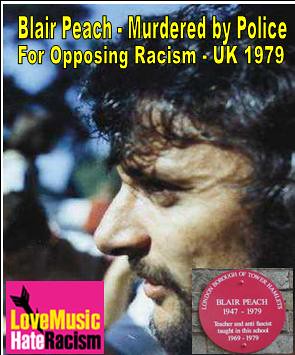
Met police chief willing to release Blair Peach report


The report on the controversial death of the anti-racist campaigner Blair Peach should finally be published more than 30 years after he died in a demonstration in west London. The commissioner of the Metropolitan police, Sir Paul Stephenson, agreed today that it should be made public after an unanimous call to do so by the Metropolitan Police Authority.

The decision was welcomed by Peach's family and partner, although no date has been set for the release of the report, which looked into allegations that Peach died at the hands of the police. The organisation Inquest, which has campaigned on the issue, expressed concerns that key details might be redacted.

Celia Stubbs, who was Peach's partner, said: "I'm totally bowled over, I was really cynical about it and I really didn't expect a result like this today." She said she felt that recent publicity given to the case by the Guardian, in which it was likened to the death of Ian Tomlinson during the G20 demonstrations on 1 April, had been a factor in the decision.

Jenny Jones, an MPA member, proposed a motion calling on the police to publish the full report, written by the former commander John Cass, before the end of the year. The report has remained secret despite requests for disclosure by Blair's family and friends, and an attempt by them last year to have access to it under freedom of information laws. Inquest has also written to Stephenson supporting the family's call for disclosure of the report, but had no response until today.

Jones told a meeting of the MPA, chaired by London's mayor, Boris Johnson, and with Stephenson in attendance, that the Met had declined to publish the report, suggesting that this was partly for the sake of the family. "It is embarrassing keeping it secret," said Jones. After other members voiced their support for publication, the mayor said it was clear that everyone was in favour of such a move.

"My starting point is a desire to publish," said Stephenson, saying that he aimed to do so "as soon as I possibly can". He said legal advice would have to be taken, but he was committed to such a course. "The reasons [not to publish] would have to be overwhelming not to do so."

Philip Peach, Blair's brother, who was at the meeting, welcomed the decision but said it would now be necessary to see how much of it was released. "I could never understand why it wasn't disclosed originally," he said.

Deborah Coles, co-director of Inquest, said: "The whole basis on which the Cass report has been withheld from the Peach family for 30 years has been widely discredited and yet the secrecy continues. Ian Tomlinson's death at the G20 protest and the similarities between the two cases makes the need to disclose this report even more urgent, and is in both the family and public interest." She said a key issue would be whether the report was published in its entirety.

It was partly as a result of the response to Peach's death and the way it was investigated that Inquest was set up in 1981. "Sadly, the need for the organisation remains as urgent today," said Coles. "Non-disclosure of evidence has been one of the most problematic issues following deaths in custody and has seriously undermined family and public confidence in the police complaints system."

Peach, a teacher and an anti-racist campaigner from New Zealand, died from a blow to the head at a demonstration against the National Front in Southall, west London, in April 1979. Cass was reported to have recommended the prosecution of police officers, but no charges were ever brought.

• This article was amended on 26 June 2009. The original reported the commissioner of the Metropolitan police, Sir Paul Stephenson, as saying that the case for publication of the report on Blair Peach's death was "overwhelming". This has been corrected.

Source: The Guardian