Thursday, September 3, 2009

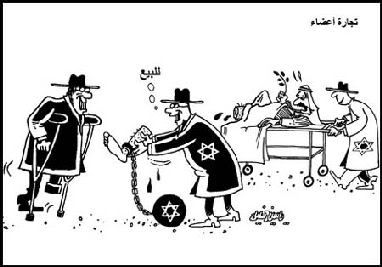
Israeli Organ Harvesting The New "Blood Libel"?


Last week Sweden’s largest daily newspaper published an article containing shocking material: testimony and circumstantial evidence indicating that Israelis may have been harvesting internal organs from Palestinian prisoners without consent for many years.

Worse yet, some of the information reported in the article suggests that in some instances Palestinians may have been captured with this macabre purpose in mind.

In the article, “Our sons plundered for their organs,” veteran journalist Donald Bostrom writes that Palestinians “harbor strong suspicions against Israel for seizing young men and having them serve as the country’s organ reserve – a very serious accusation, with enough question marks to motivate the International Court of Justice (ICJ) to start an investigation about possible war crimes.”1

An army of Israeli officials and apologists immediately went into high gear, calling both Bostrom and the newspaper’s editors “anti-Semitic.” The Israeli foreign minister was reportedly “aghast” and termed it “a demonizing piece of blood libel.” An Israeli official called it “hate porn.”

Commentary magazine wrote that the story was “merely the tip of the iceberg in terms of European funded and promoted anti-Israel hate.” Numerous people likened the article to the medieval “blood libel,” (widely refuted stories that Jews killed people to use their blood in religious rituals). Even some pro-Palestinian writers joined in the criticism, expressing skepticism.

The fact is, however, that substantiated evidence of public and private organ trafficking and theft, and allegations of worse, have been widely reported for many years. Given such context, the Swedish charges become far more plausible than might otherwise be the case and suggest that an investigation could well turn up significant information.

Below are a few examples of previous reports on this topic.

Israel’s first heart transplant

Israel’s very first, historic heart transplant used a heart removed from a living patient without consent or consulting his family.

In December 1968 a man named Avraham Sadegat (the New York Times seems to give his name as A Savgat)2 died two days after a stroke, even though his family had been told he was “doing well.”

After initially refusing to release his body, the Israeli hospital where he was being treated finally turned the man’s body over to his family. They discovered that his upper body was wrapped in bandages; an odd situation, they felt, for someone who had suffered a stroke.

When they removed the bandages, they discovered that the chest cavity was stuffed with bandages, and the heart was missing.

During this time, the headline-making Israeli heart transplant had occurred. After their initial shock, the man’s wife and brother began to put the two events together and demanded answers.

The hospital at first denied that Sadegat’s heart had been used in the headline-making transplant, but the family raised a media storm and eventually applied to three cabinet ministers. Finally, weeks later and after the family had signed a document promising not to sue, the hospital admitted that Sadagat’s heart had been used.

The hospital explained that it had abided by Israeli law, which allowed organs to be harvested without the family's consent.3 (The United Nations Convention against Transnational Organized Crime includes the extraction of organs in its definition of human exploitation.)

Indications that the removal of Sadagat’s heart was the actual cause of death went unaddressed.

Director of forensic medicine on missing organs

A 1990 article in the Washington Report on Middle East Affairs entitled “Autopsies and Executions” by Mary Barrett reports on the grotesque killings of young Palestinians. It includes an interview with Dr. Hatem Abu Ghazalch, the former chief health official for the West Bank under Jordanian administration and director of forensic medicine and autopsies.

Barrett asks him about “the widespread anxiety over organ thefts which has gripped Gaza and the West Bank since the intifada began in December of 1987.”

He responded:

"There are indications that for one reason or another, organs, especially eyes and kidneys, were removed from the bodies during the first year or year and a half. There were just too many reports by credible people for there to be nothing happening. If someone is shot in the head and comes home in a plastic bag without internal organs, what will people assume?”4

Mysterious Scottish death

In 1998 a Scot named Alisdair Sinclair died under questionable circumstances while in Israeli custody at Ben Gurion airport.

His family was informed of the death and, according to a report in J Weekly, “...told they had three weeks to come up with about $4,900 to fly Sinclair's corpse home. [Alisdair’s brother] says the Israelis seemed to be pushing a different option: burying Sinclair in a Christian cemetery in Israel, at a cost of about $1,300.”

The family scraped up the money, brought the body home, and had an autopsy performed at the University of Glasgow. It turned out that Alisdair’s heart and a tiny throat bone were missing. At this point the British Embassy filed a complaint with Israel.

The J report states:

“A heart said to be Sinclair's was subsequently repatriated to Britain, free of charge. James wanted the [Israeli] Forensic Institute to pay for a DNA test to confirm that this heart was indeed their brother's, but the Institute's director, Professor Jehuda Hiss refused, citing the prohibitive cost, estimated by some sources at $1,500.”

Despite repeated requests from the British Embassy for the Israeli pathologist's and police reports, Israeli officials refused to release either.5 6 7

Israeli government officials raise questions

Palestinian journalist Khalid Amayreh reports in an article in CCUN:

“In January, 2002, an Israeli cabinet minister tacitly admitted that organs taken from the bodies of Palestinian victims might have been used for transplants in Jewish patients without the knowledge of the Palestinian victims’ families.
“The minister, Nessim Dahan, said in response to a question by an Arab Knesset member that he couldn’t deny or confirm that organs of Palestinian youths and children killed by the Israeli army were taken out for transplants or scientific research.
“‘I couldn’t say for sure that something like that didn’t happen.’”

Amayreh writes that the Knesset member who posed the question said that he “had received ‘credible evidence proving that Israeli doctors at the forensic institute of Abu Kabir extracted such vital organs as the heart, kidneys, and liver from the bodies of Palestinian youth and children killed by the Israeli army in Gaza and the West Bank.”8

Israel’s chief pathologist removed from post for stealing body parts

For a number of years there were allegations that Israel’s leading pathologist was stealing body parts. In 2001 the Israeli national news service reported:

“... the parents of soldier Ze’ev Buzgallo who was killed in a Golan Heights military training accident, are filing a petition with the High Court of Justice calling for the immediate suspension of Dr. Yehuda Hiss and that criminal charges be filed against him. Hiss serves as the director of the Abu Kabir Forensic Institute....According to the parents, the body of their son was used for medical experimentation without their consent, experiments authorized by Hiss.9

In 2002 the service reported:

“The revelation of illegally stored body parts in the Abu Kabir Forensic Institute has prompted MK Anat Maor, chairman of the Knesset Science Committee, to demand the immediate suspension of the director, Prof. Yehuda Hiss."

Alisdair Sinclair’s death had first alerted authorities to Hiss’s malfeasance in 1998, though nothing was done for years. The Forward reported:

“In 2001, an Israeli Health Ministry investigation found that Hiss had been involved for years in taking body parts, such as legs, ovaries and testicles, without family permission during autopsies, and selling them to medical schools for use in research and training. He was appointed chief pathologist in 1988. Hiss was never charged with any crime, but in 2004 he was forced to step down from running the state morgue, following years of complaints.”10

Harvesting kidneys from impoverished communities

According to the Economist, a kidney racket flourished in South Africa between 2001 and 2003. “Donors were recruited in Brazil, Israel and Romania with offers of $5,000-20,000 to visit Durban and forfeit a kidney. The 109 recipients, mainly Israelis, each paid up to $120,000 for a “transplant holiday”; they pretended they were relatives of the donors and that no cash changed hands.”11

In 2004 a legislative commission in Brazil reported, “At least 30 Brazilians have sold their kidneys to an international human organ trafficking ring for transplants performed in South Africa, with Israel providing most of the funding.”

According to an IPS report: “The recipients were mostly Israelis, who receive health insurance reimbursements of 70,000 to 80,000 dollars for life-saving medical procedures performed abroad.”

IPS reports:

The Brazilians were recruited in Brazil’s most impoverished neighbourhoods and were paid $10,000 per kidney, “but as ‘supply’ increased, the payments fell as low as 3,000 dollars.” The trafficking had been organized by a retired Israeli police officer, who said “he did not think he was committing a crime, given that the transaction is considered legal by his country's government.”

The Israeli embassy issued a statement denying any participation by the Israeli government in the illegal trade of human organs but said it did recognize that its citizens, in emergency cases, could undergo organ transplants in other countries, "in a legal manner, complying with international norms," and with the financial support of their medical insurance.

However, IPS reports that the commission chair termed the Israeli stance “at the very least ‘anti-ethical’, adding that trafficking can only take place on a major scale if there is a major source of financing, such as the Israeli health system.” He went on to state that the resources provided by the Israeli health system "were a determining factor" that allowed the network to function.12

Tel Aviv hospital head promotes organ trafficking

IPS goes on to report:

“Nancy Scheper-Hughes, who heads the Organs Watch project at the U.S. University of California, Berkeley, testified to the Pernambuco legislative commission that international trafficking of human organs began some 12 years ago, promoted by Zacki Shapira, former director of a hospital in Tel Aviv.
“Shapira performed more than 300 kidney transplants, sometimes accompanying his patients to other countries, such as Turkey. The recipients are very wealthy or have very good health insurance, and the ‘donors’ are very poor people from Eastern Europe, Philippines and other developing countries, said Scheper-Hughes, who specialises in medical anthropology.”

Israel prosecutes organ traffickers

In 2007 Israel’s Ha’aretz newspaper reported that two men confessed to persuading “Arabs from the Galilee and central Israel who were developmentally challenged or mentally ill to agree to have a kidney removed for payment.” They then would refuse to pay them.

The paper reported that the two were part of a criminal ring that included an Israeli surgeon. According to the indictment, the surgeon sold the kidneys he harvested for between $125,000 and $135,000.13

Earlier that year another Israeli newspaper, the Jerusalem Post, reported that ten members of an Israeli organ smuggling ring targeting Ukrainians had been arrested.14

In still another 2007 story, the Jerusalem Post reported that “Professor Zaki Shapira, one of Israel's leading transplant surgeons, was arrested in Turkey on Thursday on suspicion of involvement in an organ trafficking ring. According to the report, the transplants were arranged in Turkey and took place at private hospitals in Istanbul.”

Israeli organ trafficking comes to the U.S.?

In July of this year even US media reported on the arrest of Levy Izhak Rosenbaum, from Brooklyn, recently arrested by federal officials in a massive corruption sweep in New Jersey that netted mayors, government officials and a number of prominent rabbis. Bostrom opens his article with this incident.

According to the federal complaint, Rosenbaum, who has close ties to Israel, said that he had been involved in the illegal sale of kidneys for 10 years. A US Attorney explained: "His business was to entice vulnerable people to give up a kidney for $10,000 which he would turn around and sell for $160,000."15

This is reportedly the first case of international organ trafficking in the U.S.

University of California anthropologist and organ trade expert Nancy Scheper-Hughes, who informed the FBI about Rosenbaum seven years ago, says she heard reports that he had held donors at gunpoint to ensure they followed through on agreements to “donate” their organs.16

Israel’s organ donor problems

Israel has an extraordinarily small number of willing organ donors. According to the Israeli news service Ynet, “the percentage of organs donated among Jews is the lowest of all the ethnic groups... In western countries, some 30 per cent of the population have organ donor cards. In Israel, in contrast, four percent of the population holds such cards.17

“According to statistics from the Health Ministry’s website, in 2001, 88 Israelis died waiting for a transplant because of a lack of donor organs. In the same year, 180 Israelis were brain dead, and their organs could have been used for transplant, but only 80 of their relatives agreed to donate their organs.”

According to Ynet, the low incidence of donors is related to “religious reasons.” In 2006 there was an uproar when an Israeli hospital known for its compliance with Jewish law performed a transplant operation using an Israeli donor. The week before, “a similar incident occurred, but since the patient was not Jewish it passed silently.”18 19

The Swedish article reports that ‘Israel has repeatedly been under fire for its unethical ways of dealing with organs and transplants. France was among the countries that ceased organ collaboration with Israel in the 1990s. Jerusalem Post wrote that “the rest of the European countries are expected to follow France’s example shortly.”

“Half of the kidneys transplanted to Israelis since the beginning of the 2000s have been bought illegally from Turkey, Eastern Europe or Latin America. Israeli health authorities have full knowledge of this business but do nothing to stop it. At a conference in 2003 it was shown that Israel is the only western country with a medical profession that doesn’t condemn the illegal organ trade. The country takes no legal measures against doctors participating in the illegal business – on the contrary, chief medical officers of Israel’s big hospitals are involved in most of the illegal transplants, according to Dagens Nyheter (December 5, 2003).”

To fill this need former Prime Minister Ehud Olmert, then health minister of Israel, organized a big donor campaign in the summer of 1992, but while the number of donors skyrocketed, need still greatly surpassed supply.

Palestinian disappearances increase

Bostrom, who earlier wrote of all this in his 2001 book Inshallah,20 reports in his recent article:

“While the campaign was running, young Palestinian men started to disappear from villages in the West Bank and Gaza. After five days Israeli soldiers would bring them back dead, with their bodies ripped open.
“Talk of the bodies terrified the population of the occupied territories. There were rumors of a dramatic increase of young men disappearing, with ensuing nightly funerals of autopsied bodies.”
“I was in the area at the time, working on a book. On several occasions I was approached by UN staff concerned about the developments. The persons contacting me said that organ theft definitely occurred but that they were prevented from doing anything about it. On an assignment from a broadcasting network I then travelled around interviewing a great number of Palestinian families in the West Bank and Gaza – meeting parents who told of how their sons had been deprived of organs before being killed.”

He describes the case of 19-year-old Bilal Achmed Ghanan, shot by Israeli forces invading his village.

“The first shot hit him in the chest. According to villagers who witnessed the incident he was subsequently shot with one bullet in each leg. Two soldiers then ran down from the carpentry workshop and shot Bilal once in the stomach. Finally, they grabbed him by his feet and dragged him up the twenty stone steps of the workshop stair... Israeli soldiers loading the badly wounded Bilal in a jeep and driving him to the outskirts of the village, where a military helicopter waited. The boy was flown to a destination unknown to his family.”

Five days later he was returned, “dead and wrapped up in green hospital fabric.” Bostrom reports that as the body was lowered into the grave, his chest was exposed and onlookers could see that he was stitched up from his stomach to his head. Bostrom writes that this was not the first time people had seen such a thing.

“The families in the West Bank and in Gaza felt that they knew exactly what had happened: “Our sons are used as involuntary organ donors,” relatives of Khaled from Nablus told me, as did the mother of Raed from Jenin and the uncles of Machmod and Nafes from Gaza, who had all disappeared for a number of days only to return at night, dead and autopsied.”

Why autopsies?

Bostrom describes the questions that families asked:

“Why are they keeping the bodies for up to five days before they let us bury them? What happened to the bodies during that time? Why are they performing autopsy, against our will, when the cause of death is obvious? Why are the bodies returned at night? Why is it done with a military escort? Why is the area closed off during the funeral? Why is the electricity interrupted?”

Israel’s answer was that all Palestinians who were killed were routinely autopsied. However, Bostrom points out that of the133 Palestinians who were killed that year, only 69 were autopsied.

He goes on to write:

“We know that Israel has a great need for organs, that there is a vast and illegal trade of organs which has been running for many years now, that the authorities are aware of it and that doctors in managing positions at the big hospitals participate, as well as civil servants at various levels. We also know that young Palestinian men disappeared, that they were brought back after five days, at night, under tremendous secrecy, stitched back together after having been cut from abdomen to chin.
“It’s time to bring clarity to this macabre business, to shed light on what is going on and what has taken place in the territories occupied by Israel since the Intifada began.”21

The new “Blood Libel”?

In scanning through the reaction to Bostrom’s report, one is struck by the multitude of charges that his article is a new version of the old anti-Semitic “blood libel.” Given that fact, it is interesting to examine a 2007 book by Israel’s preeminent expert on medieval Jewish history, and what happened to him.

The author is Bar-Ilan professor (and rabbi) Ariel Toaff, son of the former chief rabbi of Rome, a religious leader so famous that an Israeli journalist writes that Toaff’s father “is to Italian Jewry as the Eiffel Tower is to Paris.” Ariel Toaff, himself, is considered “one of the greatest scholars in his field.”22 23

In February 2007 the Israeli and Italian media were abuzz (though most of the U.S. media somehow missed it) with news that Professor Toaff had written a book entitled "Pasque di Sangue" (“Blood Passovers”)24 containing evidence that there “was a factual basis for some of the medieval blood libels against the Jews.”

Based on 35 years of research, Toaff had concluded that there were at least a few, possibly many, real incidents.

In an interview with an Italian newspaper (the book was published in Italy), Toaff says:

“My research shows that in the Middle Ages, a group of fundamentalist Jews did not respect the biblical prohibition and used blood for healing. It is just one group of Jews, who belonged to the communities that suffered the severest persecution during the Crusades. From this trauma came a passion for revenge that in some cases led to responses, among them ritual murder of Christian children.”25 26

Professor Toaff was immediately attacked from all sides, including pressure orchestrated by Anti-Defamation League chairman Abe Foxman, but Toaff stood by his 35 years of research, announcing:

"I will not give up my devotion to the truth and academic freedom even if the world crucifies me... One shouldn't be afraid to tell the truth."

Before long, however, under relentless public and private pressure, Toaff had recanted, withdrawn his book, and promised to give all profits that had already accrued (the book had been flying off Italian bookshelves) to Foxman’s Anti-Defamation League. A year later he published a “revised version.”27

Donald Bostrom’s experience seems to be a repeat of what Professor Toaff endured: calumny, vituperation, and defamation. Bostrom has received death threats as well, perhaps an experience that Professor Toaff also shared.

If Israel is innocent of organ plundering accusations, or if its culpability is considerably less than Bostrom and others suggest, it should welcome honest investigations that would clear it of wrongdoing. Instead, the government and its advocates are working to suppress all debate and crush those whose questions and conclusions they find threatening.

Prime Minister Benjamin Netanyahu, rather than responding to calls for an investigation, is demanding that the Swedish government abandon its commitment to a free press and condemn the article. The Israeli press office, apparently in retaliation and to prevent additional investigation, is refusing to give press credentials to reporters from the offending newspaper.

Just as in the case of the rampage against Jenin, the attack on the USS liberty, the massacre of Gaza, the crushing of Rachel Corrie, the torture of American citizens, and a multitude of other examples, Israel is using its considerable, worldwide resources to interfere with the investigative process.

It is difficult to conclude that it has nothing to hide.

Notes

  1. There are two English translations; this article uses the first:
    http://www.tlaxcala.es/pp.asp?reference=8390&lg=en
    http://www.theoccidentalobserver.net/authors/SwedishTrans.html

    The original Swedish article in Aftonbladet can be viewed at
    http://www.aftonbladet.se/kultur/article5652583.ab
  2. New York Times, Feb. 3, 1969, p. 8, Column 6 (53 words)
  3. http://www.haaretz.com/hasen/spages/1046041.html
    40 years after Israel's first transplant, donor's family says his heart was stolen By Dana Weiler-Polak, Haaretz Correspondent, Dec. 14, 2008
  4. http://www.wrmea.com/backissues/0490/9004021.htm
    Washington Report on Middle East Affairs, April 1990, Page 21, The Intifada: Autopsies and Executions
  5. http://www.jweekly.com/
    October 30, 1998,Bizarre death of Scottish tourist involves suicide, missing heart by NETTY C. GROSS, Jerusalem Post Service
  6. http://www.forward.com/articles/112915/
    The Forward, Illicit Body-Part Sales Present Widespread Problem, By Rebecca Dube, Aug. 26, 2009
  7. http://www.mail-archive.com/ctrl@listserv.aol.com/msg114437.html
    Masons, Muslims, Templars, Jews, Henry and Dolly.
  8. http://ccun.org/Opinion
    Al-Jazeerah: Cross-Cultural Understanding, Khalid Amayreh, August 20, 2009
  9. http://www.israelnationalnews.com/News/Flash.aspx/12699
  10. http://www.forward.com/articles/112915/
    Forward, Illicit Body-Part Sales Present Widespread Problem, By Rebecca Dube, August 26, 2009
  11. http://www.economist.com/
    The Economist, Organ transplants: The gap between supply and demand, Oct. 9, 2008
  12. 12/http://ipsnews.net/news.asp?idnews=22524
    BRAZIL: Poor Sell Organs to Trans-Atlantic Trafficking Ring
    By Mario Osava, IPS, Feb. 23, 2004
  13. http://www.haaretz.com/hasen/spages/935092.html
    Haaretz, Two Haifa men sentenced to jail for organ trafficking, By Fadi Eyadat, Dec. 18, 2007
  14. http://www.jpost.com/
    Police uncover illegal organ trade ring
    By REBECCA ANNA STOIL, July 23, 2007
  15. http://www.thestar.com/news/world/article/671687
    Sting rocks U.S. transplant industry, David Porter, Carla K. Johnson, ASSOCIATED PRESS, july 25, 2009
  16. http://www.haaretz.com/hasen/spages/1102799.html
    U.S. Professor: I told FBI about kidney trafficking 7 years ago
    By Natasha Mozgovaya, Haaretz Correspondent, August, 3, 2009
  17. http://www.ynetnews.com/articles/0,7340,L-3388529,00.html
    A mitzvah called organ donation, Efrat Shapira-Rosenberg, 10.6.07
  18. http://www.ynetnews.com/articles/0,7340,L-3265889,00.html
    Orthodox in uproar over organ donation incident, Neta Sela, 06.22.06
  19. http://www.israelshamir.net/English/Body_Snatchers.htm
    The Return of the Body Snatchers, By Israel Shamir

    Israeli writer Israel Shamir reports that some years ago “...a leading Chabad rabbi, Yitzhak Ginzburgh, gave his religious permission for a Jew to take a liver from a non-Jew even without his consent. He said that ‘a Jew is entitled to extract the liver from a goy if he needs it, for the life of a Jew is more valuable than the life of a goy, likewise the life of a goy is more valuable than the life of an animal.’
  20. http://www.bokus.com/b/9789170370939.html
  21. http://www.tlaxcala.es/pp.asp?reference=8390&lg=en
  22. http://www.haaretz.com/hasen/spages/829381.html
    Ha’aretz. The Wayward Son, by Adi Schwartz, March 1, 2007
  23. http://www.haaretz.com/hasen/spages/824152.html
    Ha’aaretz, Bar-Ilan to order professor to explain research behind blood libel book By Ofri Ilani, Haaretz Service and The Associated Press, Feb 11, 2007
  24. http://www.bloodpassover.com/toafftableofcontents.htm
  25. http://haaretz.com/hasen/spages/824152.html
    Haaretz, Bar Ilan to order professor to explain research behind blood libel book, by Ofri Hani, Feb. 11, 2007.
  26. Earlier books containing related information on medieval and modern Judaism, some of it particularly relevant to discussions of organ extraction, as well as on the widespread suppression of such information, were published some years ago, also by an Israeli professor, Israel Shahak, of whom Noam Chomsky once wrote, “Shahak is an outstanding scholar, with remarkable insight and depth of knowledge. His work is informed and penetrating, a contribution of great value.” We encourage people to read these books in full: “Jewish History, Jewish Religion, The Weight of Three Thousand Years” and Jewish Fundamentalism in Israel” coauthored by Professor Norton Mezvinsky.
  27. http://www.haaretz.com/hasen/spages/957357.html
    Ha’aretz, 'Historian recants theory that Jews killed Christian child in ritual murder,' By Adi Schwartz, Feb 24, 2008
Source: If Americans Knew
Bookmark and Share

Canadian Hate Speech Laws Ruled Unconstitutional


The Canadian Human Rights Tribunal on Wednesday ruled that Section 13, Canada's much maligned human rights hate speech law, violates the Charter right to free expression because it carries the threat of punitive fines.

The shocking decision by Tribunal member Athanasios Hadjis leaves several hate speech cases in limbo, and appears to strip the Canadian Human Rights Commission of its controversial legal mandate to pursue hate on the Internet, which it has strenuously defended against complaints of censorship.

It also marks the first major failure of Section 13(1) of the Canadian Human Rights Act, an anti-hate law that was conceived in the 1960s to target racist telephone hotlines, then expanded in 2001 to the include the entire Internet, and for the last decade used almost exclusively by one complainant, activist Ottawa lawyer Richard Warman.

Mr. Warman's first big loss is a victory for the respondent Marc Lemire, webmaster of freeedomsite.org and a prominent figure in the Canadian far right.

Typically for the messy state of Canada's perennial hate speech debate, public reaction to the ruling yesterday was polarized, running the spectrum from glowing praise for the "bold" Mr. Hadjis, to criticism that his "outrageous" conclusion is "vulnerable on judicial review."

All sides seem to agree, however, that the stage is set for pitched battle in federal court, where CHRT rulings can be appealed. Another less likely outcome is for Parliament itself to repeal or amend Section 13, a law that even supporters say needs updating in the age of the Internet.

Neither the CHRC nor Mr. Warman would comment.

"No matter what happens, this decision is going to federal court," Mr. Lemire said. "This is the beginning of the end for Section 13 now. This law is 32 years old. Not a single person has ever won until today. But did I really win? I have given up six years of my life. The process is the punishment."

Mr. Warman, a former investigator for the CHRC, brought a complaint against Mr. Lemire in 2003, after monitoring his website for almost a year. He alleged that postings on the discussion forum, mostly written by others, contravened Section 13 in that they were "likely to expose" identifiable groups to "hatred or contempt." Mr. Warman later urged the CHRC investigators to expand their investigation to other websites he believed Mr. Lemire was involved with, but to "hold off on informing" Mr. Lemire "until the police take a good look at it." No criminal charges were ever filed.

In all but one case, Mr. Hadjis decided that these postings either did not contravene Section 13(1), or that Mr. Lemire cannot be held responsible for what others posted on his website.

Mr. Hadjis found Mr. Lemire violated the law in one case, by posting an article called "AIDS Secrets", written by an American neo-Nazi, which Mr. Hadjis found was "rife with hyperbole and moral condemnation. Homosexuals, and Blacks to a lesser extent, are denigrated as purveyors of a "killer" that is on the loose, agonizingly destroying the lives of American children and adults alike."

Even with this finding, however, Mr. Hadjis declined to make any order against Mr. Lemire. As a statutory tribunal, Mr. Hadjis does not have the legal authority to officially declare a law unconstitutional. But if he finds it would be unconstitutional to enforce it, he can do as he has done, which is to "simply refuse to apply these provisions."

Part of his motivation was that virtually all the offending material was removed either before or shortly after Mr. Lemire received word of the complaint against him.

"Mr. Lemire had not only "amended" his conduct by removing the impugned material, but sought conciliation and mediation as soon as he learned of the complaint against him," Mr. Hadjis wrote. "The problem had thus already been eliminated, yet the complaint continued to be processed."

Section 13(1) remains valid Canadian law, despite this ruling. Its constitutionality was last upheld by the Supreme Court of Canada in a 1990 split decision, before the Internet age.

That decision, about neo-Nazi John Ross Taylor, upheld the law as a justifiable limit on free expression largely because of its remedial, non-punitive purpose. But Mr. Hadjis found that that, today, the law "has become more penal in nature," and this renders it an unjustifiable limit on freedom of expression.

Ever since a 1998 amendment to allow the Tribunal to levy fines up to $10,000 -- payable to the government -- the pursuit of Section 13(1) cases "can no longer be considered exclusively remedial, preventative and conciliatory in nature," he wrote.

He cited Mr. Warman's request for a $7500 penalty against Mr. Lemire. Mr. Warman has won over a dozen other Section 13(1) cases, many leading to similar fines, payments to himself, and legal restrictions on Internet activity.

This criticism about a punitive law masquerading as a remedial one echoes that of Richard Moon, a law professor hired by the CHRC last year to provide an expert analysis of their online hate speech mandate. In essence, his advice was that it could not be done fairly, and so should not be done at all.

Prof. Moon said Wednesday's decision is "obviously a significant moment in the history of Section 13, but it seems like it is in some important sense inconclusive."

He said the ruling has no weight as legal precedent, and could theoretically be ignored by future tribunals, but in practice it is impossible to ignore, and it hints at a fundamental problem with the law.

"As soon as the Supreme Court confirmed that the scope of Section 13 was narrow, and confined to extremely hateful messages, then it was highly unlikely that we were going to have a kind of regular human rights process that involves conciliation between the parties," he said. "That was always something that we could have foreseen."

"We still believe Section 13 is constitutional. There seems to be some major difference of opinion within the Tribunal itself," said Bernie Farber, CEO of the Canadian Jewish Congress, referring to previous constitutional challenges of Section 13 that went the other way.

Marvin Kurz, legal counsel to B'nai Brith, which was an intervenor in this case along with the CJC and others, echoed Mr. Farber's question about why Mr. Hadjis did not simply "read out" the penalty section -- that is, ignore it, but allow the actual hate speech section to stand.

"Not only did he not do it, but he failed to explain why he did not consider the alternative," Mr. Kurz said. "It's like if the police act wrongly in a criminal case, you don't throw out the criminal law. That's what he's done here, and that doesn't make sense to me."

Ezra Levant, a blogger who has led the campaign against human rights hate speech law, said the ruling "shows that the CHRC has been acting illegally for many years," and it forces the Conservative government to make a "new kind of decision" about whether to appeal.

"If they launch an appeal, they are casting their lot with the censors," he said.

Pearl Eliadis, a human rights lawyer and a defender of Section 13, played down the importance of the ruling, and said Mr. Hadjis "just got it wrong. With respect, it's constitutionally not within the normal way that these provisions are dealt with." She said he should have simply ignored the offending penalty section and upheld the law.

Bruce Ryder, a constitutional law professor at York University, said Mr. Hadjis was correct to find that the penalty provision "exacerbated the chilling effect" on freedom of expression. But he said Mr. Hadjis' reasoning "broke down at the end," and he should have simply rejected the penalty provision.

He also wondered how Mr. Lemire was acquitted over the posting of an article that explicitly denied the Holocaust, which he called "outrageous and inconsistent with jurisprudence," and makes the entire ruling "vulnerable on judicial review."

Mark Steyn, a conservative author who was the target of a prominent hate speech complaint over his writing in Maclean's, said Mr. Hadjis' realized "that there is no future for Section 13 because of the damage done to it by the dress-up Nazis of the CHRC and and the sordid racket of Richard Warman."

"It makes explicit that section 13 has no friends," he said.

Source: National Post

Bookmark and Share

Wednesday, September 2, 2009

Is it Anti-Semitic to Defend Palestinian Human Rights? Jewish Opposition to Zionism


All across Canada and in the United States, there is an organized campaign to suppress criticism of Israeli policies toward the Palestinians.

The campaign is especially strong on university campuses where many voices have been raised in support of human rights for the Palestinians.

One such example is the attempt to suppress the Public Interest Research Group, founded by Ralph Nader, at the University of Ottawa for their support for Palestinian human rights.

Similar anti-Palestinian campaigns have occurred at many universities in Canada including the University of Toronto, the University of Western Ontario and York University.

An attack against a student group that was sympathetic to the Palestinians occurred at the University of Western Ontario in 1982. The student group was refused official recognition because of its support for the Palestinians and for sponsoring Palestinian and Arab speakers. After this refusal a complaint was made to the Ontario Human Rights Commission.

After a long battle, and with the support of the Canadian Civil Liberties Association and its General Counsel Alan Borovoy, and a supportive editorial in The Globe & Mail, the Ontario Human Rights Commission compelled the University Students Council at the University of Western Ontario to issue a statement of regret and to ratify the student group. The refusal was deemed discriminatory against Palestinians and persons associated with Palestinians.1

Despite this successful legal precedent at Western Ontario there have been many attacks against individuals and groups across Canada and the United States because of their support for human rights for Palestinians. Over the last few years there is a concerted attempt to suppress discussion of the Palestinian issue in North America.

There also is a campaign to punish those individuals who have spoken out in support of the Palestinians by cutting funding and by denying them tenure and even getting them terminated from their positions of employment.

Two well-known examples of firings are the campaigns that targeted Jewish professors’ Norman Finkelstein (author of many books on Israel and Zionism including Image and Reality of the Israel-Palestinian Conflict (Verso Press, New York, 1995) and Joel Kovel (author of Overcoming Zionism: Creating a Single Democratic State in Israel/Palestine (Pluto Press: London, 2007)) for their attacks on Israel’s policies toward the Palestinians.

Another tactic is to smear such individuals who have supported the Palestinians with allegations of anti-Semitism. One such individual was Arch Bishop Desmond Tutu. A few complaints from the Jewish community led to the Noble Prize winner being banned from speaking on campus by the University of St. Thomas in Minnesota. Tutu was attacked because of statements he made criticizing Israeli policy toward the Palestinians that some Jewish individuals said were “anti Semitic.”

Marv Davidov, an adjunct professor with the Justice and Peace Studies program at the University of St. Thomas said:

As a Jew who experienced real anti-Semitism as a child, I’m deeply disturbed that a man like Tutu could be labeled anti-Semitic and silenced like this,…

I deeply resent the Israeli lobby trying to silence any criticism of its policy. It does a great disservice to Israel and to all Jews.

After provoking a strong backlash against the decision, and a campaign lead by Jewish Voice for Peace in support of the Arch Bishop which produced more than 6,000 letters of protest, the University rescinded the ban.

Professor Bill Robinson was also a target of a similar campaign about alleged anti Semitism to get him fired at the University of California Santa Barbara (UCSB). Ultimately the University administration defended Robinson’s academic freedom and the right to express his opinions in his global politics class. Robinson, who is Jewish, distributed an email prepared by a pro-Palestinian Jewish activist that compared the Israeli attack on Gaza to the Nazi attack on the Warsaw Ghetto. In response to this attack on Professor Robinson, more than 100 UCSB faculty members signed a petition asking the university to dismiss the charges against him. In addition, 16 university department chairs wrote letters to the University authorities asking them to dismiss the case against Robinson.

Sir Gerald Kaufman, one of the founders of Independent Jewish Voices in Britain, also used his position as a Member of Parliament in London, England to criticize Israeli policy toward the Palestinians. Members of Kaufman’s family perished at the hands of the Nazis and in the Holocaust. As one of the U.K.’s harshest critics of Israeli policies, Kaufman routinely compared the Jewish state’s treatment of Palestinians to Nazi Germany’s treatment of Jews.2

This campaign to silence critics of Israel and to demonize supporters of the Palestinians is most disturbing and a violation of free speech, academic freedom and violation of Palestinian human rights.

It is also a violation of basic democratic rights when a government does it. For example, the recent cuts to the Canadian Arab Federation’s funding by Citizenship and Immigration Minister Jason Kenney. The punitive action taken by Minister Kenney is a denial of the fundamental freedoms and rights which are guaranteed in the Canadian Charter of Rights and Freedoms.

The Charter guarantees the right of free speech and freedom of conscience and protects the individual and organizations from government sanction.

This campaign is also an attack on the numerous dissenting Jews who support human rights for the Palestinians.

Canadian Jewish groups like Not in Our Name (NION) and Jewish Independent Voices (Canada) and their support for the Palestinians and their criticism of the “Jewish State” are simply ignored. For political purposes, they simply do not exist.

The mainstream media also rarely covers these alternative Jewish perspectives. However, there are rare exceptions and sometimes views critical of Zionism are published in the mainstream North American press. Here is one notable example:

“It’s hard to imagine now, but in 1944, six years after Kristallnacht, Lessing J. Rosenwald, president of the American Council for Judaism, felt comfortable equating the Zionist ideal of Jewish statehood with “the concept of a racial state — the Hitlerian concept.” For most of the last century, a principled opposition to Zionism was a mainstream stance within American Judaism.

Even after the foundation of Israel, anti-Zionism was not a particularly heretical position. Assimilated Reform Jews like Rosenwald believed that Judaism should remain a matter of religious rather than political allegiance; the ultra-Orthodox saw Jewish statehood as an impious attempt to “push the hand of God”; and Marxist Jews — my grandparents among them — tended to see Zionism, and all nationalisms, as a distraction from the more essential struggle between classes.

To be Jewish, I was raised to believe, meant understanding oneself as a member of a tribe that over and over had been cast out, mistreated, slaughtered.

Millenniums of oppression that preceded it did not entitle us to a homeland or a right to self-defense that superseded anyone else’s. If they offered us anything exceptional, it was a perspective on oppression and an obligation born of the prophetic tradition: to act on behalf of the oppressed and to cry out at the oppressor.

For the last several decades, though, it has been all but impossible to cry out against the Israeli state without being smeared as an anti-Semite, or worse. To question not just Israel’s actions, but the Zionist tenets on which the state is founded, has for too long been regarded an almost unspeakable blasphemy.

Yet it is no longer possible to believe with an honest conscience that the deplorable conditions in which Palestinians live and die in Gaza and the West Bank come as the result of specific policies, leaders or parties on either side of the impasse.

The problem is fundamental: Founding a modern state on a single ethnic or religious identity in a territory that is ethnically and religiously diverse leads inexorably either to politics of exclusion (think of the 139-square-mile prison camp that Gaza has become) or to wholesale ethnic cleansing. Put simply, the problem is Zionism.”3)

Most of the rest of the World has a much more critical view of the Israeli occupation of Palestinian land and supports the right of Palestinians to self determination.

For example in one vote at the United Nations, held on December 19, 2006 on the Israeli Palestinian issue, the tally was 176 to five in favor of the Palestinians.

The countries that supported Israel were the United States, the Marshall Islands, Palau and Micronesia.

Five countries abstained. They were: Australia, Canada, Central African Republic, Nauru and Vanuatu.

The entire rest of the World voted in favor of the right of Palestinians to self-determination. However, to read the mainstream North American press you almost never hear of these one-sided votes.

All human beings are entitled to basic human rights. However, the well documented human rights violations of the Palestinians at the hands of the Israelis, by respected organizations such as Amnesty International, Human Rights Watch, The International Red Cross, the United Nations, and even by Israeli organizations such as B’Tselem, Rabbis for Human Rights and the Public Committee Against Torture in Israel and by many Israeli journalists, are attacked and buried under a barrage of criticism that they are biased, are unfair for singling out the Jewish State or are even anti-Semitic.

My own record as a lawyer representing refugee claims for Palestinians from the Occupied Territories made against Israel, is 28 positives to one negative or a 96.5% success rate.

However, in the eyes of the supporters of Israel this does not mean that there are serious human rights problems in the Occupied Territories.

Israel can do no wrong. It is the Immigration and Refugee Board of Canada that is “anti-Semitic” and the Jewish members of the IRB who rendered positive decisions on Palestinian refugee claims made against Israel are “self-hating Jews.”

A Palestinian is simply an inhabitant or citizen of Palestine. There are Jewish, Christian, Muslim and non-believers who are Palestinian. The indigenous Palestinian Jews were opposed to the European Jewish settlers who were flooding into Palestine with the support of Great Britain. A Palestinian is simply a national designation like that of being Canadian or American.

There is no racial, ethnic or religious criteria for being a Palestinian. Only by right of birth, naturalization and descent that one becomes a Palestinian, just like in most other countries.

The Jewish State’s citizenship and Immigration process are unique in the World. To qualify as a “Jew” in “the Jewish state” one must meet a racial or ethnic criteria or in the alternative, a religious criterion.

The Jewish Law of Return grants almost immediate citizenship rights to Jews from anywhere in the World. Palestinians who were born in the country and forcibly expelled are, for the most part, forbidden to return.

The Zionist state of Israel defines itself as “Jewish” and structures itself to advance the interests of Jews at the expense of non-Jews and especially against the indigenous Christian and Muslim Palestinian population.

In March 1919 United States Congressman Julius Kahn presented an anti-Zionist petition to President Woodrow Wilson as he was departing for the Paris Peace Conference.

The petition was signed by 31 prominent American Jews. The signatories included Henry Morgenthau, Sr., ex-ambassador to Turkey; Simon W. Rosendale, ex-attorney general of New York; Mayor L. H. Kampner of Galveston, Texas; E. M. Baker, from Cleveland and president of the Stock Exchange; R. H. Macy’s Jesse I. Straus; New York Times publisher Adolph S. Ochs; and Judge M. C. Sloss of San Francisco. Part of the petition read:

…we protest against the political segregation of the Jews and the re-establishment in Palestine of a distinctively Jewish State as utterly opposed to the principles of democracy which it is the avowed purpose of the World’s Peace Conference to establish. Whether the Jews be regarded as a “race” or as a “religion,” it is contrary to the democratic principles for which the world war was waged to found a nation on either or both of these bases.

There is much controversy over what is Zionism and how to define the “Jewish State.” As Akiva Orr writes,

The Zionist movement and its State- ISRAEL, do not represent the Jewish people. They never did.

They represent a particular trend within the Jewish people, namely- the nationalist trend. To find out whether Israel is a Jewish State or a Zionist State one need only ask any religious Orthodox Jew anywhere. His answer will be unambiguous: a Jewish State must be ruled by Jewish religious law- “ Halakha”. Israel is not ruled by “Halakha” laws, but by secular laws. Therefore Israel is not a Jewish State. The fact that it provides refuge to Jews does not make it a Jewish State . . . Zionism and Judaism are different entities. They have contradictory qualities.4

The argument is often made that criticism of Israel, or more appropriately the self described “Jewish State,” the meaning of which is not defined, is anti-Semitic. The fact that many Jews have criticized Israel and Zionism is deemed irrelevant. These Jewish critics are attacked as “self-hating Jews.”

There is no rational basis for the argument that criticism of the State of Israel and the political ideology of Zionism is anti-Semitic. The logic for this view is obviously flawed.

For example it makes no sense to accuse an individual who criticizes Apartheid South Africa’s racist policies toward the blacks as evidence of racism toward Whites.

Or that criticism of the Nazi policy toward the Jews should not be allowed because it is evidence of racism against Germans.

Similarly, if you criticize American policy toward the Iraq war and torture at Abu Ghraib Prison or the Jim Crow laws that institutionalized discrimination against blacks in the southern states, then you are racist against Americans. This argument is obviously absurd and should not even need a response.

To quote one American Jewish academic on the comparison of Israel’s treatment of the Palestinians to the racist Jim Crow laws in the United States: “I grew up as a white girl in the Jim Crow South and I have spent my adult life in the study of racism; what I see when I go to Palestine is Jim Crow on steroids.”5

It is a basic right to evaluate and to criticize a political ideology or political movement and to review and even criticize a state’s policies.

The argument should be evaluated on the merits and the truthfulness of the facts presented. It is also a right to present alternative facts and to have a debate.

However, when one side wants to avoid debate, divert the discussion or suppress the topic and launches personal attacks against their opponents, it is almost a certain proof that they are hiding some uncomfortable truths.

Dr. Joel Beinin in an article, “Silencing critics not way to Middle East peace,” published in the San Francisco Chronicle, on February 4, 2007, discussed the campaign to silence critics of Israeli policy.

Beinin is a professor of History at Stanford University and is Jewish. He is active with Jewish Voice for Peace. Here is what Beinin had to say about the campaign to attack critics of Israel’s policies toward the Palestinians.

“Why discredit, defame and silence those with opposing viewpoints? I believe it is because the Zionist lobby knows it cannot win based on facts.

An honest discussion can only lead to one conclusion: The status quo in which Israel declares it alone has rights and intends to impose its will on the weaker Palestinians, stripping them permanently of their land, resources and rights, cannot lead to a lasting peace.

We need an open debate and the freedom to discuss uncomfortable facts and explore the full range of policy options. Only then can we adopt a foreign policy that serves American interests and one that could actually bring a just peace to Palestinians and Israelis.”

The ethnic cleansing of Palestinians, as well as the massacres, rapes and illegal confiscation of Palestinian property, is well documented by Israeli historians. These include Simcha Flapan, The Birth of Israel: Myths and Realities (New York: Pantheon Books, 1987); Benny Morris, The birth of the Palestinian refugee problem 1947-1949, (Cambridge University Press: New York, 1987); Nur Masalha, Expulsion of the Palestinians (Washington D.C.: Institute for Palestine Studies, 1992); Benjamin Beit-Hallahmi, Original Sins, (Olive Branch Press: New York, 1993); and Ilan Pappe, The Ethnic Cleansing of Palestine, (Oneworld Publications: Oxford, 2006).

There are many more Israeli authorities that confirm the ethnic cleansing of the Palestinians in 1947-1949 and again in 1967. In fact it is still going on today in what some Israelis call the “slow motion ethnic cleansing” of the Palestinians.6

If the Palestinians, or their supporters, complain about the well-documented facts surrounding the ethnic cleansing of Palestine, losing their property to which they had legal title to, losing their personal belongings and even their bank accounts, having 531 villages destroyed, losing their country and their right to a citizenship, and then not being allowed to return to their homes in contravention of international law; or complain about discriminatory policies of the Jewish National Fund or the discrimination involved in the Jewish Law of Return; or complain about the house demolitions, the more than 600 Israeli military check points in the West Bank, the 42 years of military Occupation of Gaza and the West Bank, the program of targeted assassinations, the well-documented cases of torture; and the imprisonment of more than 11,000 Palestinians including women and children, many held without charge under what is called Administrative Detention, or the recent slaughter in Gaza, that these complaints and to expose these facts is anti-Semitic!

The view that it is anti-Semitic to criticize Israel, or its actions, is pure and simple racism against Palestinians. The Palestinians, Arabs and Muslims have many legitimate reasons to criticize the policies and actions of “the Jewish State.” A state that aggressively, and repeatedly, attacks its neighbours and is slowly but systematically ethnically cleansing its non-Jewish population is not above criticism.

No state is above criticism. You should be very afraid of a political ideology that you must accept without question.

There is also much to criticize in the Arab world but it would be absurd to say that one cannot criticize the Kingdom of Saudi Arabia for its treatment of women or its human rights record, because it is racist against Arabs or is anti-Muslim. A person who made such an argument would be laughed at. No one would take them or the argument seriously.

Yet this allegation of anti-Semitism is a frequent smear tactic that has been used against individuals who have publicly supported Palestinian human rights.

These individuals include former US President Jimmy Carter, Arch Bishop Desmond Tutu, Nelson Mandela, Bertrand Russell, Mahatma Gandhi, Arnold Toynbee, George Orwell and many, many others who have expressed public support for the Palestinians. Most of the strongest critics of Zionism and Israel’s policies are Jewish.

The only Jewish member of Lloyd George’s cabinet when Great Britain first threw its weight behind Zionism in 1917, Sir Edwin Montagu, was adamantly opposed to the creation of a Jewish state. He attacked the Balfour Declaration and Zionism because he believed they were anti-Semitic. Montagu argued that Zionism and anti-Semitism were based on the same premise, namely that Jews and non-Jews could not co-exist.

Ironically, people like me who want Jews to remain in our society, be an important part of our community and be safe from discrimination and racism are diametrically opposed to the Zionist goal of ingathering all of the Jews to Palestine.

Zionists want to “save the Jews” because they are not safe in the diaspora and face the threat of persecution due to the intractable anti-Semitism that exists in non-Jewish societies. To quote one Zionist commentator,

The Law [of Return] and the Clause and, for that matter Zionism and the Jewish State are necessary so long as the threat to our people continues; so long, in other words, as Diaspora exists…..So the Law of Return continues to be necessary for Jewish survival, to serve its essential function in Zionist theory and practice. The Law defines Israel’s Zionist mission, our state as protector and refuge for threatened Diaspora Jewry.7

Without the history of Christian anti-Semitism that has existed in Europe and the centuries of persecution of the European Jewish community political Zionism would be considered a deranged and absurd political philosophy. Without anti-Semitism, Zionism has no legitimacy.

Sir Edwin Montagu was also afraid that a Jewish state would undermine the safety of Jews in other countries. It appears that this fear was realized in that the safety of the Arab Jewish community was undermined, to a large extent deliberately, so that they would be forced to immigrate to Palestine to strengthen the Jewish presence there.

Montagu’s opposition to Zionism and the Balfour Declaration was supported by the leading representative bodies of Anglo-Jewry at the time, the Board of Deputies and the Anglo-Jewish Association, and in particular, by three prominent British Jews Claude Montefiore, David Alexander and Lucien Wolf.

Many Jews are anti-Zionist and opposed the settlement of Jews in Palestine.

In fact, historically Zionism was not supported by the majority of Jews. In the process of creating the state of Israel the political Zionists destroyed Palestine and ethnically cleansed more than 700,000 Palestinians from their homes and villages in order to create a demographic Jewish majority in their newly created “Jewish state.”

There is a very respected and honored Jewish tradition of opposition to injustice and human rights violations. There is no monolithic position for Jews when it comes to Israel and the Palestinian issue.

My article “Jewish Criticism of Zionism” which lists more than 160 Jewish critics of Zionism. This article lists many prominent Jewish intellectuals that are extremely critical of Israel’s policies towards Palestinians. There is a long distinguished line of Jewish critics of Zionism and Israel’s treatment of the Palestinians.

This list includes Albert Einstein, Sigmund Freud, Hannah Arendt, Franz Kafka, Isaac Asimov, I.F. Stone, Norton Mezvinsky, Alfred Lilienthal, Silvain Levi, Eric Rouleau, Tony Judt, Sara Roy, Ronnie Kasrils, Eric Hobsbawn, Saul Landau, Noam Chomsky, Hans Kohen, Eric Fromm, Bruno Kreisky, Pierre Mendes France, Richard Falk, Harold Pinter (the Nobel prize winner for Literature), Philip Roth, Michael Selzer, Don Peretz, Immanuel Wallerstein, Rabbi Michael Lerner, actor Ed Asner and many other leading Jewish intellectuals and religious figures.

Isaac Asimov was one of the greatest writers of the Twentieth Century and wrote on many topics. He expressed his views about Zionism in a number of pieces. One example is found in the second volume of his autobiography In Joy Still Felt. There he tells of having dinner in 1959 with some friends and his wife. Asimov wrote:

As usual, I found myself in the odd position of not being a Zionist and of not particularly valuing my Jewish heritage…. I just think it is more important to be human and to have a human heritage; and I think it is wrong for anyone to feel that there is anything special about any one heritage of whatever kind. It is delightful to have the human heritage exist in a thousand varieties, for it makes for greater interest, but as soon as one variety is thought to be more important than another, the groundwork is laid for destroying them all.

Asimov also commented on Zionism in a chapter titled “Anti-Semitism” in I. Asimov, his third autobiographical volume.

There, Asimov discussed how he was distressed by the capability of the historically oppressed (such as the Jews) to in turn become oppressors if given the chance.

Asimov wrote: “Right now, there is an influx of Soviet Jews into Israel. They are fleeing because they expect religious persecution. Yet at the instant their feet touched Israeli soil, they became extreme Israeli nationalists with no pity for the Palestinians. From persecuted to persecutors in the blinking of an eye.”

Tens of thousands of religious Jews today are adamantly opposed to Zionism including the orthodox Neturei Karta and the Satmar sects. Rabbi Yisroel Weiss is the international spokesman for Neturei Karta. Hundreds of thousands of religious Jews in Israel reject the secular political movement of Zionism which created “the Jewish State.”

There is an important book written by Dr. Yakov M. Rabkin, a professor of History at the University of Montreal. It is titled A Threat from Within: A Century of Jewish Opposition to Zionism, (Zed Books: London, 2006). This book examines Jewish religious opposition to Zionism and details the long history of religious opposition to Zionism as a political movement to establish a Jewish state in Palestine. Rabkin describes present day Jewish religious anti-Zionism as follows:

… the rejection of Zionism in the name of the Torah, in the name of Jewish tradition. Such rejection is all the more significant in that it can in no way be described as anti-Semitic, recent attempts to conflate any expression of anti-Zionism with anti-Semitism notwithstanding.

At first glance this seems to be a paradox.

After all, the public almost automatically associates Jews and Israel. The press continues to refer to “the Jewish State.” Israeli politicians often speak “in the name of the Jewish people.”

Yet the Zionist movement and the creation of the State of Israel has caused one of the greatest schisms in Jewish history.

An overwhelming majority of those who defend and interpret the traditions of Judaism have, from the beginning, opposed what was to become a vision for a new society, a new concept of being Jewish, a program of massive immigration to the Holy land and the use of force to establish political hegemony there.8

Israel’s founders were in fact atheists who wanted to transform Judaism from being a religion into a secular national movement based on race or ethnicity. This explains why Jewish religious leaders were strongly opposed to secular Zionism. Theodore Herzl was seen as an anti-Semite due to his hostility to religious Jews.

In 1943, a group of 92 Reform rabbis, and many other prominent American Jews, created the American Council for Judaism with the express intent of combating Zionism.

Included in the Council’s leadership were Rabbi Morris S. Lazaron of Baltimore; Lessing J. Rosenwald, the former chairman of the Sears, Roebuck & Company, who became president of the Council; Rabbi Elmer Berger who became its executive director; Arthur Hays Sulzberger, publisher of The New York Times; and Sidney Wallach of the American Jewish Committee.

An example of their views on Zionism is Palestine, a pamphlet published by the American Council for Judaism, 1944, p.7 [American Council for Judaism Records (1942-1968), American Jewish Archives. Cincinnati, OH] which stated as follows: “… the concept of a theocratic state is long past. It is an anachronism. The concept of a racial state — the Hitlerian concept — is repugnant to the civilized world, as witness the fearful global war in which we are involved.”

The American Council for Judaism was founded to expressly oppose Zionism.

It was created in response to a 1942 Zionist Conference in the US, which proposed the formation of a Jewish army in Palestine before the state was founded.

The Council send letters to various governments and officials expressing their objection to such a notion as a ‘religious’ state, especially since they believed that: “that Jewish nationalism tends to confuse our fellowman about our place and function in society and diverts our own attention from our historic role to live as a religious community wherever we may dwell.”9

Membership in the Council grew to more than 15,000. Its members were highly articulate and greatly angered the Zionist leadership, who wanted the American Jewish community to present a united front on the Palestine question.

The book Jews Against Zionism: The American Council for Judaism 1942-1948, by Thomas A. Kolsky, (Temple University Press, Philadelphia, 1990) is a history of the anti-Zionist American Council for Judaism during the period just before the creation of the “Jewish State.”

After Israel’s spectacular success in the 1967 Arab-Israeli war, however, a change in the policy towards Zionism occurred in the American Council for Judaism.

Anti-Zionist Jewish author Alfred Lilienthal has suggested that “Zionist infiltration” succeeded in “neutralizing” the Council. A separate organization was subsequently established in 1969 called American Jewish Alternatives to Zionism (AJAZ).

The new group, which was based in New York, continued the original anti-Zionist tradition of the American Council for Judaism. Rabbi Elmer Berger served as president of AJAZ and also editor of its publication the AJAZ Report until shortly before his death in 1996.

The American Council for Judaism is still in existence but has softened its strict anti-Zionist position but today it is non-Zionist and highly critical of the “Jewish State’s” policies toward the Palestinians.

Their publications frequently carry anti-Zionist Jewish criticism. Allan C. Brownfeld is the Editor of Issues, their quarterly newsletter and also editor of their Special Interest Report. Stephen L. Naman is President of the Council.

Adam Shatz, the literary editor of The Nation magazine, has edited a book titled Prophet’s Outcast. The book contains essays written by 24 prominent Jewish scholars and intellectuals which are very critical of Zionism and Israel’s treatment of the Palestinians.10

Another important book is The Other Israel: Voices of Refusal and Dissent, edited by Roane Carey and Jonathan Shainin. It contains articles very critical of Israel’s policies, written by 27 prominent Israelis.

The Forward was written by a prominent Israeli author and journalist Tom Segev. The Introduction is written by Anthony Lewis, the two-time Pulitzer Prize winning journalist, who worked at The New York Times between 1969 and 2001. Lewis is now the James Madison Visiting Professor at Columbia University.

There are many Israeli critics of Zionism and anti-Zionist Jews in Israel where the conflict with the Palestinians is most apparent. These include Avraham Burg, former head of the World Jewish Agency and former Speaker of the Knesset; Shulamit Aloni, a former Minister of Education; Yossi Sarid a former Knesset member and past leader of Meretz; Uri Avnery former Knesset member and leader of Gush Shalom; the late Israel Shahak former Chair of the Israeli League for Human and Civil Rights; former General and Knessett Member Mattityahu Peled; Meron Benvenisti, former Deputy Mayor of Jerusalem; Jeff Halper head of Israeli Committee Against House Demolitions; Felica Langer, a well known human rights lawyer; Michael Warschawski, co-founder of the Alternative Information Center; University of Oxford historian Avi Shalim; Eitan Bronstein Chair of Zochrot, which means “Remember,” and works to remind Israelis about the Nakba or Palestinian catastrophe; the late linguist and journalist Tanya Reinhart; New Israeli Historian Ilan Pappe; Uri Davis, author of Israel: An Apartheid State (London: Zed Books, 1987); Tikva Honig-Parnass, editor of Between the Lines; and journalists Gideon Levy, Amira Hass, A.B. Yehoshua, Yitzhak Laor, Akiva Eldar, Meron Rapoport, B. Michael, and Gideon Spiro to name only a few of the many Israelis who are anti-Zionist, non-Zionist or extremely critical of Zionism and Israel’s policies toward the Palestinians.

There was an interesting book review published in Haaretz, on February 29, 2008, written by Tom Segev. It was a review of a book titled, When and How Was the Jewish People Invented? (published by Resling in Hebrew). It is authored by Israeli historian Shlomo Zand (also spelled Sand). Prof. Zand teaches history at Tel Aviv University. The book became a best seller in Israel. Segev writes:

… in one of the most fascinating and challenging books published here in a long time. There never was a Jewish people, only a Jewish religion, and the exile also never happened — hence there was no return. Zand rejects most of the stories of national-identity formation in the Bible, including the exodus from Egypt and, most satisfactorily, the horrors of the conquest under Joshua. It’s all fiction and myth that served as an excuse for the establishment of the State of Israel, he asserts.

This information and arguments have been around for a long time but it is interesting to see them published in one of Israel’s leading daily newspapers and presented in a book written by an Israeli historian. Here is how Segev summarizes the arguments in Zand’s book:

According to Zand, the Romans did not generally exile whole nations, and most of the Jews were permitted to remain in the country. The number of those exiled was at most tens of thousands. When the country was conquered by the Arabs, many of the Jews converted to Islam and were assimilated among the conquerors. It follows that the progenitors of the Palestinian Arabs were Jews. Zand did not invent this thesis; 30 years before the Declaration of Independence, it was espoused by David Ben-Gurion, Yitzhak Ben-Zvi and others.

If the majority of the Jews were not exiled, how is it that so many of them reached almost every country on earth? Zand says they emigrated of their own volition or, if they were among those exiled to Babylon, remained there because they chose to. Contrary to conventional belief, the Jewish religion tried to induce members of other faiths to become Jews, which explains how there came to be millions of Jews in the world. As the Book of Esther, for example, notes, “And many of the people of the land became Jews; for the fear of the Jews fell upon them.”

Zand quotes from many existing studies, some of which were written in Israel but shunted out of the central discourse. He also describes at length the Jewish kingdom of Himyar in the southern Arabian Peninsula and the Jewish Berbers in North Africa. The community of Jews in Spain sprang from Arabs who became Jews and arrived with the forces that captured Spain from the Christians, and from European-born individuals who had also become Jews.

The first Jews of Ashkenaz (Germany) did not come from the Land of Israel and did not reach Eastern Europe from Germany, but became Jews in the Khazar Kingdom in the Caucasus. Zand explains the origins of Yiddish culture: it was not a Jewish import from Germany, but the result of the connection between the offspring of the Kuzari and Germans who traveled to the East, some of them as merchants.

We find, then, that the members of a variety of peoples and races, blond and black, brown and yellow, became Jews in large numbers.

According to Zand, the Zionist need to devise for them a shared ethnicity and historical continuity produced a long series of inventions and fictions, along with an invocation of racist theses. Some were concocted in the minds of those who conceived the Zionist movement, while others were offered as the findings of genetic studies conducted in Israel.11

It is somewhat ironic that issues and subjects that relate to the Palestinians and Zionism that are virtually taboo in North America are openly discussed in Israel.

These same subjects are much more openly discussed in Europe and in the rest of the World.12

Here is what noted financier, George Soros, writing in the New York Review of Books, on April 12, 2007, had to say on this the lack of debate in the United States on the Palestinian issue:

The current policy is not even questioned in the United States. While other problem areas of the Middle East are freely discussed, criticism of our policies toward Israel is very muted indeed. The debate in Israel about Israeli policy is much more open and vigorous than in the United States. This is all the more remarkable because Palestine is the issue that more than any other currently divides the United States from Europe.

The Jerusalem Post wrote:

… For an example of the type of discussion that goes on in Israel is the following statement made by Israeli Prime Minister Ehud Olmert: “For sixty years there has been discrimination against Arabs in Israel. This discrimination is deep-seated and intolerable.” Olmert made this statement while addressing a meeting of the Knesset committee that was investigating the lack of integration of Arab citizens in public service.13

Another example is the current Knesset Speaker Reuven Rivlin (from the right-wing Likud Party) who called for a fundamental change in relations between Jews and Arabs in Israel. He urged the founding of a “true partnership” between the two sectors, based on mutual respect, absolute equality and the addressing of “the special needs and unique character of each of the sides.”

The Speaker was reported to say all this in an address to be delivered at the president’s residence in Jerusalem on August 3rd, 2009. Quoting from Rivlin’s prepared speech which was released to the media:

The establishment of Israel was accompanied by much pain and suffering and a real trauma for the Palestinians (in large part due to the shortsightedness of the Palestinian leadership). Many of Israel’s Arabs, which see themselves as part of the Palestinian population, feel the pain of their brothers across the green line – a pain they feel the state of Israel is responsible for.

Many of them,” Rivlin says, “encounter racism and arrogance from Israel’s Jews; the inequality in the allocation of state funds also does not contribute to any extra love.14

Can you ever imagine a top American or Canadian politician making statements like these, or a leading Canadian or American newspaper publishing an article like this one? If they did make statements like these what would be the reaction?

However, Rivlin still tried to focus the blame on the Palestinian leadership for the problems and does not fully acknowledge Israel’s part in the expulsions. These expulsions and massacres started before the official declaration of Israel’s Independence on May 14, 1948. According to Israeli Historian Ilan Pappe, there were expulsions of the Palestinians from 30 villages after the War had ended in 1949.

Rivlin also does not address the land seizures from Palestinians who fled or were expelled from their homes but remained in Israel.

These individuals were considered Israeli citizens, but still lost all of their property. These individuals are called “present Absentees,” an Orwellian phrase if there ever was one.

Here is how one Israeli academic, Gabriel Piterberg, describes the phrase and how it relates to Israel: “How the founding myths of Israel dictated conceptual removal of Palestinians, during and after physical removal. The invention of ‘retroactive transfer’ and ‘present absentees’ as the glacial euphemisms of ethnic cleansing.”15

Nor does Rivlin acknowledge that most of the Zionist leadership wanted all of Palestine without its Arab population and this wish “miraculously” came true. Palestinian leadership, inept as it was, cannot be blamed for everything.

Another important book on this topic is Reframing Anti-Semitism: Alternative Jewish Perspectives published by the Jewish Voice for Peace. It contains articles written by eight Jewish American writers. One of the articles is written by Judith Butler, the Maxine Elliot Professor in Rhetoric and Comparative Literature at the University of California at Berkley.

Her article is on the question of whether criticism of Israel is anti-Semitic. Her answer and article is titled: “No, Its Not Anti-Semitic.”16

Another book that examines Jewish criticism of Zionism and Israel’s policies is Wrestling with Zion: Progressive Jewish-American Responses to the Israeli-Palestinian Conflict, edited by Tony Kushner and Alisa Solomon (Grove Press: New York, 2003).

Kushner is an award winning playwright and Solomon a staff writer at The Village Voice and a professor at Baruch College-City of New York. This book contains a collection of 53 prominent American Jewish writers’ critical analysis of Zionism and Israel’s policies. This list includes such distinguished writers as Arthur Miller, Susan Sontag, Marc Ellis, Naomi Klein (actually a Canadian) and Rabbi Arthur Waskow among many others.

Another important book on Jewish criticism of Zionism and Israel’s treatment of the Palestinians is A Time to Speak Out: Independent Jewish Voices on Israel, Zionism and Jewish Identity (Verso: London, 2008). It is edited by four prominent British academics, Anne Karpf, Brian Klug, Jacqueline Rose and Barbara Rosenbaum. This book contains the highly critical writings of 27 Jewish academics and thinkers on the issues of the Occupation, Israel and Zionism.

There are a number of other anthologies and collections of writings from anti-Zionist Jews. These include Zionism Reconsidered, edited by Michael Selzer, (The MacMillian Company: London, 1970); Zionism: The dream and the reality: A Jewish Critique, Gary V. Smith ed. (Barnes & Noble Books: New York, 1974); Jewish Critics of Zionism and The Stifling and Smearing of a Dissenter, by Moshe Menuhin, (Association of Arab University Graduates, 1976); Judaism or Zionism, EAFORD & AJAZ (American Jewish Alternatives to Zionism) eds., (Zed Books: London, 1986); The End of Zionism and the Liberation of the Jewish People, Eibie Weizfeld ed. (Clarity Press: Atlanta, 1989); Radicals, Rabbis, and Peacemakers: Conversations with Jews against the occupation, edited by Seth Faber (Common Courage Press, Monroe ME, 2005).

Faber’s book contains a series of interviews with leading American dissident Jews’ Noam Chomsky, Steve Quester, Joel Kovel, Norton Mezvinsky, Ora Wise, Norman Finkelstein, Phyllis Bennis, Adam Shapiro, Daniel Boyarin, Rabbi David Weiss, and includes a speech and an essay by Marc Ellis.

Mordecai Richler, the late esteemed Canadian author, wrote an article entitled “Israel marks 50th anniversary out of favor with many Jews,” Toronto Star, February 15, 1998. Many other Canadian Jews are opposed to Zionism or are critical of Israel’s treatment of the Palestinians.

Many Canadian Jews were against the war on Gaza. These dissenters include academics and writers Judy Rebick, Naomi Klein, Avi Lewis, Rick Salutin, Bernard Avishai, Howard Skutel, Yakov Rabkin, Klaus Herrmann, Janet Weinroth, Judith Weisman, Michael Neumann, Alan Sears, Gabor Mate, Judy and Larry Haiven, Michael Mandel, Ursula Franklin, Abbie Bakan, Mordecai Briemberg, Eibie Weizfeld, Zalman Amit, Rabbi Reuben Slonim, pianist Anton Kuerti, Ralph Benmergui broadcaster and producer and Judy Deutsch head of Science for Peace to name but a few.

The Jewish Outlook Society, headquartered in Vancouver, Canada, publishes Outlook. They describe their magazine as, “An Independent, secular Jewish publication with a socialist-humanist perspective.” Carl Rosenberg is the Editor and Sylvia Friedman is the Managing Editor. Harold Berson is in charge of circulation. They have over 40 Jewish individuals, primarily living in Canada, who serve in various capacities with the organization and their publication.

Outlook takes a critical view of Israel’s policies toward the Palestinians and frequently publishes Jewish anti-Zionist perspectives.

Independent Jewish Voices (IJV) (Canada) currently has more than 100 members. Dylan Penner, Sid Shniad and Diana Ralph serves as coordinators for IJV. The Steering Committee is composed of 24 Canadian Jewish activists including Fabienne Presentey, Sandra Ruch, Andy Leher and Harry Shannon. The IJV is a member-led organization, with chapters in Vancouver, Winnipeg, Toronto, Hamilton, Ottawa, Montreal, and Halifax.

Here is what Independent Jewish Voices (Canada) said, in their February 19, 2009 Press Release, about Stephen Harper Conservative government’s position on the Israeli/Palestinian conflict and Minister Jason Kenney’s cutting off funding for English Second Language training programs run by the Canadian Arab Federation:

We believe that Mr. Kenny [sic] and his Conservative government is threatening CAF’s funding because CAF stands for justice for Palestinian people and because it expresses principled criticism of oppressive Israeli policies.

As Jews, we affirm that criticizing Israeli policies is NOT anti-Semitic. Anti-Semitism refers to hostility and/or prejudice against Jews. Like any other government, Israel has obligations under international law.

To responsibly raise critical concerns about the discriminatory, illegal, and brutal policies of another government is an ethical imperative, which our government should support.

However, the Conservative government has gone further than any previous Canadian administration in endorsing illegal and brutal Israeli assaults on Palestinian and Lebanese people.

Prime Minister Stephen Harper has pledged complete allegiance with Israel and labels as “anti-Semitic” any criticism of Israeli actions (including the Gaza massacre, house demolitions, use of illegal phosphorous and DIME weapons against civilians, etc.).

As Jews, we believe this is a dishonest smoke-screen, a ploy to discredit principled calls for humanity, justice, and compliance with international law.

There are hundreds, and probably thousands, of Jewish critics of Zionism and of Israel’s policies toward the Palestinians who have published articles or written books on the subject. Yet many Zionists, and their supporters, claim that there is a monolithic Jewish position in support of Zionism, Israel and the occupation of Palestinian land.

This claim of near universal Jewish support for the Zionist state and its actions toward the Palestinians is so far from the truth that it is laughable.

One has only to open your eyes and review the written record to see that there is no Jewish consensus on these issues and a great deal of criticism and outright opposition to Zionism exists in Jewish intellectual and religious circles, both in the past and today.

Israel’s supporters shamelessly use the argument that to criticize Israel is anti-Semitic no matter what Israel does. This argument is almost entirely false and politically motivated. Not to tell the truth, or to suppress discussion, about what is going on in Palestine is racist and a crime against the Palestinian people and a crime of silence and indifference not unlike the one committed against Jews in the Second World War.

To quote George Soros on the use of anti-Semitism, a tactic he described “the most insidious argument,” to silence the political debate on Israel’s policies toward the Palestinians.

… Any politician who dares to expose AIPAC’s influence would incur its wrath; so very few can be expected to do so. It is up to the American Jewish community itself to rein in the organization that claims to represent it.

But this is not possible without first disposing of the most insidious argument put forward by the defenders of the current policies: that the critics of Israel’s policies of occupation, control, and repression on the West Bank and in East Jerusalem and Gaza engender anti-Semitism.

The opposite is the case. One of the myths propagated by the enemies of Israel is that there is an all-powerful Zionist conspiracy. That is a false accusation. Nevertheless, that AIPAC has been so successful in suppressing criticism has lent some credence to such false beliefs. Demolishing the wall of silence that has protected AIPAC would help lay them to rest. A debate within the Jewish community, instead of fomenting anti-Semitism, would only help diminish it.

Billionaire George Soros can hardly be considered a leftist. He is also Jewish.

Here is what Ben Ehrenreich, the author of the novel The Suitors, wrote in the Los Angeles Times on the issue of criticism of Zionism being anti-Semitic.

Meanwhile, the characterization of anti-Zionism as an “epidemic” more dangerous than anti-Semitism reveals only the unsustainability of the position into which Israel’s apologists have been forced. Faced with international condemnation, they seek to limit the discourse, to erect walls that delineate what can and can’t be said.

It’s not working. Opposing Zionism is neither anti-Semitic nor particularly radical. It requires only that we take our own values seriously and no longer, as the book of Amos has it, “turn justice into wormwood and hurl righteousness to the ground.

Establishing a secular, pluralist, democratic government in Israel and Palestine would of course mean the abandonment of the Zionist dream. It might also mean the only salvation for the Jewish ideals of justice that date back to Jeremiah.”3

There is clearly a wide range of opinion on Zionism that exists within the Jewish community. This fact needs to be recognized. We also need to reject specious arguments and reject false allegations of racism and anti-Semitism. We need to fight for freedom of speech, academic freedom, critical inquiry and democratic debate, at all universities and colleges, in the media, in the halls of political power and all across North America. Individuals should be allowed to decide for themselves questions about Zionism and the Palestinians based on open debate, the facts and informed opinion not on suppression of debate, intimidation and censorship.

  • This article was submitted to The Canadian Parliamentary Coalition to Combat Antisemitism and will appear in a forthcoming issue of Outlook magazine published by the Canadian Jewish Outlook Society.
    1. See “The Palestinian Question at the University: The Case of Western Ontario,” American-Arab Affairs, Summer 1987, pp. 87-98. []
    2. See for example, “We Cannot Allow These Murders to Go Unpunished: We can demand these homicidal Israeli soldiers be prosecuted for war crimes,” by Gerald Kaufman, The Independent, April 12, 2006. []
    3. Zionism is the problem: The Zionist ideal of a Jewish state is keeping Israelis and Palestinians from living in peace,” by Ben Ehrenreich, Los Angeles Times, March 15, 2009. [] []
    4. See Occupation Magazine, 25 July, 2009. []
    5. A Jewish state — or Jewish values?,” by Tema Okun, Mondoweiss, 21 July, 2009). []
    6. For example, see “Slow Motion Ethnic Cleansing,” By Uri Avnery, CounterPunch, 7 October 2003. []
    7. Hands off the Law of Return!,” David Turner, Jerusalem Post, December 10, 2007. []
    8. Yakov M. Rabkin, A Threat from Within: A Century of Jewish Opposition to Zionism (Zed Books: London 2006), p. 2. []
    9. America Council for Judaism, Series A. Correspondence, Subseries 1: General, 1942-1953. []
    10. Ed Corrigan, “Jewish Criticism of Zionism,” Middle East Policy, Winter 1990-91. []
    11. An Invention Called ‘The Jewish People,’” By Tom Segev, Ha’aretz, February 29, 2008. []
    12. For example see, “New Israeli Scholars Face up to Israel’s Origins,” by Eric Rouleau and “Are the Jews an Invented People?” by Eric Rouleau, Le Monde diplomatique, 10 May, 2008; and “A crisis in Judaism: For many Jews today, Israel is not a normal state – it is a cause or ideal, and therein lies the problem,” Brian Klug, Guardian, 15 January, 2009; “Israel’s war crimes,” Richard Falk, Le Monde diplomatique, English edition, 3 March 2009; “Israel’s Lies,” Henry Siegman, London Review of Books, 29 January, 2009. []
    13. See “PM slams ‘discrimination’ against Arabs,” By Elie Leshem and Jpost.com Staff, Jerusalem Post, Nov 12, 2008. []
    14. See “Knesset Speaker: Establishment of Israel caused Arabs real trauma,” Haaretz Service, Haaretz, 3 August 2009. []
    15. See “Erasures,” Gabriel Piterberg, New Left Review, July-August 2001. []
    16. Edward C. Corrigan, “Book Review of Reframing Anti-Semitism: Alternative Jewish Perspectives,” Middle East Policy Council, Volume XIII, Spring 2006, Number 1. []
    Source: Dissident Voice
    Bookmark and Share

    Outcry over violence in Israel ignoring occupation


    The most amazing thing about the wave of murders in recent weeks has been the collective Israeli stupefaction at the discovery of violence in our midst. Once again we have displayed our talent for excluding from the discourse the daily violence inherent in our continued domination over the Palestinians and their land.

    Even when there are no Palestinian casualties and fatalities at the hands of the Israel Defense Forces, there is no letup in the everyday bullying by the occupation regime. Many Israelis are complicit in every travel restriction and expropriation order, from the cabinet ministers responsible, to the jurists who legitimize and codify, to the officers who implement and the typists and translators. Every soldier who guards a Jewish settlement, every rabbi who serves it and every kindergarten teacher there is partner to the primal act of the established violence that built it on Palestinian land (public or private, that makes no difference). This is violence that replicates and reproduces at every moment, because the initial theft is still doing damage. The military judiciary system, which tries only Palestinian inhabitants of the West Bank, has an important role in the reproduction of violence.

    Nondominant social groups seek ways to prevent Israel's civil judiciary system from representing and favoring the interests of the centers of power alone. However, in the military judiciary system, the ruler exercises his power unhindered to ensure his control and excessive rights. The occupier produces laws whose entire aim is to punish and deter the occupied who dares to resist.

    In a normal society, violence toward children is considered particularly appalling. Yet here, for decades now, Israeli soldiers (who will count how many?) have arrested and are arresting Palestinian children, often in the middle of the night, on the basis of confessions from other children who were given months and years after committing a felony against the occupation. The children are questioned in the middle of the night and are detained until the end of the procedures, even when they are 13 and 14 years old. The military judges find nothing wrong with this. Usually it is best for the children to admit to the crimes quickly (for example, to throwing stones between 2001 and 2004, with no mention of a specific date and place) and sign a plea bargain. A real trial - (witnesses, a cross-examination) - would take longer than the expected prison term.

    At the end of July, a military order was issued for the establishment of a military court for juveniles. After 42 years, even the army understood that something is not quite right about the same military judge sentencing someone who is 35 and someone who is 13. Still, under Israeli military law, a Palestinian stops being a minor when he turns 16, two years before an Israeli minor. Under the new order, a minor's sentence will be set in accordance with the date of his indictment. This is a feeble admission of the violent practice that lasted for years whereby the punishment was set from the day the sentence was handed down. Why feeble? Because the arrest and remand of children is still being carried out the same way as in the past. Because the crucial date is not the day when the crime against the occupation was committed.

    Under the order, if two years have elapsed since the crime was committed by someone who was a minor at the time, the person must not be tried unless the chief military prosecutor demands otherwise. What military prosecution - a cat guarding the cream - isn't going to be eager to prosecute?

    From the most senior military judge down to the lowest private at a checkpoint, hundreds of thousands of perfectly normal Israelis who are not violent at home are partners in the mission of administering, demarcating, restricting and taming the other society while cumulatively damaging its rights, welfare and well-being. This is the norm that is not taken into account here in the statistics on violence and the violent.

    Source: Haaretz News
    Bookmark and Share