Tuesday, June 30, 2009

Frederick Douglass on Cheap Labor

Below is an article by Frederick Douglass from the August 17, 1871 issue of his newspaper, "The New National Era." America had its cheap labor lobby back in 1871, and it has one today in the form of the U.S. Chamber of Commerce, ImmigrationWorks, and Bill Gates himself testifying before Congress for more H-1B visas. Frederick Douglass attacked the cheap-labor lobby's "fair-seeming phrases" immediately in the first sentence. We all know that today's cheap labor lobby has similar "fair-seeming phrases" that I will not repeat here since they are all over the mainstream media. The issues that deeply concerned Frederick Douglass in 1871 are very relevant today.

Note 1: In 1996, the Center for Immigration Studies published an excellent historical review of the thoughts of African-Americans on immigration. Click here to view it.
_____________________________________________________________

Cheap Labor
by Frederick Douglass

How vast and bottomless is the abyss of meanness, cruelty, and crime sometimes concealed under fair-seeming phrases. Take the one we have made the caption of this article as an illustration. Ostensibly the demand for cheap labor is made in the interest of improvement and general civilization. It tells of increased wealth and of marvellous transformations of the old and the worthless into the new and valuable. It speaks of increased travelling facilities and larger commercial relations; of long lines of railway graded, and meandering canals constructed; of splendid cities built, and flourishing towns multiplied; of rich mines developed, and useful metals made abundant; of capacious ships on every sea abroad, and of amply cultivated fields at home; in a word, it speaks of national prosperity, greatness, and happiness. Alas! however, this is but the outside of the cup and the platter--the beautiful marble without, with its dead men's bones within.

Cheap Labor, is a phrase that has no cheering music for the masses. Those who demand it, and seek to acquire it, have but little sympathy with common humanity. It is the cry of the few against the many. When we inquire who are the men that are continually vociferating for cheap labor, we find not the poor, the simple, and the lowly; not the class who dig and toil for their daily bread; not the landless, feeble, and defenseless portion of society, but the rich and powerful, the crafty and scheming, those who live by the sweat of other men's faces, and who have no intention of cheapening labor by adding themselves to the laboring forces of society. It is the deceitful cry of the fortunate against the unfortunate, of the idle against the industrious, of the taper-fingered dandy against the hard-handed working man. Labor is a noble word, and expresses a noble idea. Cheap labor, too, seems harmless enough, sounds well to hear, and looks well upon paper.

But what does it mean? Who does it bless or benefit? The answer is already more than indicated. A moment's thought will show that cheap labor in the mouths of those who seek it, means not cheap labor, but the opposite. It means not cheap labor, but dear labor. Not abundant labor, but scarce labor; not more work, but more workmen. It means that condition of things in which the laborers shall be so largely in excess of the work needed to be done, that the capitalist shall be able to command all the laborers he wants, at prices only enough to keep the laborer above the point of starvation. It means ease and luxury to the rich, wretchedness and misery to the poor.

The former slave owners of the South want cheap labor; they want it from Germany and from Ireland; they want it from China and Japan; they want it from anywhere in the world, but from Africa. They want to be independent of their former slaves, and bring their noses to the grindstone. They are not alone in this want, nor is their want a new one. The African slave trade with all its train of horrors, was instituted and carried on to supply the opulent landholding inhabitants of this country with cheap labor; and the same lust for gain, the same love of ease, and loathing of labor, which originated that infernal traffic, discloses itself in the modern cry for cheap labor and the fair-seeming schemes for supplying the demand. So rapidly does one evil succeed another, and so closely does the succeeding evil resemble the one destroyed, that only a very comprehensive view can afford a basis of faith in the possibility of reform, and a recognition of the fact of human progress.

In our paper last week we took occasion to say a word of the ``Coolie Trade'' now prosecuted in the interest of cheap labor, and as kindred in character and results to the African slave trade of other days. Our reading on the subject since that writing, shows the points of resemblance between the two schemes to be more striking than they at that time appeared, and the coolie trade but little behind its predecessor in every species of baseness and cruelty.

It is now three centuries since the first recognition of the slave trade by our authority in England. It was during the reign of the great Queen Elizabeth, in 1562, and it is remarkable that the great princess, while sustaining the scheme in furtherance of cheap labor, professed great abhorrence of bringing away the Africans without their ``consent.'' According to her the Negroes came (to use a soft phrase of the American Colonization Society) to be colonized with ``their own consent.'' The same scrupulous regard for the rights of volition appears in the contracts and schemes by which Coolies are transported from India, China, and other parts of the globe. What all these pretensions were worth in regard to the African slave-trader, the history of that traffic as told by Thomas Clarkson and by a thousand witnesses, has abundantly shown.

The trade of the slave-trader across the sea was a track of blood. Her wake drew into it a procession of hungry sharks to feast upon human flesh, diseased, dead, and dying. The slaves were literally stowed between decks, without regard to health, comfort, or decency. The great thought of captains, owners, consignees, and others, was to make the most money they could in the shortest possible time. Human nature is the same now as then. The Coolie Trade is giving us examples of this unchanged character. The rights of a Coolie in California, in Peru, in Jamaica, in Trinidad, and on board the vessels bearing them to these countries, are scarcely more guarded than were those of the Negro slaves brought to our shores a century ago. The sufferings of these people while in transit are almost as heart-rending as any that attended the African slave trade. For the manner of procuring Coolies, for the inhumanity to which they are subjected, and of all that appertains to one feature of this new effort to supply certain parts of the world with cheap labor, we cannot do better than to refer our readers to the quiet and evidently truthful statement in another column of one of the Coolies rescued from the ship Dolores Ugarte, on board which ship six hundred Coolies perished by fire, deserted and left to their fate by captain and crew.

Source: Numbers USA

Anthony Lowenstein: Long Overdue Debate Taking Shape


Journalist Anthony Lowenstein has writen a good column for Haaretz documenting emerging fissures in American Jewish tolerance of Israel’s Occupation policies. It should be noted, though, that Lowenstein asks the wrong question: “Why aren’t Jews outraged by Israeli occupation?” Since Jews, like all groups of people, fall along a spectrum of political views and personality types, then of course some Jews are outraged by the Occupation and others aren’t. A better question, and one we ask here at Muzzlewatch, is: “Why is the Occupation debate off limits in certain circles?” Lowenstein examines how that taboo is developing cracks in the face of “a global wave of Jewish unease over Israel’s future and the Diaspora’s relationship to the self-described Jewish state. It’s a debate that is long overdue.”

Source: Muzzle Watch

Tell Obama: It's time for serious action toward a settlement freeze!


While Obama's talking tough about freezing settlements, Israel's government is approving the construction of 300 new homes for Israelis only in the West Bank. Click here to tell Obama that the time has come to back up his words with action!

Source: Jewish Voice For Peace

Girls Aloud obscenity case dropped


The Crown Prosecution Service has dropped its case against Darryn Walker, the civil servant who was facing trial under the Obscene Publications Act for writing a violent pornographic fantasy story about pop group Girls Aloud.

Darryn Walker was charged last year after posting a pornographic fantasy about Girls Aloud on a website. The story, entitled “Girls (Scream) Aloud”, described the kidnap, rape, mutilation and murder of the members of the group.

Most prosecutions brought under the Obscene Publications Act relate to images and video. The prosecution of Darryn Walker would have been a landmark test case for the freedom to publish pornographic writing online.

A statement from the Crown Prosecution Service said: “[T]he prosecution had received a number of expert reports, one of which cast doubt over the accessibility of the article to people searching the Internet and that it could only be found by those determined to find it. The prosecution was unable to provide sufficient evidence to contradict this and so took the decision there was no longer a realistic prospect of conviction.”

“This prosecution should never have been brought in the first place,” said Jo Glanville, editor of Index on Censorship. “Since the landmark obscenity cases of the 60s and 70s, writers have been protected from such prosecutions and have remained free to explore the extremes of human behaviour. This case posed a serious threat to that freedom. In future, obscenity cases should be referred directly to the director of public prosecutions before any prosecution is triggered.”

Source: Index On Censorship

‘A Crackdown on Free Speech at … Bucknell University?’


Check out FIRE Vice President Robert Shibley's latest column at Pajamas Media, where he takes on Bucknell University's suppression of a conservative student group. As Torch readers know, Bucknell has repeatedly defended its indefensible actions against the Bucknell University Conservatives Club (BUCC), but FIRE will keep the pressure on Bucknell until it lives up to its promises of freedom of speech to its students. And, as Robert points out, if Bucknell doesn't see the light, it will likely find itself part of our national campaign against "Red Alert" schools this fall. Bucknell does not want to be on that list.

To register your own concerns about Bucknell's commitment to liberty, here is FIRE's Action Alert page for Bucknell.

Source: Foundation For Individual Rights In Education

In Blow to Religious Liberty and Freedom of Association, Supreme Court Declines to Hear Appeal of Truth v. Kent


In a setback for religious liberty and freedom of association on campus, the Supreme Court of the United States today declined to hear an appeal of the United States Court of Appeals for the Ninth Circuit's ruling in Truth v. Kent. The Supreme Court's decision not to hear the appeal means that the Ninth Circuit's deeply flawed ruling in Truth will stand. As a result, the rights of student groups at public campuses in Alaska, Arizona, California, Hawaii, Idaho, Montana, Nevada, and Washington to define themselves in accordance with their shared beliefs may be threatened.

FIRE submitted a friend-of-the-court brief in late April urging the Court to hear the appeal. In our press release announcing the filing of our brief, we described the facts of the case:

The controversy surrounding Truth began in the fall of 2001, when two students at Kentridge High School first applied for official recognition of Truth from the Associated Student Body Council (ASB). Despite consulting with the school's counsel and principal, the ASB did not take any action on the application for the entire 2001-2002 school year. In January 2003, Truth submitted a second application, stating that while general membership would be open for all Kentridge students, voting membership and leadership positions would only be open to students who shared Truth's faith-based beliefs. This application was also denied, prompting Truth to file suit in federal district court, alleging a violation of the group's right to free speech and expressive association, among other claims. A third application submitted in April 2003 was also denied.

The ASB cited the group's name, mission, and the fact that it was "segregating" as reasons for the rejections, despite the fact that each of the 30 student groups recognized by the school maintain "Membership Criteria" requiring that students be, for example, committed to certain causes (EarthCorps) or even of a specific sex (the Men's Honor Club and the Girl's Honor Club). Both the district court and the Ninth Circuit found against Truth, holding that its First Amendment right to freedom of expressive association had not been violated.

Because Truth tried to ensure that its membership consisted of students who shared its core beliefs, both the ASB and the school district refused to grant the group recognition, arguing that Truth was in violation of the district's nondiscrimination policy. And in finding that this refusal did not violate Truth's First Amendment rights, the Ninth Circuit essentially held that the First Amendment right to freedom of association somehow does not apply when the association in question involves high school students seeking to form a group around their shared religious beliefs. But this holding completely misunderstands the concept of freedom of associationbecause, as the Supreme Court held in Roberts v. U.S. Jaycees, 468 U.S. 609, 623 (1984) "freedom of association plainly presupposes a freedom not to associate." Under the First Amendment, groups like Truth cannot be forced by the government to accept members that do not agree with their mission; nor can they be penalized (here, by denial of recognition) for seeking to exclude those students who disagree with their core purpose.

But under the Ninth Circuit's flawed reading of the right to expressive association in Truth, this simple principle has been discarded. Under Truth, for example, College Democrat groups may no longer require that their members be Democrats. Nor may campus pro-life groups require that their members not volunteer for pro-choice groups. As we explain at length in our brief, this interpretation of the First Amendment is not only illogical, but it is also at odds with the rulings of both the Supreme Court and other federal circuits. That the Supreme Court ignored the plain tension between the existing jurisprudence and the Ninth Circuit's cramped understanding of the right to freedom of association does not bode well for civil liberties on campus.

Still more troubling is the fact that FIRE's concerns about Truth's impact on college campuses are not hypothetical. In fact, our brief pointed out that the Ninth Circuit's faulty decision in Truth has already been cited as controlling precedent in similar cases in the Ninth Circuit's jurisdiction involving collegiate, religious student groups. We wrote:

The Ninth Circuit's holding in Truth has already negatively impacted expressive association on college campuses. Despite the fact that Truth arose in the high school context, the Ninth Circuit subsequently applied its decision and reasoning to the university setting. See Christian Legal Society Chapter of University of California v. Kane, No. 06-15956 (9th Cir. Mar. 17, 2009).

In Kane, a religious student group at the University of California at Hastings Law School challenged the school's nondiscrimination policy, which required all student groups to "accept all comers as voting members even if those individuals disagree with the mission of the group." Kane, No. 06-15956. The student group was denied official recognition because it required all voting members and officers to agree to a Statement of Faith. In a one-paragraph opinion, the Ninth Circuit upheld the law school's nondiscrimination requirement as "viewpoint neutral and reasonable," citing Truth as controlling precedent. Id.

Anticipating Kane, a district court in the Ninth Circuit applied the Truth decision to other religious college student groups. Every Nation Campus Ministries v. Achtenberg, 2009 U.S. Dist. LEXIS 12251 (S.D. Cal. Feb. 6, 2009). Relying almost exclusively on Truth, the district court denied four religious groups at two California State University system schools the right to choose their members or leaders by reference to religious beliefs. Id. Repeating Truth's mistaken application of forum analysis, the district court held that "CSU may restrict access to its recognized student organization forum so long as the restrictions are viewpoint-neutral and reasonable in light of the purposes served." Id. at *4849. Having determined that CSU's regulations were viewpoint-neutral and reasonable, following Truth, the court concluded that "CSU's nondiscrimination policy burdens Plaintiffs' expressive activity, if at all, only incidentally." Id. at *55.

Unfortunately, today's denial means that these erroneous rulings will standand that more such rulings and denials of recognition could very well follow.

For example, a federal lawsuit filed recently by the Christian Legal Society at the University of Montana School of Law against the school following the school's refusal to grant the group official recognition is headed to the Ninth Circuit on appeal. The appeal's only chance for success now is the empanelled judges diverging from their colleagues and refusing to apply Truth to colleges wholesale. That's precisely why clarity from the Supreme Court about how Truth does or does not conflict with the Seventh Circuit's ruling in Christian Legal Society v. Walker, 453 F.3d 853 (7th Cir. 2006) (holding that Southern Illinois University's denial of recognition to the Christian Legal Society was likely an infringement of the group's First Amendment right to expressive association) would have been so helpful. The Court's silence means that Truth's negative impact on college campuses in the Ninth Circuit may fester for years.

By choosing not to correct the Ninth Circuit's flawed holding in Truth, the Supreme Court has failed to address the use of nondiscrimination policies to discriminate against religious student groups at high schools and colleges across the Ninth Circuit. As such, today's Supreme Court holding is deeply disappointing to FIRE and citizens across the country who recognize that "[h]igh school and college administrators who deny Christian groups official recognition engage in the discriminatory conduct they condemnexcluding people who will not pledge allegiance to official views," as noted civil libertarian and FIRE Board of Advisors member Wendy Kaminer put it last week in a blog entry for The Atlantic. Nevertheless, while we strongly disagree with the Court's decision not to hear Truth's appeal, FIRE's efforts on behalf of religious liberty and freedom of association on campus will continue unabated.

Source: Foundation For Individual Rights In Education

Helping the Mad Hatters Understand the Tea Party Phenomenon


In April, a large number of well-attended Tea Parties drove the media mad. The movement has grown, and we can tell that these displays matter because the Mad Hatters aren't ignoring them.

* On air personalities with maturity-levels rivaling Beavis and Butthead could not resist the juvenile references of calling the attendees "Teabaggers," which according to the Urban Dictionary is a sexual act. Gee, weren't they clever?
* Other alleged reporters sought to portray the attendees as uncontrollable nut jobs who didn't realize all this spending was good for them.
* A Hollywood celebrity joined in the fun, labeling attendees small-brained, delusional people with a racist vendetta.

As you can see, far from ignoring you, they've put your Tea Parties in Gandhi's ridicule stage... verging on the attack and burn stage.

Your Tea Parties are driving the media mad as a hatter. But if these rallies keep building, someday the Mad Hatters will be building monuments to you.

Here at DownsizeDC.org, we are opposed to Random Acts of Liberty. By Random Acts of Liberty we mean those tactics which require a great deal of energy, but have no future plan -- big ideas that don't build into something else. Schemes of this sort are as common as sand, and they can suck a movement dry.

But frankly, we're encouraged by the Tea Party movement. The size, the repetition, and the critical response to it, all indicate effectiveness. And more and more Americans will feel comfortable considering our ideas, not to mention associating with them, as these movements grow larger. Success breeds success.

Indeed, the tax parties are growing and spreading, and the folks coming out are getting signed up to join various groups -- to keep working after the big event is over. This is a huge key: Getting folks involved... Growing armies (Sound familiar?).

Obviously, we'd like to grow the Downsize DC Army. And there have been a lot of requests for Downsize DC materials for these protests.

I am pleased to announce that we've created two simple flyers. Both can be printed on 8 1/2 x 11 paper, and are available at our website in pdf.

* One flyer, which we released a few months ago, is a general Downsize DC flyer, inspired by the mood of the April 15th Tea Parties. It has a simple, but nice graphical flair. It comes "two-up" on a page (every sheet you print is actually two); just cut each page in half.

* The other handout is full page sheet -- an introduction to both the Read the Bills Act and Write the Laws Act.

* In addition, you can order The Downsize DC Vision, our 16 page, color, glossy report (every new donor receives one). We can rush a package of 45 Visions to you in Priority Mail box for $99. If you want to order a stack, please contact us at Feedback@DownsizeDC.org

And if what we're offering here isn't what you're looking for, perhaps you can come up with materials of your own. If you do, please share them with us at the Feedback address.

In April, I was privileged to speak at one of these Tea Parties. It was Americana. Despite the smallness of the city, about 400 attended. They were polite and personally upbeat. They were not partisan, rather they cheered when I and other speakers scorned the major parties by name.

The assembled crowd seemed to love my talk, and one of the attendees invited me to the event I'm attending Thursday. The title of my presentation was, "A Three Trillion Dollar Federal Budget Cannot Possibly Be Constitutional."

I will give this same speech at the events I'm doing Thursday and Saturday. I'll point out that Congress has power to allocate funds or pass binding laws in 22 different areas, 20 of which are listed in Article I, Section 8 of the Constitution. This is the doctrine of Enumerated Powers.

A bill to require Congress to state where it gets the authority for any bill the body votes upon has been introduced by Rep. John Shadegg. It's called The Enumerated Powers Act, and today's Educate the Powerful action item is to send a message to your Representative and Senators to join Mr. Shadegg in sponsoring this bill.

* On Thursday, July 2nd at the Cadiz, Ohio courthouse, starting at 6:00pm.
* Then again on Saturday, July 4th at a rally that runs from 1:00 - 4:00pm in Pontiac Park, Defiance, Ohio.

Source: DownsizeDC.Org

Real ID: A Real Warning on the Danger of Government


By James Bovard

The REAL ID Act may be on the verge of receiving its final coffin nails. Unfortunately, the Obama administration is pushing a replacement bill that poses many of the same threats as REAL ID. The history of REAL ID should inspire friends of freedom to once again vigorously oppose any and every federal grab for their personal information.

The feds had sought legislation to create national ID cards in the 1990s but were rebuffed by a Republican Congress. But, after 9/11, "everything changed" -- at least in Washington. Regardless of the reasons why the CIA and FBI failed to stop the hijackers, the solution was far more snooping and the potential creation of hundreds of millions of dossiers on American citizens. Almost overnight, it became widely accepted that the government must have unlimited powers to search anywhere and everywhere for enemies of freedom. The worse the government's failure to protect Americans, the further it permitted itself to intrude.

There was scant opposition when the House of Representatives initially considered REAL ID in early 2005. The Senate unanimously approved the bill, attached as a rider to an appropriations bill for military spending. Rep. Ron Paul was practically the lone Republican sounding the alarm. At the time the bill passed, he warned, "This REAL ID Act establishes a massive, centrally-coordinated database of highly personal information about American citizens: at a minimum their name, date of birth, place of residence, Social Security number, and physical characteristics."

REAL ID provided a blank check for the feds to demand more information at any time in the future. The new law granted "open-ended authority to the Secretary of Homeland Security to require biometric information on IDs in the future. This means your harmless looking driver's license could contain a retina scan, fingerprints, DNA information, or radio frequency technology," as congressman Paul warned.

Back in 2005, it was not fashionable in Washington to be afraid of federal surveillance. Luckily, in the subsequent years, civil liberties activists have raised Cain around the nation. More than half of all the state legislatures have passed resolutions or laws restricting REAL ID’s bite in their state. But in order to understand what the feds may try next, it is important to consider how REAL ID was sold, how it was expanded, and why it remains a threat.

At the time REAL ID was being promoted, advocates of federal surveillance claimed that national identification cards were necessary to make Americans safe. In reality, national ID cards would do far more to control than to protect Americans. Savvy foreign terrorists could find ways to evade the requirements for such cards -- the same way that they easily evaded ludicrous airport security systems on September 11, 2001.

REAL ID was intended to greatly increase federal levers over the movement and lives of Americans. In 2008, Homeland Security czar Michael Chertoff announced that Americans who lived in states who had not revised their drivers licenses to meet REAL ID mandates could be banned from boarding an airplane within the United States. Since the Transportation Security Administration was part of Chertoff's fiefdom, he could snap his fingers and the TSA would block anyone who did not present the proper papers from catching a flight. (Chertoff's attempt to bludgeon state legislatures into submission backfired).

If the feds had been upfront about claiming a prerogative to arbitrarily ban any American from air travel at the time the bill was initially considered, far more people would have protested before REAL ID became law. But this is typical of the "camel's nose in the tent" style of surveillance.

REAL ID was also used to railroad through a vast expansion of the definition of terrorism. As Rep. Paul noted, the law "re-defines 'terrorism' in broad new terms that could well include members of firearms rights and anti-abortion groups, or other such groups as determined by whoever is in power at the time. There are no prohibitions against including such information in the database as information about a person's exercise of First Amendment rights or about a person's appearance on a registry of firearms owners."

Sen. Russell Feingold (D-Wis.) complained that REAL ID "defined the term 'terrorist activity' so broadly that it basically covers anyone who has ever used a firearm." REAL ID's expansion of the definition of terrorist activity is especially perilous considering the hostility that some congressmen have towards gun owners.

And the danger is compounded because some Homeland Security Department officials have already labeled individuals who invoke the Constitution or support candidates like Ron Paul as radicals and extremists. This past April, a Homeland Security report entitled "Rightwing Extremism: Current Economic and Political Environment Fueling Resurgence in Radicalization and Recruitment" defined as "right wing extremism" groups and individuals who are "mainly antigovernment, rejecting federal authority in favor of state or local authority, or rejecting government authority entirely." Thus, anyone who firmly believes in the Tenth Amendment could be classified as a threat to public safety. Once the groundwork is laid, the feds could exploit REAL ID to block people to travel to political protests. (The federal No Fly list was exploited in a similar fashion in 2002 to block Wisconsin nuns from traveling to an antiwar protest in Washington).

Now, Obama's Homeland Security chief, Janet Napolitano, is urging Congress to enact what is portrayed as "REAL ID-Lite" -- the PASS Act (Providing for Additional Security in States' Identification Act of 2009).

But this bill contains many of the same risks as the REAL ID. And Napolitano is promoting requiring state drivers’ licenses to contain RFID (Radio Frequency Identification) chips with unique numbers for each individual. Katherine Albrecht, author of the bestseller Spychips, warns that this scheme could make it easy for the government to identify anyone who attends a gun show or an antiwar rally. Albrecht asks: "What happens to all those people when a government operator carrying a reading device makes a circuit of the event? They could download all those unique ID numbers and link them." And it would be a small step from this to putting all the names on watch lists.

But PASS ID sounds more innocuous than REAL ID. However, from another perspective, it sounds reminiscent of high school - when students had to get a hall pass from their teacher before being permitted to step out of the classroom.

Many REAL ID advocates insisted that there was no risk of the government using the new law as a launching pad to go further into people’s lives. But the experience with other federal surveillance efforts proves that things can get far more worse than even paranoids suspect. In the 1980s, when cell phones became popular, many people saw them as a way for people to enjoy a new freedom and mobility. But, in 1999, the Federal Communications Commission bowed to FBI demands and required that all new cellular telephones be de facto homing devices. Cell phones must now include components that allow law enforcement to determine the precise location of any caller using the device. As Electronic Design magazine noted, "Unlike the location feature being created for 911 emergency services, this capability will apply to all calls and users won't be able to turn it off."

There was no reason to pass Real ID, and there is no reason to enact a replacement after state legislatures shot REAL ID to pieces. Nothing has happened since 2005 to make the government more trustworthy or to make liberty less valuable. It is vital that we never permit our rulers to treat all Americans like criminal suspects all the time. The government's incompetence at protecting Americans must not be converted into a political entitlement to destroy all privacy.

Source: Campaign For Liberty

Red Cross Report Slams Israel’s Blockade on Gaza


The Red Cross today issued a report on the Israeli blockade of the Gaza Strip, declaring that it had left the tiny enclave’s 1.5 million residents in despair, and that import procedures were keeping even basic medical items like painkillers and X-ray film developers from entering the strip.

The strip has been blockaded for years, and the massive damage caused by the Israeli air campaign against the strip and the subsequent military invasion in January have left the most heavily hit regions looking “like the epicenter of a massive earthquake,” according to the report. The Israeli government has refused to allow cement or other building materials in to repair the damage.

The United Nations has also been investigating reports of war crimes in the Israeli invasion, and today child psychologist Dr. Iyad Sarraj reported that about 20 percent of Gaza’s children suffer from post-traumatic stress syndrome as a result of the violence they witnessed during the onslaught.

An aid ship left Cyprus today to challenge the ongoing naval blockade of the strip. Several ships have successfully managed to dodge threats from the Israeli Navy and reach the strip in past years, but in late December an Israeli patrol boat attacked an aid ship, heavily damaging and nearly sinking the vessel. Today’s ship appears to be the first attempt to reach Gaza since that incident.

Source: AntiWar.Com

Monday, June 29, 2009

Make Congress Read Their Bills Before Voting

Make Congress Read Their Bills Before Voting
Make Congress read every word of every bill they create before they vote on it.
Urge your Representative and your Senators to sponsor DownsizeDC.org's “Read the Bills Act” (RTBA).

Click Here to Go To Campaign and Learn More


Dash cam proves Maryland cop to be a boldface liar


By Carlos Miller
Knowing that his actions were being recorded, Steven Jackson of the Prince George’s County Police Department grabbed a 24-year-old man out of his car and punched him twice before tackling him to the ground.

But that didn’t stop Jackson from claiming on his report that it was the man who struck him first, then tackled him into traffic.

Jackson not only proved to be a boldface liar, but a dimwitted idiot as well.

After all, he specifically told Shawn Leake that he was being “visually recorded” during the May 25, 2008 traffic stop.

Didn’t he think a defense attorney would subpoena the tape?

After watching the tape, prosecutors dropped all charges against Leake, including assault on a police officer, reckless conduct and failure to obey a lawful order.

Jackson obviously doesn’t think about the consequences of his overly aggressive actions because three months after this incident, he shot and killed an unarmed man for carrying an open container of beer.

In that incident, Jackson claimed that he “feared for his life” - which has become such a cliche in these unjust killings.

But three witnesses, including Espina’s son, say he was not resisting when he was beaten and shot. An autopsy revealed that Espina suffered blunt force injuries to his face and arms.

Jackson is still on paid administrative leave for the August 16, 2008 shooting, suggesting that the Prince George’s County Police Department is a lot more thorough in its investigations than the Miami Beach Police Department, which allowed an officer to return to duty just four days after shooting an unarmed man - only to kill again.

Or perhaps the Prince George’s County Police Department was just hoping people would forget about the controversial shooting.

Little did they know that Jackson would make the news again for the incident in which he pulled Leake over for having illegal tints.

During the traffic stop, Jackson had some type of issue with Leake’s insurance documents and ordered him to step out of the car.

Leake inquired why he needed to step out of the car, which infuriated Jackson.

“Step out of the car now, or I’ll have you out of the car,” Jackson can be heard saying.

“You yelling, but you have to give me a reason to step out of the car,” Leake replied.

When Jackson grabs and starts yanking him out the car, you can hear Leake saying something about his leg being stuck on the steering wheel.

Jackson punches him twice, then grabs him by his neck and tackles him down where they fall out of frame.

However, Jackson claimed in his report that Leake “immediately took a combative stance and struck me with a closed fist uppercut to my face.”

He also said that Leake “continued to fight me and even tackled me to the ground into the next lane of oncoming traffic.”

Jackson was in such a state of denial that after he handcuffed Leake, he accused him of hitting him.

“You hit me in my [expletive] lip,” Jackson says.”I did not hit you, man,” Leake replies. ‘

“I was trying to get out of the car. My leg was stuck to the thing.”

“Dude, it’s all on tape,” Jackson said.

Leake replies, “You hit yourself when you tried to knock me out.

Source: Photography Is Not A Crime

Hate crime law unneeded


Hate crime legislation is well-intended - but it's not necessary.

U.S. Attorney General Eric Holder, though, has this notion that federalizing criminal statutes somehow will send a message that criminals had better not commit hate-related crimes - or else.

What is the or else?

Tougher sentences in meaner prisons?

States, such as Texas, have plenty of laws on the books that compel the harshest penalties possible for a whole array of crimes. Federalization of these crimes makes an important political statement - which plays well with many key constituent groups.

But what is the point?

Holder told the U.S. Senate Judiciary Committee that Congress should approve the Matthew Shepard Hate Crimes Prevention Act, named after a young Wyoming man who was tortured and killed in 1998 because he was gay.

Shepard's death brought horror to the nation, given the manner in which he died. No, he shouldn't have died because of his sexual orientation.

What does a federal statute do that a state law doesn't do?

Shepard's killers would be put to death in Texas and in most of the states. Isn't that sufficient punishment for such a crime?

One would think so.

Most recently, Holder asserted, the killer of a security guard at the Holocaust Museum in Washington was motivated by hate for Jews. The suspect is an 88-year-old white supremacist. What should happen to him if he is convicted of the crime for which he is charged? He would receive a harsh sentence - and without the presence of a hate crimes law.

No one should condone hate crimes. But do these categories of crime deserve a new federal law dedicated exclusively to those who commit them?

No. Existing state statutes are quite sufficient.

Source: Amarillo.Com

Subsidies for Israel, Sanctions for Iran


President Barack Obama’s fiscal year 2010 budget request for $2.775 billion in military aid to Israel is proceeding smoothly through the Congress. On June 17 the House Appropriations Subcommittee on State, Foreign Operations, and Related Programs held a “markup” session on the budget. The subcommittee came under pressure from an antiwar group that sought to suspend or condition foreign aid over Israel’s use of U.S. weapons that left 3,000 Palestinians dead during the Bush administration. The subcommittee held its session in a tiny Capitol room, denying activists and members of the press access to determine whether there was any discussion on aid to Israel. The budget quickly passed and is now before the full House Appropriations committee.

Israel enjoys “unusually wide latitude in spending the [military assistance] funds,” according to the Wall Street Journal. Unlike other recipients that must go through the Pentagon, Israel deals directly with U.S. military contractors for almost all of its purchases. This gives the U.S.-based Israel lobby, particularly the American Israel Public Affairs Committee (AIPAC), increased influence on Capitol Hill. Large contractors proactively segment many military contracts across key congressional districts to make them harder to oppose. The military contractor fight for Israel’s favor frees up AIPAC from shepherding the massive aid package to dedicate its considerable resources toward Iran sanctions.

Rep. Mark Steven Kirk (R-Ill.) sponsored an amendment to the foreign operations bill that would prevent the Export-Import Bank of the United States from providing loan guarantees to companies selling refined petroleum to Iran. According to the Washington Report on Middle East Affairs, Kirk is the top 2008 recipient of pro-Israel political action committee (PAC) contributions [.pdf]. Kirk received $91,200 in the 2008 election cycle, bringing his career total thus far to more than $221,000. Kirk’s AIPAC-sponsored sanctions legislation passed the House Appropriations Committee on June 23. While tactically positioned as a rebuke to the crackdown on Iranian election protesters, the measure is only the most recent of a raft of long-term AIPAC-sponsored sanctions against Iran’s nuclear program. Israel contends Iran is secretly developing nuclear weapons under the auspices of a civilian program, though no hard evidence has emerged. Yet one illicit nuclear arsenal in the region has been positively identified.

The U.S. Army [.pdf], former president Jimmy Carter, and Assistant Secretary of State Rose Gottemoeller have all recently confirmed that the only country in the Middle East that has deployed nuclear weapons is Israel. The Symington and Glenn amendments to foreign aid law specifically prohibit U.S. aid to nuclear states outside the Nuclear Nonproliferation Treaty (NPT). Iran has signed the NPT. Israel hasn’t.

Congress can’t have it both ways on taxpayer-funded sanctions and rewards. If gasoline imports indirectly support Iran’s nuclear ambitions, then $2.775 billion in cash for conventional U.S. weapons and military technology clearly allows Israel to focus on development and deployment of its illicit nuclear arsenal. Recently released CIA files long ago forecast that such an arsenal would not only make Israel more “assertive” but also more reluctant to engage in bona fide peace initiatives. Cutting the massive indirect U.S. subsidization of Israel’s nukes and insisting that Israel sign the NPT would go further in averting a nuclear arms race and conflicts in the region than targeting hapless Iranians at the gas pump. It would also demonstrate to the American public that the president and Congress, even under the pressure of AIPAC, won’t blatantly violate U.S. foreign aid laws by publicly pretending Iran – rather than Israel – is the region’s nuclear hegemon.

Source: AntiWar.com

CIA CRUCIFIED CAPTIVE IN ABU GHRAIB PRISON


By Sherwood Ross

The Central Intelligence Agency crucified a prisoner in Abu Ghraib prison near Baghdad, according to a report published in The New Yorker magazine.

“A forensic examiner found that he (the prisoner) had essentially been crucified; he died from asphyxiation after having been hung by his arms, in a hood, and suffering broken ribs,” the magazine’s Jane Mayer writes in the magazine’s June 22nd issue. “Military pathologists classified the case a homicide.” The date of the murder was not given.

“No criminal charges have ever been brought against any C.I.A. officer involved in the torture program, despite the fact that at least three prisoners interrogated by agency personnel died as a result of mistreatment,” Mayer notes.

An earlier report, by John Hendren in The Los Angeles Times indicted other torture killings. And Human Rights First says nearly 100 detainees have died in U.S. custody in Iraq and Afghanistan.

Hendren reported that one Manadel Jamadi died “of blunt-force injuries” complicated by “compromised respiration” at Abu Ghraib prison “while he was with Navy SEALs and other special operations troops.” Another victim, Abdul Jaleel, died while gagged and shackled to a cell door with his hands over his head.” Yet another prisoner, Maj. Gen. Abid Mowhosh, former commander of Iraq’s air defenses, “died of asphyxiation due to smothering and chest compression” in Qaim, Iraq.

"There is no question that U.S. interrogations have resulted in deaths," says Anthony Romero, executive director of the ACLU. "High-ranking officials who knew about the torture and sat on their hands and those who created and endorsed these policies must be held accountable. America must stop putting its head in the sand and deal with the torture scandal." At least scores of detainees in U.S. custody have died and homicide is suspected. As far back as May, 2004, the Pentagon conceded at least 37 deaths of prisoners in its custody in Iraq and Afghanistan had prompted investigations.

Nathaniel Raymond, of Physicians for Human Rights, told The New Yorker, “We still don’t know how many detainees were in the black sites, or who they were. We don’t fully know the White House’s role, or the C.I.A.’s role. We need a full accounting, especially as it relates to health professionals.”

Recently released Justice memos, he noted, contain numerous references to CIA medical personnel participating in coercive interrogation sessions. “They were the designers, the legitimizers, and the implementers,” Raymond said. “This is arguably the single greatest medical-ethics scandal in American history. We need answers.”

The ACLU obtained its information from the Pentagon through a Freedom of Information suit. Documents received included 44 autopsies and death reports as well as a summary of autopsy reports of people seized in Iraq and Afghanistan. An ACLU statement noted, “This covers just a fraction of the total number of Iraqis and Afghanis who have died while in U.S. custody.” (Italics added).

Torture by the CIA has been facilitated by the Agency’s ability to hide prisoners in “black sites” kept secret from the Red Cross, to hold prisoners off the books, and to detain them for years without bringing charges or providing them with lawyers.

Kenneth Roth, executive director of Human Rights Watch, denounced the Obama administration for considering “prevention detention,” The New Yorker’s Mayer wrote. Roth said this tactic “mimics the Bush Administration’s abusive approach.”

From all indications, CIA Director Panetta has no intention of bringing to justice CIA officials involved in the systematic torture of prisoners. Panetta told Mayer, “I’m going to give people the benefit of the doubt…If they do the job that they’re paid to do, I can’t ask for a hell of a lot more.”

Such sentiments differ markedly from those Panetta wrote in an article published last year in the January Washington Monthly: “We either believe in the dignity of the individual, the rule of law, and the prohibition of cruel and unusual punishment, or we don’t. There is no middle ground.”

One way to discern who really runs a country is to look to see which individuals, if any, are above the law. In the Obama administration, like its predecessors, they include the employees of the CIA. Crucifixions they execute in the Middle East differ from those reported in the New Testament in at least one important respect: Jesus Christ had a trial.

Source: After Downing Street.Org

Abu Ghraib Crucifixion Death Demonstrates Need for Independent Criminal Investigation into U.S. Torture Program


CIA Torturers Should Be Held Accountable

U.S. Cannot Move Forward Without Facing the Full Truth of What the Country Has Done

Washington, DC -- A report published in the June 22nd issue of The New Yorker magazine that a prisoner had been crucified by the CIA at the Abu Ghraib prison highlighted the need to apply the rule of law to the U.S. torture program. This issue will be discussed at a press conference at 9:30 on Monday morning at the National Press Club in Washington, DC.

Kevin Zeese, who is filing complaints on Monday against three CIA lawyers who facilitated torture said: "The United States must face the reality of the extent of the torture program under the Bush-Cheney administration. War crimes were committed. The toxic poison of torture will not be removed from the body politic unless the rule of law is applied." Zeese said "the filing of complaints against CIA torture lawyers is a first step in ensuring an independent legal review of the U.S. torture program."

According to the New Yorker report authored by Jane Mayer "A forensic examiner found that he (the prisoner) had essentially been crucified; he died from asphyxiation after having been hung by his arms, in a hood, and suffering broken ribs. Military pathologists classified the case a homicide." Mayer further reports "No criminal charges have ever been brought against any C.I.A. officer involved in the torture program, despite the fact that at least three prisoners interrogated by agency personnel died as a result of mistreatment."

One of the lawyers whom Zeese is filing a complaint against is Jonathan Feldman, who is now an attorney in the Obama administration, said "If the detainee dies, you’re doing it wrong." Indeed prisoners have been killed as a result of U.S. torture. Human Rights Watch reports nearly 100 detainees have died in U.S. custody in Iraq and Afghanistan and many more are unaccounted for.

John Hendren reported in the Los Angeles Times that one Manadel Jamadi died "of blunt-force injuries" complicated by "compromised respiration" at Abu Ghraib prison. Another, Abdul Jaleel, "died while gagged and shackled to a cell door with his hands over his head." Yet another prisoner, Maj. Gen. Abid Mowhosh, former commander of Iraq’s air defenses, "died of asphyxiation due to smothering and chest compression" in Qaim, Iraq.

"The American people do not know the worst of what occurred to people in detention in Iraq, Afghanistan, Cuba and other detention centers around the world. The United States needs to face what is has done and can only put torture behind us by holding those responsible accountable for their actions," said Zeese, who is executive director of VotersForPeace.US and on the board of Velvet Revolution. Under the auspices Velvet Revolution Zeese filed one dozen complaints against lawyers who facilitated torture. On Monday he is filing complaints against three CIA lawyers. See www.DisbarTortureLawyers.com for more information.
DETAILS OF PRESS CONFERENCE

WHAT: Press Conference at the National Press Club (NPC) with former Associate Deputy Attorney under President Reagan, Bruce Fein, Shahid Buttar, Director of the Bill of Rights Defense Committee, a national grassroots organization defending civil liberties eroded by the War on Terror and Velvet Revolution Boardmember and Executive Director of VotersForPeace.US, Kevin Zeese.

WHEN: 9:30AM – 11:00AM, June 29, 2009

WHERE: National Press Club, Murrow Room, 529 14th Street NW; 13th floor, corner of 14th and ‘F’ St.

*National “Disbar Torture Lawyers” Coalition to File Formal Disciplinary Complaints and Call For Dismissal Of ‘Torture Architects’ Top CIA Lawyer, John Rizzo, and DNI lawyer Jonathan Fredman*

Washington, D.C. – On Monday, June 29th at 9:30AM in the Murrow Room of the National Press Club , three prominent D.C. lawyers, including a former Associate Deputy Attorney General under President Reagan, will discuss the legal case against the lawyer architects of a program of torture and cruel and inhumane treatment of detainees held in the custody of the U.S. Government.

The sponsoring coalition, Velvet Revolution, has called for the disbarment of over a dozen lawyers filing formal complaints in five states as part of a national campaign at www.disbartorturelawyers.com.

“On Monday we’ll call for dismissal of two torture architects still working in the Obama administration,” says board member Kevin Zeese, “and we will be calling for the President to keep his campaign commitment to accountability and transparency. Documents and photographs related to the torture program should be de-classified, lawyers who implemented the program still working in government should be dismissed, and a Special Prosecutor should be appointed. The President must uphold the rule of law and State disciplinary committees and courts should disbar these torture lawyers”

As part of a growing international movement demanding accountability for an unlawful program of “enhanced interrogation,” the coalition will be announcing the filing of three additional complaints against current and former CIA lawyers. Two of the lawyers continue to work within the intelligence community under President Obama; John Rizzo is acting General Counsel of the Central Intelligence Agency and Jonathan Fredman is Counsel in the Office of the Director of National Intelligence.

“These lawyers have no business practicing law, especially under salary in the Federal Government given their involvement in furthering the torture of detainees,” insists Zeese.

Bruce Fein, a former Reagan administration lawyer, and Shahid Buttar, Director of the Bill of Rights Defense Committee, will join Zeese. They will make introductory remarks outlining applicable U.S. and international law, and mounting evidence of an unlawful conspiracy to commit torture and other inhumane treatment of detainees held by U.S. authorities in detention facilities.

The three additional complaints will be filed next week with the Appellate Division of State Supreme Court in New York State and with the District of Columbia Court of Appeals in Washington, D.C.

Source: After Downing Strret.Org

Citizenship for sale: TMC offering maternity packages to Mexican women, raising questions on birthright


By Mariana Alvarado
ARIZONA DAILY STAR
A Tucson hospital's health-care package promises affluent Mexican women the chance to have their babies in posh surroundings with access to the latest medical equipment.
But the marketing materials leave out a key draw in the arrangement: U.S. citizenship for the newborn.
Tucson Medical Center's "birth package" gives an official nod to a generations-old practice of wealthy Mexican women coming to U.S. hospitals to give birth. Mexican families do the same thing at all local hospitals, but TMC is the only one actively recruiting their business.
The practice is legal, but offensive to some advocates of tougher U.S. immigration standards.
"What it really amounts to," said Mark Krikorian, executive director of the Center for Immigration Studies, "is buying U.S. citizenship."
"This is different from any other kind of medical treatment," said Krikorian, whose Washington, D.C.-based think tank studies the impact of immigration on the United States. "If you come for cancer treatment … there's no consequence for the United States. You pay your money, you go home."
The Mexican consul general in Tucson said parents naturally want to give their children every advantage and securing U.S. citizenship is something a small percentage of Mexican families can afford.
"This is not a new phenomena," said Juan Manuel Calderón Jaimes, who says he's seen the practice for almost 30 years. "Many families of means in Sonora send their wives here to give birth because they have the resources to pay for the services."
Expectant mothers can either schedule a Caesarean section or arrive a few weeks before their due dates to give birth at TMC. It is one of 13 packages aimed at Mexican families, some of which include a stay at a local resort and shopping excursion.
TMC's maternity package costs $2,300 for a vaginal birth with a two-day stay and $4,600 for a Caesarean section and a four-day stay, assuming no complications. That includes exams for the newborn and a massage for the new mother. There is a $500 surcharge per additional child.
"These are families with a lot of money, and some (women) arrive on private jets and are picked up by an ambulance and brought here," said Shawn Page, TMC's administrator of international services and relations. "These are families with a lot of clout."
U.S. citizenship for their children brings even more clout: the opportunity — and right — to live, work and study in the United States. Because their parents do not earn the same right, many children of such arrangements grow up in Mexico and come here as adults for school and work.
The United States recognizes the jus soli doctrine, which grants citizenship to those born on U.S. soil. Like the U.S., Mexico honors the jus sanguinis doctrine, which grants citizenship to a child based on the citizenship of the parents regardless of where the birth occurs. So a child of Mexican parents born at TMC would have dual nationality.
Array of packages
Aside from the maternity package, TMC offers 12 packages for international patients, including bone density tests, mammograms and urology procedures.
Many pair pampering with medical care.
Earlier this month, TMC launched the Mujer Sana (Healthy Woman) Health Tour Package, targeted to women 50 or older. It includes six exams at the hospital and three days and two nights at a Tucson-area resort and a shopping spree.
The hospital partnered with the Metropolitan Tucson Convention & Visitors Bureau, and the program is marketed through the visitors bureau in Hermosillo, Sonora.
"TMC has generated a package dedicated exclusively to women, something Mexico hasn't done," said Miguel Angel Partida Ruíz, director of the bureau's Sonora office.
He said the patients can bring their families and turn the trip into a mini-vacation. The MTCVB has a contract with Super Shuttle to provide transportation.
Rocío Pérez Medina, coordinator of "Vamos a Tucson" — the campaign to promote Tucson in Sonora — said the new TMC package is appealing.
Although a fixed price has not been set, the visitors bureau estimates the cost will be between $500 and $600, which includes the $150 exams at TMC.
Earlier this month, Pérez Medina reviewed the results of the exams she took in order to sample the care patients would receive.
"It is very good, very thorough," she said. The package can be purchased by one person or for groups of up to 10.
Aside from treating international patients and the local Spanish-speaking community, Page said, the goal of TMC's international program is to reach out to U.S. citizens living in Canada or Mexico to come to Tucson for medical treatment.
Health niches on both sides
South of the border, private hospitals are applying for international certification and partnering with U.S. insurance providers to cover medical costs.
Officials with the recently created Medical Tourism Cluster in Sonora say the cross-border patient phenomena illustrates the different niches.
"It's good that Mexican patients go to Arizona," said Héctor Xavier Martínez, head of the Sonora Medical Tourism Cluster. "Hopefully, we can create agreements between private hospitals on both sides of the border."
Next month, hospital officials will visit Tucson to promote Sonoran hospitals and the lower cost of medical procedures.
Among the hospitals that will participate are Hospital Cima Hermosillo, Grupo Médico San José, Clínica del Noroeste and Grupo Médico de Hermosillo.
Tourism representatives and bus and airline companies will also participate in the Tucson visit.
The cluster is also promoting the idea of building small clinics in tourist destinations such as Puerto Peñasco, also known as Rocky Point.

Source: Arizona Daily Star

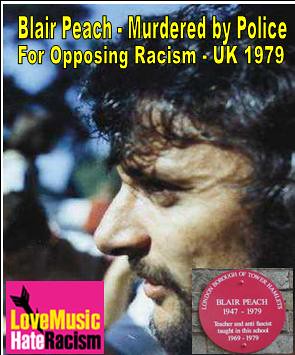
Met police chief willing to release Blair Peach report


The report on the controversial death of the anti-racist campaigner Blair Peach should finally be published more than 30 years after he died in a demonstration in west London. The commissioner of the Metropolitan police, Sir Paul Stephenson, agreed today that it should be made public after an unanimous call to do so by the Metropolitan Police Authority.

The decision was welcomed by Peach's family and partner, although no date has been set for the release of the report, which looked into allegations that Peach died at the hands of the police. The organisation Inquest, which has campaigned on the issue, expressed concerns that key details might be redacted.

Celia Stubbs, who was Peach's partner, said: "I'm totally bowled over, I was really cynical about it and I really didn't expect a result like this today." She said she felt that recent publicity given to the case by the Guardian, in which it was likened to the death of Ian Tomlinson during the G20 demonstrations on 1 April, had been a factor in the decision.

Jenny Jones, an MPA member, proposed a motion calling on the police to publish the full report, written by the former commander John Cass, before the end of the year. The report has remained secret despite requests for disclosure by Blair's family and friends, and an attempt by them last year to have access to it under freedom of information laws. Inquest has also written to Stephenson supporting the family's call for disclosure of the report, but had no response until today.

Jones told a meeting of the MPA, chaired by London's mayor, Boris Johnson, and with Stephenson in attendance, that the Met had declined to publish the report, suggesting that this was partly for the sake of the family. "It is embarrassing keeping it secret," said Jones. After other members voiced their support for publication, the mayor said it was clear that everyone was in favour of such a move.

"My starting point is a desire to publish," said Stephenson, saying that he aimed to do so "as soon as I possibly can". He said legal advice would have to be taken, but he was committed to such a course. "The reasons [not to publish] would have to be overwhelming not to do so."

Philip Peach, Blair's brother, who was at the meeting, welcomed the decision but said it would now be necessary to see how much of it was released. "I could never understand why it wasn't disclosed originally," he said.

Deborah Coles, co-director of Inquest, said: "The whole basis on which the Cass report has been withheld from the Peach family for 30 years has been widely discredited and yet the secrecy continues. Ian Tomlinson's death at the G20 protest and the similarities between the two cases makes the need to disclose this report even more urgent, and is in both the family and public interest." She said a key issue would be whether the report was published in its entirety.

It was partly as a result of the response to Peach's death and the way it was investigated that Inquest was set up in 1981. "Sadly, the need for the organisation remains as urgent today," said Coles. "Non-disclosure of evidence has been one of the most problematic issues following deaths in custody and has seriously undermined family and public confidence in the police complaints system."

Peach, a teacher and an anti-racist campaigner from New Zealand, died from a blow to the head at a demonstration against the National Front in Southall, west London, in April 1979. Cass was reported to have recommended the prosecution of police officers, but no charges were ever brought.

• This article was amended on 26 June 2009. The original reported the commissioner of the Metropolitan police, Sir Paul Stephenson, as saying that the case for publication of the report on Blair Peach's death was "overwhelming". This has been corrected.

Source: The Guardian

A Teenager's Superior Judgment


It's official, even though we knew this already: Safford (AZ) Middle School assistant principal Kerry Wilson, administrative assistant Helen Romero, and school nurse Peggy Schwallier are not reasonable people. They will now have to live with the hard-to-expunge infamy that comes with strip-searching a 13-year-old female student on the (unfounded) suspicion that she possessed a few ibuprofen pills, a mild and legal painkiller. I wrote about it here.

The search would have been a sexual assault under almost any other imaginable circumstances; as Popehat noted at the time, "If this had happened anywhere but school, they'd be all be in jail."

In a rare 8-1 Supreme Court decision, the school authorities have finally been slapped upside the head for violating Savana Redding's rights. Justice John Paul Stevens opined

It does not require a constitutional scholar to conclude that a nude search of a 13-year-old child is an invasion of constitutional rights of some magnitude.

It does not, and it clearly is. In fact, a 13-year-old middle schooler knew it was wrong. We owe Savana Redding a debt of gratitude for seeing this through till the end. With students like her, the future of liberty appears to be in good hands. There's a fine video interview with Savana here. I like the slight smile of her mom. I'd be proud of her too. In fact, I am.

Source: Nobody's Business

MPs condemn G20 police demo tactics


MPs have warned Britain's police chiefs that they must rethink the controversial tactic of "kettling" participants of mass demonstrations.

Members of Parliament's home affairs committee said that it was not acceptable to impose a blanket ban on movement and that peaceful protesters should be allowed to leave.

The findings were contained in a report published by the committee into the G20 protests in the City of London.

More than 35,000 people took to the streets as world leaders met over two days at the beginning of April.

The police have endured a barrage of criticism in the aftermath of the death of newspaper seller Ian Tomlinson, who was hit and pushed to the ground by officers during clashes.

Independent investigators have launched several inquiries after footage of officers lashing out at protesters was caught on camera.

MPs said that images of so-called distraction tactics - shows of controlled violence against hostile individuals - shocked many and could undermine public trust.

They added that "urgent action" was required to ensure officers display identification at all times. Those who do not must face the "strongest possible" disciplinary measures, they said.

Members said that they were also concerned that untrained and inexperienced officers were left in a "highly combustible atmosphere" at the front line of the protests.

The committee added that police should not spend money on water cannons and other equipment to create distance between them and protesters. They said that the money could be better spent on training and planning, adding that police organisers must also work harder to communicate with protest organisers and the media.

Stop The War Coalition convener Lindsey German said: "Kettling is clearly unacceptable and, if it is not already illegal, it should be. The police are treating people like criminals when they have not committed any offence," she said.

Committee chairman Labour MP Keith Vaz said that the basic principle that the police must remember is that protesters are not criminals. The police doctrine must remain focused on allowing protest to happen peacefully, he said.

"In many ways, this was a large protest which passed off remarkably well. But it is clear that concerns about the policing of the G20 protests have damaged the public's confidence in the police and that is a great shame.

"The ability of the public and the media to monitor every single action of the police through CCTV, mobile phones and video equipment should mean they take even greater care to ensure that all their actions are justifiable.

"It is unacceptable for officers not to wear identification numbers at such events and any officers found to be deliberately removing their identification should face the strongest possible disciplinary measures."

Source: The Morning Star

European Union's Lisbon Treaty fuels flames of dissent across continent


The Lisbon Treaty is expected to take a key step towards becoming law across the European Union this week when Germany's highest court rules that it is broadly compatible with the country's constitution.

The much-anticipated judgment will mean that only three out of the EU's 27 member states will still have to complete formal ratification of the treaty - Poland, the Czech Republic and Ireland.

The former two countries merely need their presidents' signatures on the legislation to finalise the process. Ireland, where voters rejected the Treaty last year, will stage a new referendum in October - with the government increasingly confident of a "Yes" vote this time round after the EU assured Ireland of its independence over taxation, security, defence, abortion, and workers' rights.

Politicians across Europe are now looking forward to a day when the controversial treaty gives the EU more streamlined institutions - with greater central power and, for the first time, a new "President of Europe" to represent all the member states around the world.

In Britain, the government has refused demands for a referendum - despite a pledge in Labour's 2005 general election manifesto to hold a public vote on the Lisbon Treaty's predecessor, the European Constitutional Treaty, which collapsed after being voted down in France and the Netherlands.

Recently, however, it has been the Conservatives who have faced difficulties on the treaty. Both David Cameron and William Hague, the Eurosceptic shadow foreign secretary, have publicly pledged that, even if the treaty completes its ratification process in October with an Irish "Yes" vote, they "will not let matters rest."

Kenneth Clarke, the pro-Brussels shadow business secretary, stirred up a hornets' nest by claiming that his party's "settled policy" was not to reopen the treaty once it became law. His comments led to Mr Cameron privately reassuring Tory backbenchers that the party was not softening its tough line on Europe, as revealed by The Sunday Telegraph last week.

Internal Tory troubles over Europe were also heightened last week when the party announced details of its new allies in a new "anti-federalist" group in the European parliament which sees the Tories sitting alongside politicians from a range of parties - mainly from Eastern Europe - some of which have uncomfortable views on homosexual rights and immigration.

The group represents eight countries - above the seven-nation threshold required to receive funding and staffing from the parliament.

The announcement was made on the same day as the election of the new Speaker of the House of Commons - attracting criticism that Mr Cameron was seeking to divert attention away from his new alliance in Strasbourg.

Last week a Finnish Euro-MP pulled out of the 55-strong grouping, which includes 26 Tories and is expected to be the fourth biggest alliance in the newly elected parliament, because some of its members were "too extreme."

Hannu Takkula told The Sunday Telegraph that his British colleagues were not the problem and added: "Some other groups have policies that are too extreme and policies that are too much against Europe."

Two of the parliamentary grouping's members used to belong to the far-right League of Polish Families, which supports capital punishment, and whose youth wing has been accused of attacking gay rights marches. Another MEP in the group, from Latvia, belongs to a party which supports an annual march commemorating former Latvian members of the Waffen-SS.

While the Tories ponder their uncomfortable new European bedfellows, leaders of some of Europe's separatist movements are celebrating the progress of the treaty towards full ratification. They are convinced that the more powerful the EU's own institutions become, the weaker the nation state - and the stronger the case for granting breakaway regions their independence.

The European Union has always had a strong hold over regional policy - including supplying funding - and regional leaders across the continent sense a fresh shift towards breakaways. Regions will have, for example, powers to challenge decisions at the European Court of Justice for the first time, rights which have so far been the preserve of national parliaments. Some 300 different regions already have offices in Brussels.

As well as these greater powers, the proliferation of even smaller states among some of the EU's newer members - including Slovakia and Slovenia - is encouraging those fighting for local independence elsewhere.

Source: The Telegraph